

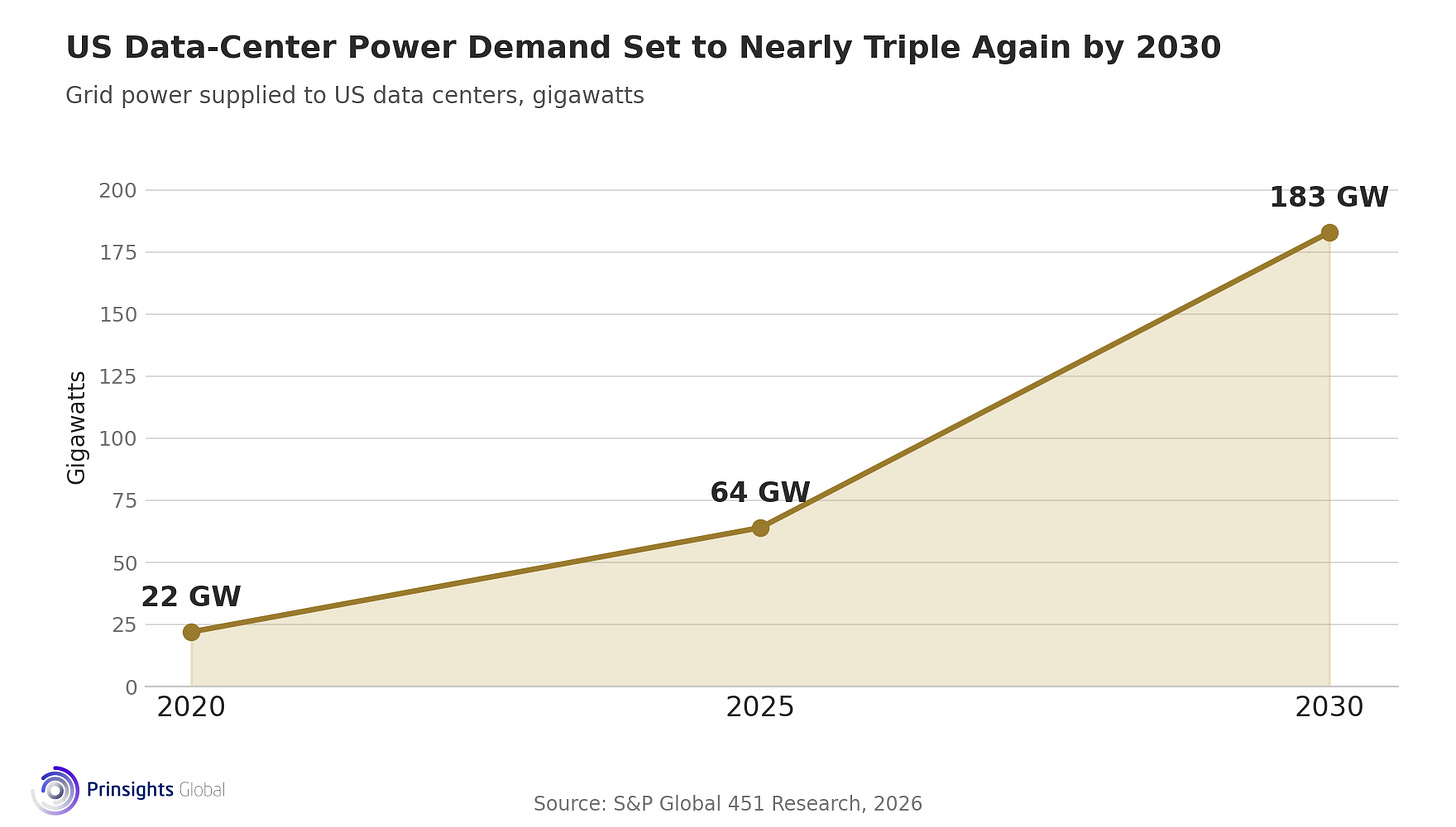
The strategic onshoring of businesses, advanced manufacturing facilities and massive hyperscalers driving artificial intelligence all require resilient, uninterrupted baseload electricity. As we’ve been detailing for Prinsights readers over the last couple of years, nuclear energy offers the solution and is in a prime position as the go-to power source.
Over the past several weeks, three major developments have illustrated how institutional capital, global tech leaders, and modular engineering are fundamentally changing the economics of nuclear energy.
Below, we outline exactly what you need to know, why they matter and what it could mean for strategic investors.
1. Amazon and Constellation: A 20-Year Commitment to Firm Power
On September 30, Amazon (AMZN) and Constellation (CEG) signed a 20-year power purchase agreement for 690 megawatts from the Calvert Cliffs nuclear plant in Maryland, including a 190-megawatt uprate, with more than $3 billion going into expanding the plant.
After facing regulatory and grid-interconnection scrutiny over an earlier proposed colocation deal at Pennsylvania’s Susquehanna station, Amazon altered its approach. Instead of simply siphoning existing baseload off the grid behind the meter, Amazon is directly underwriting long-term utility-scale nuclear operations and plant preservation.
Under the agreement, Amazon buys clean power for twenty years and Constellation locks in two decades of guaranteed revenue.
2. Blue Energy Files to Build a Small Modular Reactor in Texas
While existing nuclear reactors are seeing renewed life via long-term contracts, the next generation of supply requires a radical rethink of construction economics.
Historically, traditional gigawatt-scale nuclear projects have suffered from lengthy permitting cycles, mounting challenges that come with on-site engineering and multi-year budget overruns that leave investors both anxious and reluctant. The last new reactors built in the U.S., Plant Vogtle’s units 3 and 4 in Georgia from Southern Company (SO), came in around $36.8 billion, roughly 2.5 times the original budget, and finished about 7 years late.
Blue Energy just moved its Texas project into the NRC permitting process. On October 8 the NRC published its notice of the company’s phased construction permit application for the Blue Energy Center at Port of Victoria, a single BWRX-300 reactor, the GE Vernova small modular design, on the Gulf Coast.
That step builds on the $380 million Blue Energy raised earlier this year. The Texas project is designed as a phased gas-to-nuclear build using GE Vernova gas turbines and BWRX-300 small modular reactors, with Blue Energy targeting power delivery in 48 months or less.
3. Google and Constellation: Strategic Clean Firm Power Pacts
On October 6, Google (GOOGL) and Constellation signed a 20-year agreement for 890 megawatts of new nuclear capacity on the PJM grid, coming from upgrades to eleven reactors at six plants in Illinois, Pennsylvania and New Jersey, worth more than $4.3 billion. Google also signed a separate 15-year agreement covering another 2,700 megawatts of existing PJM generation, bringing the broader package to about 3.6 gigawatts.
Google was an early mover to this. It signed its first corporate power deal in 2010, a 20-year contract for 114 megawatts of Iowa wind, and by 2017 it became the first company its size to match 100% of its annual electricity use with renewable energy. In many ways, they were in the data center space before it was on the map. Link here.
However, like its big-tech peers across Silicon Valley and beyond, Google has recognized the operational limitations of intermittent renewable energy. That’s because high-demand workloads like AI model training and inferencing consume power around the clock due to growing global business needs.
And while this partnership structure has a significant focus on “clean firm power,” the reality is that financially speaking, it is seeking to match electricity consumption around the clock in the most cost-efficient way.
The Big Picture: Infrastructure Follows the Physics
Access to baseload energy drives the pricing power of contracts and the underlying uranium demand. And 20-year contracts emanating from the tech industry’s richest balance sheets will increasingly set a higher price floor under what operators can earn.
Private capital will be a big part of funding the build, because private money wants exposure to construction methods that cut the former decade-plus timelines that impacted and triggered major delays for projects like Vogtle.
What’s different today is that policy and capital are becoming more aligned. Regulators want grid reliability (and want to deliver for their commissions). At the same time, Washington wants energy security (or dominance), and hyperscalers want reliable power that never cuts out. Nuclear is the one source that gives all three of them what they need - carbon-free power that runs around 92% of the time, and a higher capacity factor than any other source on the grid.
The largest companies in the world are paying up front for decades of nuclear power because they need baseload power that never stops. The reactors are being contracted and upgraded, but they still depend on a constrained fuel supply chain.
Uranium is currently trading near $90 a pound spot and close to $97 on long-term contracts. These long-dated nuclear agreements lock in decades of fuel demand at a time when the West is still rebuilding uranium conversion and enrichment capacity outside Russia.



Comments
Log in or sign up to join the conversation.