

Here’s something that may surprise you.
According to widely cited industry data, more than 43 million tonnes of copper is sitting in waste piles at mines around the world. That amount constitutes roughly two years of global mine supply. It has already been dug up, crushed and hauled to the earth’s surface.
And then it was left there.
It’s not hard to see why if you consider related logistics. When a mine processes its ore, it never recovers all of the copper. Some of it always ends up in the tailings, which is the finely ground slurry left over once the valuable concentrate has been skimmed off as concentrate.
For most of the last century, nobody worried much about what got left behind. The ore was rich, the plants were less efficient, and there was always more where that came from.
So the waste piled up. The world now holds an estimated 282 billion tonnes of tailings, stored in roughly 8,500 facilities. And measured by metal content, copper is the biggest prize inside them, more than half of all the metal locked up in the world’s tailings.
The Waste Got Richer
So why go back for it now? Because both sides of the demand and value equation have changed: how much copper resides in the waste compared with the ore, and what that copper sells for.
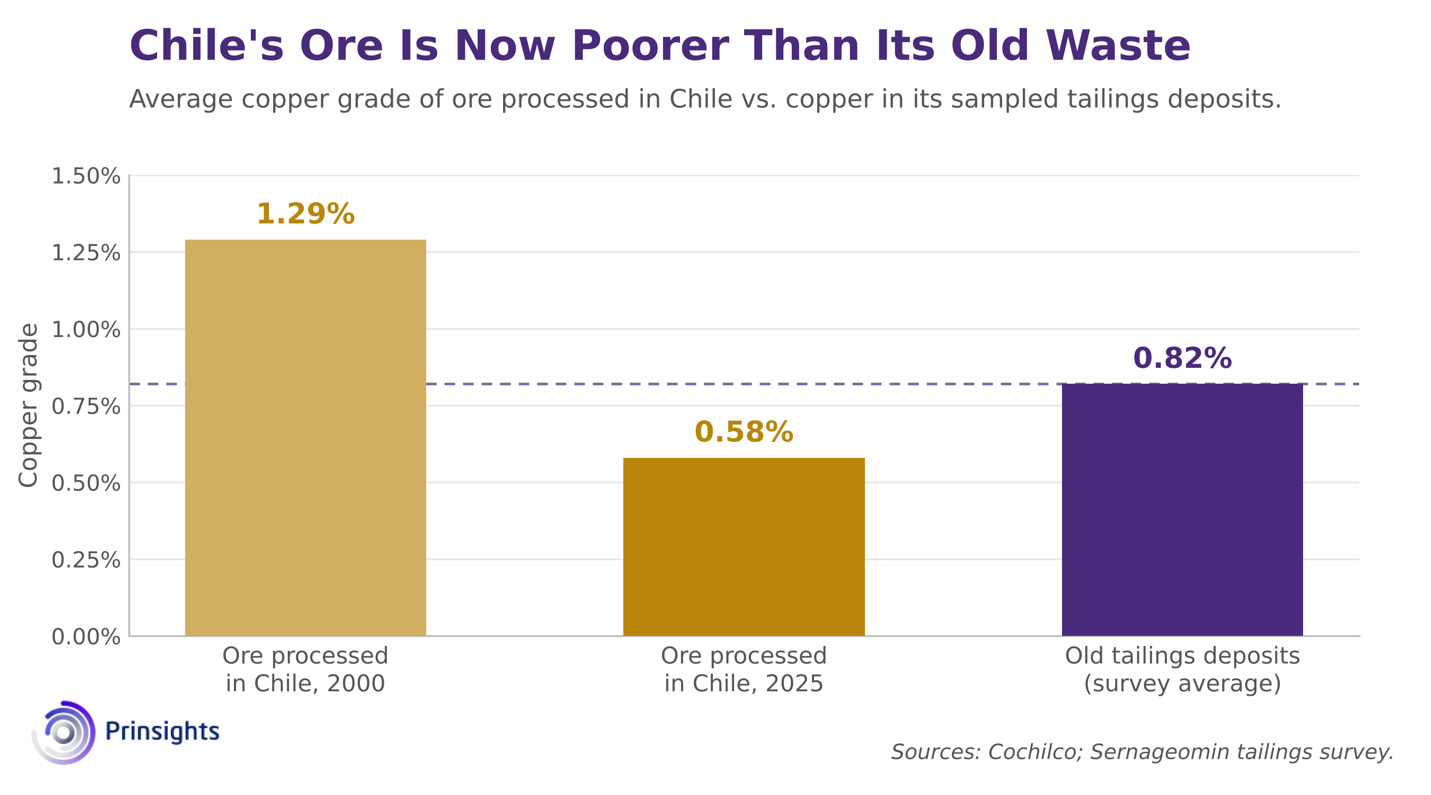
The ore the industry digs today is far leaner (lower grade) than it used to be. Take Chile, the world’s biggest copper producer, which also happens to hold more metal in its tailings than any other country. In 2000, the average ore processed there carried 1.29% copper. By 2025, it dropped to 0.58%. That means a lot of the old waste rivals the quality of the ore coming out of the ground today.
In some cases, it’s even better.
When Chile’s geological survey sampled the country’s tailings deposits, the ones it studied averaged 0.82% copper. That was higher than the roughly 0.6% grade of the ore at Chile’s operating mines at the time. Chile has about 795 tailings deposits on record, and roughly eight in ten of them are no longer in use.
Then there’s the price consideration. Copper prices spent most of the last decade stuck between $3 and $4 a pound. Today it trades above $6. At those levels, material that was never worth the cost or additional trouble suddenly is far more attractive.
And here’s the key factor of what makes tailings different from a new mine, and it’s a big distinction.
That copper is already situated above ground, which means it doesn’t have to be found, blasted or crushed. There’s no discovery risk, cost or years-long fight to permit a new pit attached. In many cases, the material sits on a site that’s already permitted, near key infrastructure such as roads, power and water.
The Majors Are Going Back for It
The biggest names in mining have been noticing this supply source, too.
Freeport-McMoRan, the largest U.S. copper producer, is using new leaching methods to pull copper out of old stockpiles at its Arizona mines. The company says that technology could deliver about two-thirds of its U.S. production growth by 2030.
BHP, the world’s largest mining company, is testing similar methods at its giant Escondida mine in Chile and estimates it could produce as much as 55,000 tonnes of copper a year that way.
Rio Tinto, another of the world’s biggest miners, has gone a step further. It has produced copper at industrial scale using bacteria to free metal from low-grade material, and Amazon Web Services signed on as its first customer to supply copper for U.S. data centers.
In other words, the companies with the deepest pockets in the industry are now spending serious money to work out how to convert waste into supply.
But here’s the thing you should know. Most of that process is still in the testing phase. New technology takes years to prove, and it doesn’t always work. Some miners have already backed away from existing methods they once championed to pivot to developing their own in-house solutions.
Not everyone is waiting for new technology to pan out, though.



Comments
Log in or sign up to join the conversation.