

This Monday morning, Chase’s online and mobile banking went down for much of the day, and the Zelle payments that transfer through it stalled with it. JPMorgan, which does business as Chase bank, had its systems back to normal by Monday evening.
Yet that’s the trap that only serves to pacify a much deeper issue around these events. We read them as one-day stories. The concentration of risk and damaging volatility doesn’t go away when the outage stops, just as closing a door on a smoking room doesn’t stop the fire behind it.
Now, Chase is the largest bank in the U.S. with about $5 trillion in assets, so its outage touches the most customers, about 80 million U.S. consumers. The other big Wall Street banks did not report outages of their own, but their customers did, on Downdetector and through delayed Zelle payments. U.S. Bank reported its own systems were not affected, even as its customers’ Zelle payments slowed. Zelle itself was working.
The problem originated in Chase’s own systems, not in the Zelle network. Chase blamed a software bug in one of its on-premise systems, and told customers they still had access to their accounts and funds. In my own experience the isolated problems that routinely plague the banking system are not the most alarming point when so many things can compound if they go wrong at once.
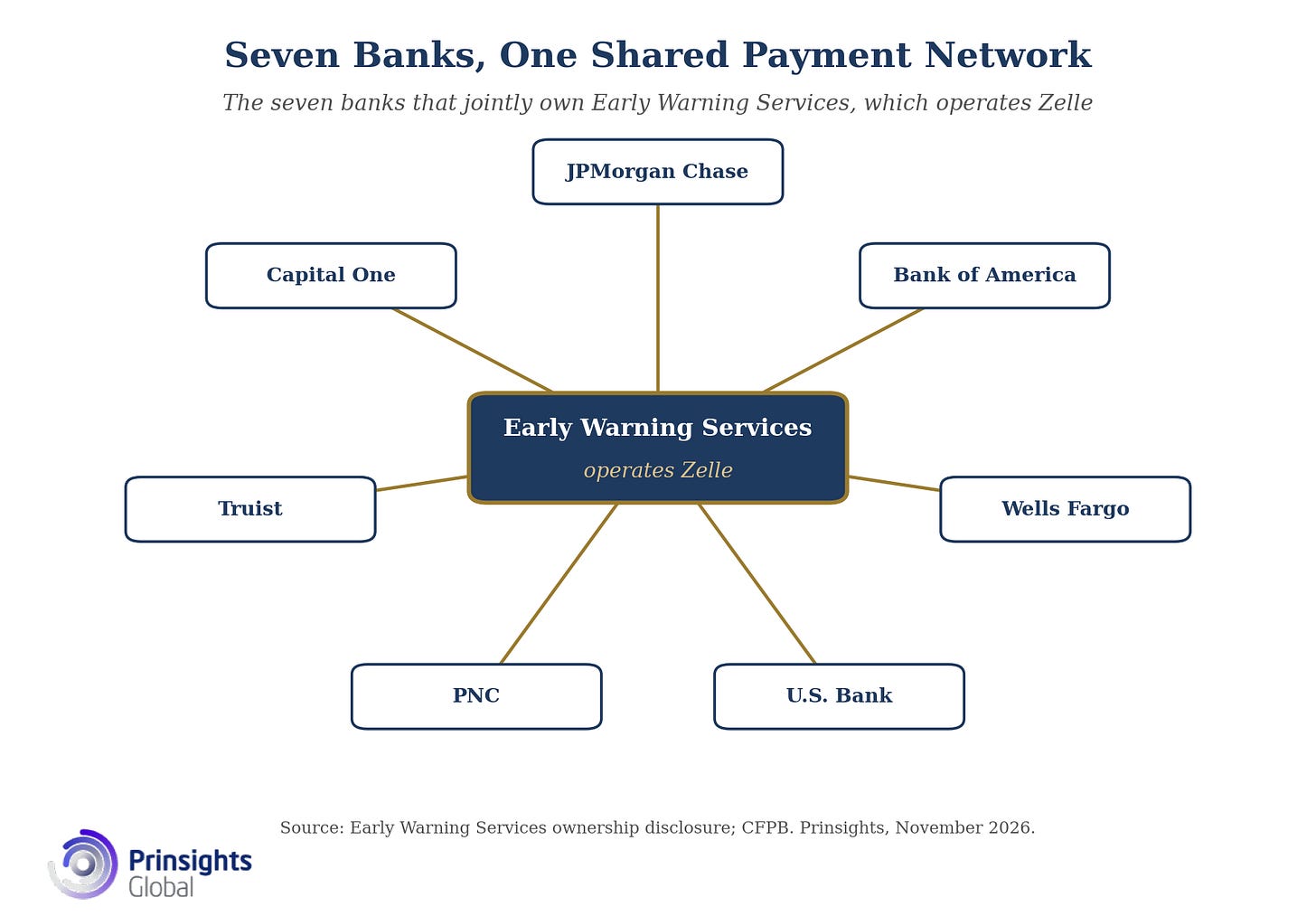
What matters more is what these banks have in common and how that commonality can exacerbate risk to consumers, taxpayers, small businesses and those caught in the crossfire. In yesterday’s case, payments utilized Zelle, a network several of the largest banks built and share. Zelle is owned by Early Warning Services, a payments company that belongs to seven of the biggest U.S. banks, JPMorgan, Bank of America, Wells Fargo, U.S. Bank, PNC, Truist and Capital One. So, a serious problem at one of them can slow payments across the others.
The 2008 Crisis Fueled Dangerous Banking Concentration
We’ve seen banking concentration risk build before. In 2008, the strongest and most influential banks, with the greatest connections to federal bailout money and Federal Reserve backing, absorbed the failing ones.
Their power grew exponentially in the aftermath of the financial crisis predicated on the same subprime mortgage loans repackaged across the entire banking system. That consolidation of risk didn’t just happen in the fall of 2008, but accrued over months leading up to that.
JPMorgan acquired my old employer, Bear Stearns, as it neared collapse in March with a $30 billion Federal Reserve backstop. It went on to buy Washington Mutual’s banking operations out of FDIC receivership in September for $1.9 billion. Bank of America acquired Merrill Lynch in a roughly $50 billion stock deal announced that September, after it had already bought Countrywide, the country’s largest mortgage lender, earlier that year.
Wells Fargo acquired Wachovia for about $15 billion in October. My other former employer, Lehman Brothers, would collapse on September 15. That October, the nine largest banks received a massive $125 billion in federal capital, under a rescue law that authorized up to $700 billion.
The Fed went on to expand its securities holdings to more than a whopping $4 trillion through successive rounds of quantitative easing, purchasing Treasury and mortgage-backed securities.
The U.S. had about 7,000 commercial banks operating independently in 2008. Today, that number has shriveled to about 4,000, and most of that decline came via mergers rather than failures.
Now, the four largest U.S. banking giants, JPMorgan Chase, Bank of America, Citigroup and Wells Fargo, account for close to half of all U.S. banking assets, or about $13 trillion. The same banks we bailed out are bigger now than they were then. As the volatility and concentration of power escalated, so did the risk.
The Biggest Banks Own the Payment Systems Everyone Uses
Let’s consider the ramifications in light of the problems experienced by Chase. Yes, the survivors got bigger. And they also built the systems the rest of us now depend on to access and move our money. Zelle grew out of clearXchange, a bank-owned payments venture that Bank of America, JPMorgan and Wells Fargo co-launched in April 2011 to let their customers send money straight to one another from their bank accounts.
Early Warning Services, that same bank-owned company, acquired clearXchange and relaunched it as Zelle in 2017. That same November, The Clearing House, owned by two dozen of the largest banks, launched a new initiative called the Real-Time Payments network, the first new core payments system built in the U.S. since the ACH network of the early 1970s. The same big banks now own both Zelle and the Real-Time Payments network, two major bank-owned payment networks that have become increasingly important to how Americans move and interact with their hard-earned money.
The one available public alternative that’s mostly independent from Early Warning, the Fed’s FedNow instant payment system, launched on July 20, 2023. When Early Warning subsequently shut down the standalone Zelle app in April 2025, people lost the separate app and now must access Zelle inside their own bank’s app. More than 2,200 banks offer that ability, and they all tie into the same network. Each of these shifts left a few big banks owning more of how Americans move money and influence how they keep that money.
The Clearing House’s Real-Time Payments network connects the big banks that together hold about 75% of US deposit accounts. That means your hard-earned payroll deposits along with rent, utility bills and other transfers traverse systems that a few big banks own or the Fed operates. When a Chase customer sends money to a Wells Fargo account, the transaction now depends on a network neither bank controls alone, but both are exposed to.
There Is No Lender of Last Resort When the Network Fails
In 2008, the main banking system problem was solvency and liquidity, both of which eventually respond to a cascade of rescue money. The Fed lent against bank collateral, the Treasury injected capital into the financial system by buying bank stock, and eventually, the panic cleared.
This week’s outage transcends solvency or liquidity. When the system enabling the movement of money stops functioning properly, there’s no amount of capital that can just automatically switch it back on. What transpired as a “one off” was the mild version. Accounts stayed open, though the bug double-charged some customers before it was fixed.
The danger we now increasingly face with so many interlocked technological fences around our money moves is that the next delay or outage may be more acute, widespread and dramatically more damaging to the faith in the system.
Comments
Log in or sign up to join the conversation.