


As the dust from the U.S. midterm elections settles and the blame games from those kicked out of office linger, the media coverage has focused on gridlock and talk of a Trump impeachment.
Less covered is a supply chain problem that is awaiting the new Congress in January. Miners have found just 6 major copper deposits and 9 major gold deposits worldwide since 2020, S&P Global data show. And none of the copper deposits discovered in 2025 has yet qualified as major.
Domestically in the U.S., a new mine takes 29 years on average to go from discovery to production, which lands it second only to Zambia in such a timeline. That matters because any deposit found this year would likely not produce metal until the mid-2050s at that rate, if things remain the same.
Copper and gold are the clearest cases of that discovery drought. Silver has been in a supply deficit every year since 2021, while tin and antimony depend heavily on production and trade decisions in a handful of countries. Copper, silver, tin and antimony are on the U.S. critical minerals list. And while gold is not, several Trump administration actions have treated it as critical and a priority among policymakers.
How Washington responds on the policy-side now will depend in part on a Democratic Congress. For Prinsights, an important area that we are actively watching is the House Committee on Natural Resources, which oversees mining on federal land. Its top Democrat, Jared Huffman of California, is in line to become the Chairman and called oversight of the administration’s critical minerals deals “a priority” in September.
Washington has put $8.6 billion into equity stakes in critical minerals companies since January 2025. They include a 10% stake in Trilogy Metals, which is developing copper, zinc, gold and silver deposits in Alaska, and a stake tied to Korea Zinc’s planned Tennessee smelter, meant to cut U.S. reliance on China for metals such as antimony. Shares of another recipient, USA Rare Earth, fell 9.5% last Thursday on the prospect of hearings.
The first test of how both parties will work together on these policy matters comes today, November 9, when the outgoing Senate is scheduled to vote on whether to take up S.5653, a bipartisan bill that would speed up federal permits for U.S. mines. Faster permits could help shorten that massive 29-year timeline.
As we detailed last Wednesday, it is one of the four key bipartisan minerals bills in Congress that should survive the change in majorities. That legislation matters because five key metals face different supply pressures that transcend the election results, starting with copper.
1. Copper Buyers in China Paid a 12-Year-High Premium
LME copper fell 1.72% last Thursday, to $13,774 a ton, the same day the Nasdaq dropped 5.5%, its worst day since April 2025, on fears that the new Democratic Congress would slow the AI buildout. Because data centers use so much copper, copper futures traders sold too. Microsoft’s Chicago data center campus alone contains an estimated 2,177 tons of copper, roughly 27 tons for every megawatt of power it uses. COMEX copper finished last week at $6.22 a pound, its lowest since July.
Our analysis shows that the selloff confuses regulation with a shutdown. Democrats are likely to push harder on who pays for data centers’ power and grid upgrades (and environmental impacts like their water use and toxic emissions).
The House already voted 417 to 3 in September for the Ratepayer Protection Act, which would push the largest data centers to pay the full cost of their grid upgrades, and today’s Senate bill carries a similar requirement. Data centers will still get built, and they will still need copper. The pathforward could simply look different.
Copper buyers in China were not selling. Last Wednesday, importers paid $205 a ton over the London price, the highest premium in 12 years, and copper stocks in China’s main regions have fallen to about 60,000 tons, from roughly 200,000 a year earlier.
That is why sourcing new copper remains essential. The 6 major copper finds since 2020 contain 8.7 million tons combined, less than 1% of the copper in the 263 major deposits found since 1990.
2. Gold Has Only Nine Major Finds Since 2020
Gold told a different story after the election. The monetary metal jumped 3.4% to $4,061.30 an ounce last Wednesday as the dollar fell to a one-month low, and closed Friday at about $4,070, up nearly 5% for the week.
In its October review, S&P Global found that only nine gold deposits discovered since 2020 have reached two million ounces, and none found in the past decade ranks among the 30 largest ever. So, miners are buying proven deposits instead.
Last month, SSR Mining agreed to pay $464 million for Roxmore and its Converse project in Nevada, with 2.2 million ounces of indicated resources. Based on our analysis, we expect more of these deals.
3. Silver Buyers Stepped In at a One-Year Low
Then there is silver, the other dual-purpose metal, used in solar panels and electronics and bought by investors both as physical bars and coins and as ETF shares. It fell to a one-year intraday low of $48.62 on November 3, then jumped 5.1% to $52.29 the day after the election and closed Friday near $52.
ETF buyers stepped in as the price fell. Global silver ETF holdings rose to 815.86 million ounces on November 4, their highest since March, after about 7 million ounces of inflows as silver fell below $50.
Even so, ETF holdings are still down about 6% this year, while the Silver Institute’s latest World Silver Survey, published in April, projected a 46.3 million ounce deficit for 2026, for the sixth year in a row.
4. Global Factors: Tin Depends on Myanmar, Indonesia and Congo
Most investors don’t follow tin, but solder, which bonds the chips in technology like smartphones allowing them to connect to a circuit board, makes up about half of global tin demand.
The restart of mining in Myanmar’s Wa State, a main source of ore for Chinese smelters, was still slow as of November 2. Indonesia ordered 1,000 illegal mines closed this year, and security risks persist in eastern Congo. LME tin closed at $46,467 a ton on November 6, still about 36% above its 2025 average.
5. Antimony: Why a Chinese Decision Due November 27 Matters
Antimony trisulfide is a key ingredient in the primers that ignite the gunpowder in nearly 30% of all U.S. military ammunition items. China, Russia and Tajikistan mined 94,000 of the 110,000 tons produced worldwide in 2025, and the U.S. imports 91% of the antimony it uses.
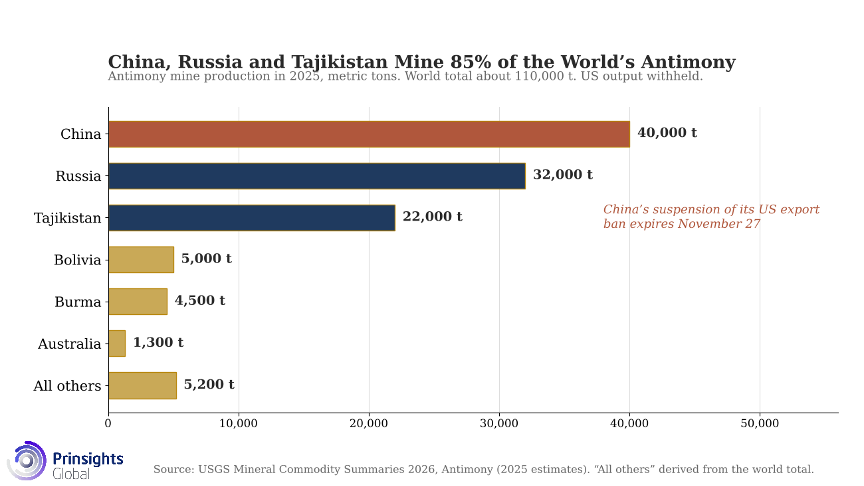
Antimony mine production by country in 2025, in metric tons.
China suspended its December 2024 ban on antimony exports to the U.S. until November 27. It has since extended its broader U.S. trade truce to January 10, 2027, yet as of last week had published no notice extending the antimony date, and its ban on sales to the U.S. military was never lifted.
The main U.S. alternative, Perpetua Resources’ Stibnite mine in Idaho, is not expected to start production until late 2028. That gives Beijing leverage over the U.S. ammunition supply for at least two more years.



Comments
Log in or sign up to join the conversation.