

The intense 2026 midterm race wrapped up on Tuesday, changing who controls Congress. Democrats won the midterms, flipping the United States House of Representatives and adding seats in the Senate to take control of the committees and the floor calendar.
But it did not change how much the U.S. relies on China and others for critical minerals and nuclear fuel.
The U.S. imports the vast majority of its critical minerals and much of its nuclear fuel. China controls the processing of the ones that matter most, and it has used that grip, banning antimony and gallium exports to the U.S.
Four current bills with bipartisan support take on this dynamic specifically. And while the electoral headlines are focused on inflation and the cost of living, the election decides who can advance them forward and work toward delivering energy security, economic independence and resilience. The four bills detailed below include mine permitting, a federal minerals stockpile, domestic uranium enrichment and supply deals with strategic partners and allies.
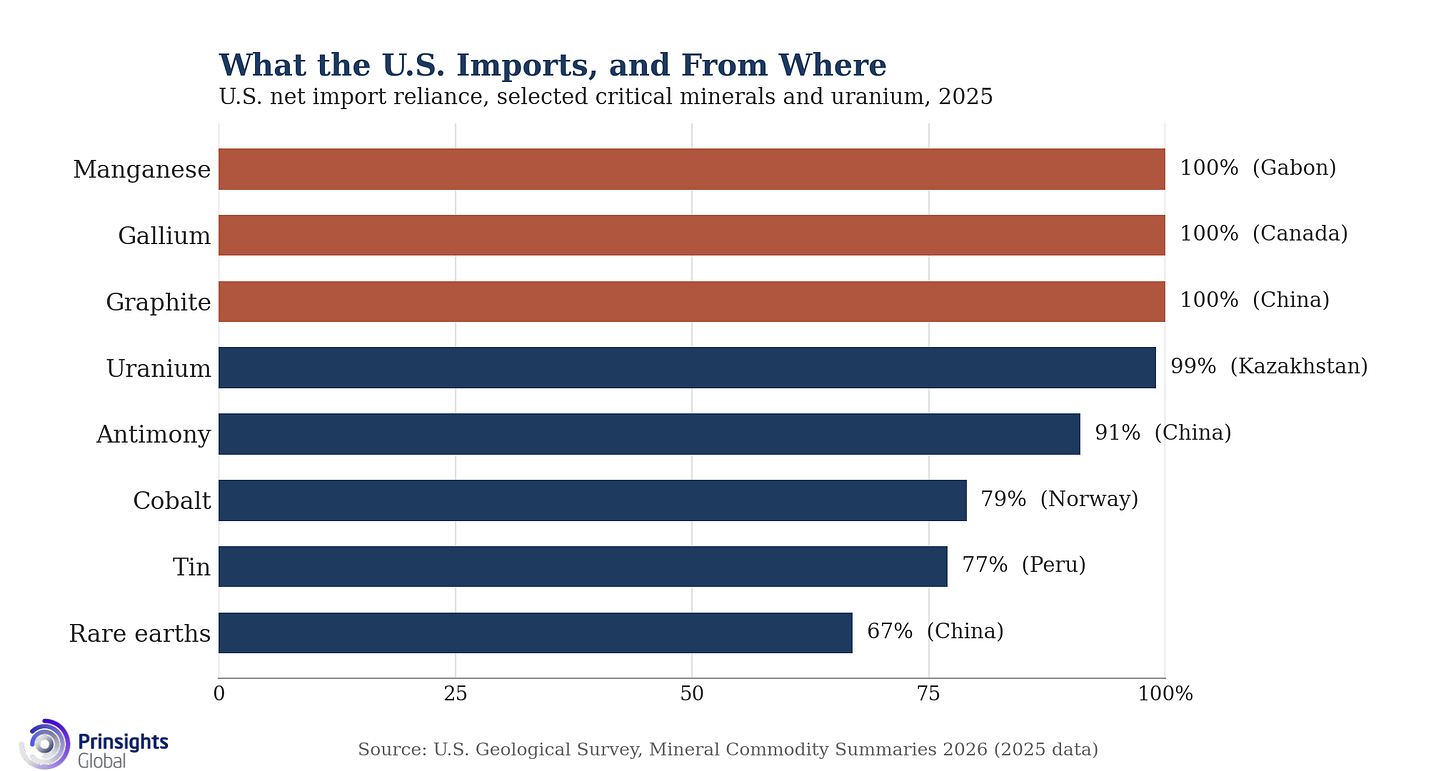
Here is where each stands and what you need to know:
The Senate’s Permitting Bill Is the Biggest NEPA Rewrite Since 1969
The permitting bill is S.5653, the Bipartisan American Affordability and Jobs Act, a comprehensive overhaul of federal environmental review.
Senators Shelley Moore Capito (R-WV), Mike Lee (R-UT), Sheldon Whitehouse (D-RI) and Martin Heinrich (D-NM) introduced it on September 30. It went to the Energy and Natural Resources Committee the same day.
The bill sets a uniform 150-day window to challenge a federal permit and reopens acquired federal land to mining by undoing the Rosemont decision that had blocked it. It is the largest rewrite of the National Environmental Policy Act since 1969.
Permitting a mine in the U.S. can take years and critical funding to secure a comprehensive federal review. Shorter permitting timelines could help bring domestic copper, lithium and antimony projects into production sooner. Sen. Capito, who chairs the Environment and Public Works Committee, calls the deal “monumental and legacy-setting” and expects it to be the Senate’s priority when members return.
The first procedural vote is scheduled for November 9. It still needs 60 votes and must be squared with a House bill.
Even if the bill is delayed until the next Congress, the opportunity offers a bipartisan moment to deliver economic security and resilience. In fact, because of its importance, leadership in Washington specifically scheduled the procedural vote for the first day back from the election recess. The move was intentional and meant to test whether the bipartisan coalition can draw the 60 votes necessary to clear the filibuster threshold, or to understand how to navigate it forward in 2027.
Both Parties Back a $2.5 Billion Minerals Reserve to Counter China
The SECURE Minerals Act would authorize $2.5 billion for a Strategic Resilience Reserve, a government corporation that buys and stores critical minerals. China controls 90% of rare earth processing.
Senator Todd Young (R-IN) introduced the bill with Catherine Cortez Masto (D-NV) and wrote that it would “counter China’s ongoing coercion.” It’s modeled on the Strategic Petroleum Reserve, but would stockpile critical minerals such as antimony, cobalt, graphite and rare earths.
The White House launched its own version in February. Project Vault, a $12 billion critical minerals stockpile, is funded by a $10 billion Export-Import Bank loan and $1.67 billion from companies including General Motors, Boeing and Google.
The companies sign purchase agreements at set prices and can call on the stockpile when supply is cut. It buys and stores antimony, cobalt, copper, graphite and other minerals the country imports.
The Latest Bipartisan Nuclear Fuel Bill Just Passed the Senate
The U.S., for a country that spans a continent with a diverse set of resources, only has one commercial uranium enrichment plant. That means it is forced to import most of the enriched uranium its reactors need. Rebuilding that supply has had both parties behind it for years.
Congress banned most Russian uranium under the Prohibiting Russian Uranium Imports Act in 2024, and the last import waivers expire in 2028. The MORE American Fuel Act, introduced by Cynthia Lummis (R-WY) and Mark Kelly (D-AZ), passed the Senate on September 30 and now goes to the House.
It would speed the Nuclear Regulatory Commission’s licensing of new enrichment and let a plant start building before its license is final. Lummis wrote that it would “stop making enrichment companies wait years just to break ground.” While Lummis will step down in January, Wyoming just elected Harriet Hageman to replace her, and she is a strong backer of domestic uranium.
Nuclear power supplies about 18% of U.S. electricity. U.S. reactors import roughly 80% of their enriched uranium, much of it from Russia. In January, the U.S. Department of Energy split $2.7 billion among Centrus, General Matter and Orano, about $900 million each, to build enrichment on U.S. soil. The 2028 cutoff adds urgency to building that domestic capacity.
The House-Passed Allied Minerals Bill Now Waits on the Senate
In June, the House passed the DOMINANCE Act by voice vote, after the Foreign Affairs Committee cleared it 45 to 0. It would direct a new State Department bureau to fund critical mineral supply chains in partner countries and back allied projects. Representatives Ami Bera (D-CA) and Young Kim (R-CA) introduced it. Bera called securing critical minerals “not a Democratic or Republican issue.”
China refines about 90% of the world’s rare earths and most of its gallium, graphite and antimony, so ore mined in Canada or Australia often ends up processed in China anyway. The DOMINANCE Act would pay to build that processing in allied countries instead. The Senate has not voted on it since it cleared the House in June.
The Four Bills at a Glance
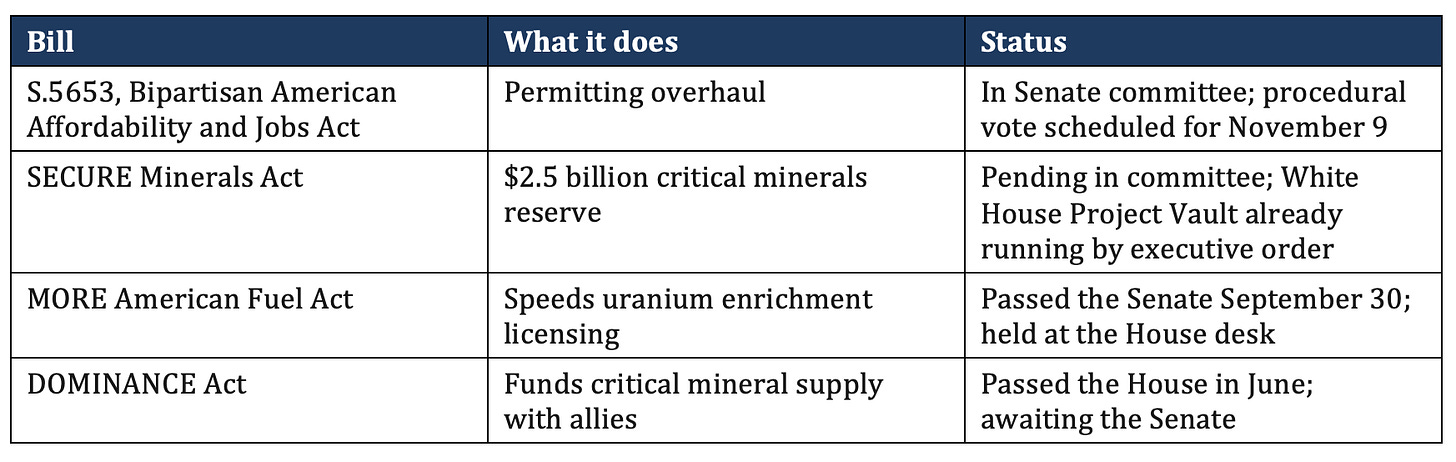
Even as Tuesday’s election results changed the majorities in Congress, it did not rewrite the bipartisan drive to secure critical minerals and nuclear fuel at home. All four bills point the same way, whichever party controls Congress, toward producing more of what the country now imports.


Comments
Log in or sign up to join the conversation.