


Copper is hovering around $6.70 a pound, posting its tenth straight weekly gain and the longest winning streak since 1994, putting our 2026 forecast of $7 within reach. That is up from around $6 on April 29, the day we argued copper’s official forecaster had the market wrong.
The International Copper Study Group had just called a surplus for 2026. Its most recent bulletin shows the market swinging into a 60,000-tonne deficit in June, from a surplus the month before. Three-month copper prices on the London Metal Exchange held near $14,400 a tonne, just a tad below the record it set in January.
Bolstering those prices, the world’s biggest producers cut output in the first half of 2026 as demand from power grids and large energy load data centers continues to climbing.
Here’s what this tightening market is doing to the companies scrounging for new metal supply and what they are willing to pay up for it.
Anglo Is Merging With Teck, and Coeur Just Bought New Gold
Anglo American, one of the world’s biggest miners, and Teck Resources, a major Canadian copper producer, are in the final stretch of merging into Anglo Teck, which will rank among the top copper producers on earth. The deal is only awaiting approval from China after clearing their shareholders in Canada and Australia and regulators in South Korea.
Coeur Mining, a United States gold and silver producer, just absorbed New Gold to lift its 2026 output to 815,000 ounces of gold and 65 million pounds of copper.
With few new large mines coming online quickly, Anglo American and Codelco agreed in June to operate their neighboring Los Bronces and Andina mines in Chile as one, squeezing an extra 120,000 tonnes of copper a year out of ground they already own.
Across the industry, mining takeovers reached $41 billion in the first five months of 2026, with gold and copper the biggest targets, alongside another $32 billion of equity and debt financing. None of that dealmaking creates a deposit. Of the 239 major copper deposits found since 1990, just 14 have come in the past decade, holding only 3.5% of the copper. So the fastest way for these giants to add metal is to buy the companies that already own it.
Codelco Is Down 11%, Grasberg a Fifth
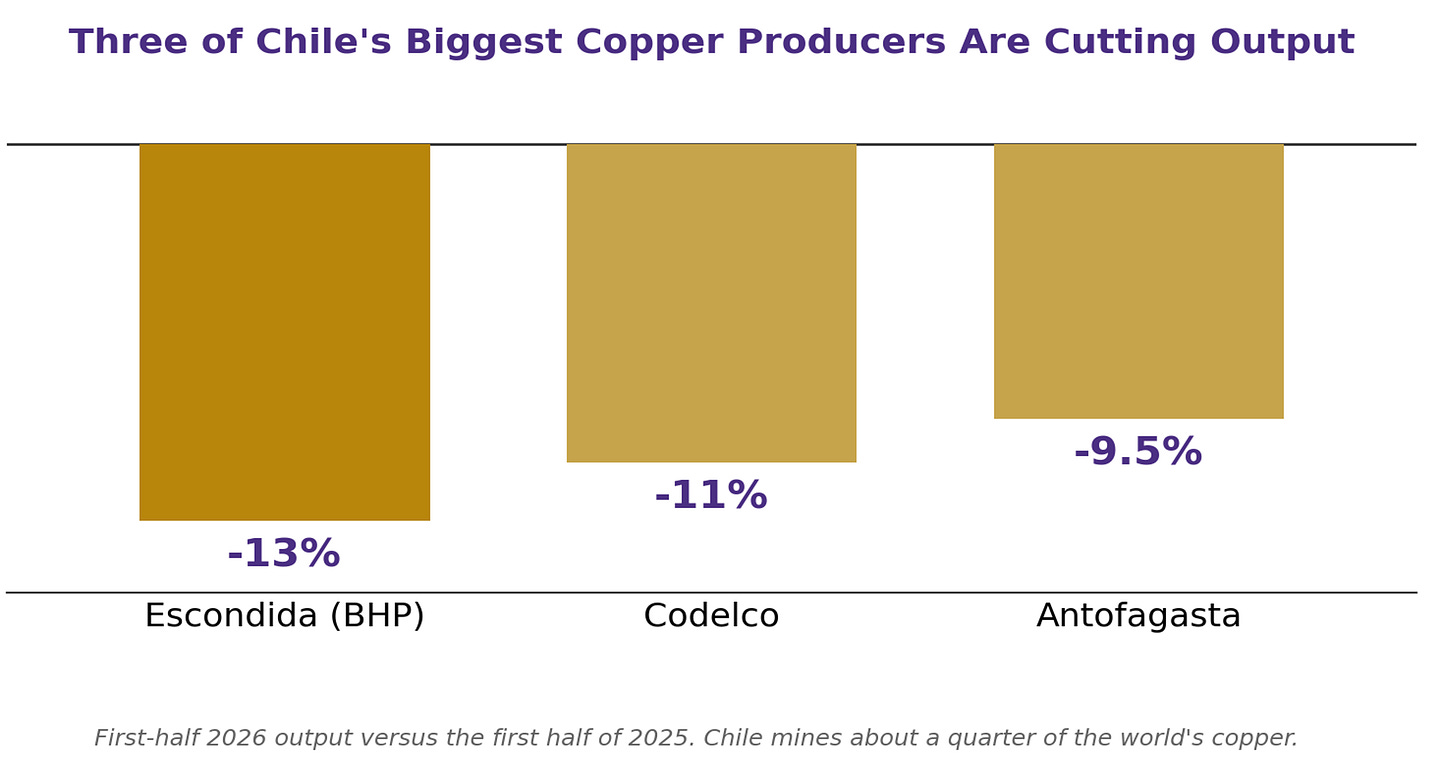
Codelco, the largest copper miner on earth, produced 11% less in the first half of 2026 than a year earlier. Grasberg in Indonesia, the second-largest copper mine, is producing about 20% less than a year earlier, near 0.8 billion pounds against 1.0 billion in 2025, with full output not expected until 2027 or 2028. BHP’s Escondida, the single biggest mine anywhere, is down about 13%, and Antofagasta lost 9.5%. Chile, which mines a quarter of the world’s copper, cut its 2026 national forecast to 5.27 million tonnes. Freeport-McMoRan, the largest US producer, also fell by double digits. Newer mines elsewhere are adding supply, with Rio Tinto lifting copper output more than 30% as Oyu Tolgoi in Mongolia ramped up, but not fast enough to cover the losses as demand climbs, which tightened the market into its June deficit.
Demand is increasing at the same time. China is pouring a record 5 trillion yuan, about $722 billion, into its power grid through 2030, and power grids worldwide consume roughly 12.5 million tonnes of copper a year.
For the full year, Morgan Stanley forecast a 600,000-tonne deficit, the widest in more than twenty years.
And every tonne that falls in that gap has the effect of lifting copper prices, for mined copper and future supply still in the ground, in safe, neutral jurisdictions.
Buyers Are Paying 60% Premiums for Juniors
Gold tells the same story. It is trading near record highs and drove more than 40% of this year’s mining takeovers, so the majors are buying gold developers just as intensively as they are copper ones this year.
Those premiums stretch from 30% to past 100% for the best projects in stable countries. In February, Gold Candle paid CA$65 million for Fokus Mining and its 1.4 million ounces of Abitibi gold, a 36.8% premium. In March, Heliostar Metals bought Liberty Gold’s Goldstrike project for US$72.5 million.. In June, Central Asia Metals agreed to buy Cygnus Metals and its Quebec copper-gold project for A$232 million, a 60% premium to the prior day’s close.
And on August 20, US Gold Corp formed a special committee to weigh a sale of its fully permitted CK Gold project in Wyoming.
Strategy-driven investors should view the breakdown like this: copper is in increasingly short supply, its price is near a new record, and the majors are paying up for the developers that own the next deposits. That scenario points to higher copper prices and to the companies that already own viable projects in the ground.


Comments
Log in or sign up to join the conversation.