

There is a piece of advice that sounds obviously correct until you run it on a funded account: if one strategy is risky, run two. Diversification, more signals, smoother curve.
On a prop firm account it can produce the opposite result, and the reason has nothing to do with the quality of either strategy.
The sample problem nobody sizes for:
A profitable system is profitable over a hundred trades. An evaluation gives you 20 or 40, inside a drawdown limit and, often, a clock. Over that slice, the outcome of a genuinely positive-expectancy strategy is close to a coin flip — not because the edge is imaginary, but because the sample is too small for the edge to assert itself.
That is why two traders running the identical system can have opposite stories about it. One was handed the month where conditions lined up. The other was handed the month where they didn't. The difference between them is sequence, not skill, and sequence is the one variable neither of them controls.
Which is where a second system is supposed to help. Sometimes it does. Often it doesn't, for two specific reasons.
Reason one: the quiet periods overlap
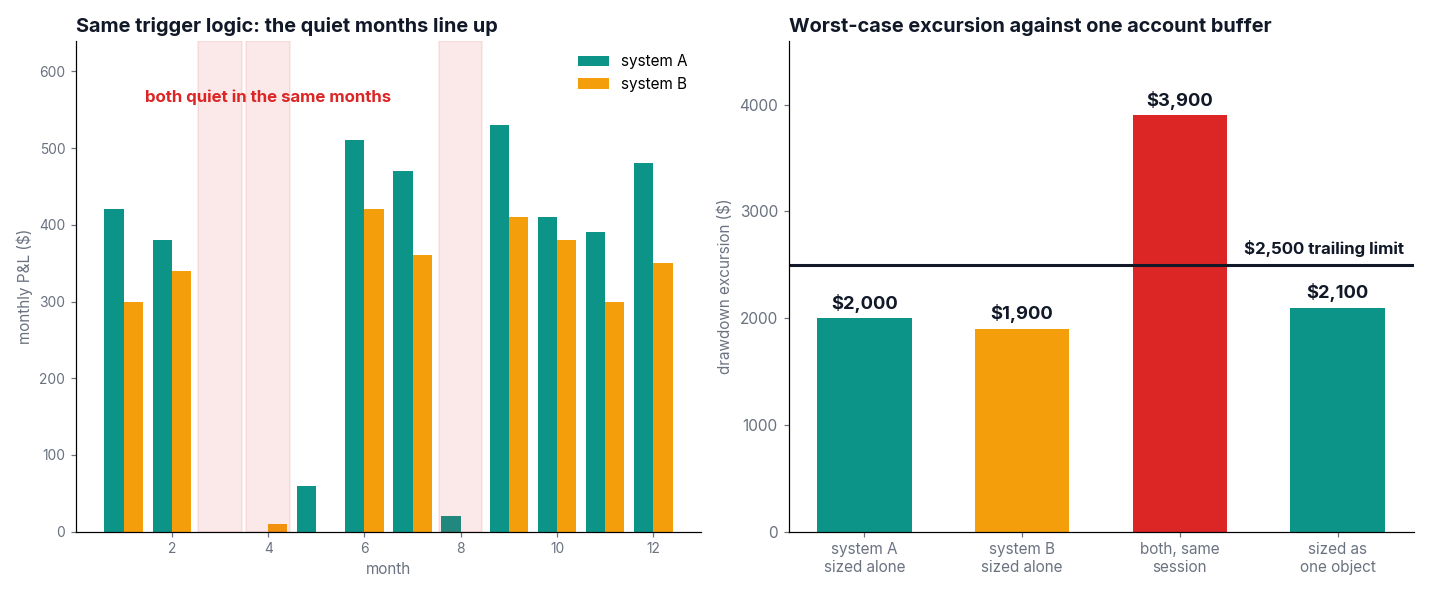
Take an illustrative case. Two intraday systems, both trend-following, both on index futures, both waiting for expansion after a compression phase. Each one is profitable over a year. Both go quiet in the same conditions, because the condition they wait for is the same condition.
Run them together through a flat, rangebound stretch and you don't get diversification. You get two systems doing nothing at once, on an account with a clock, while the subscription fees keep clearing.
The useful question isn't "are these two systems different products". It's "when this one goes quiet, does the other one pay". That's a correlation question, and it's answerable from your own records: line up the monthly results side by side and count the months where both are flat or red. If that count is close to the count for either one alone, the second system is adding trades, not resilience.
Pairing on three axes usually fixes it: different instrument, different mechanism, different time structure. Two systems on the same instrument with the same trigger logic are one system with extra commissions.
Reason two: two systems, one drawdown limit
This is the failure that surprises people who did the correlation work correctly.
Each system gets sized against the account's buffer. Sensible in isolation: a $2,500 trailing limit, size so a realistic losing streak doesn't reach it. Do that twice, independently, and the account now carries two position sizes each of which assumes it owns the whole buffer.
The account has one buffer. On the day both systems take their normal losses in the same session — which is not a rare event even at low correlation — the combined excursion is the sum, and the sum was never the number either sizing calculation was checking against.
The correct procedure is to size the pair as a single object: model the combined equity path, find the worst combined stretch, and size so that stretch fits inside the buffer with room left. The result is always smaller positions per system than sizing them separately, and that reduction is the price of running two. A Monte Carlo simulator will show you the distribution of that combined worst case rather than a single historical path, which matters because your historical worst streak is a sample of one.
The human variable that undoes both: Even with uncorrelated systems and correct combined sizing, there's a failure mode that lives outside the math. The system that has paid nothing for three weeks is the one you will start second-guessing. You'll skip its next signal, or size it down, or decide the market has changed

Comments
Log in or sign up to join the conversation.