

Most writing about revenge trading is anecdotal. Someone blew up an account, felt bad about it, and wrote a cautionary post. That is useful as a warning and useless as evidence, because it tells you nothing about how widespread the behaviour is or who it affects.
There is, however, a proper study, and it deserves to be better known than it is.
WHAT THE DATA SHOWS
In 2005, Joshua Coval and Tyler Shumway published Do Behavioral Biases Affect Prices? in the Journal of Finance. They obtained trading records from proprietary traders at the Chicago Board of Trade — full-time professionals, trading their own capital, many with years or decades in the pit.
The authors split each trader's day in two and asked whether the morning result changed afternoon behaviour.
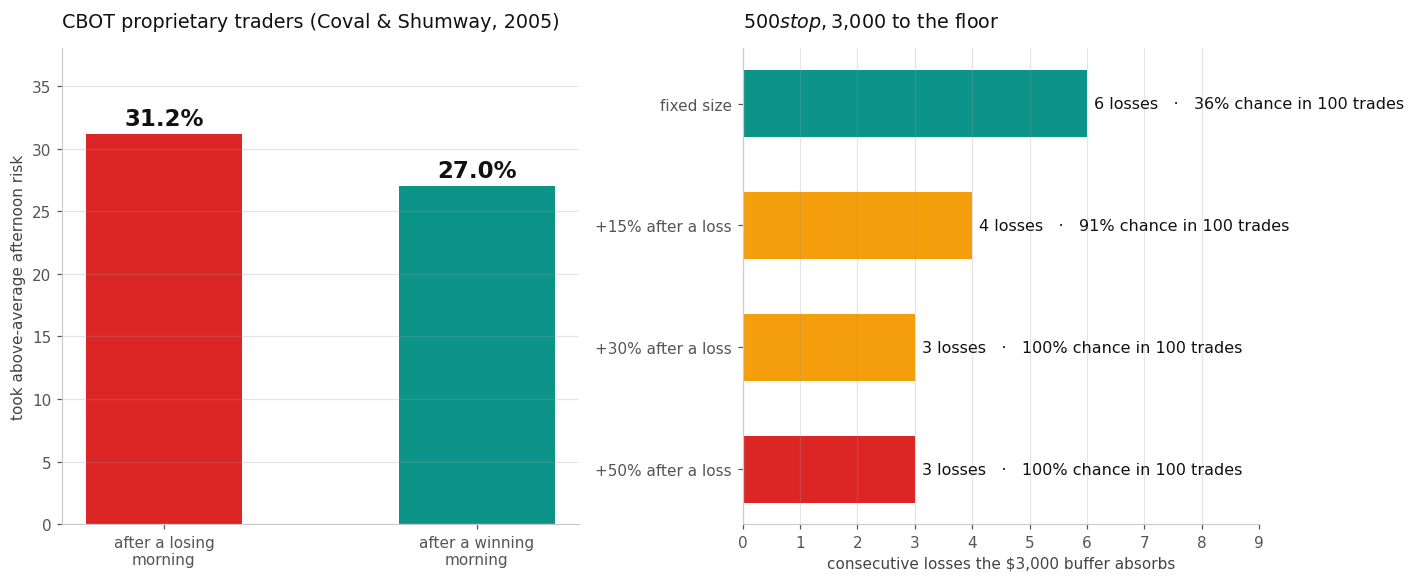
It did. Traders who were down on the morning took above-average risk in the afternoon 31.2% of the time. Traders who were up: 27%. The losing group also traded more frequently and accumulated larger positions. The effect has since been found in other markets, which means it is not an artefact of one exchange or one period.
Four percentage points does not sound dramatic. What makes the finding uncomfortable is who displayed it. The convenient explanation for revenge trading is inexperience — that it is a beginner's problem, something you grow out of. These were not beginners. If the effect survives decades of full-time experience with personal capital at stake, then the standard advice to "be more disciplined" is asking people to do something that a population of professionals demonstrably could not.
WHY IT MATTERS MORE TODAY THAN IT DID IN 1998
A pit trader having an elevated-risk afternoon had a worse afternoon. The structure of the account absorbed it.
The structure most active traders operate under now does not. Funded and evaluation accounts come with a daily loss limit and a drawdown floor, and neither cares why a position was larger than usual. The behaviour is identical; the consequence is categorically different. What used to be a bad session becomes the end of the arrangement.
The arithmetic is worth doing explicitly, because it is more brutal than intuition suggests.
Take a straightforward case: $3,000 of room between your equity and your drawdown floor, and a $500 stop on each trade. At a fixed size, the buffer absorbs six consecutive losses before you are out.
Now escalate modestly after each loss — not doubling down, just a 30% increase, the kind that feels like conviction rather than recklessness. The first stop costs $500, the second $650, the third $845. Three losses and you have consumed $1,995 of a $3,000 buffer. The fourth wipes it.
Six mistakes became three.
And the probability of encountering the streak changes with it. At a 55% win rate, the chance of hitting six consecutive losses somewhere in a hundred trades is around a third — unpleasant but survivable. The chance of hitting three consecutive losses in the same span is essentially certain. You have not increased your risk by 30%. You have converted a tail event into a routine one.
THE SECOND-ORDER PROBLEM
There is a subtler version of the same mechanism that catches people who believe they are immune to the first.
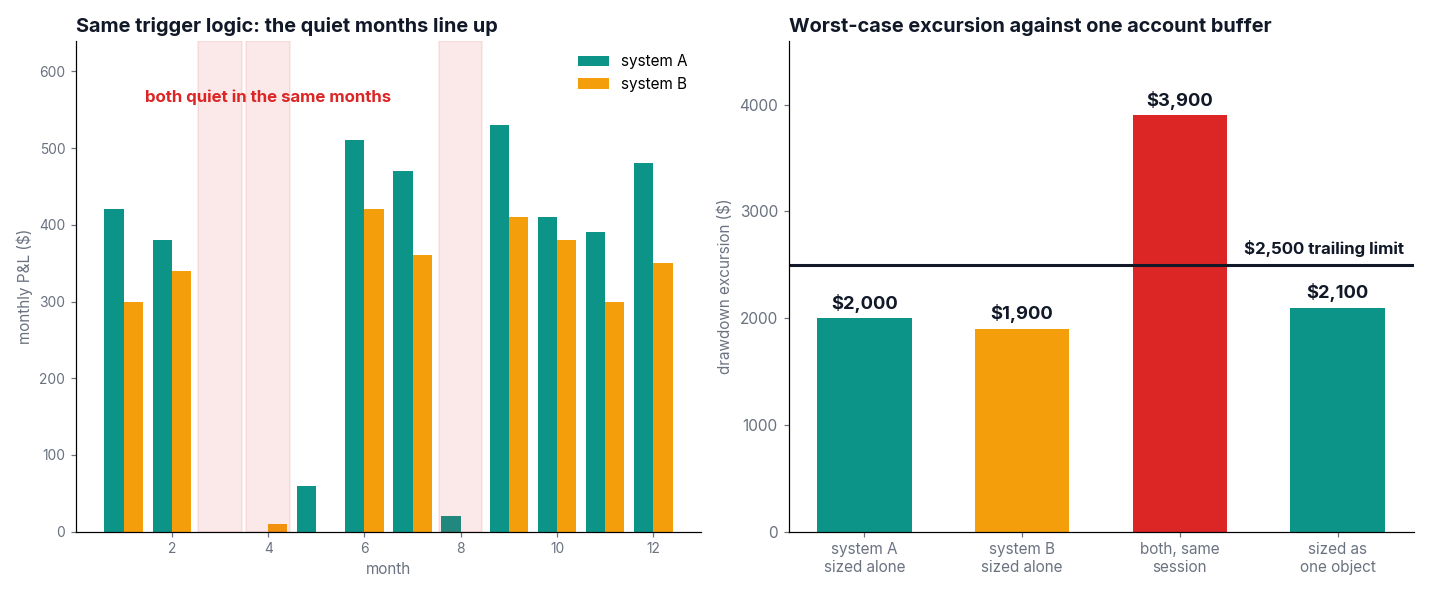
Most position sizing is keyed to the account tier: a $100,000 account uses the size appropriate to a $100,000 account. That number does not change when your buffer does. Take a payout, absorb a drawdown, or simply have a bad week, and the distance to your floor shrinks while your position size stays put.
You do not have to escalate deliberately for your effective risk to rise. You only have to leave the size alone while the room behind it disappears. The trader who never revenge trades but also never re-sizes after a drawdown is running the same experiment more slowly.
This is why the useful number to watch is not your balance or your account label, but the distance between your equity and the level that ends the account. You can work out how many full stops that distance represents in about ten seconds, and a position size calculator that sizes against the drawdown buffer rather than the balance will do it for you across instruments.
WHAT ACTUALLY WORKS
The research implies that the fix cannot be applied in the moment, because the moment is precisely when the judgment is compromised. If professionals with decades of experience showed the effect, willpower is not the control mechanism.
What works is moving the decision earlier, to a point where the loss cannot reach it.
A rule written before the session — maximum trades per day, what happens after a stop-out, how size adjusts when the buffer shrinks — is a decision made by a version of you that has not just lost money. It is the same logic behind surgical checklists and pilot procedures: not because the professionals involved are careless, but because performance under stress is unreliable in ways that are predictable and therefore plannable.
Two rules cover most of the damage. First: after a stop-out, a fixed interval away from the platform. The length matters less than the fact that it was decided in advance. Second: size against the room you have left, not the account you were assigned. If your buffer has halved, your size should follow it down until you have rebuilt the distance.
Neither requires discipline in the difficult moment. That is the entire point.
A WORD ON TESTING THIS ON YOURSELF
You do not need anyone's research to find out whether this applies to you. Export your trade history and tag every trade whose preceding trade was a loss. Compare that group against everything else on three numbers: average position size, win rate, and time elapsed before entry.
If position size is higher in the tagged group, you have a sizing problem that no resolution will fix on a bad morning. If time to entry is shorter, you have a timing problem. Most traders who run this exercise for the first time find at least one of the two, and are surprised, because in the moment those trades did not feel different. They felt decisive.
The gap between how those trades felt and how they performed is the whole subject, and it is measurable on your own data in about twenty minutes.

Comments
Log in or sign up to join the conversation.