

Most traders obsess over the entry. The perfect setup, the confluence, the signal that finally works. But if you look at what actually determines whether an account survives a losing streak, the entry is rarely the deciding factor. Position sizing is.
Here's the uncomfortable truth: two traders can take the exact same entries on EUR/USD or Gold and end up with completely different outcomes — one steadily profitable, one blown — purely because of how much they risked per trade. Same signals, same market, opposite results. The difference lives entirely in the sizing.
Drawdown is a sizing problem, not a strategy problem
When traders hit a drawdown, the instinct is to blame the strategy. "The edge stopped working." Sometimes that's true. More often, the strategy was fine and the sizing was wrong for the volatility.
Consider a systematic approach on XAU/USD. Gold's average range can swing dramatically between quiet consolidation and news-driven expansion. A fixed lot size that feels comfortable during a tight range becomes reckless when the range doubles. The trader didn't change anything — the market did — but the risk per trade silently tripled because the position wasn't sized to current volatility.
This is why professional systematic strategies size against volatility, not against conviction. The position shrinks when the market gets wild and expands when it calms. The entry logic stays identical; the exposure adapts.
The maths that ends accounts
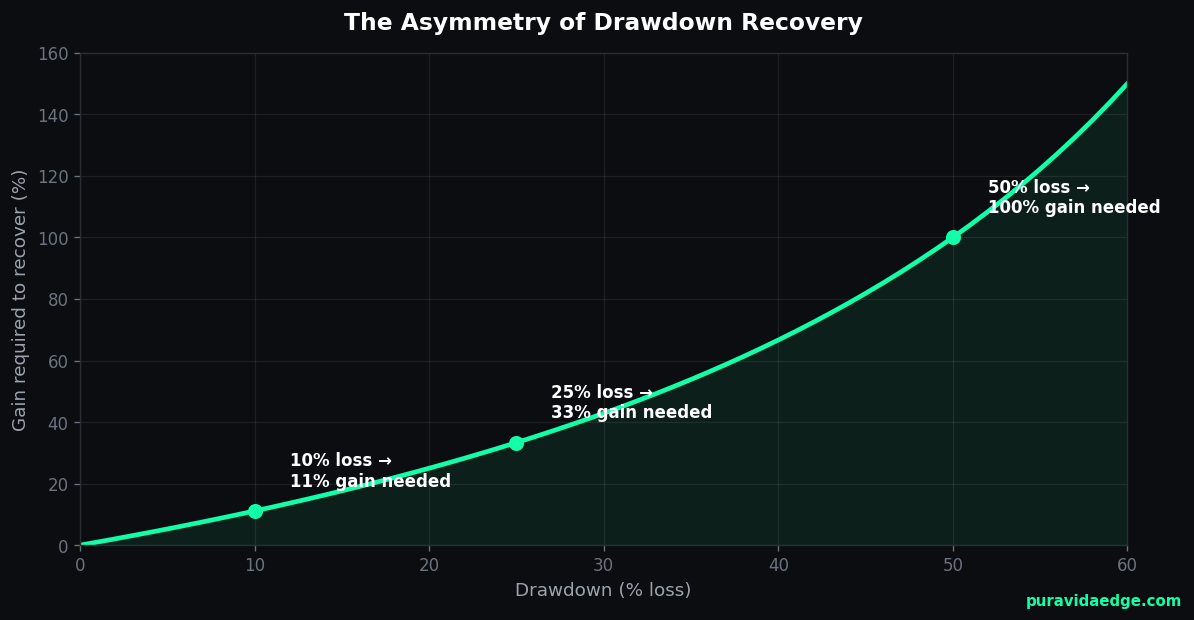
The reason sizing matters so much comes down to the asymmetry of recovery. A 10% drawdown requires an 11% gain to recover. A 25% drawdown requires 33%. A 50% drawdown requires a 100% gain — you have to double what's left just to get back to even.
Every increment of drawdown makes the climb back disproportionately harder. This is why capping the depth of the hole matters more than maximising the upside. A strategy that makes slightly less but never digs a deep hole will outcompound one that swings for the fences and periodically craters — not because it wins more, but because it never has to climb out of a 50% grave.
You can run these numbers on any drawdown figure with a drawdown recovery calculator — the required gain accelerates faster than most traders expect.
For traders on funded or prop accounts, this is even more acute: the drawdown limit isn't just a psychological threshold, it's an account-ending line. Size for the limit, or the limit finds you.
What this looks like in practice
The practical shift is simple to state and hard to do: decide your risk before your position size, and let volatility set the size.
Instead of "I'll trade one lot because that's what I usually trade," the logic becomes "I'm risking X% of the account on this trade; given where my stop is and how volatile this pair is right now, that means this position size." When the stop has to be wider because Gold is moving, the position gets smaller automatically. Risk stays constant; size flexes.
Done consistently, this does something quietly powerful: it makes your worst losing streak survivable by design, rather than by luck. The strategy's job is to find the edge. Sizing's job is to make sure you're still in the game when the edge pays off.
The takeaway
Entry signals get all the attention because they're the exciting part. But the trader who masters position sizing — risking a constant fraction, sizing against volatility, and respecting what drawdown does to recovery maths — will outlast the trader with a better signal and worse risk control every time.
The edge tells you when to trade. Sizing decides whether you're still trading a year from now.

Comments
Log in or sign up to join the conversation.