

Takeaways by The Dark Side of the Boom
• Wall Street has delivered another extraordinary session of whiplash, with the Nasdaq flirting with bear-market territory before a wave of buying turned what looked like another rout into a rather different afternoon.
• Beneath the violent price swings, institutional positioning is undergoing a substantial reshuffle, creating the sort of market where forced selling, short covering and opportunistic buying can overwhelm the fundamentals.
• The bond, currency, credit and commodity markets are beginning to tell a more complicated story, suggesting investors may be shifting their attention from stubborn inflation toward something considerably less comfortable.
• The AI investment cycle remains at the centre of the storm, but the question facing investors is no longer simply how much the technology can deliver. It’s whether the economic and financial system can withstand a sustained retreat in the capital supporting it.
Wall Street’s Latest Whipsaw: Somebody Call the Referee
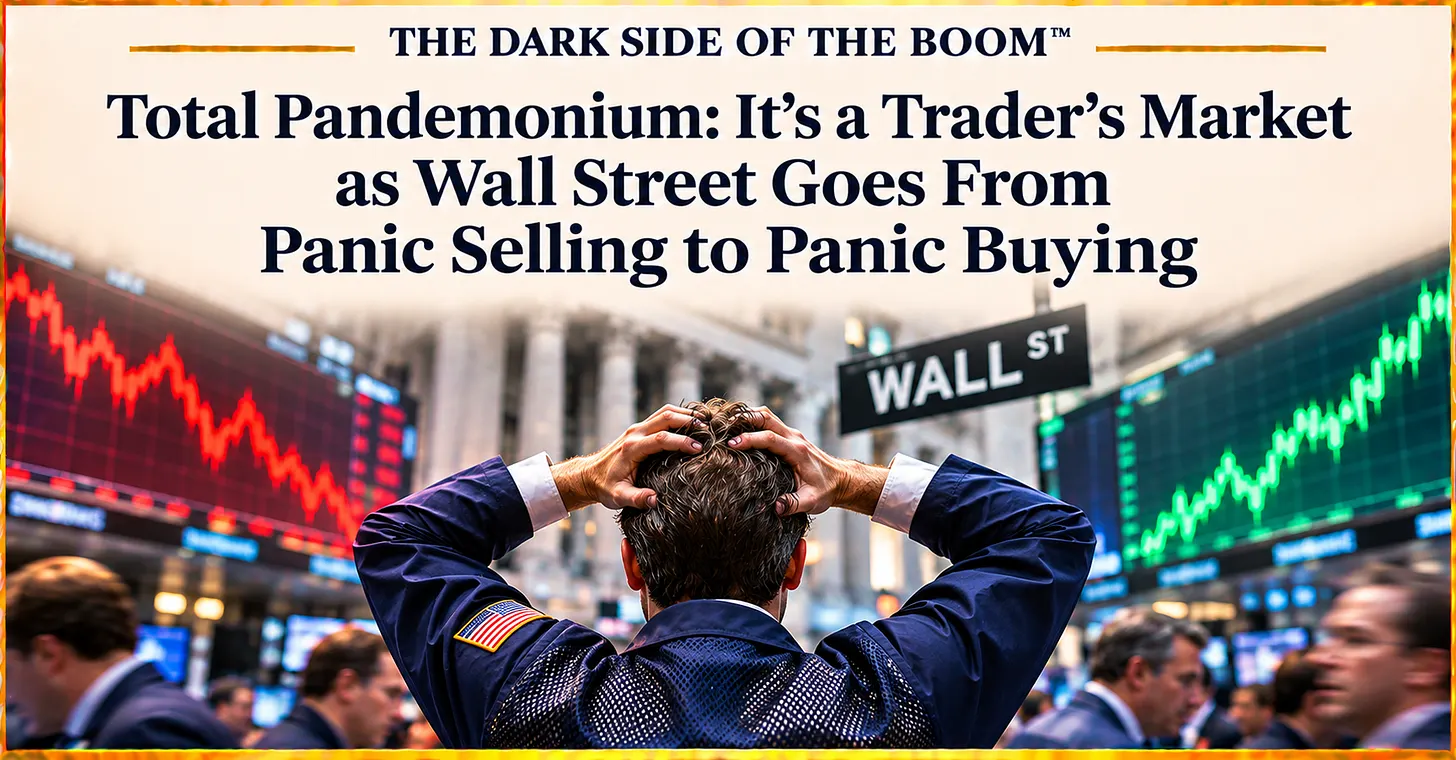
Total pandemonium. There’s really no other way to describe Wednesday’s session, as Wall Street went from what looked like another full-blown technology liquidation to a frantic bout of dip buying that dragged the Nasdaq back from the edge of bear-market territory. Given the extraordinary whipsaws of the past several sessions, it’s becoming increasingly difficult to pin the tail on the donkey when it comes to identifying exactly what’s driving this market. Was it short covering, portfolio rebalancing, the sudden realization that the risk-reward equation had become more attractive, or did somebody dust off the old Plunge Protection Team playbook?
The more conspiratorially inclined were certainly entertaining the last possibility, with the President’s Working Group on Financial Markets once again attracting attention as stocks staged their remarkable intraday recovery. There’s no evidence it intervened, of course, but when a market suddenly turns on a dime in conditions where liquidity is practically nonexistent, you can understand why trading desks start looking for explanations beyond the usual economic headlines.
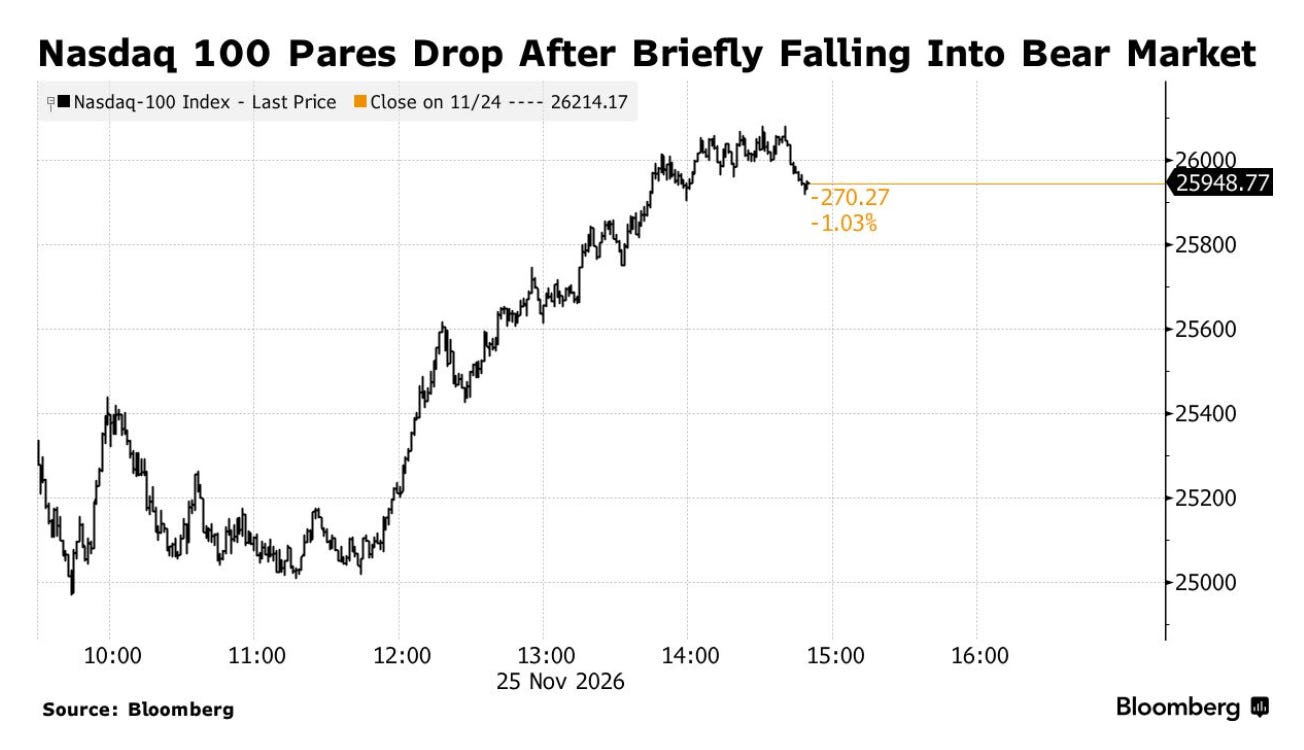
The Nasdaq 100 briefly entered bear-market territory, down 20% from its record high, while the Dow was more than 1,000 points underwater at its worst levels.
Nvidia (NVDA) fell more than 9% intraday as the enthusiasm surrounding Jensen Huang’s return continued to evaporate, and the broader AI complex looked as though it was preparing for another trip through the financial meat grinder.
Then, shortly before midday in New York, the script flipped.
The dollar began selling off around 11:15 a.m., equities found a floor roughly half an hour later, and suddenly the same traders who had spent the morning desperately reducing exposure were scrambling to cover shorts and pick through the wreckage. Gold and cryptocurrencies joined the rebound, with a conspicuous spike in trading volume near the equity lows. By the closing bell, the Nasdaq was still the laggard, but the S&P 500 had clawed back toward unchanged, while the Dow and Russell 2000 posted respectable gains.
The explanations came thick and fast. Some pointed to reports of regulatory approval for SpaceX’s proposed orbital data-centre constellation, others to Michael Burry reportedly closing his remaining Nasdaq put exposure. The more imaginative crowd saw a yen-funded carry squeeze helping propel equities off the lows. None offers a particularly convincing standalone explanation for the sheer violence of the reversal.
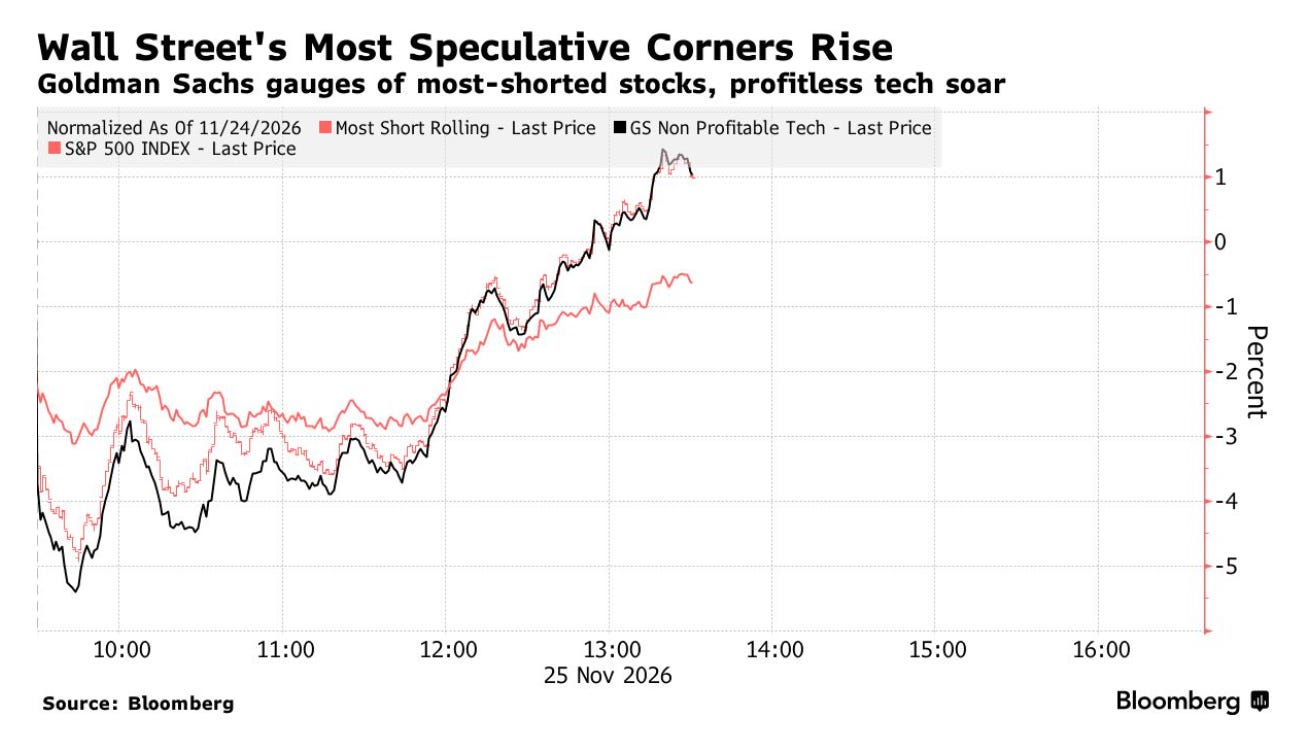
My suspicion is that the explanation is far less glamorous: a badly dislocated market, almost no liquidity, and enough investors suddenly deciding the price of risk had become more attractive than the prospect of staying short.
After all, the statistical argument for buying into severe corrections is reasonably straightforward. Historically, the more comprehensively investors reduce exposure, the better prospective returns tend to become. But that doesn’t mean markets must endure some final biblical washout before they can recover, nor does it guarantee that the first substantial bounce marks the beginning of a durable advance.
The asymmetry simply becomes more interesting as liquidation progresses.
And for traders, that’s precisely what makes this environment so compelling. Volatility is extraordinary, the market is constantly wrong-footing positioning, and opportunities exist on both sides of the book. But anyone confusing a violent intraday reversal with a sudden resolution of the market’s underlying problems is asking for another expensive lesson.
The AI Trade Is Getting Repriced, Not Just Repositioned
The extraordinary sequence began with Monday’s Jensen Huang resurrection, when Nvidia’s reinstated chief executive helped ignite a nearly 7% Nasdaq rally. That was followed by Tuesday’s bruising reversal, then Wednesday’s plunge toward bear-market territory, before dip buyers finally found their nerve.
Three sessions, three very different market personalities, and no shortage of investors discovering that their carefully constructed risk models weren’t designed for this sort of circus.
But the more interesting development is taking place beneath the headline indices.
Aggregate hedge-fund net exposure to AI stocks has fallen to its lowest level since September 2025, while the sector's long-to-short ratio is at its weakest since October 2024. Meanwhile, AI short exposure as a proportion of overall hedge-fund gross exposure has climbed to multi-year highs.
That’s a significant change in the composition of the trade.
The AI complex has shifted from one of the market’s most crowded long positions to a battleground where institutional investors are increasingly comfortable expressing bearish views. When that happens, price action can become extraordinarily violent in both directions. Shorts become vulnerable to sudden squeezes, longs are forced to defend deteriorating positions, and systematic strategies can amplify the resulting swings.
Anthropic provided another example, recovering above its $83 IPO price after briefly falling beneath it the previous session. Nvidia also staged a substantial recovery from its intraday lows, though it finished lower for the day. Across the broader technology complex, the initial carnage moderated considerably as the afternoon progressed.
But the financing questions haven’t changed.
The enormous capital requirements of the AI buildout, uncertain returns on data-centre investment, the economics of token pricing, and the increasingly complicated relationship between the companies financing and consuming AI infrastructure remain unresolved. Add export restrictions, permitting constraints and political scrutiny, and it’s difficult to see why investors should suddenly return to the unquestioning enthusiasm that characterized the earlier stages of the boom.
That is where the argument between bulls and bears becomes more interesting than the daily price swings.
The bulls see an increasingly attractive positioning setup, with enough exposure already liquidated to create a powerful recovery once the selling pressure subsides. They argue that the recent drawdown has been driven disproportionately by sentiment, positioning and uncertainty rather than a fundamental collapse in the earnings outlook.
The bears see something more structural: an investment cycle whose financing commitments have outpaced demonstrated returns, with political and regulatory risks adding another layer of uncertainty.
Both arguments have merit, which is precisely why the market is producing these extraordinary reversals.
A market can become cheap enough to buy before the underlying problems are solved. But it can also become cheaper again when the earnings assumptions supporting those valuations begin to change.
Meanwhile, the rotation away from the AI heavyweights is becoming increasingly visible. Consumer staples, real estate, and dividend-paying companies attracted buying, while the equal-weighted S&P 500 continued to outperform its capitalization-weighted counterpart. Roughly 340 S&P constituents advanced against just over 150 decliners, suggesting the broader market was in considerably better shape than the technology benchmarks implied.
That’s encouraging for market breadth, but it also highlights how much of the previous advance depended on a relatively narrow group of exceptionally large companies.
And when those companies stumble, the consequences extend well beyond the equity market.
Credit Is Where the Real Trouble Starts
The credit market delivered another uncomfortable reminder that equity-market recoveries and genuine improvements in financing conditions are not necessarily the same thing.
Credit spreads widened sharply during Wednesday’s initial liquidation before recovering much of the damage alongside equities. Hyperscaler credit-default swaps also retreated from fresh highs, but data-centre credit spreads pushed to new records and stayed there, underscoring the growing divergence between established technology companies and the more leveraged businesses funding AI infrastructure expansion.
That distinction matters enormously.
An equity investor can decide that Nvidia looks sufficiently attractive after a substantial correction and purchase shares with a reasonably straightforward investment thesis. A lender financing a data-centre project has to worry about construction costs, customer commitments, utilization rates, debt servicing, and whether expected revenues will materialize on schedule.
The entire AI ecosystem has been built around assumptions that capital will remain available and that demand for computing power will continue expanding rapidly enough to justify extraordinary investment commitments.
As those assumptions come under scrutiny, the consequences can extend into credit markets long before the broader economy fully feels the effects.
This is why I keep coming back to financial conditions rather than simply watching whether the Nasdaq manages another spectacular rebound.
The equity market can celebrate a trillion-dollar resurrection, but the credit market still wants to know who’s going to pay the bills.
An increasingly asset-heavy US economy has become more sensitive to both asset prices and the availability of financing. The AI capital-expenditure cycle has supported construction, equipment spending, employment and corporate profits, while rising technology shares have reinforced household wealth and consumption.
But that creates an uncomfortable feedback loop. If equity valuations weaken and financing becomes more expensive, companies may begin reconsidering investment commitments. Slower investment then weighs on growth and earnings, putting additional pressure on asset prices.
The IMF estimates that a sharp retrenchment in AI investment could reduce global GDP by about 1.1% by 2028. That’s not a forecast of what must happen, but it illustrates why the AI selloff is no longer merely a question of technology-stock valuations.
Pull enough capital out of the AI investment cycle, and the consequences will eventually hit the real economy.
The Bond Market Is Starting to Worry About Yesterday’s Problem
Perhaps the most important development in Wednesday’s cross-asset price action was the continuing demand for Treasuries, even as crude oil rallied on renewed geopolitical supply concerns.
The economic calendar delivered a mixed but generally resilient picture. Revised third-quarter GDP, personal income, jobless claims and new-home sales surprised positively, while durable goods and consumer spending disappointed. Core PCE inflation remained elevated, and the broader inflation backdrop offered the Fed little excuse to abandon its tightening plans.
Yet Treasury yields declined across the curve, with the shorter end increasingly reflecting concerns about how much additional monetary tightening the economy can absorb.
That’s a meaningful shift.
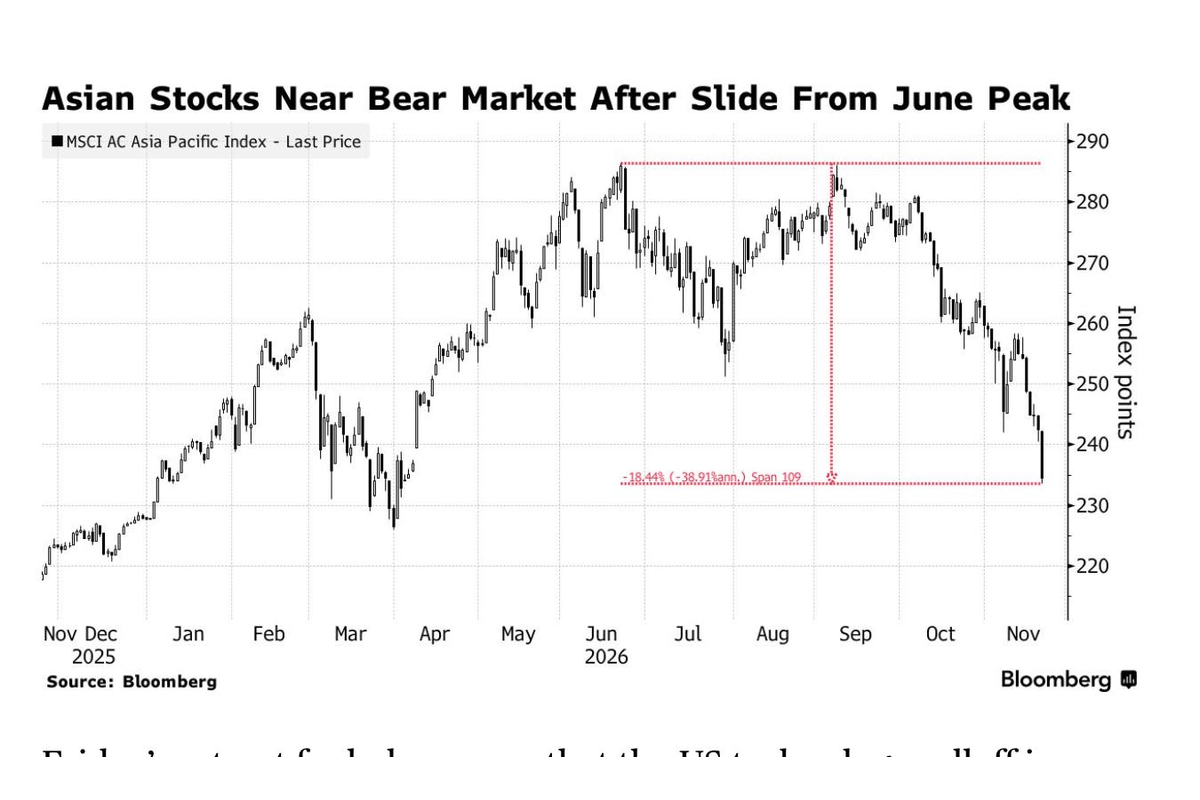
For much of 2026, the dominant macroeconomic question was how aggressively central banks would need to respond to inflation, particularly the energy shock stemming from the conflict with Iran. Markets spent months debating the terminal rate and how long policymakers would need to keep conditions restrictive.
Now a different question is creeping into the conversation.
What happens if the Fed is still fighting inflation just as the economy starts losing one of its most important engines of growth?
The technology liquidation, weakness in industrial commodities and increasingly fragile credit environment have encouraged investors to reconsider the assumption that monetary tightening can continue indefinitely without meaningful damage to growth.
December still looks like the likely meeting for another Fed hike. Policymakers have prepared markets for it, and inflation remains too high to make an abrupt reversal particularly credible. But the outlook beyond December is becoming considerably less certain.
The March tightening expectation looks more vulnerable, particularly if financial conditions continue deteriorating and the AI investment cycle begins showing signs of a sustained slowdown.
There is a familiar historical parallel in the Fed’s December 2018 hike, when Jerome Powell tightened policy into weakening financial markets before shifting toward patience barely two weeks later.
That doesn’t mean history must repeat itself. But it demonstrates how quickly the monetary-policy conversation can change once financial conditions begin doing the tightening for the central bank.
The market may be moving from worrying about inflation forever to wondering whether the Fed is about to overstay its welcome.
And the distinction matters enormously for currencies, commodities and risk assets.
Oil Rallies, Bonds Rally, and the Dollar Blinks First
Wednesday’s energy market offered another example of how difficult the current environment has become for anyone expecting conventional cross-asset relationships to hold.
Crude oil rallied despite the broader growth concerns, supported by fresh geopolitical developments across the Middle East and additional disruptions to Russian refining capacity.
Saudi forces intercepted drones targeting Ras Tanura, a critical refining and export facility, while restrictions on tanker movements near UAE terminals and reports of another maritime incident east of the Strait of Hormuz revived concerns about physical supply.
Ukrainian attacks on Russian refineries added to the pressure, while US inventory data showed a smaller-than-expected crude build of approximately 1.1 million barrels. The upcoming OPEC+ meeting added another layer of uncertainty.
Yet Treasuries largely ignored the crude rally, suggesting investors were placing greater emphasis on the deteriorating growth outlook than on the immediate inflationary implications of higher oil prices.
That is not the reaction one would expect if inflation remained the market’s overriding concern.
The dollar then retreated sharply before equities found their intraday lows, offering one of the first clues that the broader liquidation might be nearing a temporary exhaustion point.
Gold recovered above $3,550( from near $3400 lows), while other metals clawed back losses and bitcoin (BTC.X) surged toward $60,000 as speculative appetite returned.
But the precious metal still finished lower, another reminder that the liquidation process has not necessarily run its course.
Gold's recent behaviour has been particularly revealing. During the worst of the equity panic, bullion was sold to raise cash, and its traditional relationships with Treasury yields and the dollar temporarily took a back seat to the need for liquidity.
When equity prices recovered, and the dollar weakened, gold found support. But those rebounds have remained vulnerable because the underlying financing conditions have yet to improve decisively.
The same applies to copper, where weakness has reflected growing concern about the global investment cycle and the possibility that AI-related spending may no longer provide the same powerful support for industrial demand.
For me, this is why a genuine Fed pivot matters considerably more than another spectacular equity-market rescue act.
A Trump put can interrupt a liquidation by temporarily supporting asset prices and reducing pressure on leveraged portfolios. But it doesn’t automatically lower borrowing costs or broadly ease dollar funding conditions.
A meaningful monetary-policy shift that reaches credit markets and improves financing conditions would change that equation. Until then, investors remain vulnerable to further rounds of deleveraging, however attractive individual assets may appear after substantial corrections.
A Trader’s Market, but Not Necessarily an Investor’s All-Clear
Wednesday’s extraordinary reversal captured the contradiction at the heart of the current market.
On one hand, the scale of recent selling has created increasingly attractive opportunities for investors prepared to look beyond the immediate turmoil. Hedge-fund positioning in AI has been substantially reduced, bearish exposure has increased, and the broader equity market is beginning to show signs of rotation rather than indiscriminate liquidation.
On the other hand, the fundamental questions surrounding the AI investment cycle, credit availability and monetary policy remain unresolved.
That’s an environment made for traders, particularly those comfortable managing risk around violent price swings and rapidly changing positioning. The opportunities are considerable, but so is the danger of becoming emotionally attached to a market narrative that can be overturned before lunch.
The distinction between a tradable rebound and a durable investment recovery has rarely been more important.
The bulls may eventually be proved right that the correction has created sufficient value to attract sustained buying. The bears may also be correct that the financing and earnings assumptions underpinning the AI boom still require a considerably more uncomfortable adjustment.
Both outcomes remain possible, and the market is effectively charging investors a substantial volatility premium while it works through the uncertainty.
The bigger macroeconomic question is whether financial conditions tighten sufficiently to force a change in the Fed’s outlook before weakness in AI investment begins feeding more directly into growth.
If the Fed eventually pivots because credit conditions and economic activity demand it, that could provide the basis for a much broader recovery in gold, industrial commodities and cyclical assets. But the timing matters, because the final stages of a tightening cycle can produce some of the most punishing liquidation episodes before monetary relief arrives.
And that is where I would keep my attention rather than trying to identify the precise reason behind every spectacular intraday reversal.
Wall Street can argue about the Plunge Protection Team, short covering, gamma, vanna or whether the dip buyers simply decided prices had fallen far enough. In a market this thin, several of those forces can operate simultaneously, and none necessarily explains the entire move.
What I do know is that the AI trade is no longer a one-way ticket, the credit market is becoming increasingly selective, and the bond market has started asking questions the equity bulls would rather postpone.
For traders, it’s a remarkable environment. For investors who still believe every violent rebound must be the start of the next leg higher, it could be a very expensive education.
And after Wednesday’s performance, I wouldn’t be surprised if half of Wall Street needed a stiff drink before Thanksgiving dinner.


Comments
Log in or sign up to join the conversation.