

Takeaways
• Wall Street has handed Asia a slippery technology baton, and Monday’s early relief rally is already setting up an intriguing test of investor nerves.
• Beneath the green US futures screens, the opening action across Asian markets suggests the weekend hasn’t been nearly long enough to heal last week’s wounds.
• Policymakers are reaching for their emergency toolkits, but the market may have a few unpleasant surprises left before the dust settles.
• An unlikely source of relief is emerging from the commodity markets, although whether it can provide a springboard for battered risk assets is another matter entirely.
Wall Street Passes the Slippery Baton, and Asia Isn’t Particularly Grateful
Wall Street has handed Asia a rather unpleasant parcel to unwrap on Monday morning, and after a weekend of watching the AI trade come apart like a cheap suitcase on an airport conveyor belt, traders are discovering that the opening bell has brought a few bargain hunters back into the ring. US equity futures have bounced sharply, with Nasdaq 100 contracts climbing as much as 3% before easing off at the time of writing , while S&P 500 futures are enjoying a welcome reprieve. After the beating technology shares absorbed last week, that sort of recovery is hardly surprising. Even the most vicious selloffs eventually run into a few shorts looking to take profits and dip buyers convinced the worst must surely be over.
But here’s the rub. The important question isn’t how high US futures can bounce this morning. It’s how much stock gets thrown at the market when they do. After a week when the Nasdaq 100 lost 10.4%, more than $4 trillion evaporated from Nasdaq-listed companies, and Nvidia (NVDA) was hammered 14% on Friday alone, there will be no shortage of portfolio managers looking at a green screen and wondering whether somebody has just handed them a second chance to lighten the load. In a market struggling with deteriorating liquidity, that distinction between genuine investment demand and a temporary reprieve from forced selling is worth considerably more than a cheerful opening futures print.
US futures are enjoying a spirited relief rally this morning, but the question I'm wrestling with is whether traders see a genuine recovery taking shape or simply a dead cat bouncing off Friday's wreckage. After last week's brutal liquidation, I suspect there are plenty of fund managers who would welcome a little green on their screens, not because they're itching to buy, but because they've been handed a better price to unload another boatload of risk. The real test isn't how high the market bounces, but how much selling it can absorb before gravity takes over again. ( Stephen Innes 🇨🇦 🇹🇭 )
Friday’s damage was extraordinary. The S&P 500 entered correction territory, while the Nasdaq 100 briefly crossed the traditional 20% bear-market threshold from its October peak before recovering somewhat by the close. The volatility index surged to its highest level since April 2025, and the selling spread well beyond Silicon Valley into metals, emerging markets and the broader global equity complex. It was the sort of session that reminds traders why leverage is such an agreeable companion on the way up and such a thoroughly unpleasant travelling partner on the way down.
And Asia has inherited the bill, although judging by the opening price action, not everyone is equally enthusiastic about settling it.
Korea Gets the Hangover While the Fed Keeps Pouring
South Korea is providing the clearest evidence that Wall Street’s overnight recovery hasn’t magically repaired the damage. The Kospi opened almost 3% lower, with Samsung Electronics and SK Hynix shedding around 3% in early dealings even as Nasdaq futures were finding their feet. These are not peripheral players in the AI boom but two of its most important semiconductor suppliers, and their continued weakness suggests investors are still more interested in reducing exposure than celebrating a few hours of improved sentiment in US futures.
The outlook for Samsung has also taken a knock, with its price target cut to 350,000 won from 430,000 won and earnings forecasts trimmed through 2028. Softer NAND memory prices, weaker consumer demand and slowing Chinese demand for enterprise solid-state drives are outweighing an improved outlook for DRAM prices in 2027. In other words, the market isn’t merely fretting about valuations anymore; some of the underlying earnings assumptions are being sharpened with a considerably less forgiving pencil.
And Korea’s central bank now finds itself in an awkward policy squeeze. The Bank of Korea meets Thursday after holding its benchmark rate at 3% last month, following back-to-back increases in July and August. Inflation remains above target, supported by the chip-driven economic boom, and another quarter-point hike remains a live possibility. But tightening monetary policy while the country’s equity market is taking a beating is rather like asking a boxer to climb back into the ring after he’s already spent twelve rounds absorbing punishment. The inflation problem hasn’t disappeared simply because shareholders are feeling bruised, yet another rate increase could hardly arrive at a more uncomfortable moment.
China, meanwhile, is discovering that building cheaper AI models doesn’t necessarily offer much protection when global investors decide they have paid too much for the entire technological revolution. Three of the country’s technology-heavy indexes have collectively surrendered approximately $1.7 trillion in market value since the end of June, putting fresh pressure on Beijing’s ambitions to develop a self-sufficient semiconductor and AI ecosystem. The industry’s strategic ambitions clearly haven’t disappeared, with SK Hynix planning to convert bonds into an indirect 14.1% stake in Japan’s Kioxia Holdings, but the market’s willingness to finance those ambitions at yesterday’s valuations is another matter altogether.
Policymakers Reach for the Fire Extinguishers
Across Asia, the authorities have evidently decided that simply watching the screens turn red is no longer an acceptable strategy. China is easing minimum margin requirements for leveraged securities purchases, Taiwan has tightened short-selling restrictions and disclosed equity purchases following its worst weekly decline in 35 years, while South Korea is relaxing corporate buyback limits and preparing the ground for a possible market-stabilization fund.
That is a fairly impressive collection of emergency tools for a market supposedly suffering from nothing more serious than temporary AI indigestion.
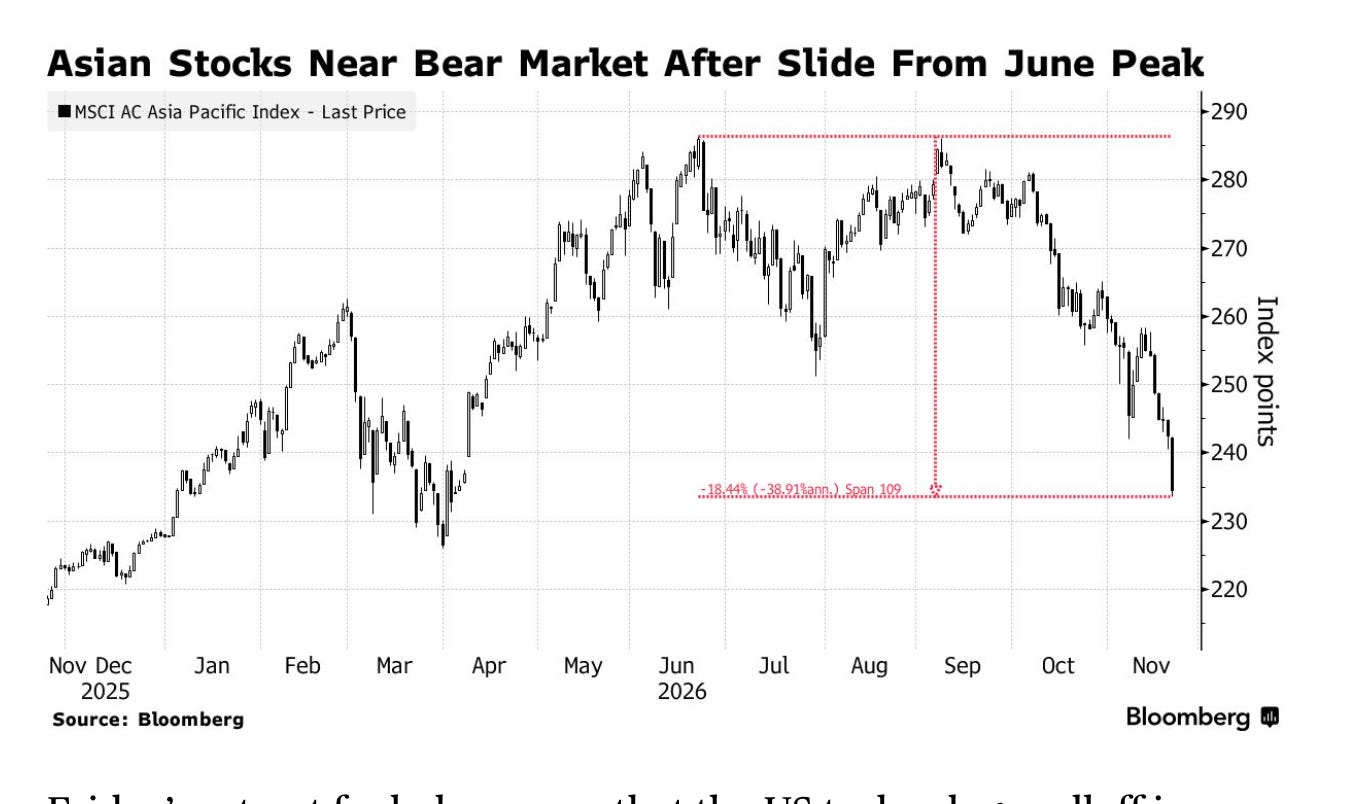
The danger is that measures intended to restore confidence can sometimes advertise just how nervous the authorities have become. Relaxing margin requirements may encourage buying, buyback flexibility may create additional demand, and short-selling restrictions can temporarily slow the pressure, but none of these measures can manufacture conviction among foreign investors who have decided their portfolios are carrying too much risk. The MSCI Asia-Pacific equity benchmark is already down approximately 18% from its June peak, leaving it uncomfortably close to bear-market territory.
Australia is offering a somewhat brighter picture, with the ASX 200 recovering its opening losses as strength in mining shares offsets weakness among the banks. But even there, the sector divergence suggests investors are being selective rather than indiscriminately charging back into risk.
You can make it easier to buy the market, but you cannot force investors to want what they’re still trying to sell. And when the authorities start wheeling out the emergency equipment before the fire has been contained, traders would do well to keep an eye on where the smoke is coming from.
The Bounce That Needs to Pass the Smell Test
There is a perfectly reasonable argument that the recent retreat reflects an aggressive deleveraging of the AI trade rather than a terminal deterioration in the investment cycle. Lower leverage, less crowded positioning and the removal of some speculative excess could ultimately leave the underlying technology story on firmer ground. The difficulty is that a healthier positioning backdrop and an actual market bottom are not necessarily the same thing, particularly when the Fed is still threatening to make the price of money more expensive.
The S&P 500 may have room to recover toward 7,250–7,350 before running into renewed selling, especially if short covering gathers momentum and bargain hunters become more aggressive. But the broader technical picture remains damaged, and the market hasn’t necessarily displayed the sort of sustained breadth deterioration and exhaustion that would give traders greater confidence that the final flush is behind us.
This is where experience matters more than enthusiasm. A sharp recovery after a brutal liquidation can look wonderfully convincing on a five-minute chart, especially when traders who sold into Friday’s panic suddenly find themselves scrambling to cover shorts. But there is an enormous difference between a market attracting fresh investment capital and one bouncing because the sellers have temporarily run out of ammunition.
And after the extraordinary destruction of wealth last week, there will be no shortage of fund managers who would rather sell the next rally than buy the next dip.
The policy backdrop isn’t offering much comfort either. Warnings that the Fed risks overtightening in response to stubborn inflation will resonate with investors hoping the central bank might eventually ride to the rescue, but until policymakers signal an actual change in direction, the market is left wrestling with an awkward combination of higher real yields, tighter financing conditions and deteriorating risk appetite.
The Fed may eventually find itself forced to reconsider the pace of tightening, but the market would be making a dangerous assumption if it treated every equity correction as an automatic invitation for a monetary rescue.
A Little Oil on Troubled Waters
If there is one potential silver lining in this rather murky market, it may be coming from an unlikely corner of the commodity complex. While technology shares have been getting their teeth kicked in, crude oil has been quietly surrendering much of its geopolitical premium, with Brent falling roughly 20% this month and slipping back below $92 a barrel. Even the Middle East powder keg is struggling to keep prices elevated when the physical market is staring at the prospect of considerably more supply than it needs.
The latest estimates point to a surplus of roughly 2 million barrels a day this quarter, with current shipments continuing to flow out of the Persian Gulf despite renewed attacks on tankers and escalating hostilities. Estimates suggest a geopolitical premium of as much as $25–$30 a barrel remains embedded in crude prices, an indication of how much uncertainty traders are still being asked to insure against. That premium is hardly guaranteed to disappear, especially with renewed US strikes against Iran remaining a possibility after the New Year, but the underlying supply picture is beginning to exert a gravitational pull that even the Middle East’s seemingly endless capacity for confrontation is struggling to overcome.
And this is where lower oil prices could become considerably more important than another bearish headline about crude demand.
Cheaper energy can do some of the Fed’s inflation-fighting heavy lifting without another turn of the monetary-policy screw. It puts money back into consumers’ pockets, eases pressure on corporate operating costs and offers the prospect of moderating headline inflation just when financial markets are becoming increasingly nervous about the consequences of further tightening. With the US holiday shopping season approaching and investors already questioning whether households can continue carrying the economy, a meaningful decline in fuel prices could provide precisely the sort of modest financial relief that doesn’t require another trillion-dollar AI spending commitment.
There is an important caveat, of course. Falling oil prices are not automatically bullish for equities. If crude is declining because the world economy is losing momentum, the benefit of cheaper energy can quickly be overwhelmed by deteriorating corporate earnings. But if abundant supply is doing most of the work while economic activity remains reasonably resilient, lower prices could become a genuine cushion beneath battered risk assets.
And in a market that has spent the past week searching desperately for something positive to cling to, that is no small consideration.
Oil may not be the cavalry riding over the hill, but it could provide a little grease for Wall Street’s increasingly squeaky wheels. The geopolitical fuse remains lit, however, and any serious disruption to Gulf shipments could turn that potential relief into another inflation headache almost overnight.
Gold Finds Its Feet, but the Liquidity Test Isn’t Over
Precious metals are also beginning to recover after being dragged through last week’s liquidation, with gold climbing roughly 1% toward $3,570 and silver finding buyers after a particularly bruising stretch. Copper has managed a modest recovery ahead of the London Metal Exchange opening, where the next meaningful test of industrial metals sentiment awaits.
But gold’s rebound deserves to be viewed through the same lens as the equity recovery. Last week’s selling was sufficiently severe that even traditional havens were being liquidated, suggesting investors were scrambling to raise cash rather than simply rotating from risky assets into safer ones. There is a familiar trading-desk smell to that sort of price action: when the margin clerk comes knocking, nobody asks whether the gold position is a long-term inflation hedge. They ask how quickly it can be sold.
Bullion-backed ETF flows will be particularly important this week. Holdings experienced modest outflows last week, and any acceleration would suggest that liquidation pressure remains alive beneath the surface. Conversely, a stabilization in ETF demand alongside a recovery in equities could indicate that the market is finally beginning to find its footing.
Brent’s continued retreat, modestly weaker Treasury futures and recovering precious metals all suggest some of Friday’s more extreme short positioning is being unwound, although Japan’s holiday closure removes an important regional market from the opening session and leaves cash Treasury trading unavailable during Asian hours.
The broader lesson from last week’s rout is that when investors are forced to find liquidity, the distinction between good assets and bad assets can temporarily become irrelevant. They sell what they can, not necessarily what they want, and the resulting price action can make even perfectly sensible investment themes look like financial train wrecks.
The Real Test Comes When the Sellers Return
Wall Street has passed Asia a battered baton, and the early futures rally suggests the market is at least willing to run another lap. But after last week’s extraordinary destruction of wealth, the bigger question is whether the buyers have finally returned with fresh money or whether the sellers are merely waiting for a better price to hand over the next load of stock.
The recovery in precious metals, resilience in Australian mining shares and continued decline in oil prices offer some encouragement that the market isn’t entirely devoid of support. Cheaper energy could ease the inflation squeeze, lower leverage could improve the foundations of the AI trade, and the authorities across Asia are clearly determined to prevent the selloff from turning into a broader financial accident.
But none of those developments automatically repairs the technical damage inflicted on global equities, and none guarantees that the institutional liquidation which dominated last week’s trading has finished running its course.
The market may be offering traders a lifeline this morning, but the real question is whether it’s a rescue rope or simply another opportunity for the big money to unload stock at a better price.
After a week like that, I wouldn’t be too quick to confuse a green futures screen with the all-clear signal. The smart money will be watching how much selling emerges into strength, whether the chipmakers can finally find a bid and, above all, whether the market can absorb the supply without another trip through the trapdoor.
Because in this business, the bounce is the easy part. Finding out who really wants to own the market when the sellers come back is where the hard work begins.



Comments
Log in or sign up to join the conversation.