


The Weekender is going out a fair bit earlier than usual today, as I’m heading up to my wife’s family farm in Phibun Mangsahan, on the banks of the Mun River in northeastern Thailand, for Loy Krathong, Thailand’s traditional festival of lights and water, celebrated on the full moon of the 12th lunar month. Looking forward to some family time, a little peace away from the trading screens, and a week of hard running mileage on the rural roads. After a bruising week in the markets, I’m overdue for a proper mental reset and, more importantly, a serious physical one. But I’ll be keeping the blog active, and hopefully the markets will finally give us something worth smiling about.
Wall Street’s Sea of Red: When the Lifeboats Start Looking Overcrowded
There’s an old saying on trading desks that markets climb a staircase and descend in an elevator. Well, Wall Street appears to have misplaced the staircase, jammed the elevator button, and discovered that the emergency exits are considerably narrower than advertised. What began as an uncomfortable wobble in the artificial-intelligence trade has turned into a full-blown global de-risking exercise, with the S&P 500 tumbling 10% from its October peak, officially entering correction territory, and the Nasdaq 100 shedding another 3.5% as the technology sector’s once-invincible aura takes a decidedly expensive beating.
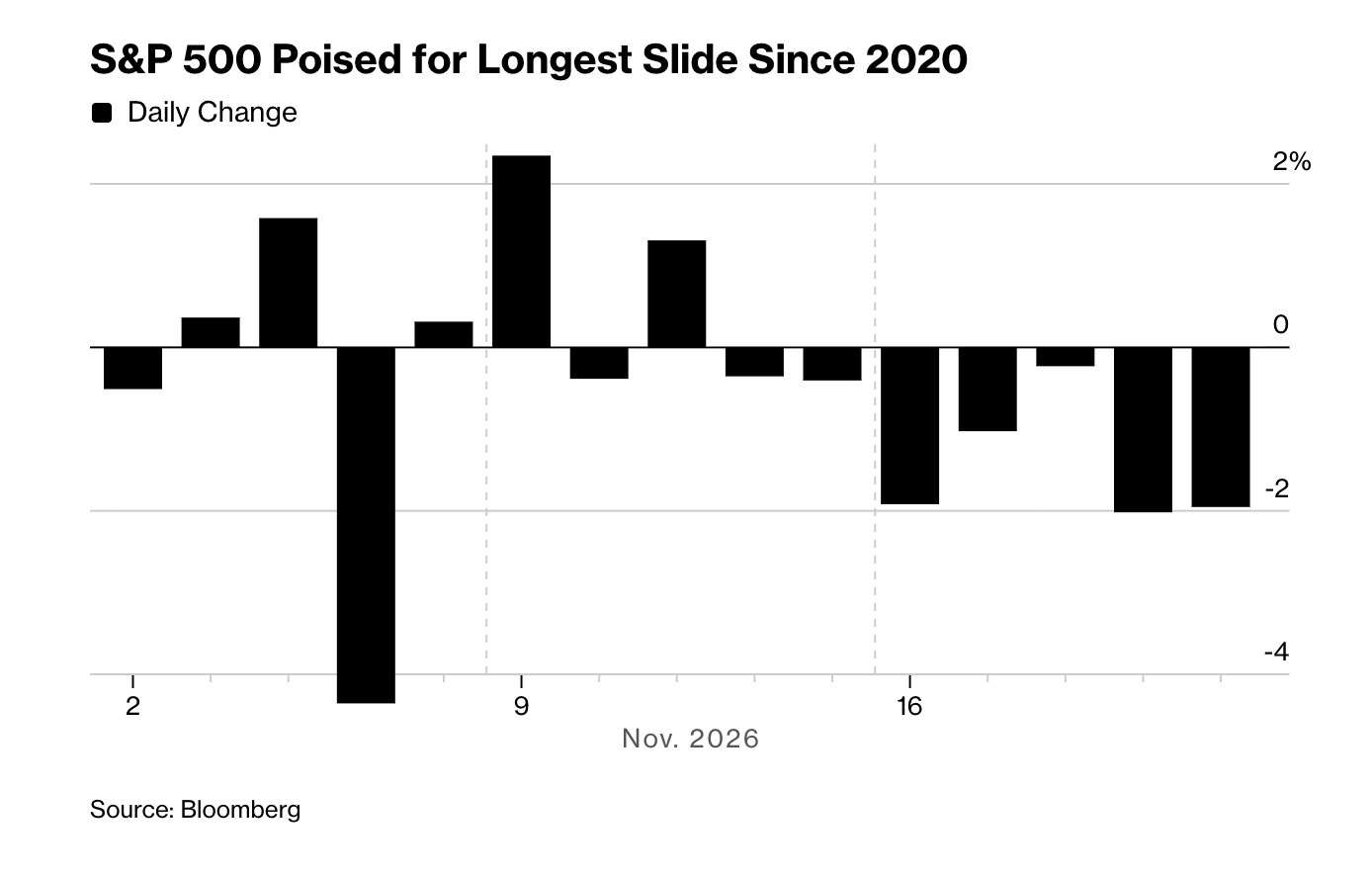
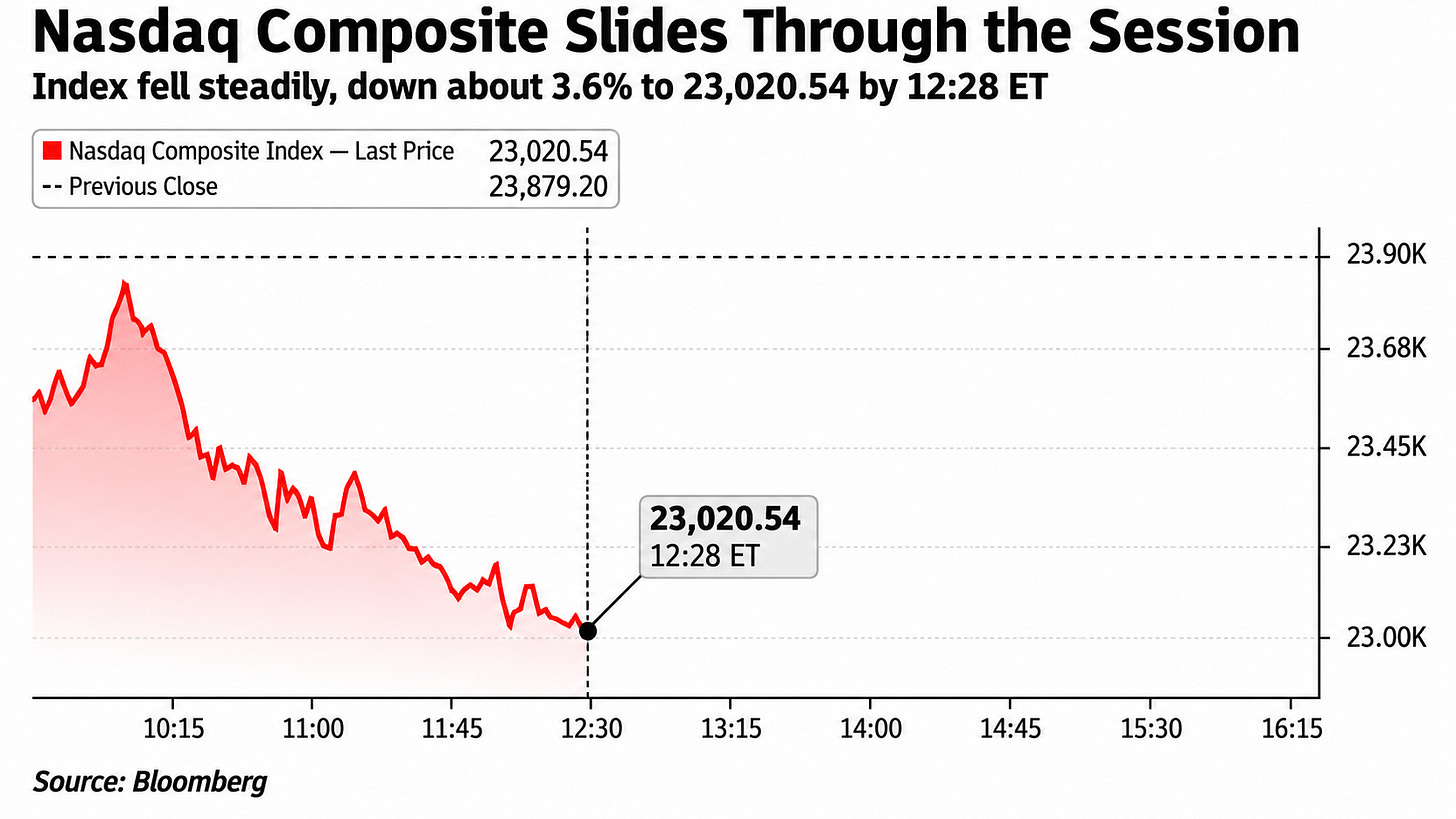
And this is no longer your garden-variety bout of profit-taking, where a few overextended technology names get their wings clipped before the dip-buying cavalry rides to the rescue. The selling has spread across global equities, emerging markets, high-yield credit and precious metals. Investors are piling into Treasuries, the dollar is heading for a fourth consecutive weekly gain, and the market’s favourite hiding places are becoming increasingly difficult to distinguish from its liquidation baskets.
The irony is that Wall Street entered the week hoping two major events would clear the decks. Nvidia (NVDA)’s earnings were supposed to reassure investors that the AI spending machine remained in excellent working order, while Anthropic’s (ANT) historic IPO was expected to demonstrate that capital markets still possessed an insatiable appetite for the next generation of artificial-intelligence champions.
Instead, the market bought the anticipation and sold the celebration.
Anthropic’s shares plunged 11% on their second day of trading, leaving investors who had barely finished congratulating themselves on securing an allocation wondering whether they had purchased the future or simply financed somebody else’s exit. The enthusiasm surrounding the offering had been extraordinary, with companies throughout the AI supply chain reacting to every twist in its pricing and size. Yet once the transaction was completed, the broader technology market found itself staring at the same uncomfortable questions it had been trying to ignore.
How much longer can this extraordinary AI investment cycle sustain itself? Who ultimately earns an adequate return on the enormous capital being deployed? And what happens when the cost of financing the revolution rises at precisely the moment investors begin demanding evidence of profitability?
The technology may be revolutionary, but the financing still has to obey the laws of gravity.
The AI Champagne Has Gone Flat
The problem with speculative markets is that they rarely ring a bell at the top. They simply reach a point where genuinely good news stops producing good price action, and investors gradually discover that the marginal buyer has either exhausted his ammunition or decided the next opportunity might come at a considerably cheaper price.
That appears to be the uncomfortable territory the AI complex is entering.
Anthropic’s spectacular debut was meant to be a risk-clearing event, a financial exclamation mark confirming that the AI boom still had plenty of fuel in the tank. Instead, its second-day decline has become an emblem of the market’s changing psychology. The IPO attracted enormous demand, but that enthusiasm failed to spread into the broader technology complex, where concerns about valuations, capital expenditure and the durability of the AI investment cycle are now drowning out the familiar promises of exponential growth.
The Nasdaq 100 briefly lost more than $1 trillion in combined market value during Friday’s session, with Nvidia, Broadcom (AVGO) and SpaceX (SPCX) each surrendering more than $100 billion. Those are not the sort of numbers that disappear quietly into the market’s daily statistical noise. They represent substantial destruction of equity value in companies that have become central pillars of the technology investment narrative.
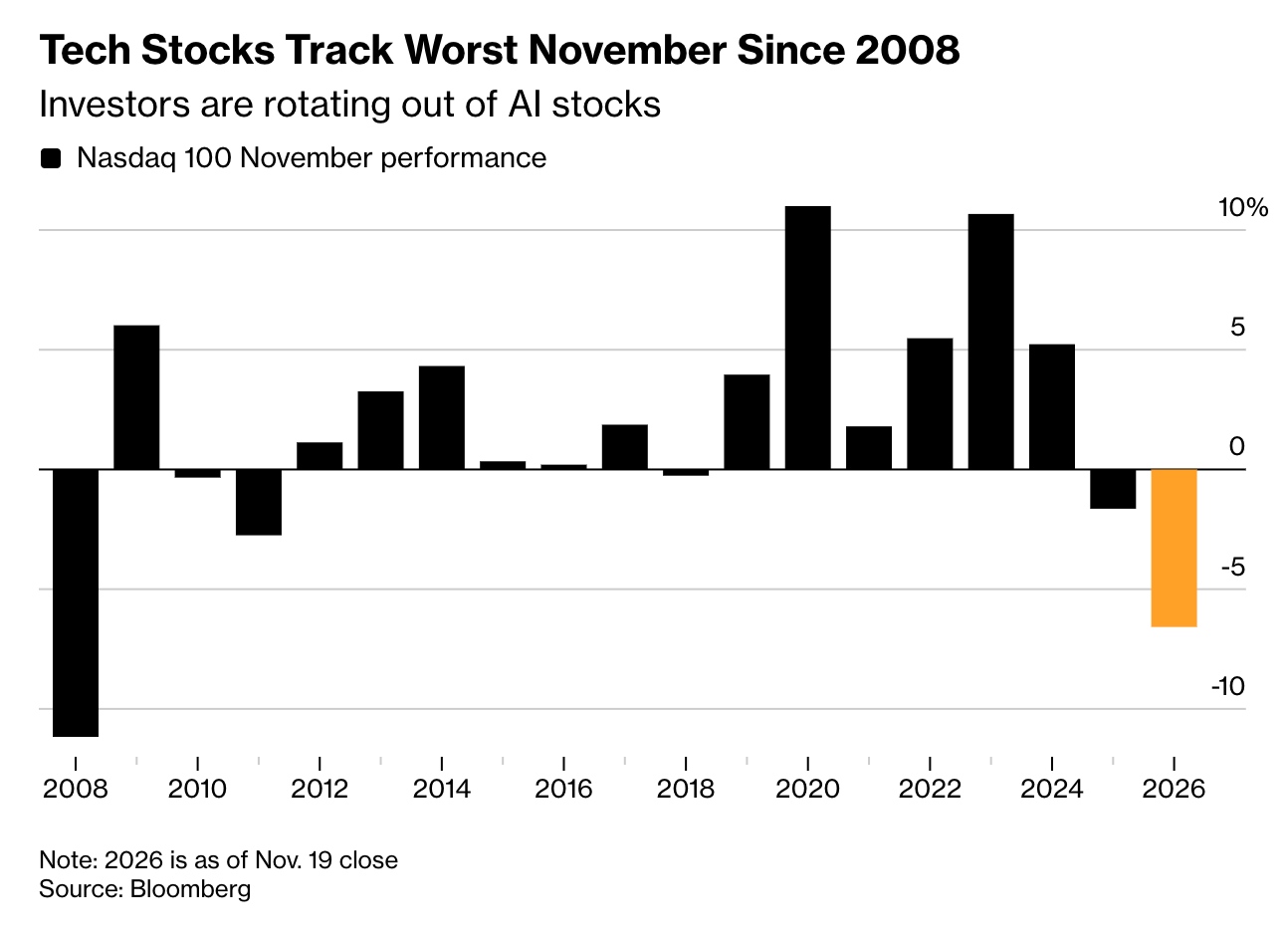
And yet, even in this sea of red, interesting currents run beneath the surface. Alphabet (GOOGL) managed to buck the selling pressure, advancing nearly 2% after suffering a sharp decline the previous session. That divergence suggests investors have not abandoned every technology business indiscriminately, even if the broader market is increasingly questioning the valuations attached to the AI buildout.
There is also a fundamental distinction between enthusiasm for artificial intelligence and confidence in the financial structures supporting its development. The enormous investment required to build data centres, develop advanced models and secure semiconductor capacity depends on access to capital at a tolerable price. The prospect of tighter regulation and higher interest rates complicates that calculation considerably.
Wall Street may still believe in the AI revolution, but belief alone doesn’t service the debt.
When Credit Markets Start Smelling Smoke
Equity markets are wonderful at generating excitement, but credit markets have an unfortunate habit of asking who is going to pay the bill.
And right now, the bond market is beginning to ask some rather pointed questions.
The widening of CCC-rated credit spreads to a reported record 1,135 basis points is one of the more troubling developments beneath the headline equity selloff. These are the weakest borrowers in the corporate credit universe, companies whose financial survival can depend heavily on continued access to refinancing and a reasonably forgiving economic environment.
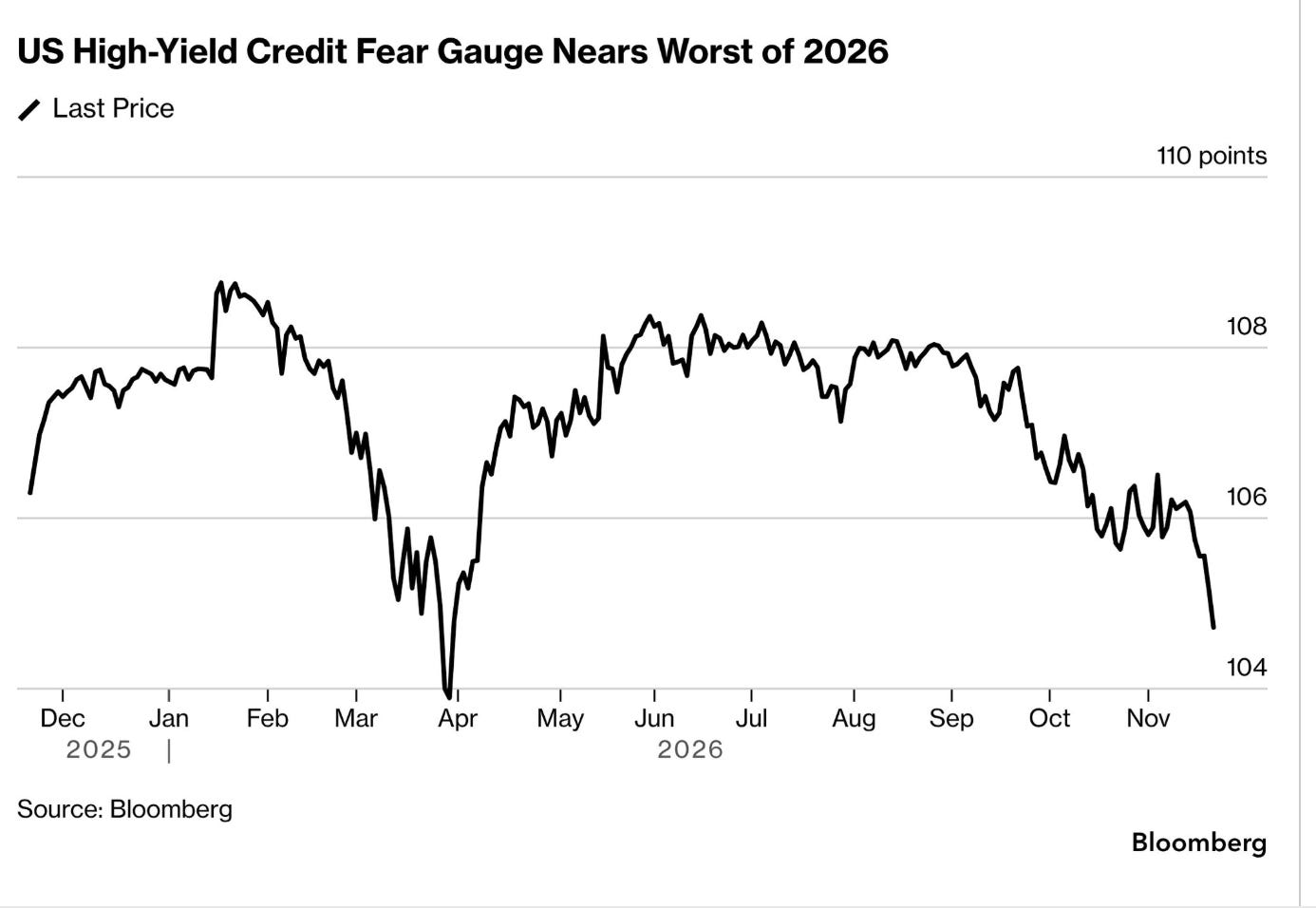
When spreads widen this aggressively, the message is not simply that investors have become nervous about stock valuations. It is that lenders are demanding substantially more compensation for the possibility that some borrowers may struggle to meet their obligations.
That distinction matters enormously.
US high-yield bonds have already suffered seven consecutive sessions of losses through Thursday, with broader credit stress approaching its most uncomfortable levels since late March. The most vulnerable borrowers are now facing the prospect of tighter financing conditions just as investors are becoming less willing to absorb risk.
The equity market may be debating whether AI valuations are too high, but the credit market is beginning to question whether the financing architecture supporting parts of the boom is sufficiently robust to withstand higher rates and declining risk appetite.
And that is where a technology correction threatens to become something considerably more consequential.
When the stock market catches a cold, leveraged credit can develop pneumonia.
Gold Gets Thrown Overboard With the Furniture
Perhaps the most revealing feature of this selloff is that even gold has failed to provide its customary sanctuary.
Bullion tumbled toward $3,500 an ounce on Friday, leaving it on course for a weekly decline of approximately 8%, while silver has shed nearly 15% over five sessions. Gold’s decline to its lowest level since September 2025 is particularly striking given the simultaneous deterioration in equity markets and the resurgence of demand for defensive assets.
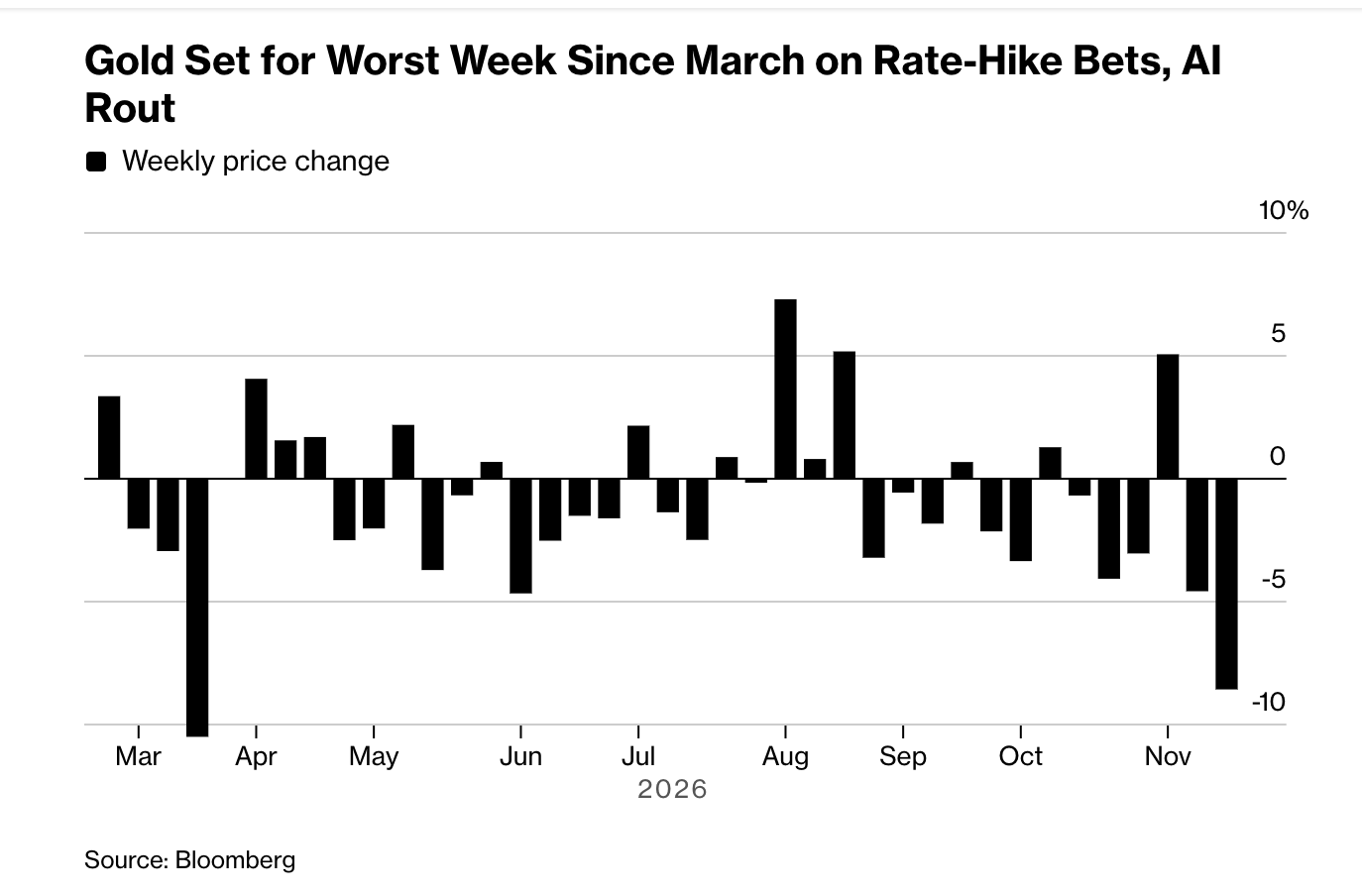
Under normal circumstances, one might expect a significant correction in technology shares, widening credit spreads and rising geopolitical anxiety to provide considerable support for precious metals.
But markets do not always behave according to the comfortable relationships printed in investment textbooks.
Gold is also sensitive to the direction of US real interest rates, and the prospect of a more hawkish Fed raises the opportunity cost of holding an asset that pays no income. More importantly, when investors are forced to reduce leverage or replenish liquidity, assets that can be sold quickly often become sources of cash regardless of their longer-term investment merits.
The contrast with Treasuries is telling. Government bonds are attracting defensive demand while precious metals are being liquidated alongside equities and other risk assets.
That suggests this is not simply a conventional flight to safety. There is also an element of portfolio liquidation running through the market, where investors are selling what they can rather than necessarily what they want.
Bitcoin (BTC.X) slipping below $60,000 for the first time since July adds another piece to the puzzle, while emerging-market equities have extended their decline from record levels to 20%. The global retreat from risk is broadening, and the distinction between an orderly portfolio adjustment and a more disruptive deleveraging episode is becoming increasingly important.
When investors start selling the family silver to pay the margin clerk, you know the market has moved beyond an ordinary disagreement over valuations.
The 2018 Ghost Has Returned, but the Fed Put Is Missing
There is a distinctly uncomfortable echo of 2018 in the current market behaviour, and it is worth revisiting because the similarities extend well beyond a few red numbers on an equity screen.
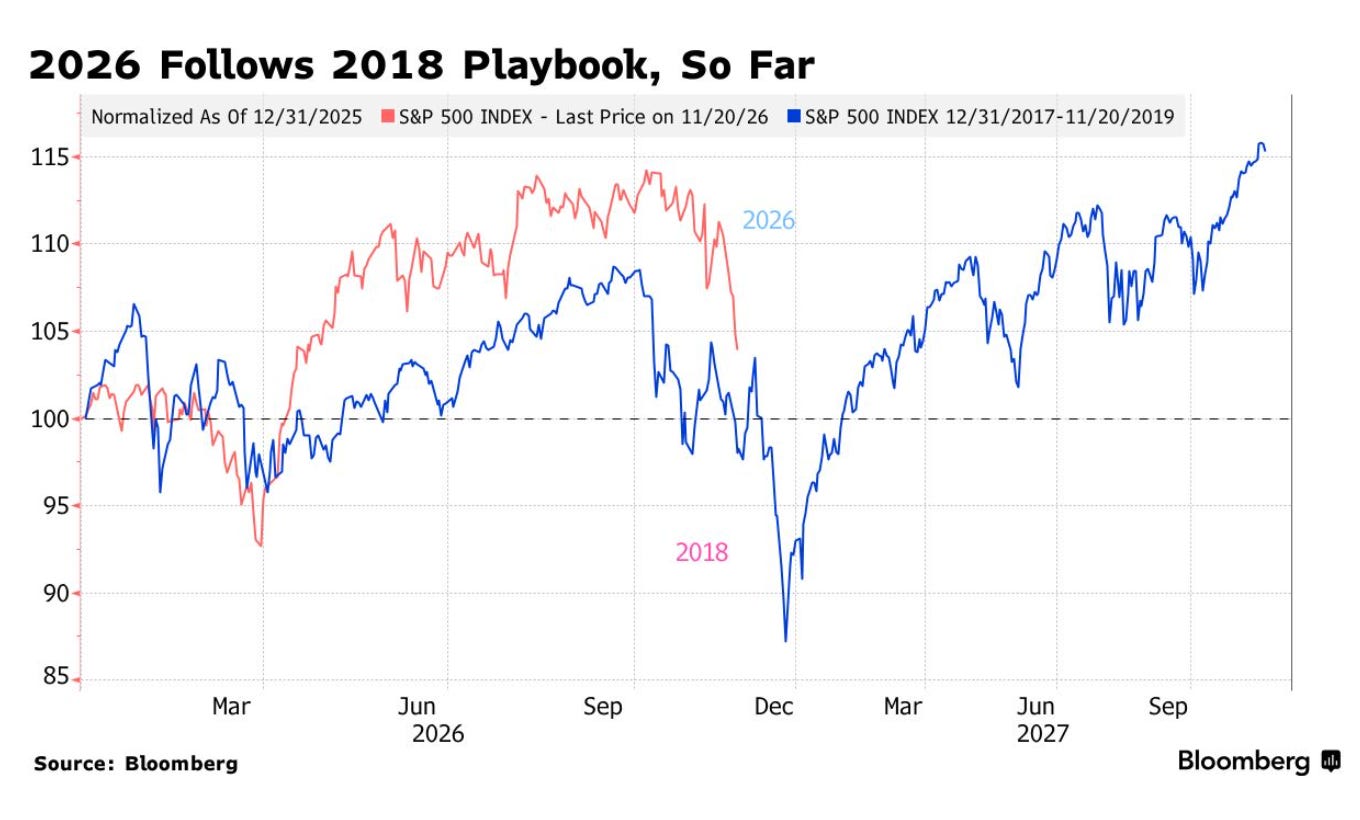
Back then, a relatively new Fed chair, Jerome Powell, found himself navigating the late stages of a monetary tightening cycle while financial markets wrestled with the consequences of higher interest rates. Stocks initially held up before buckling under the combined weight of tighter policy, political uncertainty and deteriorating risk appetite.
Powell’s suggestion that rates remained a considerable distance from neutral rattled investors, and the S&P 500 subsequently suffered a brutal December, falling approximately 9% during the month. Cyclical sectors, including financials, energy and materials, absorbed particularly heavy punishment.
Eventually, the pressure became sufficiently intense that prominent investors began openly questioning the wisdom of continued tightening through both higher rates and balance-sheet reduction. The Fed ultimately changed course, helping establish the conditions for a market recovery in 2019.
That historical comparison is understandably attractive to investors searching for evidence that another policy rescue might be waiting around the corner.
But there is one rather inconvenient difference.
Inflation.
Core PCE inflation was running around 2% in late 2018. Today, it is above 3%, leaving the Fed with considerably less flexibility to respond to falling asset prices without risking renewed inflation pressure.
That changes the entire policy equation.
In 2018, the Fed eventually had room to retreat. In the current environment, policymakers face the uncomfortable prospect of watching financial conditions tighten while inflation remains too elevated to justify an easy monetary-policy escape route.
The possibility of further rate increases only compounds the difficulty, particularly for growth companies whose valuations depend on earnings expected well into the future and for weaker borrowers already struggling with financing costs.
This is why the old Wall Street assumption that the Fed will eventually come riding over the hill with a monetary cavalry charge may prove considerably less reliable this time around.
The famous Fed put still exists as a market concept, but with inflation above target, its strike price may be a long way below where investors would prefer to exercise it.
The 7,000 Line in the Sand
For all the macroeconomic arguments, positioning concerns and policy uncertainties, equity traders are now confronting a much simpler question: where does the selling stop?
The S&P 500 has broken below its 200-day moving average (for the third straight session), adding a technical dimension to an already uncomfortable fundamental backdrop. This widely followed trend indicator often serves as a dividing line between routine corrections within established advances and more persistent deteriorations in market momentum.
Nothing good happens when a market breaks below the 200-day!
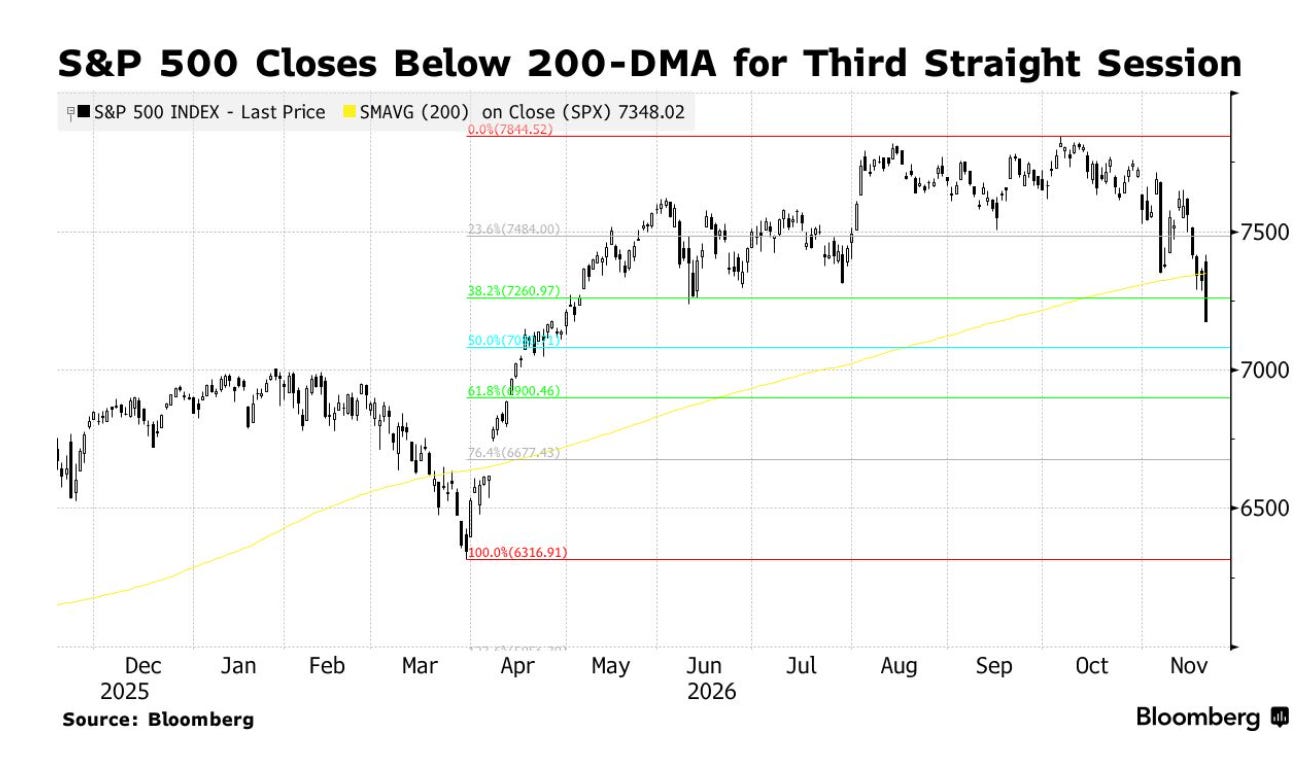
Attention is shifting toward the 7,000 region, where key technical support could determine whether the market establishes a more durable base or extends its decline into year-end.
The problem is that technical support levels are rarely defended by good intentions alone. They require genuine buying interest, sufficient liquidity and a willingness among investors to absorb additional risk.
At present, those ingredients appear to be in short supply.
A more aggressive capitulatory selloff could eventually help reset positioning and sentiment, creating the conditions for a healthier recovery. Markets have a long history of exhausting sellers before finding their footing, and there is nothing particularly unusual about corrections becoming more violent near their final stages.
But capitulation is a process, not a date on the calendar, and calling the bottom while credit spreads are widening and the Fed remains hawkish can be an expensive exercise in wishful thinking.
Geopolitical uncertainty adds another complication. Without a meaningful improvement in the Iran situation, elevated inflation and tighter financial conditions remain significant obstacles to any sustained recovery in risk appetite.
The coming sessions will therefore test more than the S&P 500’s ability to defend a particular technical level. They will test whether investors have reduced enough leverage, whether the AI complex can stabilize and whether the credit market can absorb the tightening in financial conditions without transmitting more serious stress into the broader economy.
A Market Running Out of Lifeboats
The most important development this week may not be that the S&P 500 has entered correction territory. Markets have survived plenty of 10% declines, and some of the most profitable advances in history have emerged from precisely these moments of discomfort.
What matters is the increasingly synchronized selling.
Technology shares are being repriced, emerging-market equities are falling into bear-market territory, speculative credit is under pressure, and gold is being liquidated despite the growing demand for safety elsewhere.
Meanwhile, the dollar continues to attract defensive flows, Treasuries are finding buyers, and investors are being forced to reconsider whether the monetary-policy environment that supported years of aggressive risk-taking is still reliable.
There is a meaningful difference between a market correcting excessive enthusiasm and a market beginning to discover that the liquidity supporting that enthusiasm was never quite as deep as everyone assumed.
The first is a valuation adjustment. The second can become a funding problem.
And with inflation still limiting the Fed’s freedom to intervene, the distinction could prove crucial.
For now, Wall Street finds itself staring at the proverbial sea of red, hoping the selling eventually burns itself out before the financial plumbing starts springing leaks.
The AI party may have supplied the champagne, but the Fed is controlling the bar tab, and the credit market is beginning to wonder who is going to settle the bill.



Comments
Log in or sign up to join the conversation.