


Takeaways by The Dark Side of the Boom
• Wall Street’s extraordinary relief rally has developed a nasty hangover, with investors discovering that yesterday’s spectacular rescue act did little to settle the questions haunting the AI trade.
• Beneath another bruising session for technology, the widening divide between equities, credit and Treasuries is revealing where investors are still willing to take risk and where they would rather keep their powder dry.
• The dollar’s retreat offered little comfort to gold, copper or cryptocurrencies, suggesting that the liquidation has become about something considerably more uncomfortable than the usual currency and interest-rate relationships.
• With inflation data looming and the Fed still talking tough, the market is beginning to confront the limits of political intervention in an economy increasingly dependent on asset prices and credit.
The Champagne Went Flat Before the Ice Melted
Well, that didn’t take long. The champagne from Monday’s Nvidia (NVDA) resurrection had barely lost its fizz before Wall Street was back reaching for the sick bags. What looked like the mother of all relief rallies has already acquired the rather less flattering characteristics of a dead-cat bounce, with the Nasdaq taking another beating, Nvidia surrendering a sizeable chunk of its extraordinary gains, and professional investors apparently using the opening provided by the Jensen Huang comeback to unload technology exposure rather than rebuild it.
And that, unfortunately, is what happens when a market rallies on the back of forced buying rather than genuine conviction. Monday’s fireworks were spectacular, with the Nasdaq surging nearly 7% as shorts scrambled for cover, options hedges were dismantled, and systematic strategies were dragged kicking and screaming back into the market. But once the initial buying frenzy had run its course, there was precious little evidence of another wave of institutional demand waiting to pick up the baton. The shorts had been carried out on stretchers, but the real-money crowd wasn’t exactly fighting to get through the door.
By Tuesday, the Nasdaq 100 was down as much as 3% intraday, Nvidia had fallen sharply, and the Philadelphia Semiconductor Index was tumbling another 7.6%, leaving the chipmaking complex approximately 40% below its June peak. Anthropic slipped beneath its $83 IPO price, while AI infrastructure names such as CoreWeave (CRWV), Marvell (MRVL) and SanDisk (SNDK) were being given another thorough going-over. Hewlett Packard Enterprise (HPE)’s weaker margin outlook for its cloud and AI business reinforced suspicion that the industry’s enormous spending commitments may be outpacing its ability to generate sufficiently attractive returns.
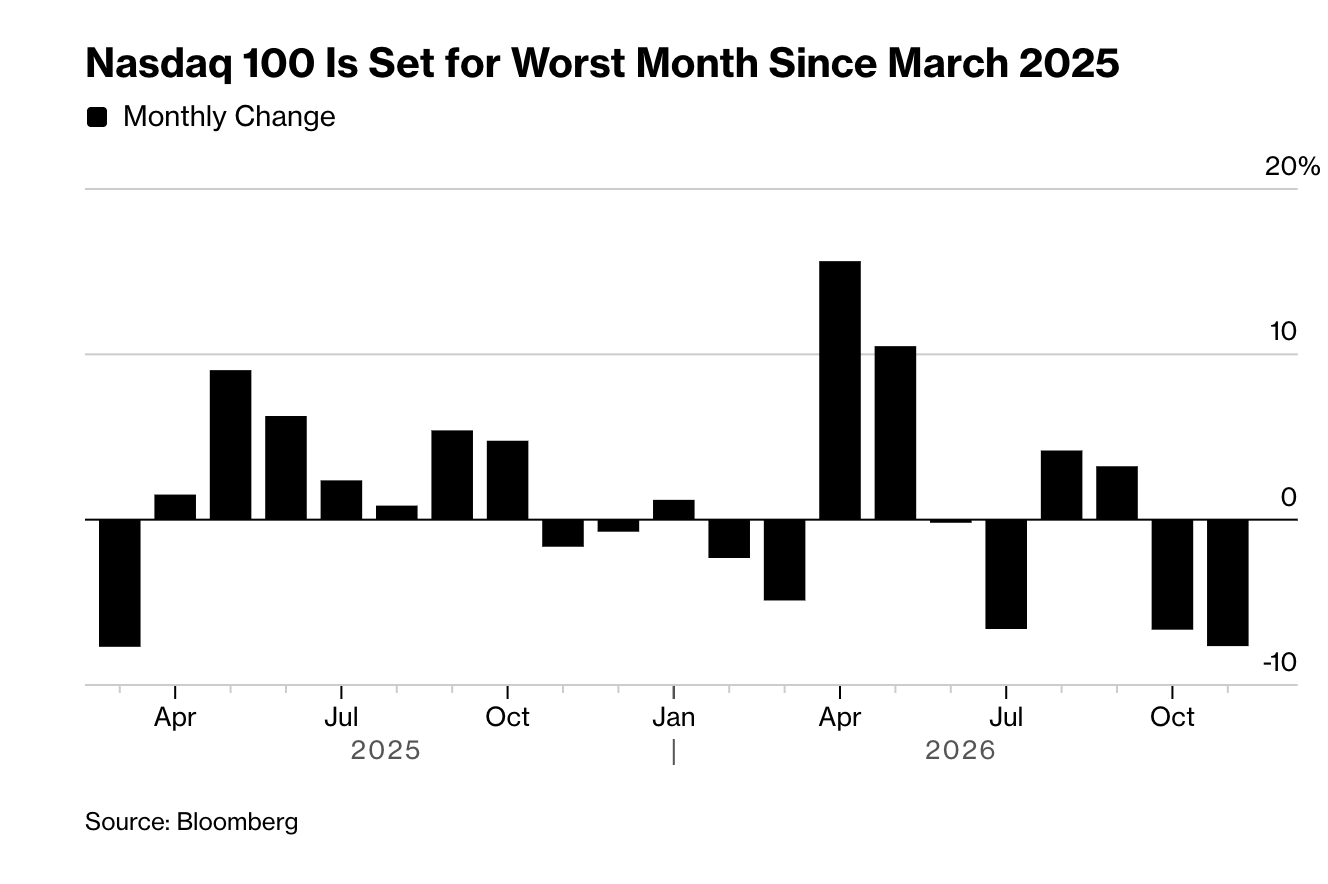
The broader market was considerably less miserable. The Dow and Russell 2000 stayed in positive territory, while defensive sectors attracted buying and equal-weighted equities outperformed the technology-heavy benchmarks. That distinction matters. This wasn’t simply investors throwing every stock overboard; it was a more selective retreat from the companies and investment themes that have carried so much of the market’s enthusiasm.
The problem for the AI bulls is that none of the awkward questions disappeared when Huang returned to Nvidia’s corner office. The financing arrangements remain complicated, the economics of massive data-centre investment remain under scrutiny, and the debate over how quickly AI revenues can justify the industry’s capital expenditure continues to grow louder. Add congressional investigations, export controls, permitting restrictions and increasingly uncomfortable questions about corporate governance, and it becomes clear that Monday’s presidential intervention solved one immediate problem while leaving the rest of the bill on the table.
Indeed, once the champagne goes flat at Nvidia HQ, investors may find themselves wrestling with a rather different set of questions. Beyond the feel-good factor of Jensen being back at the helm, the market has yet to properly price in some uncomfortable political and corporate governance implications.
Frankly, neither the US nor, more importantly, China can count on having the old Jensen Huang back behind the AI steering wheel.
There’s also the question of precedent. A White House willing to intervene directly in the leadership of a strategically important company may offer investors the comfort of an implicit political backstop, but it also introduces uncertainty over where government involvement in corporate decision-making begins and ends. Some companies may benefit from those relationships. Others may find that political favour comes with strings attached, particularly as the balance of power in Washington changes.
The Trump put may have saved Monday’s opening bell, but it hasn’t repaired the economics of the AI investment cycle. And judging by Tuesday’s price action, investors are beginning to appreciate the distinction.
Credit Isn’t Buying the Comeback
What concerns me considerably more than another ugly session in semiconductors is the continuing deterioration in credit. Equity markets can produce extraordinary rebounds when positioning becomes stretched, but a meaningful recovery in risk appetite generally needs some cooperation from the financing markets. Monday’s Nasdaq rally was enormous, yet investment-grade credit spreads tightened only modestly, while high-yield credit failed to improve much. By Tuesday, credit conditions were deteriorating again.
That’s not the confirmation I would want to see if the market were genuinely turning a corner.
The entire credit complex looks decidedly ugly, with yesterday’s exuberance evaporating and tech credit bearing the brunt of today’s selling.
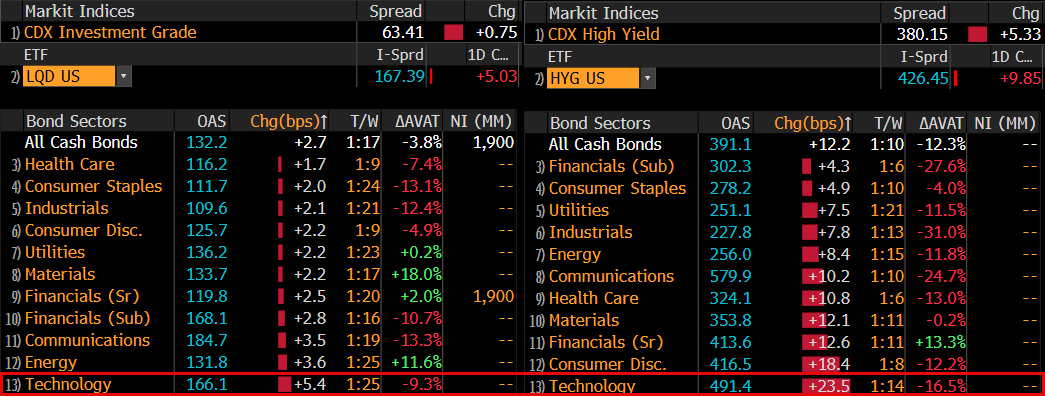
An increasingly asset-heavy US economy depends heavily on access to financing, not merely on rising share prices. AI laboratories, hyperscalers, data-centre developers and their suppliers have made enormous commitments against expectations of future demand. When funding conditions tighten, those commitments become more expensive to maintain, and eventually the pressure travels from balance sheets to construction, equipment orders, employment and the broader economy.
Recessions don’t have to begin with an equity-market collapse. They can begin when the credit market decides it no longer likes the collateral, the borrower or the price of the risk.
That is why the distinction between a Trump put and a Fed pivot matters so much. Political intervention can support confidence and arrest a liquidation, temporarily lifting collateral values and reducing the immediate pressure from margin calls. But it doesn’t create additional dollar liquidity or lower the cost of borrowing across the economy. Only a change in monetary conditions can deliver that more durable relief.
The AI boom is making the US economy more vulnerable to disruption and financial-market volatility, strengthening the case for holding high-quality bonds. Meanwhile, Treasuries have resumed behaving like a defensive asset, rallying as equities and other economically sensitive markets weaken.
The ten-year Treasury yield slipped below 4.90%, more than 25 basis points beneath the previous week’s highs, despite stronger US consumer confidence and another disappointing five-year Treasury auction. That is worth paying attention to. Consumer confidence reached its highest level in almost two years, yet the bond market still found buyers as technology shares unravelled.
In other words, the bond market was more interested in the potential consequences of another equity liquidation than in celebrating the latest improvement in household sentiment.
But the Fed remains a complication. Minutes from the regional Federal Reserve banks revealed that eight of the twelve boards had recommended raising the discount rate ahead of the October meeting, reinforcing expectations for a December policy hike. Inflation remains too high, and the Fed has little reason to declare victory merely because investors have had a particularly unpleasant fortnight.
The bigger question is whether financial conditions and falling energy costs are already doing some of the Fed’s work. If sustained, tighter financial conditions could weigh on growth in 2027, while cheaper gasoline and weaker refining margins should gradually ease inflation pressure. That doesn’t necessarily prevent another December hike, but it does make the case for a long series of additional rate hikes considerably less straightforward.
And while the bond market was finding shelter from the technology storm, the oil market was busy introducing another complication.
Oil Refuses to Follow the Risk-Off Script
Crude rebounded sharply from Monday’s August lows, with WTI climbing back toward $82 a barrel and Brent reclaiming $90, even as much of the equity market was heading in the opposite direction. Holiday-thinned volumes undoubtedly exaggerated the move, but the underlying energy story remains considerably more complicated than a simple demand-led selloff.
Geopolitical tensions around the Strait of Hormuz continue to threaten shipping and energy flows, while reports of further tanker incidents and Iranian pressure on vessels have kept a risk premium embedded in crude. The approaching OPEC+ meeting adds another layer of uncertainty, particularly after Iraq reportedly disputed an assessment of its production capacity that could influence future quota negotiations.
Chinese refiners have also been taking advantage of lower crude and freight costs to replenish inventories, providing a source of physical demand even as investors question the strength of the broader global economy.
But the important distinction lies in the product markets. Diesel and heating oil remain weak, gasoline crack spreads have softened, and crude time spreads have been signalling a market more generously supplied than the geopolitical headlines might suggest. That is not exactly the picture of a global demand boom.
For the Fed, the recent decline in energy prices could eventually become helpful, particularly if lower refined-product costs filter through transportation and other consumer prices. For bond investors, however, Tuesday’s crude rebound was a reminder that the inflation story can become uncomfortable again very quickly, especially when geopolitical risk refuses to stay politely in the background.
Oil is reminding everyone that geopolitical supply risks and weakening underlying demand can coexist, and the bond market has to price both.
The Dollar Falls, but Gold Still Can’t Find a Bid
Perhaps the most revealing part of Tuesday’s session was the behaviour of assets that ordinarily benefit from a weaker US dollar.
After the greenback’s relentless advance during both the AI selloff and Monday’s extraordinary rebound, the dollar finally retreated. The Swiss franc attracted safe-haven demand, while Treasuries were bid as investors sought protection from another round of technology-sector pain.
Yet gold still slipped beneath $3,600, copper and silver were hammered, and bitcoin (BTC.X) fell back through $60,000, behaving less like an alternative monetary asset and more like another leveraged technology position.
That is not how a conventional dollar-driven commodity recovery is supposed to work.
The continuing weakness in gold despite a softer dollar and lower Treasury yields suggests that the liquidation is not yet finished. Investors are still raising cash, reducing leverage and selling positions that can be converted into liquidity, even when the usual macro relationships might suggest those assets should be finding support.
Monday’s temporary recovery in gold alongside equities offered an important clue. When Nvidia’s return lifted collateral values and interrupted the forced selling, gold recovered sharply as well. That was consistent with the argument that bullion had been liquidated to meet margin calls rather than because investors had fundamentally abandoned its longer-term appeal.
But Tuesday’s reversal suggests that arresting the initial panic was not the same thing as resolving the underlying squeeze.
The Trump put lifted asset prices, but it didn’t put more dollars into the financial system. And when everybody still needs year end liquidity, even a weaker dollar doesn’t automatically rescue the gold market.
Copper’s continued weakness carries a similar warning. Unlike gold, copper is directly exposed to industrial demand and capital investment, making its poor performance particularly uncomfortable when the market is already questioning how much AI infrastructure spending can continue supporting growth.
Bitcoin, meanwhile, has once again demonstrated the difficulty of treating an instrument dominated by speculative flows as a reliable refuge during a broad liquidation. When the margin clerk wants dollars, he isn’t especially interested in whether the asset being sold is supposed to represent the future of money.
The Fed Put Is the One That Matters
For all the attention directed toward Jensen Huang, Nvidia and Washington’s intervention, the bigger macroeconomic story is becoming harder to ignore.
The US economy has grown increasingly dependent on rising asset values, abundant financing and the enormous investment commitments associated with AI. That combination can be remarkably powerful while credit is available and investors remain confident about future returns. But it also leaves the system vulnerable when funding conditions tighten and the market begins questioning whether projected cash flows will justify the expenditure.
Monday’s extraordinary short squeeze demonstrated how quickly an overcrowded bearish position can reverse when an unexpected catalyst changes the immediate risk calculation. Tuesday’s selloff demonstrated how little that catalyst necessarily changes once investors return to the underlying fundamentals.
There are still reasons for the bulls to argue that the correction has created opportunities. Corporate earnings have remained strong, economic data have not collapsed, and stretched positioning could provide further support if volatility begins to settle. But the bearish argument is no longer just about excessive valuations or investors becoming temporarily nervous. It increasingly concerns the cost of financing, the sustainability of AI revenues, political uncertainty and the risk that tighter financial conditions eventually undermine the very growth story that justified those valuations.
Wednesday’s core PCE report will therefore be more important than another round of upbeat commentary from the technology industry. If inflation remains stubbornly elevated, the Fed may have little choice but to maintain its hawkish posture despite mounting evidence of stress in financial markets. If disinflation begins gathering pace while financial conditions continue tightening, the case for an eventual change in policy becomes stronger.
And that is where I think the next meaningful opportunity will emerge.
An increasingly asset-heavy and credit-sensitive US economy may eventually force the Fed to reconsider how much additional tightening the system can absorb. A genuine monetary-policy turn, accompanied by improving dollar liquidity and credit conditions, would provide a far more convincing foundation for renewed interest in gold, commodities and cyclical assets than a presidential intervention designed to halt an equity-market panic.
But we are not there yet.
The Trump put temporarily relieved the pressure on leveraged equity books by pushing asset prices higher and interrupting the margin-call cycle. But it didn't repair the credit market, ease funding conditions or inject a single dollar of liquidity. That's where the Fed comes in. Washington can rescue the equity tape, but only monetary policy can deliver broader relief to the cost and availability of money. Until then, the short trade remains very much alive.
Monday’s champagne went flat almost as quickly as it was poured. The shorts may have been blown out, but the credit market never joined the celebration, the dollar squeeze has left its scars, and the AI investment machine still has an enormous financing bill to pay.
Until there is genuine relief in funding conditions rather than another spectacular equity-market rescue act, I suspect Wall Street will continue discovering that gravity is a rather stubborn opponent.
And after Tuesday’s performance, the dead cat appears to have landed with quite a thud.
Huang’s return certainly removes a significant near-term uncertainty for Nvidia. His influence across the AI ecosystem is extraordinary, and restoring him to the corner office should help stabilize relationships with customers, suppliers and investors. But the underlying concerns over circular financing, the enormous capital commitments embedded in the AI buildout, and the ability of frontier laboratories and neocloud operators to generate adequate returns haven’t magically disappeared.
Neither have the political complications. Congressional investigations, export-control restrictions, concerns over data-centre development and Nvidia’s governance issues remain very much alive. In fact, Washington’s unusually direct intervention may have added another layer of scrutiny rather than removing one.
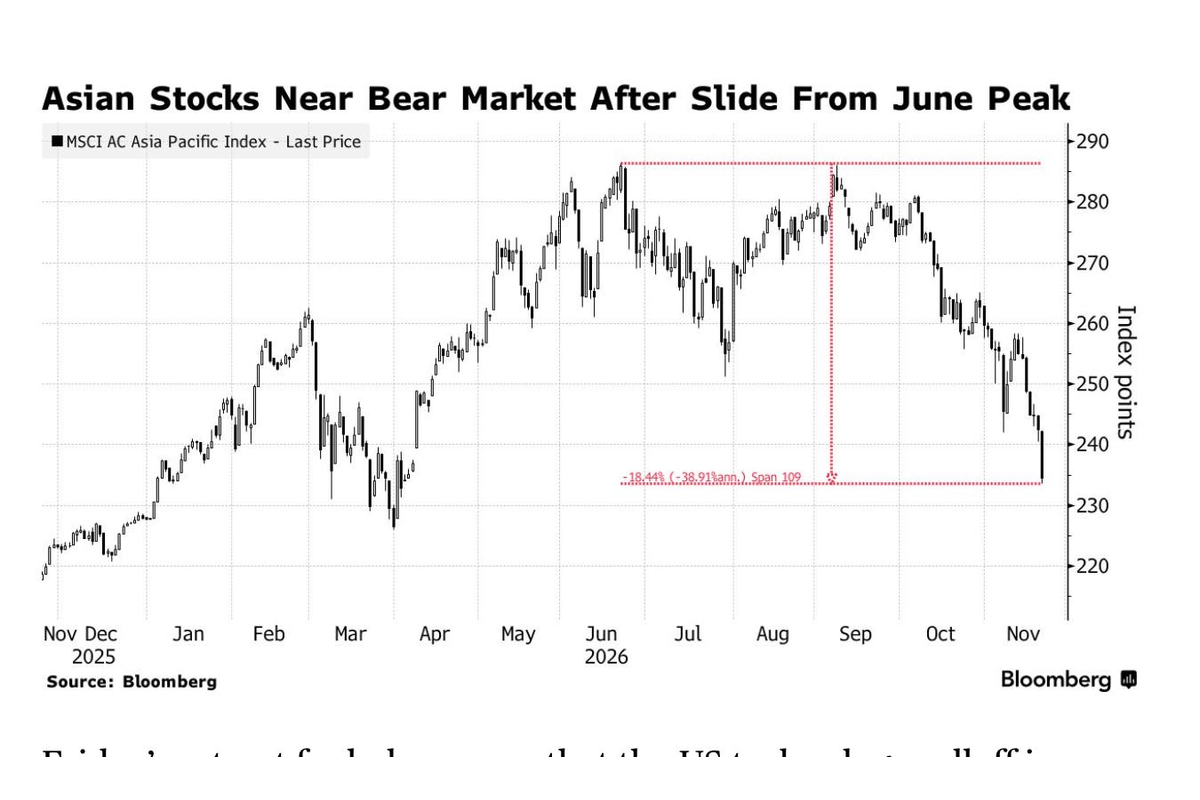
There is also something deeply uncomfortable about an equity market whose immediate fortunes appear so dependent on the employment status of a single executive. That’s not necessarily a reflection of a healthy, diversified investment cycle. It may be a warning about how narrowly concentrated the entire AI trade has become. Asia Wrap: The King Is Back, but the AI Kimono Has Already Been Opened


Comments
Log in or sign up to join the conversation.