

Takeaways by The Dark Side of the Boom
• Wall Street has witnessed one of the most extraordinary corporate U-turns in recent memory, and the return of Nvidia's (NVDA) larger-than-life founder has delivered a rally that even the most battle-hardened trading desks will remember.
• Beneath the spectacular headlines, a violent unwinding of short positions and options hedges has exposed just how fragile market liquidity has become, raising questions about the staying power of the rebound.
• The bond market, dollar and commodities are telling a rather more complicated story than the jubilant equity screens suggest, with some familiar relationships being turned on their heads.
• Washington may have helped put the AI locomotive back on the tracks, but the political, regulatory and financial obstacles ahead haven’t disappeared simply because its most famous conductor has returned.
The King Is Back, and Wall Street Throws the Biggest Party Since Liberation Day
Well, you couldn’t make this stuff up. Just when Wall Street had spent the better part of a fortnight writing Nvidia’s obituary, questioning the future of the AI revolution and wondering whether the entire technology complex was about to disappear down a financial rabbit hole, Jensen Huang walked back through the front door of Nvidia headquarters and the market promptly went absolutely bananas. In one of the most extraordinary corporate reversals in recent memory, Nvidia’s board reinstated its former chief executive following direct intervention from President Trump, with Vice President Vance reportedly enlisted to help push the process along. Whatever one makes of the governance implications, the market’s verdict was delivered with all the subtlety of a wrecking ball.
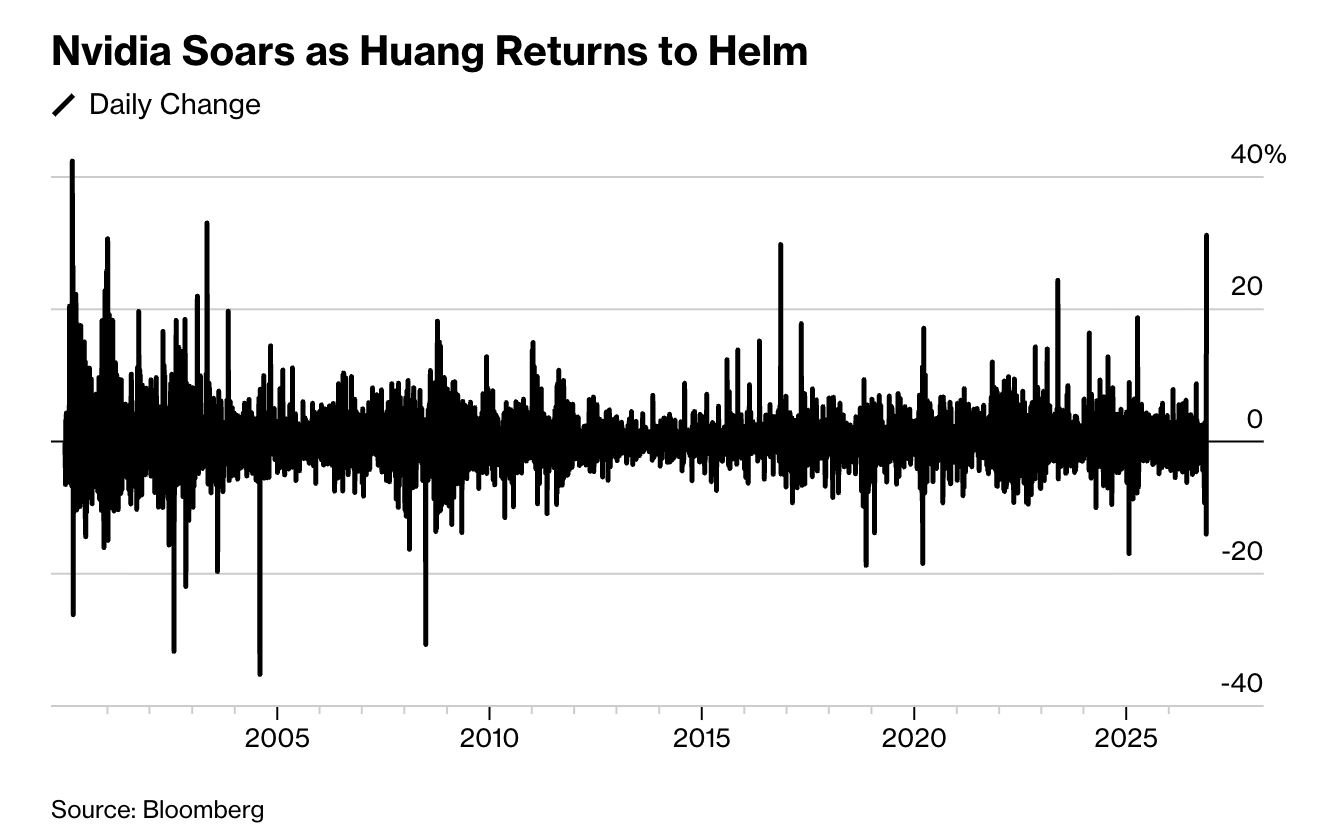
Nvidia surged 31%, adding a staggering $952 billion in market value in a single session, while the Nasdaq 100 rocketed 6.9%, the S&P 500 jumped 4.7%, and the semiconductor index exploded 14%. It was Wall Street’s biggest celebration since Trump paused his Liberation Day tariffs in April 2025, and for anyone unfortunate enough to have been leaning heavily short into Monday’s opening bell, it must have felt like being run over by the AI express train just as they thought it had finally derailed.
The irony is delicious. Only days earlier, the market had been treating Nvidia like a corporate crime scene, with the company’s leadership crisis, regulatory investigations and mounting political controversy threatening to pull the rug from beneath the entire AI investment complex. Now the same stock was being chased higher with almost religious enthusiasm, as though the return of one man had magically restored the industry’s earnings forecasts, repaired its financing problems and settled every uncomfortable question about the enormous capital expenditure required to keep the AI machine humming.
Huang’s importance to Nvidia is unquestionably extraordinary. He is not merely the company’s chief executive but its principal dealmaker, industry evangelist and strategic architect, with an influence that stretches from semiconductor design to data-centre investment and the complicated relationships linking AI laboratories, hyperscalers and their suppliers. His reinstatement restores a familiar hand to the wheel, and that has genuine value for investors trying to assess the company’s strategic direction.
But there is a rather uncomfortable distinction between restoring confidence in Nvidia’s leadership and repairing the financial foundations of the entire AI boom.
Wall Street may have got its king back, but the kingdom still has a few unpaid bills.
And judging by the extraordinary violence of Monday’s price action, much of the rally had less to do with investors suddenly discovering a new earnings outlook than with traders being caught spectacularly on the wrong side of an overcrowded book.
The Mother of All Short Squeezes Meets a Market With No Liquidity
The opening explosion in Nvidia was accompanied by a wholesale demolition of bearish positioning, with leveraged short products suffering devastating losses and options traders scrambling to unwind hedges built during the previous week’s panic. The initial burst of call buying, dealer hedging and short covering produced the kind of price action that makes the trading desk feel like a casino where somebody has suddenly turned the lights back on and announced that every losing ticket is now a winner.
But the most revealing detail wasn’t how far the market jumped. It was what happened after the opening fireworks.
Nvidia held much of its extraordinary advance, yet the buying failed to accelerate meaningfully beyond the initial surge. The Nasdaq recovered sharply, but was still only returning to levels last seen around the previous Tuesday’s lows, while the major indices remained below their 200-day moving averages. For all the champagne being sprayed around Wall Street, the broader technical damage hadn’t disappeared.
And then there was liquidity, or rather the astonishing lack of it.
Top-of-book liquidity in the S&P 500 futures market was reportedly around $2.5 million, the sort of depth that would have raised eyebrows on a quiet summer afternoon, never mind during one of the largest technology rallies in years. Hedge funds were doing much of the heavy lifting, aggressively buying technology shares and ETFs, while traditional long-only investors were modest net sellers on substantially smaller volumes. Retail favourites and previously crowded winners enjoyed explosive rebounds, but the underlying flow suggested a market being driven by positioning rather than a broad institutional stampede back into equities.
There is a world of difference between a market rising because everybody wants to own it and one rising because nobody can afford to remain short.
The options market offered another clue. The VIX retreated sharply as protective positions were unwound, yet at approximately 28.9 it remained unusually elevated for a session in which the S&P 500 had surged close to 5%. More troubling was the VVIX, the volatility of volatility itself, which remained above 118 and in the 93rd percentile of its historical distribution. In plain dealing-room English, investors had stopped paying quite so much for immediate protection, but they were still paying a handsome premium for insurance against the next nasty surprise.
The extraordinary dislocation across momentum strategies reinforced the picture. Longer-term momentum dramatically outperformed shorter-term signals, with the spread between twelve-month and three- or six-month momentum reaching record territory. Correlations between these strategies were breaking down, creating precisely the sort of violent crosscurrents that can turn sophisticated quantitative portfolios into very expensive washing machines.
This wasn’t the orderly return of confidence. It was a market violently repricing the probability of disaster after discovering that one of its largest assumptions had changed overnight.
And while the shorts were being carried out on stretchers, another supposed beneficiary of the AI renaissance was conspicuously missing from the celebrations.
Anthropic fell 1.4%, despite the introduction of listed options, with the world’s largest IPO still struggling to put meaningful distance between its share price and the $83 offering level. That divergence deserves attention. Nvidia’s leadership uncertainty may have been dramatically reduced, but investors were clearly not prepared to extend the same enthusiasm to every corner of the AI ecosystem.
The financing question hasn’t gone away, and neither has the uncomfortable debate over whether frontier laboratories and neocloud operators can generate the revenues needed to meet their enormous computing commitments.
The Trump Put Arrives, but the Fed Sends the Bill
If equity traders were celebrating the return of the Trump put, the bond market was busy reminding everyone that policy interventions have consequences. Last week’s equity liquidation had driven investors into Treasuries, with two-year yields falling approximately 20 basis points as traders scaled back expectations for aggressive Fed tightening. Monday’s spectacular equity rebound reversed some of that defensive positioning, pushing short-dated yields higher as the market began pricing a greater likelihood of further rate increases.
The initial Treasury selloff was perfectly understandable. With the immediate threat to the AI investment cycle apparently diminished, some of the urgency to seek shelter in government bonds evaporated. But as the session progressed, the picture became considerably more interesting.
Oil prices began collapsing, dragging inflation expectations lower and attracting renewed demand for longer-dated Treasuries. By the close, long-end yields had fallen roughly 3–4 basis points, leaving the curve sharply flatter even as the equity market was enjoying its biggest party in eighteen months.
That is a rather curious combination. The equity market was celebrating the restoration of its favourite growth champion, the short end was acknowledging a potentially more hawkish Fed, and the long bond was finding support as crude oil tumbled and inflation concerns eased.
The dollar, meanwhile, was having none of the equity market’s newfound enthusiasm for risk. The greenback strengthened again, extending a remarkable run of gains across nine of the previous ten sessions and continuing to tighten global financial conditions even as US stocks surged.
This is one of the more important cross-asset signals from Monday’s session. A genuine improvement in global risk appetite would ordinarily provide some relief to higher-beta currencies and reduce demand for defensive dollar liquidity, yet the greenback continued marching higher. That suggests the broader financial squeeze has not simply disappeared because Nvidia has recovered some of its lost market capitalization.
Wall Street may have received a presidential rescue package, but the Fed still controls the price of money, and the dollar is making sure nobody forgets it.
Wednesday’s core PCE inflation report now becomes the next major test. A softer reading could encourage expectations that the Fed’s hawkishness is approaching its peak, potentially giving equities another leg higher. But another uncomfortable inflation print would leave investors confronting the same monetary-policy dilemma that helped fuel the original liquidation.
Oil Takes the Elevator Down While Gold Finds Its Feet
If Monday’s equity rally was all fireworks and champagne, the energy complex looked as though somebody had cancelled Christmas.
WTI crude plunged more than 3% toward $80 a barrel, while Brent slipped below $90 to its lowest level since August as investors unwound geopolitical risk premiums following indications that Washington might allow diplomacy with Iran more time. The reopening of Libya’s Sharara pipeline, restoring approximately 350,000 barrels a day of disrupted supply, added to the downward pressure, while weakness in gasoline, heating oil and refining margins reinforced the increasingly bearish petroleum picture.
Natural gas joined the rout, with US front-month futures tumbling as much as 9.1% intraday before settling roughly 6% lower near $3.50. Warmer weather forecasts across the Midwest and eastern US had traders rapidly dismantling winter-demand expectations. Europe initially moved in the opposite direction, with colder forecasts pushing TTF gas sharply higher before that rally also evaporated by the close.
For the broader market, cheaper energy is potentially useful medicine. Lower fuel costs can relieve pressure on household budgets, reduce corporate expenses and do some of the Fed’s inflation-fighting work without another turn of the monetary-policy screw. But there is always a catch: falling oil prices are considerably less comforting when they reflect weakening demand rather than improving supply.
Gold managed to retain some of its early gains as demand for dollar liquidity eased, although the broader metals complex faded from its initial highs. Bitcoin (BTC.X) offered an even more revealing performance, leaping on the Nvidia headlines before surrendering the entire advance as the dollar strengthened. The supposed alternative to fiat money had briefly remembered its high-beta technology credentials before discovering that a rising dollar was still an uncomfortable opponent.
The message from commodities was considerably less euphoric than the one flashing across equity screens.
The $952 Billion Question: Relief Rally or Something More Durable?
For all the extraordinary gains, Nvidia remains approximately 31% below its October 6 peak, with nearly $1.8 trillion in market value still missing from its record valuation. Monday’s rebound was spectacular, but it did not restore the previous high-water mark, repair every broken technical level or resolve the governance and regulatory questions that triggered the original crisis.
The political complications may yet prove particularly uncomfortable. Huang is scheduled to appear before congressional investigators in early December, with lawmakers from both parties pressing for tougher chip export controls and greater scrutiny of the circumstances surrounding his reinstatement. The intervention that helped restore market confidence has also intensified questions about the relationship between Washington, Nvidia and national-security policy.
For traders, the more immediate roadmap is technical.
The S&P 500’s explosive recovery has already reclaimed the initial 7,200–7,250 area, making that zone the first important test on any pullback. Sustained strength above 7,250, accompanied by improving breadth and declining volatility, would open the possibility of a move toward 7,350–7,400, with 7,450–7,500 a more ambitious extension if the short-covering and options-driven momentum continues through Thanksgiving week.
But a failure to defend 7,200 would quickly take some of the shine off Monday’s spectacular reversal, particularly if volatility begins rising again and semiconductor leadership falters. Below 7,100, attention would shift toward 7,000 and potentially Friday’s panic low near 6,883.
The distinction matters because the circumstances surrounding last Friday’s options expiration created fertile ground for a violent rebound even without a lasting improvement in the underlying fundamentals. Deeply negative dealer gamma, stretched bearish positioning and elevated volatility can produce extraordinary upside moves once selling pressure begins to ease. Monday’s rally was a textbook example of how rapidly those forces can reverse, but a genuine bottom requires the market to demonstrate that fresh buying can absorb supply after the initial short squeeze has run its course.
There is plenty to celebrate in Huang’s return. Nvidia has regained the executive who helped build one of the most consequential businesses in modern technology, and the immediate uncertainty surrounding its leadership has been dramatically reduced. Yet the company remains exposed to investigations, political scrutiny and the broader question of whether the AI investment boom can sustain its enormous financing requirements.
The more troubling issue is what Monday revealed about the market itself. A single corporate decision, apparently accelerated by intervention from the White House, was sufficient to add nearly a trillion dollars to one company’s value and ignite the largest US equity rally since April 2025, even as liquidity remained painfully thin and institutional investors showed relatively little appetite for chasing the opening surge.
Wall Street got Jensen Huang back, the shorts got taken to the woodshed, and the AI circus suddenly discovered its ringmaster was alive and well. But when nearly a trillion dollars can appear on the screen in a single session while the underlying financial plumbing remains this fragile, I’d be careful about confusing a spectacular rescue act with a market that has genuinely found its feet.
The king has returned. Whether the kingdom can afford another coronation is an entirely different question.


Comments
Log in or sign up to join the conversation.