

The market has entered that peculiar phase common to great technological revolutions when skepticism still fills television panels while trillions of dollars quietly rearrange themselves beneath the surface of the economy. America is no longer merely participating in an AI boom; it is reorganizing industrial civilization around it. While there is a rising chorus from Ostriches with their heads in the sand calling for an AI moratorium, little do they realize how much they already use and benefit from AI every day or the risk of allowing adversaries to establish the rules of the road.
Artificial Intelligence has become to the 2020s what railroads were to the 1880s, electricity to the 1920s, and the internet to the late 1990s — except this time the enabling infrastructure stretches far beyond Silicon Valley. The new AI aristocracy includes not only semiconductor titans like NVDA, MU, ARM and AVGO, but also the industrial republic supporting them: VRT cooling the machines, CAT moving earth and powering sites, NUE supplying steel, GLW manufacturing specialized fiber and glass, ETN managing electricity, GEV rebuilding the grid, and companies such as VST, BE and CEG racing to feed the appetite for power.
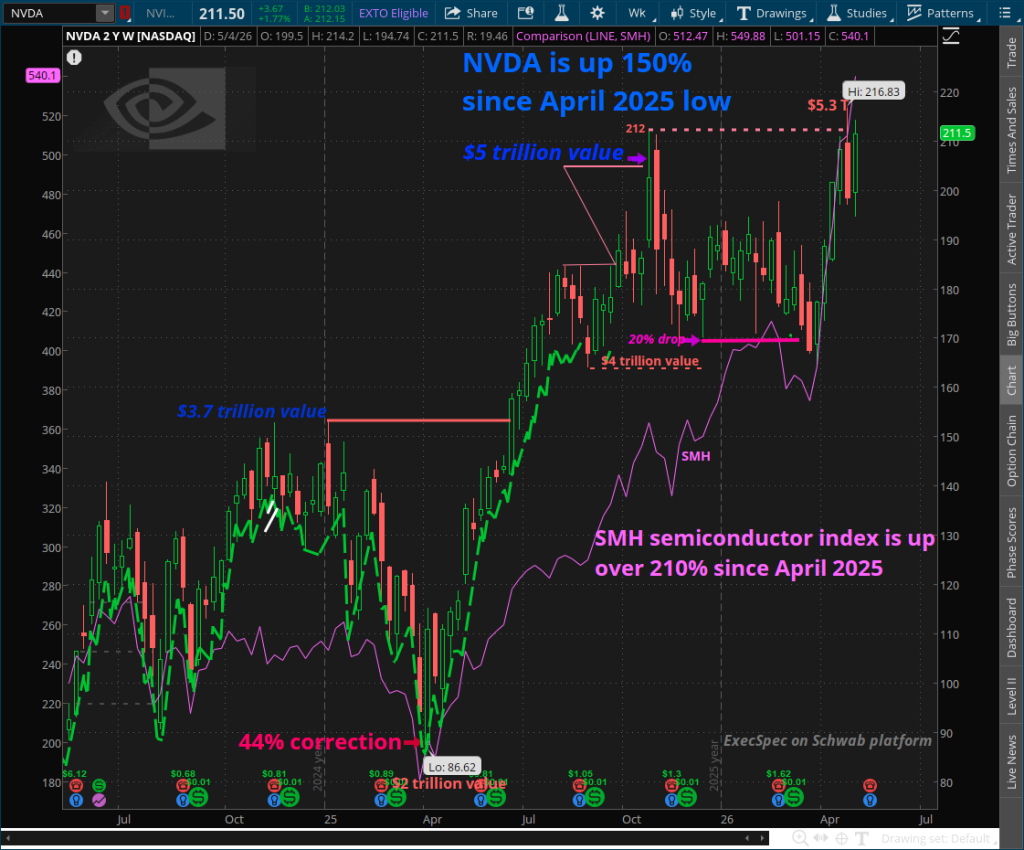
The modern AI factory is not merely software. It is concrete, copper, turbines, transformers, memory chips, cooling towers, fiber optics, natural gas, nuclear power and vast oceans of capital expenditure. America’s hyperscalers are now spending sums once associated only with wartime mobilization. Combined AI infrastructure expenditures are moving toward levels that account for several percentage points of U.S. GDP annually, while AI-linked earnings growth increasingly dominates total S&P 500 profit expansion.
Indeed, the concentration is becoming historically extraordinary. A disproportionate share of recent U.S. market capitalization gains, corporate earnings acceleration, and even nominal GDP momentum can now be traced directly or indirectly to AI infrastructure and deployment. Direct and indirect creators of the AI infrastructure are estimated to comprise 40 to 60% of the Nasdaq Composite and S&P 500 Index. Remove AI-related contributors and much of the remaining market resembles a passenger train watching a bullet train disappear over the horizon. Since the March nadir, the technology index (XLK) and semiconductor index (SMH) were up 35 and 50% while the healthcare index (XLV) caught a cold – with no gain.
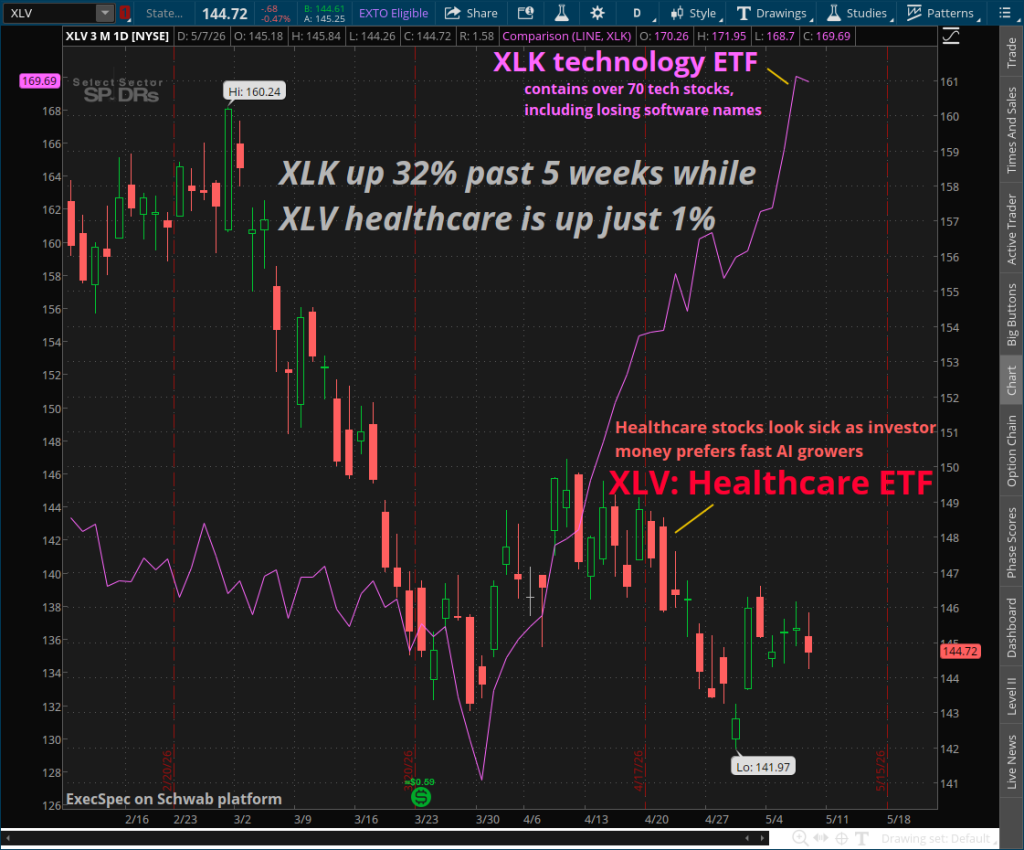
That divergence explains the increasingly bifurcated stock market. Investors are not irrationally abandoning broad swaths of the economy; they are reallocating toward visible growth. Businesses without credible pathways toward accelerating cash flow, automation leverage, or AI integration are increasingly treated like department stores during the rise of e-commerce — not necessarily doomed, but no longer deserving premium valuations. Would you rather own Amazon (AMZN) in recent years or Macy’s (M)? Don’t forget that Amazon already has a $20 billion tailwind from producing semiconductors that are oversubscribed with a $200 billion backlog for Tranium chips.
This explains why companies advancing 100%, 300%, or even 1,000% are not universally exhibiting the excesses of prior bubbles. In many cases, earnings are rising even faster than stock prices. NVDA still trades near a forward P/E ratio around the mid-20s despite becoming the central nervous system of the AI economy and a 73% revenue growth rate. MU, critical to high-bandwidth memory demand, with a forward PE of just 11, trades at valuation levels that would historically be associated with mature cyclicals rather than one of the most strategically constrained industries on earth. NVDA has a Trillion dollar backlog into 2027 that will likely grow. Micron can only fulfill half of its current orders due in 2027.
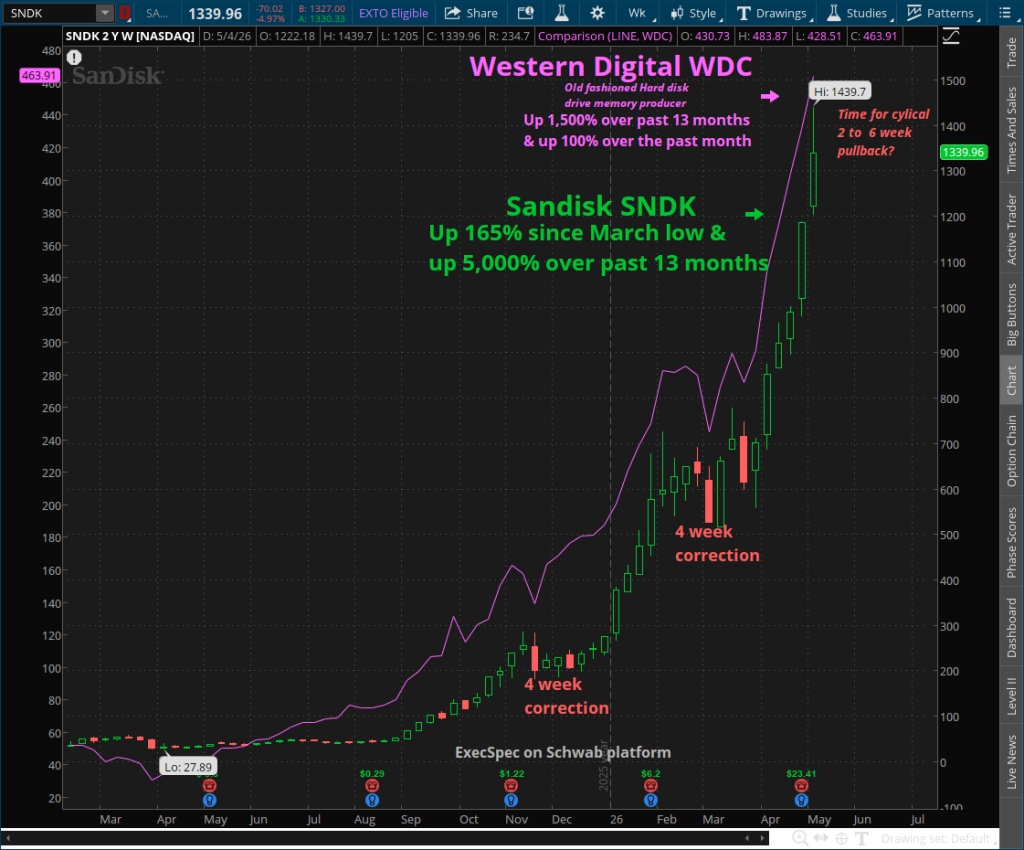
Parabolic advances inevitably invite corrections, however. Gravity still exists on Wall Street, even if temporarily suspended by exponential earnings revisions. Today’s sharp selloff in ARM Holdings reflected precisely this tension. Investors punished the company not because demand is collapsing, but because demand may be outrunning the industry’s capacity to satisfy it. That is a profoundly different problem than technological obsolescence. The modern panic is no longer, “What if nobody wants this?” It is, “What if we cannot build enough of it?”
Those are, historically speaking, good problems to have.
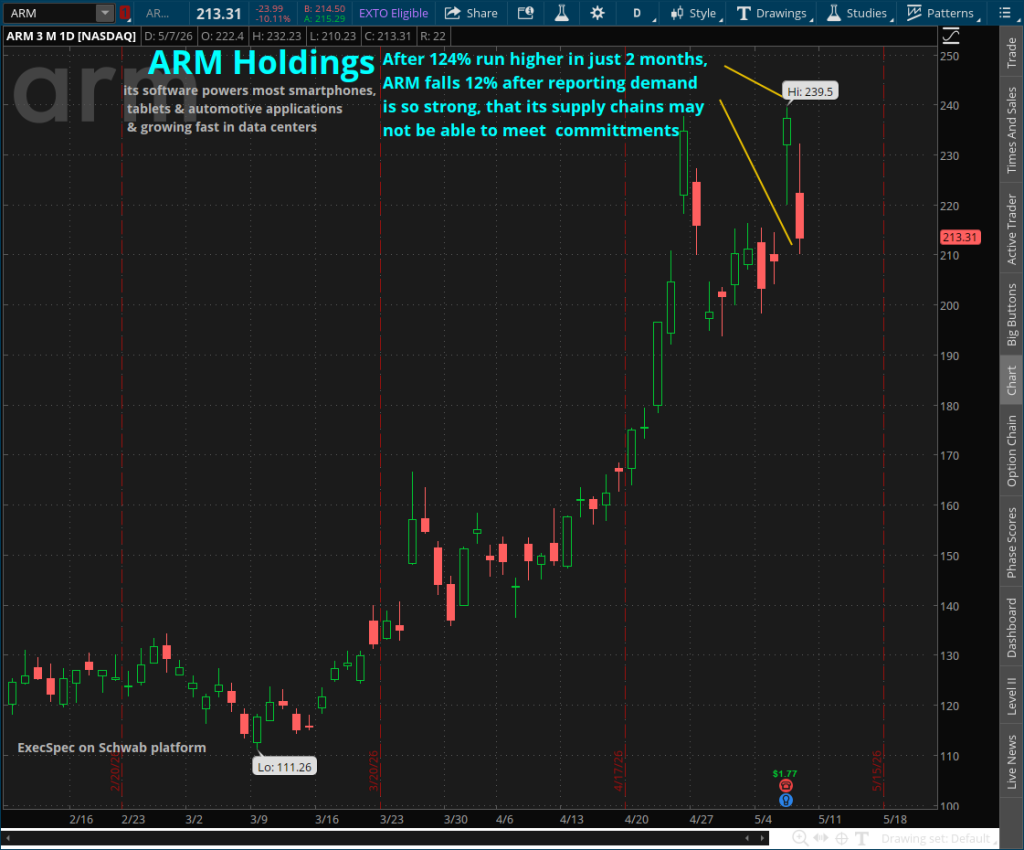
Delivery timelines for advanced semiconductors, networking equipment, transformers, cooling systems and grid infrastructure are now measured in years rather than quarters. Supply chains remain stretched from Arizona fabs to Texas data centers to Asian packaging facilities. Yet every delay merely reinforces the durability of the spending cycle. Deferred demand is not disappearing; it is forming a longer queue, extending the expansion cycle.
The market’s violent corrections — such as the 10% SP decline into the end of March or the 20% panic into early April last year — increasingly resemble brief intermissions rather than the final curtain. This remains a Buy the Dip bull market until there is credible evidence that supply is finally catching demand. At present, demand appears to be accelerating faster than global industrial capacity can expand. Deglobalization – onshoring – exacerbates this cycle in the name of geopolitical security.
The irony is that geopolitics may soon add fuel to an already overheated advance. Consensus targets for the S&P 500 reaching 7,700 this year once appeared ambitious. Now they appear merely chronological as earnings surpass expectations. Should the Iran–U.S. confrontation ease and the Strait of Hormuz normalize, the resulting decline in energy prices could become a powerful secondary stimulus. Lower oil and jet fuel prices would reduce business input costs, support travel demand, ease inflation pressure and potentially pull interest rates lower just as housing markets attempt stabilization. Bringing consumer sentiment out of its multi year slump would be an indirect benefit. While we continue to expect a narrow stock market appreciation and a positive resolution with Iran (is there really any realistic alternative long term), we also expect near term volatility and a corrective wave in stocks as Oil rebounds on continued Iranian attacks near term. High flying AI stocks can easily pull back 15 to 30% without a meaningful impact upon their secular uptrends.
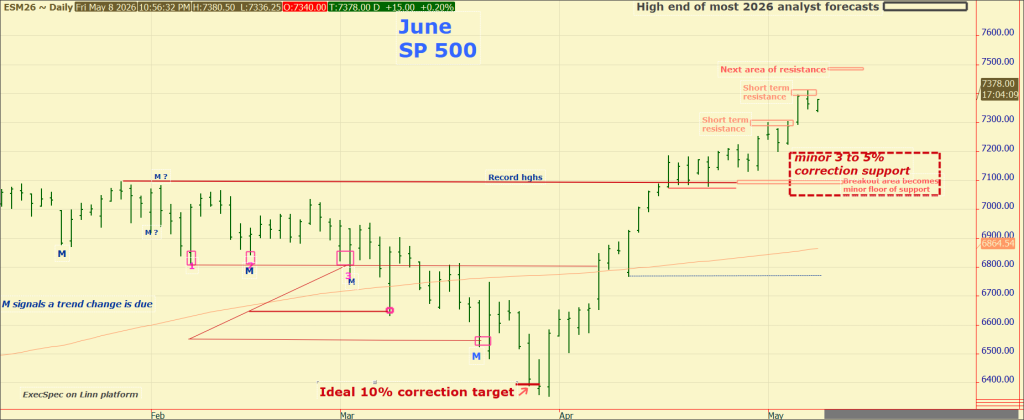
A messy peace will eventually arrive, adding more jet fuel to equities. Even China, heavily dependent on uninterrupted Middle Eastern – mostly Iranian – energy flows, has substantial incentive to quietly encourage its terror ally to de-escalate. Markets understand this arithmetic instinctively. If the energy blockade moves into the rear-view mirror, investor attention could rapidly pivot toward a tax refund stimulus, the so-called “Big Beautiful Deal,” easing inflation pressures and lower borrowing costs arriving just ahead of midterm elections.
Whether these tailwinds arrive in time to influence November’s political landscape remains uncertain. Investors, however, appear almost comically indifferent to the question for now.
The AI party continues. Capital keeps flowing toward chips, memory, cooling, electricity and steel with the urgency of a nineteenth-century gold rush. The picks-and-shovels companies of this era are not selling denim and wheelbarrows; they are selling megawatts, GPUs, TPU’s, CPU’s and liquid cooling systems.
And for the moment, Wall Street’s operating motto appears lifted directly from Buzz Lightyear rather than Benjamin Graham:
“To infinity and beyond.”


Comments
Log in or sign up to join the conversation.