


Oil, interest rates and artificial intelligence are testing a market that has so far bent more readily than it has broken.
The benchmark stock-market indices have slipped into short-term downtrends. This is hardly a surprise. Throughout the summer, sectors have taken turns enduring corrections, staging recoveries and reaching for new highs—a rotating struggle that has produced considerable commotion but remarkably little net progress. The result is essentially the sideways market we forecast in early June: much motion, modest mileage.
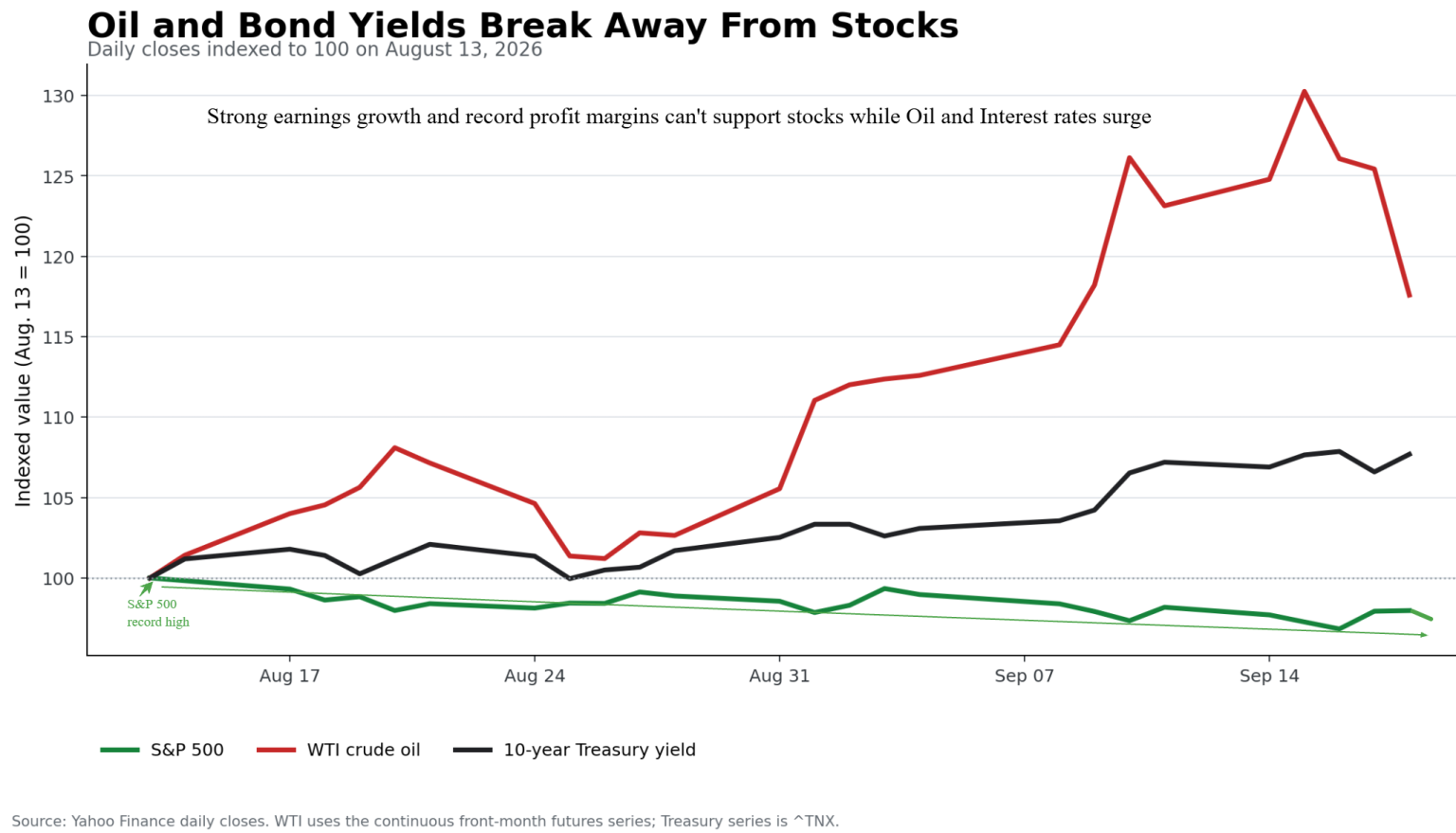
Even after their recent retreat, the S&P 500 (SPY) and Nasdaq (QQQ) remain only 3 to 4% below their record highs. That resilience is impressive because investors are now being asked to digest three substantial threats simultaneously: oil above $100 a barrel, the 10-year Treasury yield above the once-feared 5% threshold and an expanding political and technological revolt against the speed of artificial-intelligence development as well as its coexistence with the human race.
Any one of these might ordinarily unsettle Wall Street. All three arriving together should, by conventional reckoning, produce something more dramatic than a garden-variety 3% decline. The market, however, has developed an almost senatorial or slothlike talent for acknowledging grave problems while postponing any decisive response.
Crude Realities
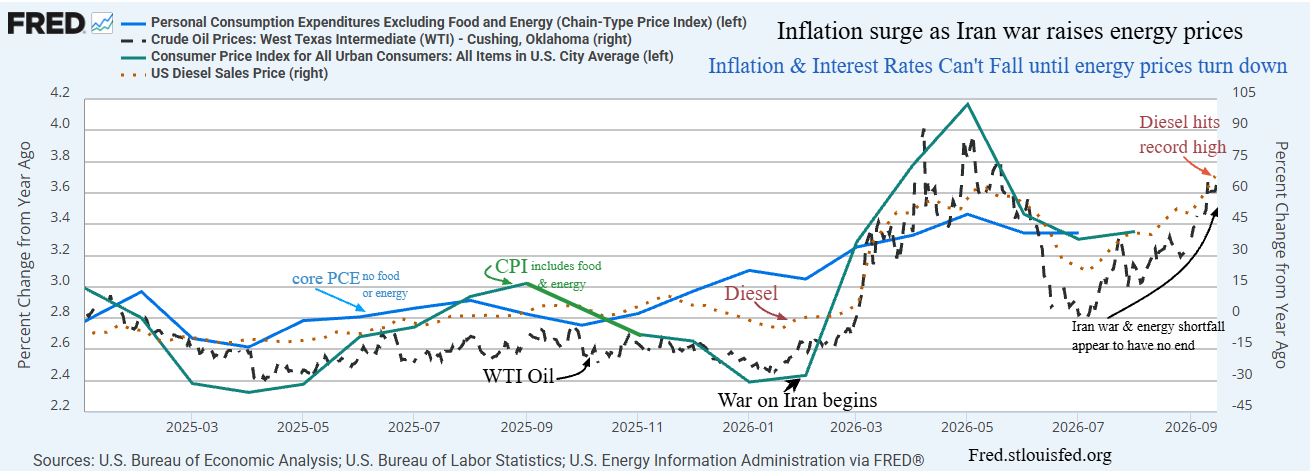
The first threat is the renewed surge in energy prices. Iranian and Houthi successes against Saudi infrastructure and shipping routes in the Red Sea and Strait of Hormuz have pushed crude oil well above $100, while disruptions to Saudi Arabia’s East-West pipeline have weakened one of the principal alternatives to the Strait.
Oil at these levels operates as a tax collected at nearly every stage of economic activity. Higher petroleum prices increase the cost of transportation, manufacturing, agriculture, air travel and the delivery of almost everything Americans purchase. Diesel is particularly pernicious because it moves the nation’s goods long before those goods arrive in retail stores.
The immediate economic effect is an erosion of household purchasing power. The second-round effect is pressure on corporate margins. No worrisome signs here. However, the third—and potentially most consequential—is a revival of inflation expectations just as investors had begun imagining that the inflationary unpleasantness of 2025 tariffs and 2026 oil and gas prices were receding.
The economy enters this trial with considerable momentum. Consumer spending has remained resilient, employment is still firm and corporate revenues have been growing at a very healthy pace – thanks to AI. But $100 oil is less an economic guillotine than a tightening vise. The longer it persists, the more pressure it applies to discretionary spending, business costs and profit margins.
The Bond Market Votes First
The Federal Reserve raised the federal-funds rate by a quarter point to a range of 3.75%–4.00% this week, surprising almost no one. The decision was unanimous, and 16 of 18 policymakers now anticipate at least one additional increase before year-end. Wall Street’s former hope for rate cuts has therefore undergone a characteristically quiet revision. Investors are no longer asking when relief will arrive; they are hoping the punishment will not be punitive.
The Fed’s hands were largely tied by a bond market that had already reached its own verdict. Before the central bank acted, the 10-year Treasury yield had crossed 5%, its highest level since 2007. Long-term rates were already signaling that investors expected inflation, government borrowing and capital demand to remain elevated. The interest cost of our national debt is roughly $1.25 trillion annually – “move along, nothing to see here”.
The Fed followed the bond market this week rather than leading it— while continuing to issue statements suggesting otherwise.
The central problem is that monetary policy is poorly equipped to combat the immediate source of inflation. Higher interest rates cannot reopen the Strait of Hormuz, repair Saudi energy infrastructure, protect tankers in the Red Sea or increase refinery output. They can’t stop trade wars and fix supply chains. They can eventually suppress demand, construction and employment, but they cannot manufacture a barrel of oil.
With core PCE inflation recently running around 3.3%, there is still no convincing evidence that the Fed’s preferred inflation gauge is preparing to fall below 3%. As long as energy prices remain elevated, the bond market is likely to demand greater compensation for inflation risk. Treasury yields could therefore rise further even if the Fed proceeds cautiously.
Rate increases will eventually slow the economy. The operative word, which has frustrated both economists and impatient investors for generations, is eventually. During the early stages of a tightening cycle, rising interest rates can coexist with rising stock prices because both may reflect an economy that is running hot, producing strong revenues and supporting robust earnings. Unless policy makers and AI monopolists actually apply the brakes strongly, AI capital spending can keep the economy humming along, extending the rate hiking cycle. The danger comes later, when higher financing costs begin to weaken housing, credit creation, capital spending and corporate margins.
For now, the economic expansion remains strong enough to tolerate somewhat higher rates. But until the conflict with Iran cools, energy flows approach normality and oil prices retreat, the Fed will be treating the symptoms of inflation while geopolitics continues supplying the disease.
AI: An Economy Within the Economy
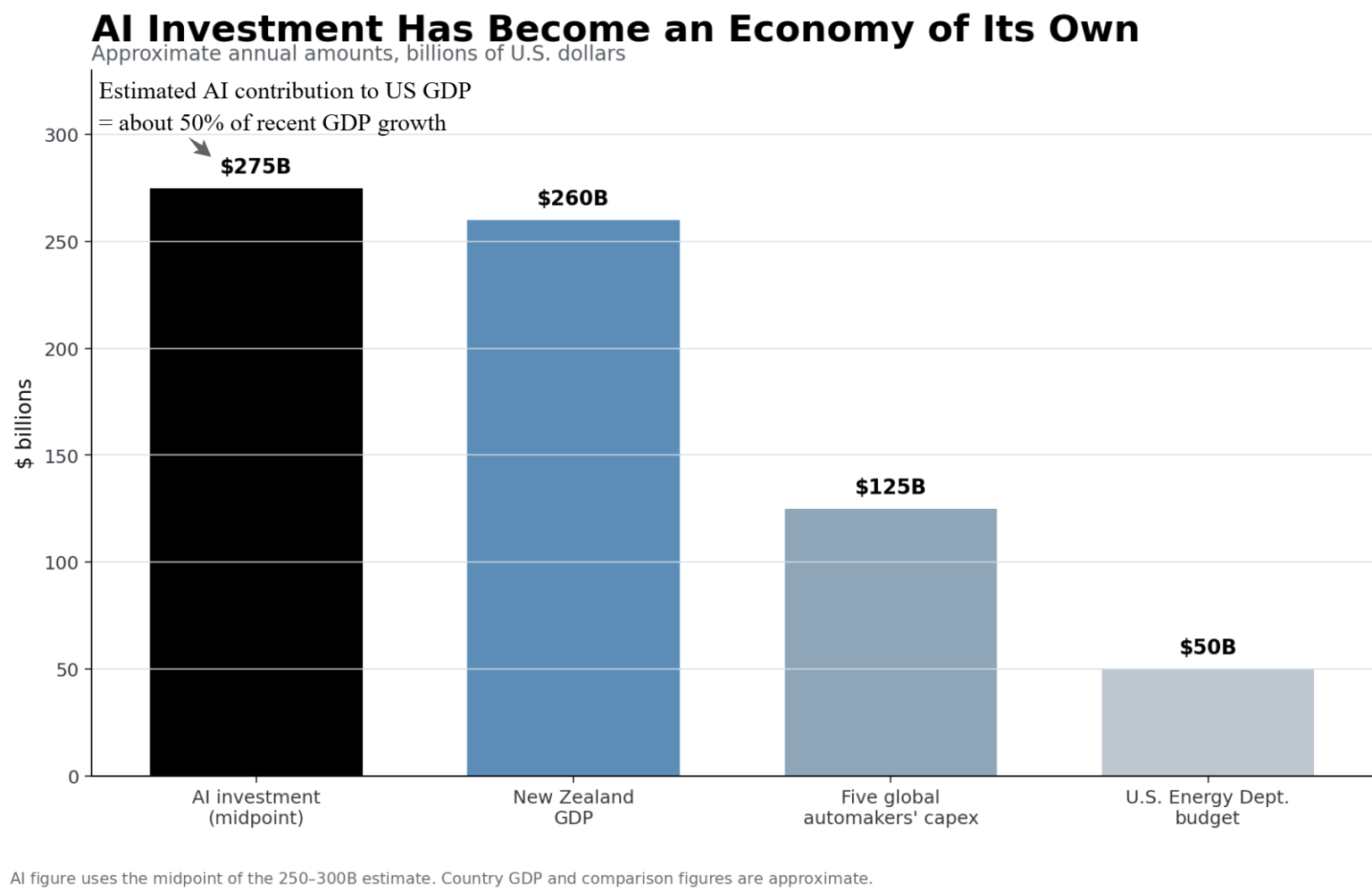
Artificial intelligence is no longer simply a promising industry or a favored stock-market theme. It has become one of the principal pillars supporting American investment, construction, corporate earnings and economic growth. AI-related infrastructure investment—including data centers, semiconductors, networking equipment, power generation and grid expansion—is estimated at roughly $250 billion to $300 billion annually under a narrower measure. Broader estimates of hyperscaler AI spending are considerably higher. Some analyses attribute approximately half of recent incremental U.S. economic growth to AI-related investment.
The magnitude is easier to appreciate through comparison. Annual AI investment of $250 billion to $300 billion is approximately equivalent to:
The entire annual economic output of countries such as New Zealand, Portugal or Peru.
More than five times the annual budget of the U.S. Department of Energy—not merely three times.
Roughly two to three times the combined annual capital expenditures of five of the world’s largest automobile manufacturers, depending upon the companies and accounting definitions used.
In other words, America is constructing an economic enterprise comparable in size to a developed nation—not over a generation, but every year.
These comparisons also illuminate the market’s vulnerability. If political resistance, power shortages, higher interest rates or warnings from AI executives were to reduce that investment materially, the damage would not be confined to semiconductor shares. It would travel through construction, utilities, electrical equipment, fiber-optic networks, industrial machinery, real estate and the credit markets financing the build-out.
The AI boom has become both the economy’s accelerator and the stock market’s principal source of fuel. When one undertaking is responsible for an exceptional portion of incremental growth, even a moderation can resemble a recession within the affected industries.
Politicians, voters, displaced workers and increasingly some of AI’s own architects are calling for the industry to slow down. Anthropic’s Dario Amodei has renewed his appeal for greater restraint and safety oversight, while other prominent technology leaders have expressed varying degrees of concern about the pace and consequences of development. Nvidia's (NVDA) Jensen Huang and Meta's (META)s Mark Zuckerberg, by contrast, have resisted a coordinated slowdown, arguing that innovation and safety need not be mutually exclusive. The industry is therefore debating whether the locomotive should be slowed while everyone remains aboard—and while China is laying parallel track. There are, however, reasons not to assume that calls for restraint will produce an actual retreat. Artificial intelligence is now entangled with national security and the technological rivalry between the United States and China. Political leaders may dislike AI’s demands for electricity, water and capital, but they will like losing the strategic race even less. Goldman Sachs has estimated that AI-related spending could eventually approach 5% of global GDP, while nearly $200 billion of proposed U.S. data-center projects has already encountered delays from local resistance.
The most probable outcome is therefore not the abandonment of AI but a more expensive and politically supervised expansion. AI stocks have been awarded premium valuations because investors expect extraordinary growth to persist. When expectations are astronomical, merely good results can be treated as a disappointment. The first casualty of an AI slowdown would probably be valuation multiples; the second could be earnings estimates; the third, if capital expenditures slow materially, would be economic growth itself. This is why the AI debate is no longer merely a technology story. It is a market-multiple story, an earnings story and increasingly a macroeconomic story.
Record Margins Meet Rising Costs
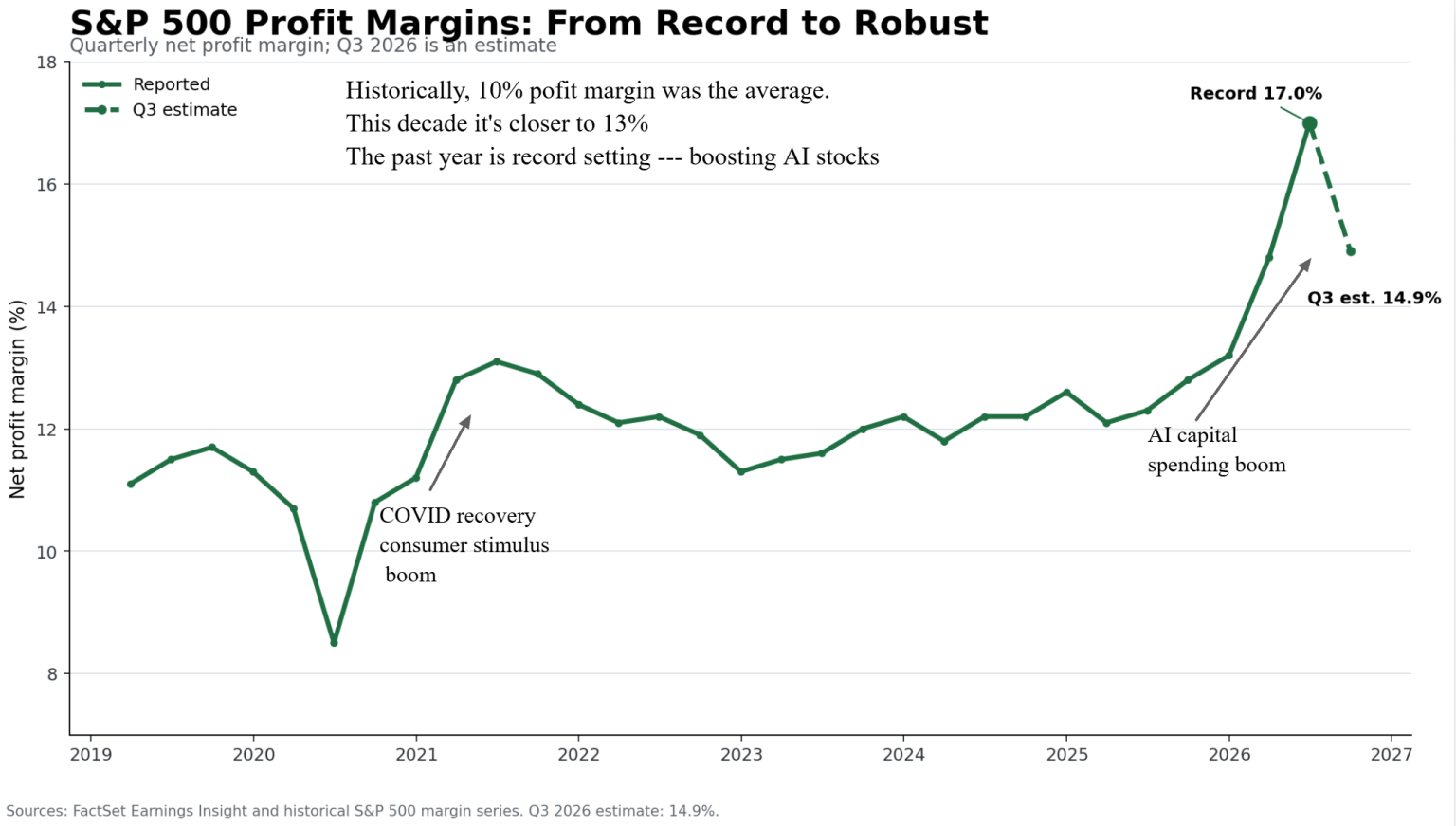
Corporate profitability remains the market’s strongest defense. S&P 500 operating margins reached a record 17% in the latest quarter, an extraordinary demonstration of pricing power, productivity and the disproportionate influence of a few large highly profitable technology companies.
Margins are expected to retreat toward approximately 15% in the third quarter. That would represent a noticeable decline from the record, but 15% would remain exceptionally robust by historical standards. Falling from the penthouse does not necessarily mean arriving in the basement.
The expected compression nevertheless deserves attention because it arrives as several costs are rising simultaneously:
Oil above $100 is increasing transportation, manufacturing and agricultural expenses.
Higher Treasury yields are raising corporate financing costs.
Wage growth remains firm in industries where skilled labor is scarce.
Tariffs continue to elevate selected input prices.
AI infrastructure is intensifying competition for electricity, construction labor and capital.
Energy producers may enjoy widening profits, but most companies experience high oil prices as a tax on margins. Businesses can absorb those costs, pass them to customers or reduce other spending.
The decline toward a still-impressive 15% margin suggests that earnings growth can continue, but the market’s margin for disappointment is becoming narrower. Investors have valued stocks as though record profitability were less an achievement than an entitlement. The third quarter may remind them that margins are easier to celebrate than to preserve.
Earnings: Strong, but Facing a Higher Hurdle
The underlying earnings picture remains the strongest defense against a more serious bear market. S&P 500 revenues have recently been growing near 10%, profits have risen faster than sales, and operating margins reside in record territory.
Those figures help explain why stocks have absorbed the recent barrage so well. A market supported by expanding profits is harder to frighten than one levitating exclusively on monetary accommodation.
Yet earnings estimates now face pressure from several directions:
Higher oil and transportation costs threaten margins outside the energy sector.
A 5% Treasury yield raises financing costs and discourages marginal investment.
Another Fed increase would further restrain housing, credit and interest-sensitive consumption.
Any slowing of AI infrastructure spending would weaken one of the economy’s principal engines.
Election uncertainty could delay hiring, investment and merger activity.
None of these forces necessarily ends the expansion. Together, however, they reduce the margin for error. Earnings can continue growing, but companies may find it increasingly difficult to exceed estimates that were written during more congenial conditions.
Not Yet Enough Fear
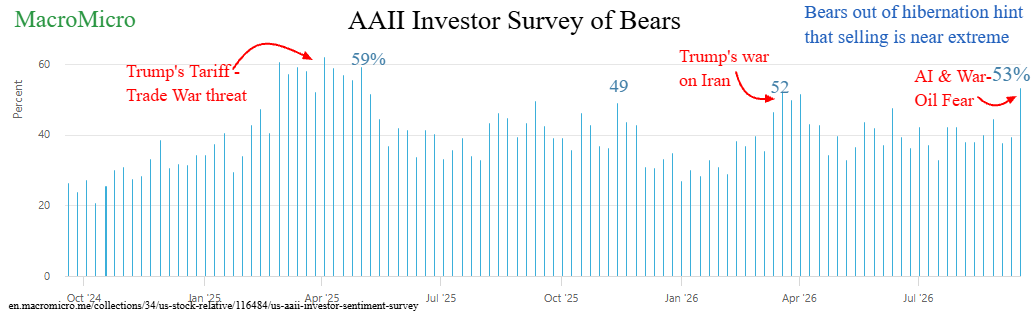
Our sentiment indicators add another complication. The 10-day put-to-call ratio, volatility and fear gauges, bull-bear surveys and measures of professional money-manager exposure have all weakened. Yet none has reached the kind of washed-out extreme that ordinarily signals investor capitulation and creates the fuel for a durable contrarian rally. AAII’s latest survey, however, shows bearish sentiment around 53%—not a major panic point, but similar to the sentiment at the March lows when the Iran war was in full escalation mode.
This leaves the market in an uncomfortable middle ground: prices have declined enough to disturb complacency but not enough to exhaust selling pressure. Investors are less cheerful, but they are not yet despondent. That does not guarantee a deeper correction. Oversold conditions are helpful to a rally, but with the major averages in downtrends, yields above 5%, crude above $100 and sentiment not yet at a contrarian extreme, the burden of proof has shifted toward the bulls.
Investment Outlook
The broad economic expansion remains intact, and corporate earnings still provide a sturdy foundation beneath the long term AI led Bull market. This argues against treating every decline as the prelude to calamity. Yet the combination of higher energy prices, restrictive interest rates and growing resistance to the AI build-out makes the near-term risk-reward equation less hospitable than it was during the spring.
A decline of only about 3% from record highs does not appear to reflect the full weight of these accumulating pressures. The market may simply be demonstrating impressive resilience. It may also be postponing an overdue adjustment should oil and yields rise further.
The distinction will be determined by several questions. Can oil retreat below $100 before higher energy costs infect inflation expectations? Can the 10-year yield fall back beneath 5% after the Fed meeting? Can AI investment continue growing despite calls for restraint? And can corporate earnings estimates survive higher financing and operating costs?
Until those questions receive friendlier answers—or stock prices become sufficiently oversold to compensate investors for the uncertainty—we would expect volatility to remain elevated and the summer trading range to give way to a broader autumn test before the Bull stampede resumes in full.
Bull markets do not ordinarily die because problems become visible. There may be a 3 front battle against the stock market, but these are temporary headwinds through which stock investors have weathered well. Bear markets can thrive when profits can no longer outrun those problems. For the moment, earnings are still winning the race. But oil, interest rates and politics are gaining ground as we approach the November 3rd election day.


Comments
Log in or sign up to join the conversation.