

The world is not running out of oil. It is merely discovering that the right fuel is stranded in the wrong place, trapped behind a closed shipping lane. The present danger is not simply a shortage of crude; it is a shortage of the security and confidence required to turn crude into commerce. That distinction now separates the hopeful headline from the rude reality. WTI crude, near $91 a barrel, is roughly 30% above its prewar level. Yet U.S. retail diesel, at $5.85 a gallon, and jet fuel have both more than doubled since their pre-war low. The shortage is concentrated in the middle of the barrel—the fuels that move trucks, tractors, trains, aircraft, construction equipment and much of modern commerce. Compared to the light oil from the US, oil transiting by Iranian drones is heavier and produces more middle distillates consisting of jet fuel, heating oil, and Diesel, all of which are leading the energy complex higher. Thus, replacing a missing Gulf barrel with dollars from a Texas barrel may satisfy an accountant without satisfying an airline. The Iran conflict sharply restricted the Strait of Hormuz, which normally carries about one-fifth of global oil trade. At the worst point, roughly 14 million barrels per day were shut in. The Middle East had also supplied about 10% of seaborne shipped diesel and 20% of seaborne jet fuel.
Russia supplies the second half of this unhelpful coincidence. Ukrainian drone strikes have repeatedly damaged Russian refineries, and Moscow has restricted product exports to protect its military and domestic consumers. Global refining capacity was already short of slack after years of closures, so the simultaneous loss of Middle East product flows and Russian refinery output turned a tight market into a tourniquet.
Washington’s shrinking cushion
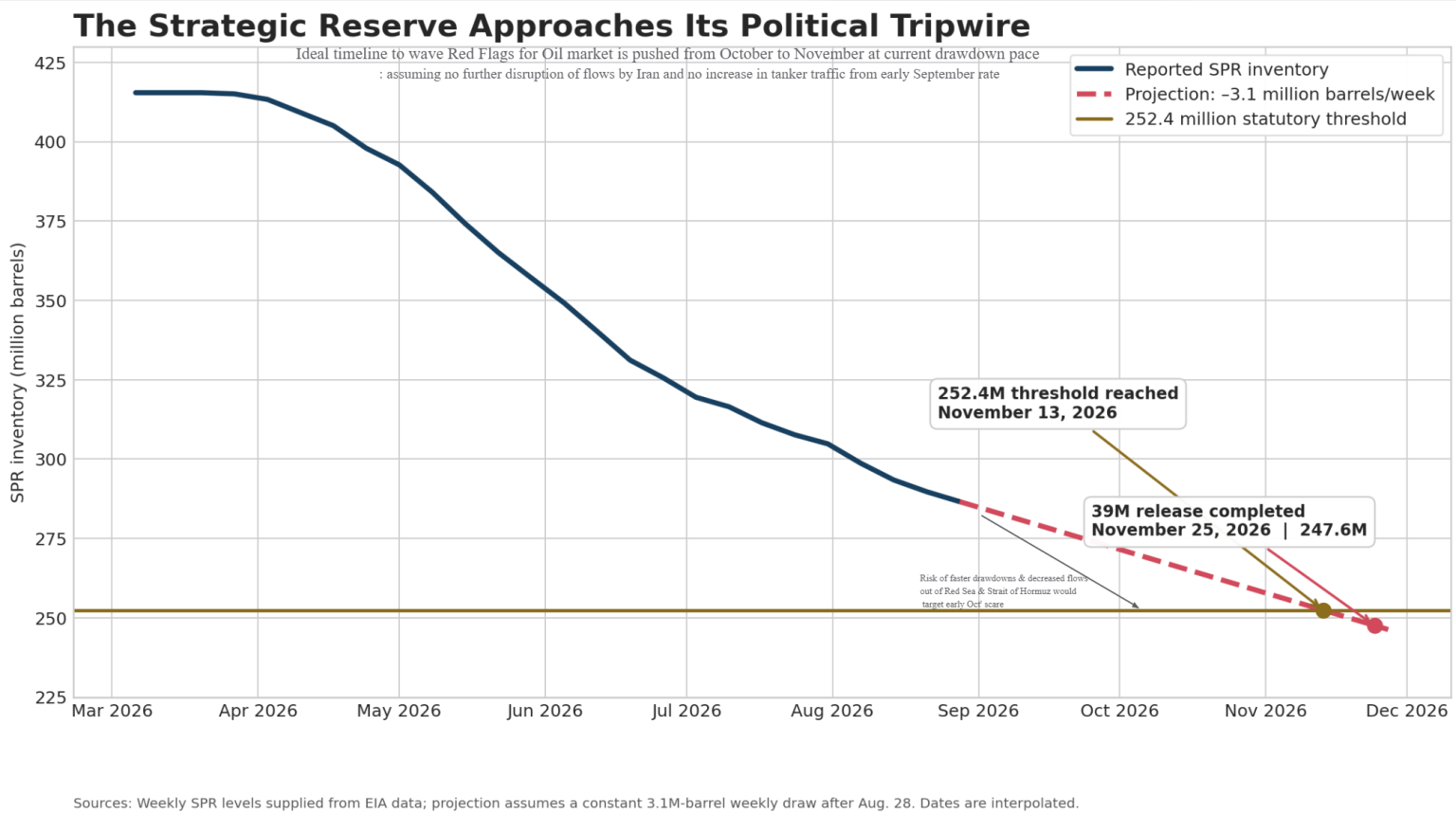
According to the Energy Information Administration, the Strategic Petroleum Reserve (SPR) held 286.6 million barrels on August 28, down almost 129 million since late March – 5.8 million barrels per week drawdown. The pace has slowed since we wrote about it over a week ago: the most recent weekly decline was about 3.1 million barrels. At a constant 3.1-million-barrel weekly draw, the reserve reaches the 252.4-million-barrel statutory threshold around November 13 – about a month further out than we projected a couple of weeks ago. Completing Trump’s stated remaining 39-million-barrel release from the SPR would take until approximately November 25 and leave 247.6 million barrels, at this pace. This is a policy collision: the full remaining release that the President announced exceeds the room above the threshold by about 4.8 million barrels. Either the release slows or stops, the threshold is altered or bypassed, or the SPR moves below it and risks the integrity of US underground storage. Reaching these levels is likely to ring investor alarm bells more vigorously.
The SPR is a bridge to a better future beyond Iran. It’s not an oil field. A bridge is useful precisely because it ends on the other side. The recent 3.1-million-barrel weekly global inventory draw suggests that lost Middle Eastern supply, increased production elsewhere (+~2million barrels), emergency releases and demand restraint may be moving the physical market closer to equilibrium than the more apocalyptic forecasts imply. But equilibrium here means a narrow balance at elevated prices—not abundance. It assumes that Iran does not further damage export terminals, pipelines or stop tanker traffic and that the Houthis do not make the Red Sea a maritime shooting gallery.
The insurance premium is also an oil price
Missiles need not sink many ships to alter trade. They need only persuade owners, crews and underwriters that a voyage has become a high-risk adventure. War-risk insurance costs have reportedly risen 48% in parts of the market; on the most threatened Red Sea routes, quoted premiums have jumped from roughly 0.3% to 0.75% of a vessel’s value, an even larger increase. Add longer voyages around the Cape of Good Hope, scarce tankers and delayed cargoes, and the delivered cost of energy rises even when the spot price of the product is unchanged.
Pipelines are no safer merely because they cannot sink. Iranian attacks on Gulf infrastructure—or Houthi strikes on Saudi shipping and export arteries—could remove precisely the marginal barrels that now appear to be closing the global energy deficit. In a balanced market, a small disruption is an inconvenience. In a market balanced by reserve releases and demand destruction, it can be a major price event.
Diesel is inflation with work boots
Diesel is more consequential than gasoline because its cost is embedded in almost everything. Trucks deliver groceries; tractors harvest crops; machinery builds the warehouse; aircraft carry urgent freight and impatient passengers. Businesses initially absorb some of the increase, then discover the virtues of a fuel surcharge. Insurers will add a $10 million charge per $100 million vessel passing through the Strait.
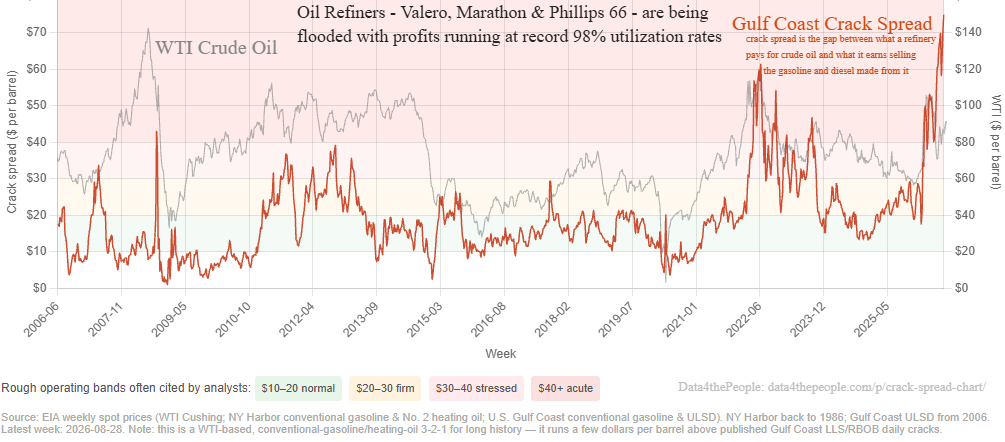
This makes the distillate shock unusually sticky. Motorists can postpone a Sunday drive or visit to the beach. A farmer cannot postpone harvest because the crack spread is disagreeable, and an airline cannot ask a 737 to use less jet fuel. Record refining margins—U.S. diesel cracks have exceeded $100 a barrel—are the market’s impolite request for more supply and less demand. {Crack spread is the gap between what a refinery pays for crude oil and what it earns selling the gasoline and diesel byproducts}
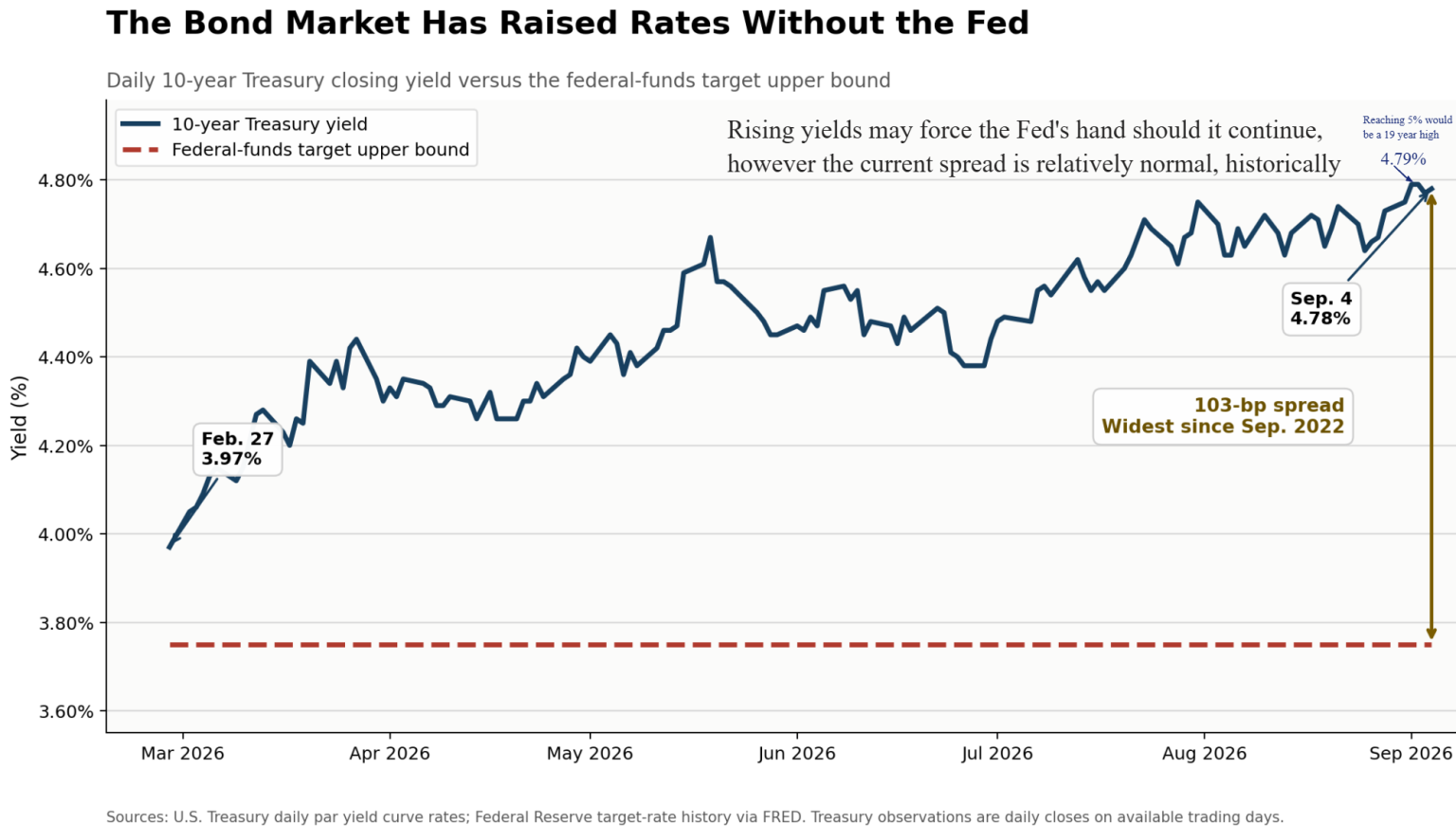
The inflation effect arrives in two stages. Energy first raises headline inflation directly; diesel and jet fuel then migrate into freight, food, travel and manufactured-goods prices. They are less able to ignore several quarters in which transportation costs contaminate core prices and inflation expectations. Bond investors, who do not enjoy waiting for committee consensus, may raise long-term yields first, as has occurred during the Iran war. This year the Fed has feigned deep concern about inflation while sitting on its hands and letting bond investors steadily raise market rates. Rising 10-year Treasury yields at 4.8% today are on the verge of moving so far ahead of the Fed that they may feel compelled or even rewarded by investors if they finally raise the Federal Funds rate as many have expected.
A forecast requiring good weather and good behavior
Europe enters autumn with an uncomfortable lack of padding. Jet-fuel imports from the Middle East fell to four-year lows earlier in the crisis, benchmark inventories were reported down sharply, and diesel stocks remain well below the normal start-of-winter targets. European natural-gas storage is also unusually low for the season. The continent has better infrastructure than in the 2022 crisis when Russia invaded Ukraine, but preparedness is not warmth. Northern Europe may be underestimating the shortfalls they could experience as they bid for scarce supplies during the high-demand season approaching.
The benign case is plausible: non-Middle Eastern production and tanker traffic continue rising, demand adapts, and refinery runs improve. In that scenario, the slowing global inventory draw is a signal that the market is approaching equilibrium and crude prices need not revisit their panic highs near $120.
The less benign case requires only one item from a short menu: a severe Gulf hurricane that idles U.S. production and refining; a cold European winter that drains gasoil and natural-gas stocks; renewed Iranian strikes on ships, refineries or pipelines; or a sustained Houthi campaign that closes another shipping artery. Two such events would be excessive; one may suffice. The fourth quarter and first quarter therefore contain less margin for meteorology or geopolitics than today’s crude price quotation suggests.
For investors, the distinction is decisive. The market may be nearer physical balance, but it has purchased that balance with strategic stocks, costly rerouting away from harm and weakened demand. If the wars quiet and the weather behaves, energy inflation can crest, and bond yields can stabilize. If not, the next rally will begin not at the wellhead but in the refinery, the tanker-insurance market and the diesel pump—and it will end, as energy shocks often do, on the inflation desk of the pusillanimous Federal Reserve.
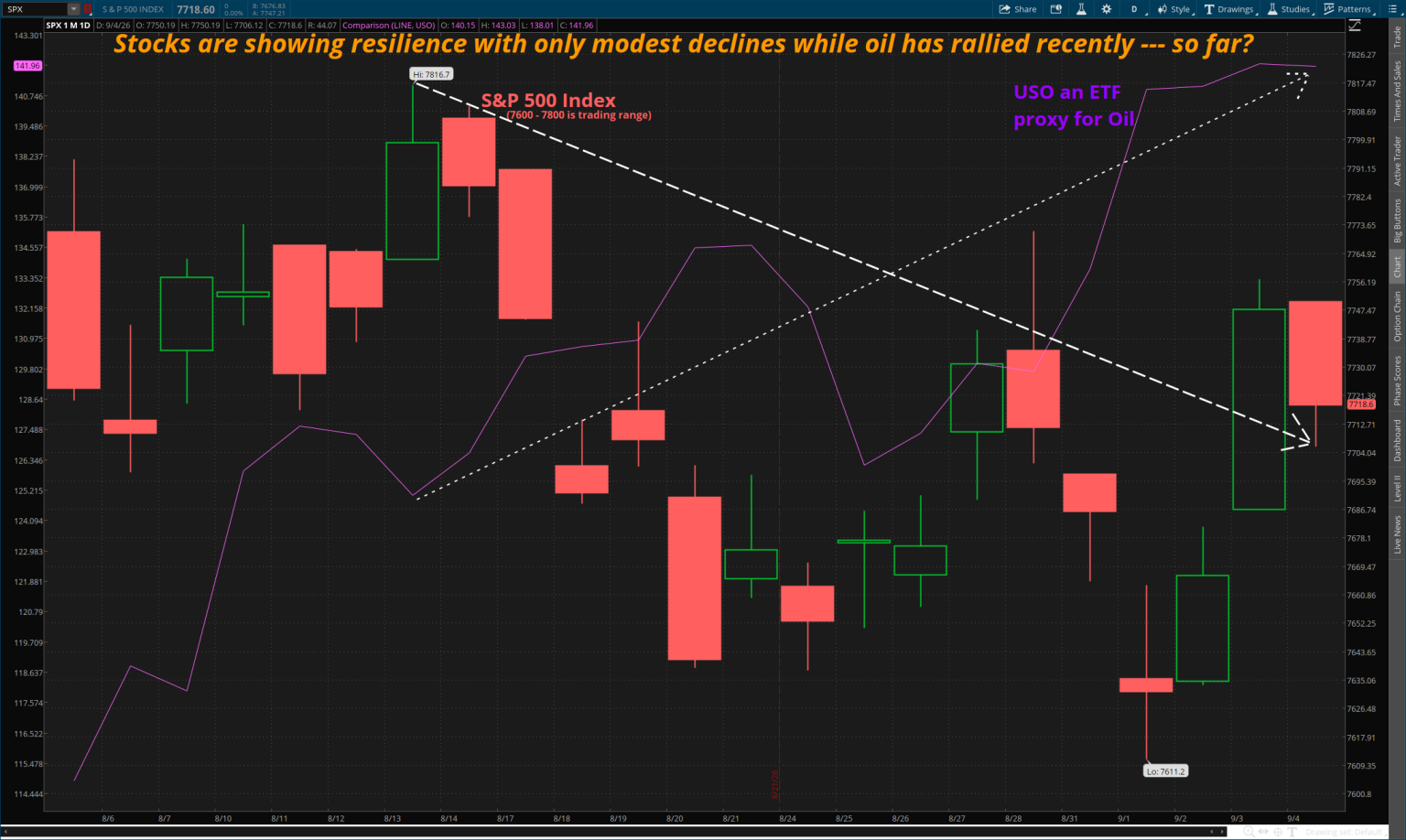
We have grown increasingly bullish on the energy sector in recent reports, particularly over the past several weeks as WTI crude advanced from the $ 70s to the lower $90’s and investors gradually abandoned hopes for an imminent cessation of hostilities or normalization of tanker traffic. Thus far, rising oil prices have inflicted only modest damage on equities. Investors plainly want to carry the major averages to new highs, and the earnings picture can justify an S&P 500 above 8,000. Yet until the summer trading range is decisively broken—by convincing evidence of either more war or more peace—equities seem reluctant to choose a direction. Nvidia's (NVDA) post-earnings run to resistance in the 230’s is a hopeful sign for Bulls waiting for their beloved general to lead a new charge.
As the accompanying chart illustrates, stocks have so far treated oil’s advance as an inconvenience rather than an indictment. That tolerance may persist, but it is not limitless. We continue to monitor diesel and jet-fuel crack spreads, European petroleum-product and natural-gas inventories, Gulf Coast hurricane risks, tanker war-risk premiums, Russian refinery availability and the weekly SPR draw. These gauges should reveal whether the market’s apparent equilibrium is becoming durable—or is merely the temporary calm purchased by consuming America’s emergency cushion.


Comments
Log in or sign up to join the conversation.