


There is something almost impolite about this bull market. The major averages keep arriving at the record-high party while much of the market remains outside on the wait list for having misplaced its invitation.
By late September, nearly half of the S&P 500 (SPY)’s individual stocks were already in their own bear markets, trading at least 20% below their 52-week highs—even as the capitalization-weighted index hovered within a few percentage points of an all-time high. Measured from individual all-time highs, the damage was greater still: nearly 60% of the index’s members had suffered declines of 20% or more.
And yet the benchmark indices refuse to behave badly with the benchmark itself trades within one percent of record territory and the tech heavy Nasdaq (QQQ) just returned to the record high party. Investor enthusiasm, meanwhile, is far from what one normally associates with speculative excess.
The explanation is less mysterious than it first appears. The stock market is capitalization weighted, not democratically elected. NVIDIA (NVDA)’s vote counts for considerably more than than that of Walgreens (WBA) or a struggling small-cap manufacturer. The companies enjoying the strongest earnings growth also happen to be among the largest companies in America.
The result is a bull market with a remarkably small guest list.
Where the Money Is
Willie Sutton was supposedly asked why he robbed banks. His immortal answer: “Because that’s where the money is.”
Investors presently require no more complicated philosophy. Why do they continue returning to hyperscalers, AI infrastructure, memory, semiconductors and data-center companies?
Because that is where the earnings are.
The S&P 500 is entering another extraordinary reporting season. Consensus estimates now call for approximately 29.5% year-over-year earnings growth in the third quarter, which would mark the third consecutive quarter of earnings growth exceeding 25%. Even more unusually, analysts raised their estimates during the quarter instead of performing their customary ritual of lowering the hurdle shortly before corporate America jumps over it. The bar is set higher, but forecasters may be getting tired of underestimating earnings and profit margins.
The market’s enthusiasm may be narrow, but it is not inexplicable.
AI-related capital spending is certainly inflationary. It consumes electricity, copper, steel, transformers, labor, cooling equipment, memory, semiconductors and acres of real estate. But this is a rather different species of inflation from paying more for gasoline because tankers cannot safely transit the Middle East.
One inflation purchases scarcity. The other purchases productivity.
Markets generally prefer the latter.
Three Months, Two Markets
The past three months provide an almost laboratory-quality demonstration of today’s market.
During June and July, the hyperscalers and large-cap AI complex finally suffered a meaningful correction. The Magnificent Seven (MAGS) were down over 15% at one point during June. Oil and bond yields were declining, inflation fears were subsiding, and leadership temporarily passed to the rest of the market. Small caps, banks and other economically sensitive stocks briefly took the reins.
Then August changed the weather.
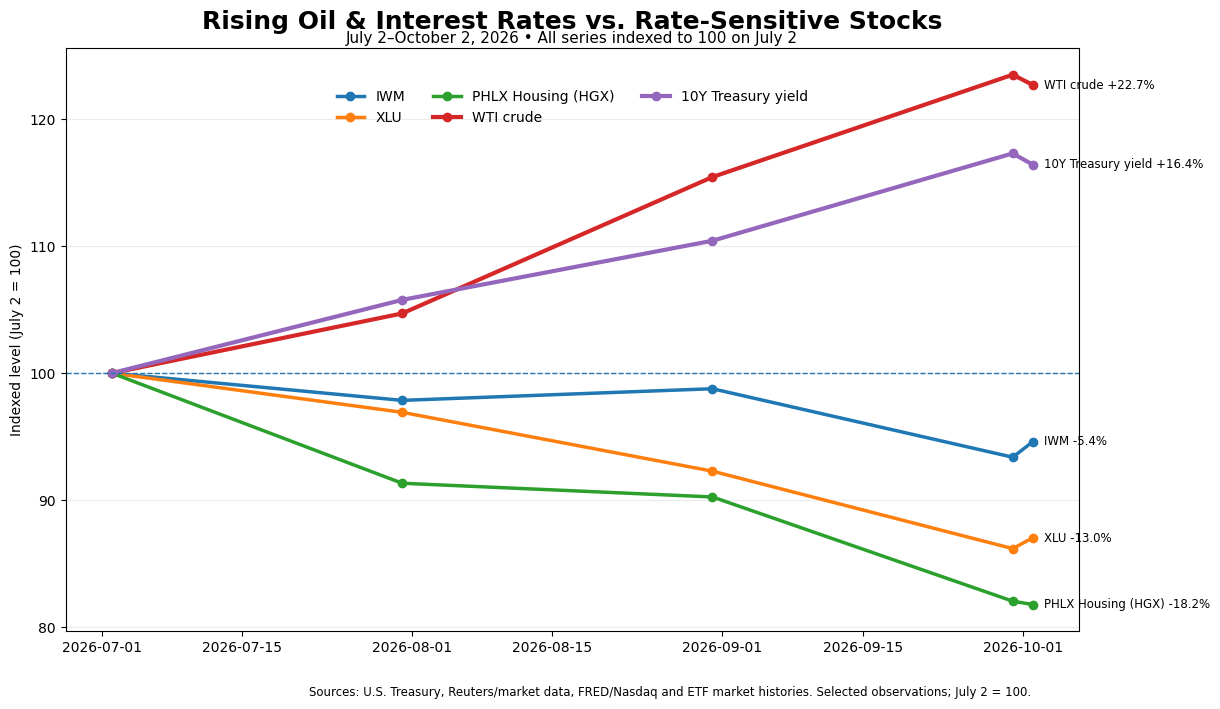
Energy costs rose. Treasury yields followed. Housing, utilities, banks and smaller companies—all more sensitive to borrowing costs—began surrendering their gains. Capital migrated back toward the businesses capable of producing extraordinary earnings growth despite expensive money.
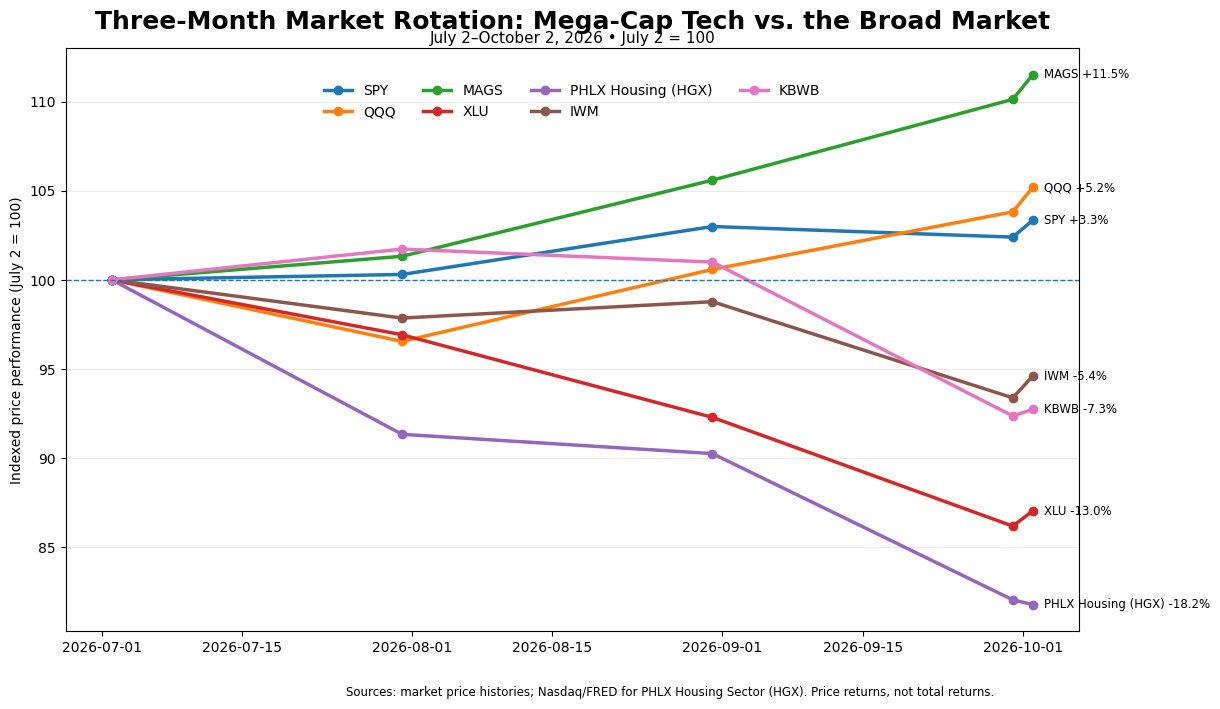
From July 2 through October 2, the divergence became extraordinary:
MAGS rose approximately 11.5%, QQQ 5.2% and SPY 3.3%. Meanwhile, IWM declined 5.4%, the KBW Bank ETF (KBWB) fell 7.3%, utilities lost 13%, and the PHLX Housing Sector Index (HGX) plunged roughly 18%.
That is not merely sector rotation. It is a market voting on the price of capital. When money becomes expensive, investors become considerably less charitable toward companies promising profits tomorrow. They gravitate toward companies producing enormous cash flows today. Hence the paradox: breadth can deteriorate while the capitalization-weighted indexes rise.
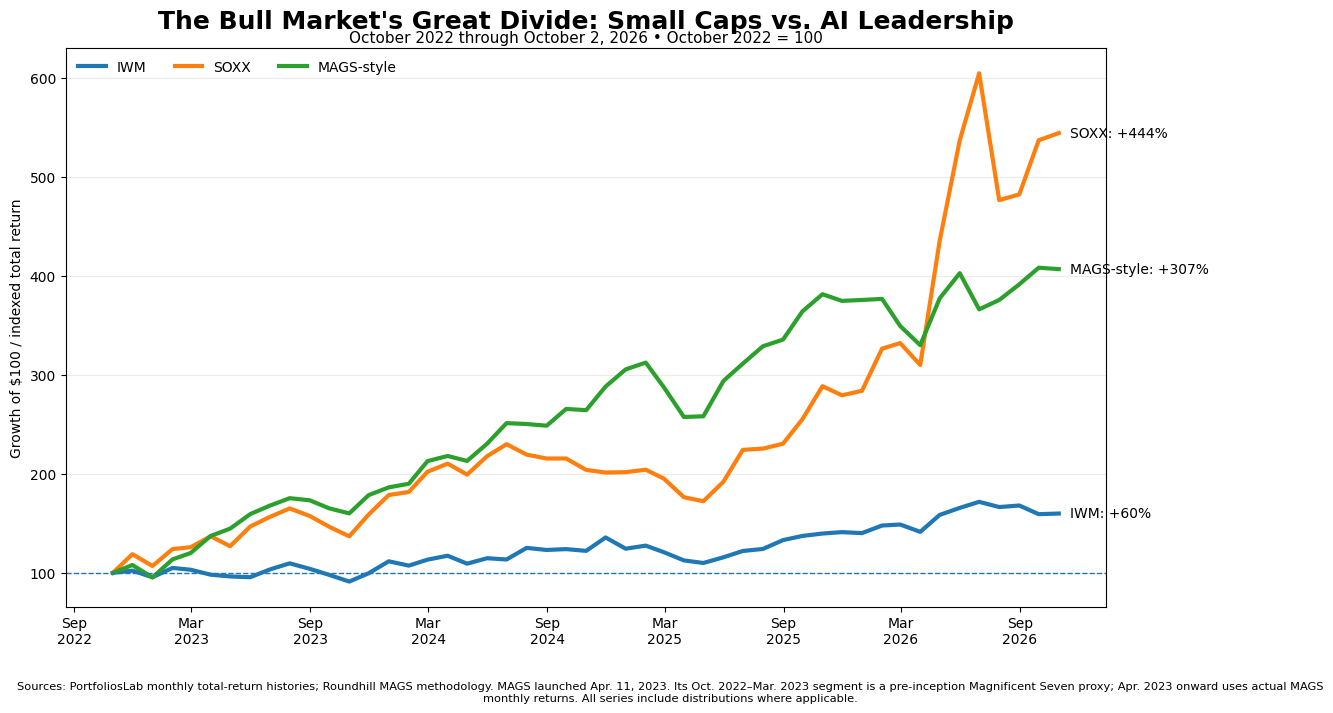
The great paradox of this bull market is that small companies have not actually done badly. They have merely had the misfortune of being compared with one of the greatest technology investment booms in American history. Since the October 2022 market bottom, the Russell 2000 (IWM) has gained 68%. Semiconductors (SOXX), however, have risen nearly 480%. Even the Magnificent Seven ETF (MAGS), which did not exist until six months after the bull market began, has roughly tripled. A respectable bull market in small stocks has therefore felt like a bear market because it has been conducted in the shadow of an AI supercycle.
The Labor Market: Slow Hiring Is Not Mass Firing
Friday’s employment numbers supplied another apparent contradiction.
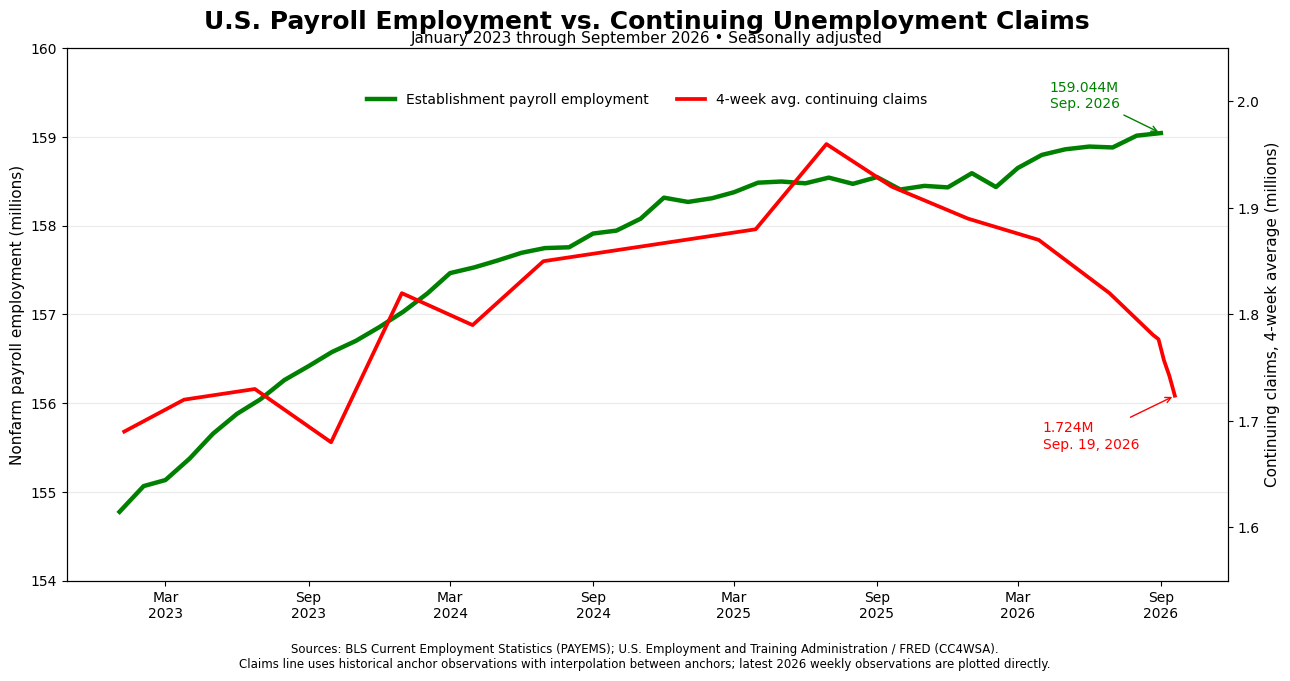
Payroll growth has slowed markedly. Yet unemployment claims tell a considerably less alarming story.
The four-week average of continuing unemployment claims has been falling sharply from its 2025 peak and recently approached 1.72 million, while total nonfarm payroll employment remains near a record 159 million.
This is increasingly a low-hire, low-fire economy.
Companies are cautious about adding workers, but they are not behaving as businesses ordinarily do before a recession. They are not conducting widespread layoffs.
There is another complication: America increasingly has too little skilled labor for some of the investment it is attempting to undertake. Data centers need electricians, engineers, construction workers, power specialists and technicians. Manufacturing reshoring requires many of the same people.
An economy can therefore produce weak hiring statistics and wage pressure simultaneously.
Good economic news has become inflationary partly because the economy is attempting to build more than its labor and infrastructure can comfortably accommodate. That is a much more pleasant problem than collapsing demand, although the Federal Reserve may still be navigating that distinction.
The Two Inflations
The economy is presently wrestling with two very different inflationary forces.
The first is productive inflation: AI infrastructure, factories, power generation, transmission equipment and data centers competing for capital and labor.
The second is scarcity inflation: tariffs, disrupted Middle Eastern energy supplies and geopolitical risk raising the cost of goods without increasing America’s productive capacity.
The stock market can tolerate a surprising amount of the first. It has considerably less affection for the second.
If Iran were removed from the energy equation and tariff inflation continued to fade, one suspects the breadth problem would look considerably less sinister. Lower oil prices would relieve headline inflation. Lower inflation would relieve Treasury yields. Lower yields would relieve housing, utilities, banks and small companies.
In other words, the broad market does not necessarily need dramatically faster economic growth. It may simply need cheaper money and oil prices.
October’s Usual Collection of Ghosts
Which brings us to October, the month in which Wall Street traditionally discovers reasons to be frightened, yet its often a month with solid stock market gains during mid-term election years.
The first question is Iran.
Can Iran or its proxies mount a credible attack capable of driving oil materially higher? Or can the United States continue containing the conflict while increasing the effective flow of Middle Eastern petroleum?
The rapid decline in Strategic Petroleum Reserve has slowed to a trickle, supporting the case that oil flows have substantially improved and the alarms bells we worried about have quieted for now.
The second question is interest rates. Higher energy prices would reinforce inflation and keep pressure on Treasury yields—the combination that has punished precisely those areas of the market already suffering the largest corrections.
The third question arrives in November wearing campaign buttons.
Will Democrats capture the House? Could they also capture the Senate? A divided Washington would mean investigations, lawsuits, legislative paralysis and potentially a more hostile political debate over the enormous electricity and infrastructure requirements of AI. Although the pipeline of data center activity may be hard to stop.
Markets dislike uncertainty, although they frequently exaggerate its durability. The tariff panic of April 2025 eventually became a buying opportunity. The Iran panic of April 2026 did the same.
October or November may yet provide another.
Fear Without a Bear
Perhaps the most constructive feature of the present market is precisely what appears most unsettling.
Investors are cautious.
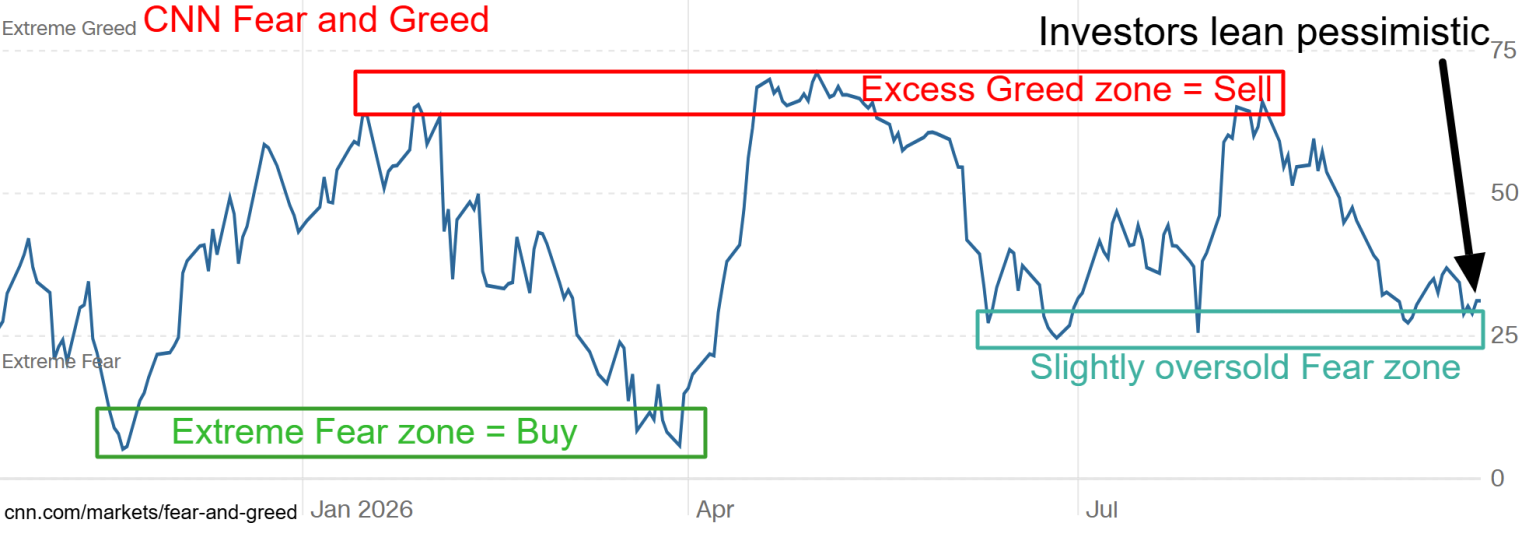
The broad market has already experienced substantial corrections. Housing has fallen roughly 18% in only three months. Utilities are down about 13%. Banks and small caps have retreated meaningfully. Many individual stocks have already endured what technically qualifies as a bear market.
Yet the major averages remain near their highs because corporate earnings continue growing at a pace normally associated with the early stages of an economic recovery.
This creates an unusual asymmetry.
A modest decline in the major averages could push already-depressed breadth and sentiment toward genuinely oversold territory without requiring any deterioration in the underlying earnings outlook. That would create the sort of setup we generally prefer: frightened investors, corrected stocks and rising profits.
The opposite—euphoric investors paying ever-higher prices for deteriorating earnings—is considerably more dangerous.
Investment Conclusion
The economy remains stronger than the market’s internal breadth would suggest.
Employment is high. Layoffs remain subdued. Consumer and corporate balance sheets are broadly healthy. Businesses continue investing aggressively, particularly in AI infrastructure. Corporate profits are surging, and analysts are doing something almost unnatural: raising earnings estimates before companies report.
The principal obstacles are not presently collapsing demand or deteriorating profits. They are oil, inflation and interest rates.
That distinction matters.
Should energy prices retreat more sustainably, supply chains continue improving and AI-driven productivity accelerate, today’s narrow market could broaden quickly. Housing, banks, small caps, industrials and utilities do not require perfection. After their recent declines, they require merely less bad news.
Meanwhile, the companies financing and constructing the AI revolution continue producing the earnings necessary to hold the major averages aloft.
Thus we arrive at the peculiar condition of the autumn of 2026: a bull market surrounded by bear markets.
October may yet provide its customary surprise. Iran may rattle the oil market. Bond yields may again frighten equities. Elections may furnish Washington with a fresh supply of combatants.
But absent a genuine deterioration in earnings or employment, those disturbances are more likely to interrupt the bull market than end it.
Wall Street has spent much of this year climbing a wall of worry. The wall has become narrower, steeper and increasingly concentrated in artificial intelligence.
But it is still climbing.



Comments
Log in or sign up to join the conversation.