


Markets have rediscovered an old and inconvenient truth: the price of money and the price of energy are seldom strangers for long. When oil rises persistently, inflation expectations follow; when inflation expectations rise, bondholders demand compensation; and when Treasury yields climb, stock valuations encounter the cold arithmetic that replaces enthusiasm.
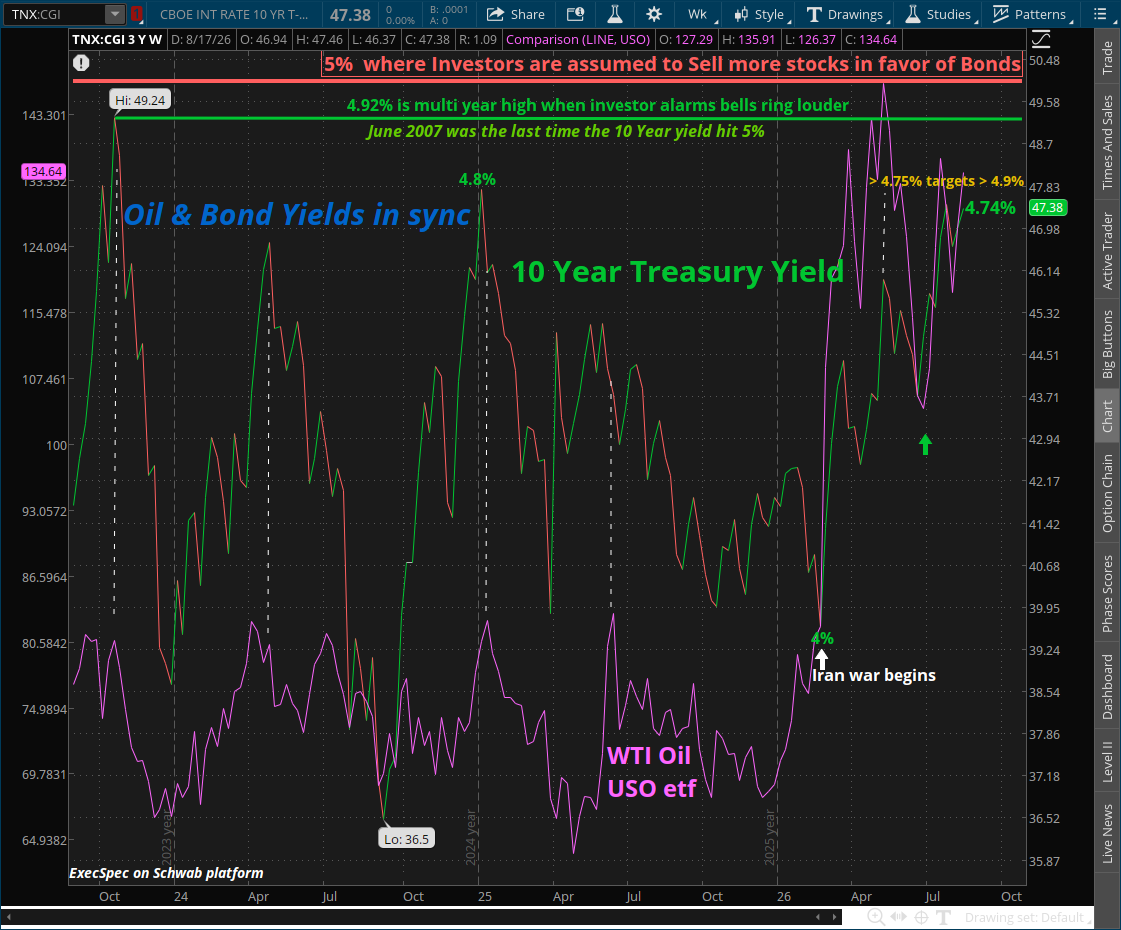
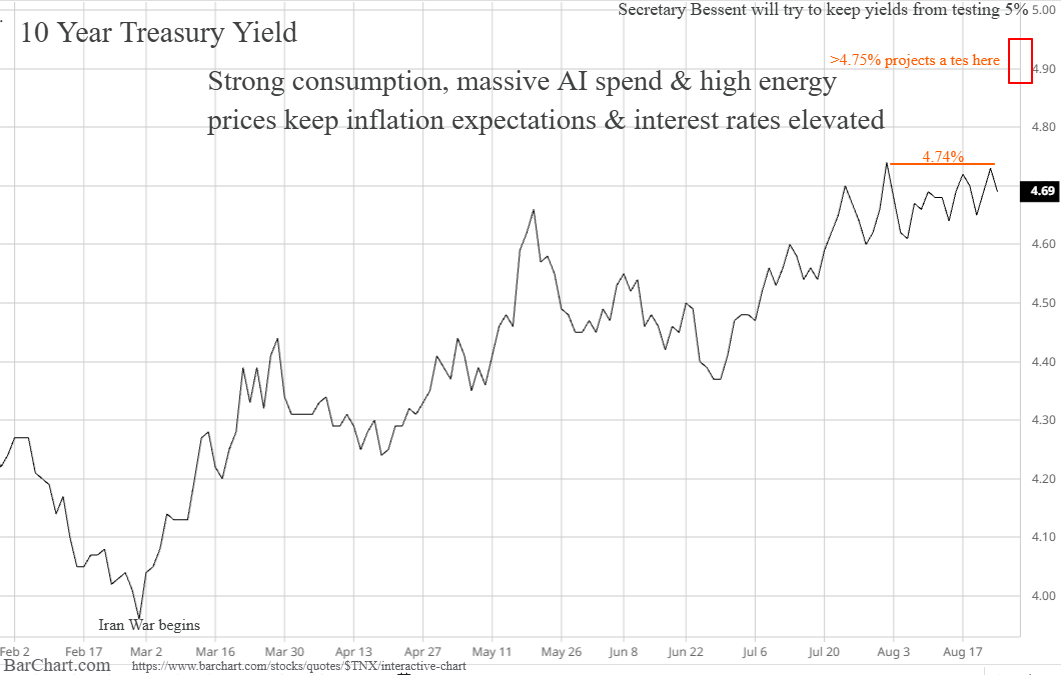
Thus, oil and interest rates are again advancing as investors become more apprehensive. West Texas Intermediate Oil closed Friday at $87.83 and the 10-year Treasury yield at 4.74%. Throughout history, Oil price trends have correlated well with interest rates and inflation expectations. Major Oil price peaks in 2013 and 2018 line up with interest rate peaks. Oil price highs in each of the past 4 years have coincided quite well with Bond yields. Since the 6 month battle over the Strait of Hormuz began, Oil and bond yields have moved with almost military synchronicity. Interest rates have moved up even faster than Oil lately with the rise in inflation expectations and increased borrowing from the AI boom. Oil is raising the prospective cost of nearly everything, while Washington’s borrowing and the artificial-intelligence construction boom are raising the demand for nearly everyone’s capital.
The Six-Month War of Attrition
The conflict involving the United States, Israel and Iran, which began February 28, has now lasted nearly six months—long enough to cease being a temporary emergency and become an ongoing economic condition. Washington’s present strategy is to tighten the financial screws without resuming the most expensive forms of military escalation. The administration just announced harsher sanctions today, reinforcing its Iranian blockade, threatening to cut off sympathetic trading partners from the US banking system and global dollar network. They will try to make Tehran choose between economic survival and control of the Strait of Hormuz.
American restraint is not born entirely of pacific sentiment. The United States has consumed an estimated 65 to 80% of certain long-range missile and interceptor inventories and nearly half of its global Tomahawk supply. A new seven-year contract that should lift production of these weapons will fail to replenish in time to impact Iran militarily this year or next. The Pentagon may possess the world’s largest arsenal, but even abundance becomes scarcity when the replacement cycle is measured in years and consumption in days.
This helps explain the preference for sanctions, blockades and negotiations. Dollars are more plentiful than interceptors, and sanctions do not require replenishing a missile magazine. Iran understands the constraint. Its leverage lies not in winning a conventional war against the United States, but in prolonging an economic contest the West finds politically uncomfortable. Tehran can threaten tankers in Hormuz, pipelines crossing the Saudi desert and shipping near the Red Sea. It need not close every route. It need only make each route sufficiently dangerous so that insurance costs rise, tanker traffic declines and oil markets begin pricing chaos rather than barrels. It’s a target rich environment for Iran and the US appears incapable of engaging in a sustained military offensive.
There is also an obvious political incentive by Iran to keep American gasoline, diesel and borrowing costs elevated through the November midterm elections. If Tehran cannot defeat American power, it can at least attempt to irritate American voters. History records few regimes above trying to influence an adversary’s politics with economic pain. The 1973 Arab Oil embargo and 1979 Iranian Revolution as well as ongoing disinformation campaigns by Russia and China are standout examples. Until November 3rd we would expect at least a continued assault on oil tankers around the Strait of Hormuz and Red Sea, and likely an escalation as that date nears.
The Strait Is the Lever
Before the conflict, the Strait of Hormuz carried approximately 21.6 million barrels per day of crude oil and petroleum liquids. During the second quarter, that volume collapsed to only 4.9 million barrels per day. Flows improved intermittently during the summer, at times exceeding 10 million barrels, but have remained erratic and vulnerable to the latest missile, drone or diplomatic communiqué.
The arithmetic of relief is straightforward. If Hormuz shipments can stabilize nearer 14–15 million barrels per day, rather than periodically slipping toward 5–10 million, and if the Bab el-Mandeb and Red Sea routes remain reliably open, the energy crisis should be containable, oil would fall back under $70 and stocks and Bonds would roar. Second-quarter oil flows through Bab el-Mandeb averaged 8.1 million barrels per day as Saudi Arabia rerouted additional crude through its East-West pipeline to the Red Sea—more than the 6–7 million frequently cited, but still no substitute for a fully functioning Hormuz. Note that these are estimates, including ships that can’t be tracked.
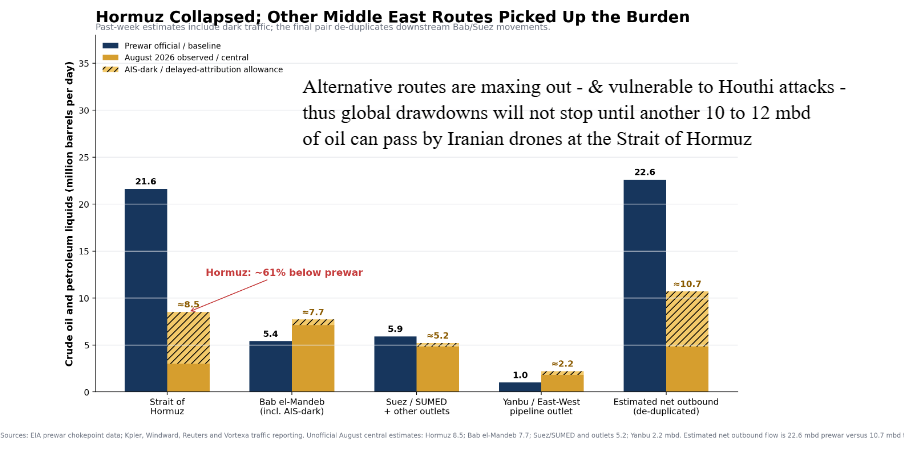
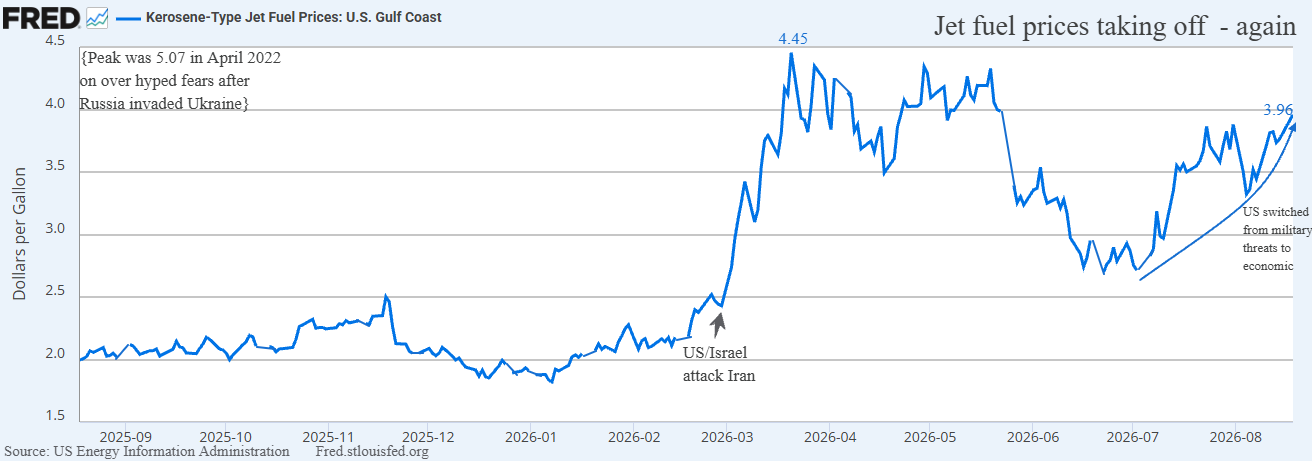
Saudi Arabia’s East-West pipeline and the UAE’s alternative routes provide some relief, but only limited spare bypass capacity. Pipelines are useful things, although they possess the strategic disadvantage of being long, stationary and clearly marked on maps. Should Iran or its regional partners seriously damage the Saudi pipeline network, close Bab el-Mandeb or reduce Hormuz traffic further, then Iran would regain the upper hand in the oil market. Crude above $100 would then be less a prediction than a first approximation. A continued sucking sound from global oil reserves could generate a global energy panic in the fourth quarter of 2026 or first quarter of 2027, particularly because refined-product inventories—not merely crude supplies—are already strained and strategic reserves would begin running out. Transportation fuels would be the first pain points as it relates to Jet Fuel and Diesel.
Living On Borrowed Barrels
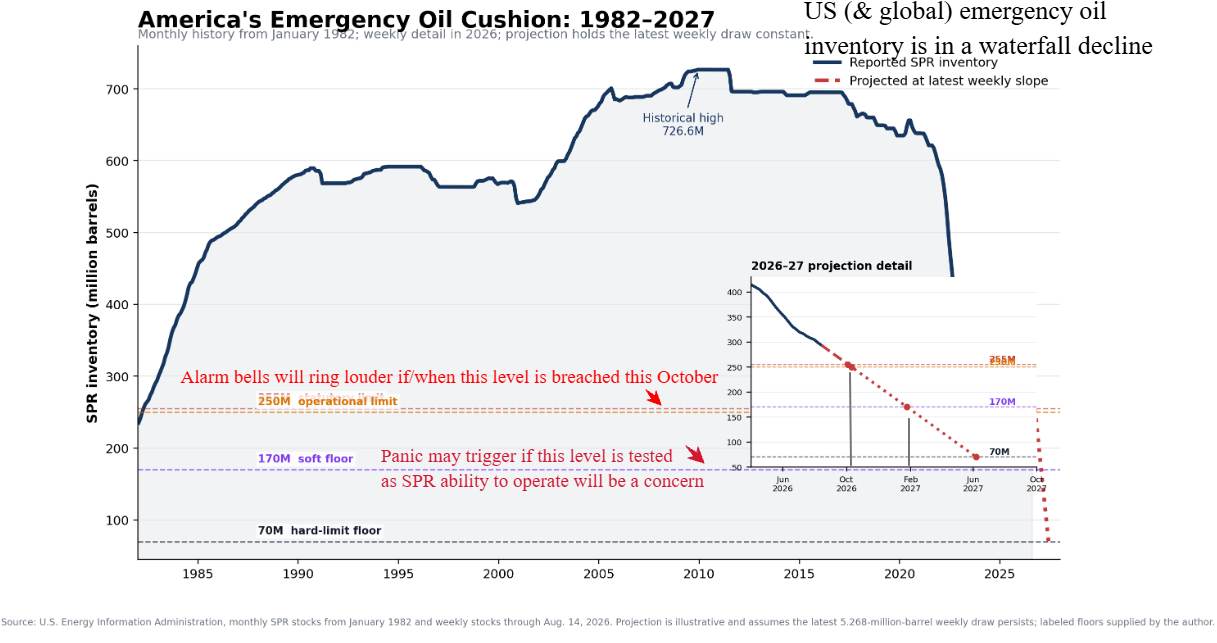
Global observed oil inventories have fallen approximately 410 million barrels since the war began, an average draw of 2.7 million barrels per day. July alone produced another 69-million-barrel decline. The EIA estimates that global stocks fell at an even faster 4.2 million barrels per day during the second quarter and forecasts a 3.8-million-barrel daily draw during the third. The IEA now expects a global oil-market deficit of roughly 1.8 million barrels per day this quarter. With the US strategic reserves (SPR) down to about 293 million barrels of oil, down from 413.3 million in early April—a decline of nearly 120 million barrels in a little more than four months. At the recent average pace, the reserve would approach the 252.4-million-barrel statutory threshold governing certain non-emergency releases around late September or early October. That threshold is an important political and legal alarm bell, although it is not a physical floor and does not prevent a presidentially ordered emergency drawdown. The danger is not literally reaching zero; it is losing the ability to respond credibly to the next disruption and avoiding panic hoarding by consumers and corporations. The President is also well aware that stock market investors and voters are to be ignored at his peril.
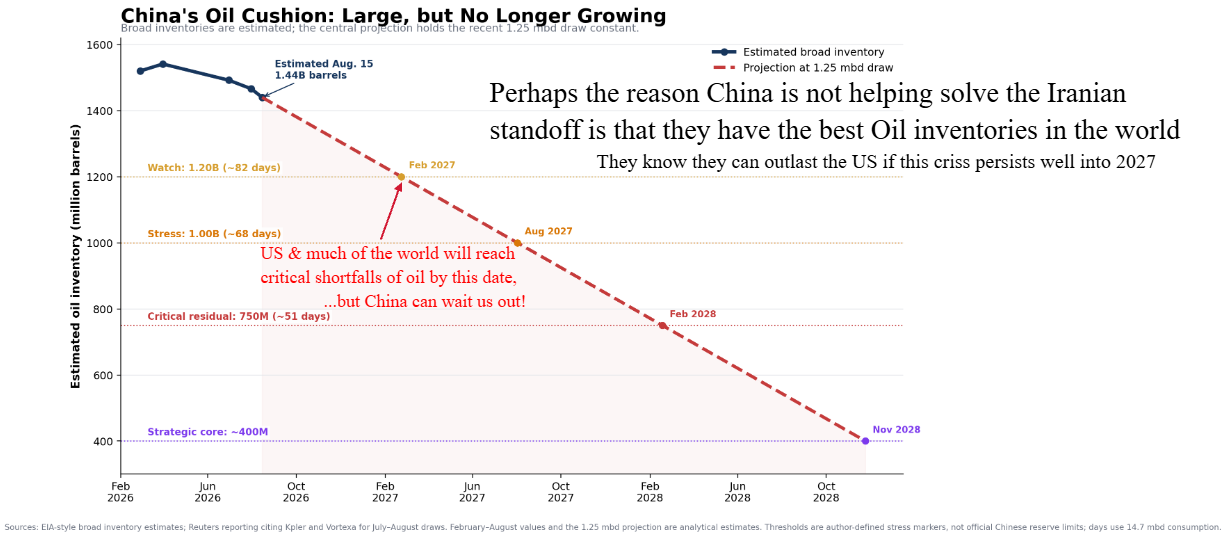
China can wait. Many wonder why China has not negotiated with Iran to open the Strait of Hormuz as they are Iran’s primary destination. Even though China has lost almost 4 million barels per day of oil shipments since before the war, their inventories are far larger than the US and its allies. This chart illustrates that under continual drawdowns, China has no strategic risk of energy shortages for another year or so. They have sharply reduced refinery runs and fuel consumption during the spring and early summer. Some indications show they may even start adding to their strategic oil reserves soon. This appears to be a positive effect from a Dictatoriship that doesn’t worry about losing an election.
The Return of the Bond Vigilantes
Energy markets are not the only place where inventory is being depleted. The Treasury market is also being asked to absorb an imposing supply of paper. The Congressional Budget Office projects a fiscal 2026 deficit of approximately $1.9 trillion. Meanwhile, U.S. corporate borrowing associated with artificial-intelligence investment has reached roughly $220 billion this year, up from only $12.5 billion in 2025. AI companies possess enviable earnings and balance sheets, but even wealthy companies need to borrow other people’s money, thus raising the market price of capital when they arrive at the bank window together carrying loan applications.
Oil compounds the pressure. Higher crude and record-setting diesel and jet-fuel refining margins keep headline inflation elevated, delay the hoped-for decline in core consumer prices and increase the probability that the Federal Reserve will contemplate another rate hike. Higher Treasury yields reduce the present value investors assign to future corporate earnings.
President Trump is already working at the margins. His administration failed this week attempting a new trade agreement for more oil and gas from Canada. More directly, the Treasury has doubled planned buybacks of certain 10- to 30-year Treasuries to at least $4 billion per operation and tapped into a Trillion funding tool at their discretion. The purpose is to improve liquidity and relieve pressure in long-dated bonds, but the political desire for lower yields before November is hardly concealed by the technical vocabulary. Thus far, the bond market remains unimpressed as yields remain at multi-year highs. It is difficult to persuade creditors that borrowing is harmless by buying back old debt with the proceeds of new debt. Any success at bringing rates lower will be brief, but perhaps another 2 months of stall in rising rates is all that is desired.
The Market’s Narrow Stairway
Corporate earnings remain stellar. The AI investment cycle, despite its increasingly debt-financed structure, should continue generating remarkable revenue and productivity growth. These fundamentals can ultimately justify an S&P 500 well above 8,000 in 2027. But “ultimately” is an expensive word on Wall Street.
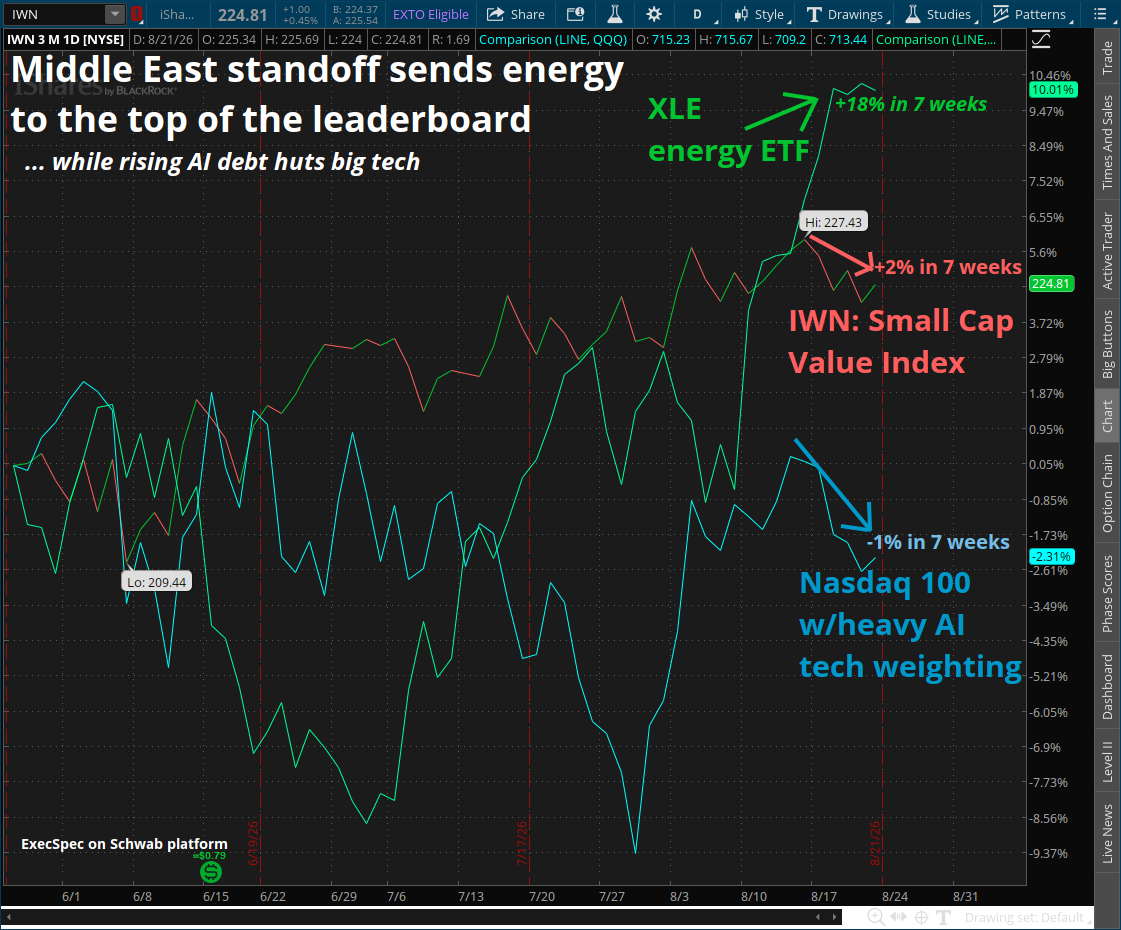
Between now and the November elections, markets face a tug of war between exceptional earnings and an increasingly obstinate cost of capital. Healthcare and energy leadership reflects this adjustment. Healthcare offers comparatively dependable earnings; energy offers the one commodity whose scarcity is forcing the adjustment with no near term prospect of relief.
As long as the S&P 500 holds the upper 7500’s, the stair-step advance can continue. But our summer topping thesis remains intact: a deeper pullback before November would be neither surprising nor fatal to the bull market. It would probably create a buying opportunity—but one requiring patience rather than bravado. One trigger we have been warning about for several months is the ground swell and politcal backlash against data centers. Any cancellation of energy and data center buildouts to meet the excess of AI demand will send shockwaves that reduce forward guidance and lower PE multiples currently projected.
The 10-year Treasury yield closed today at 4.7%. A sustained breakout above 4.74% would technically expose the 4.85%–4.92% zone. A breach of 5% would be more consequential, signaling that the bond market no longer regards energy inflation, fiscal deficits and AI borrowing as temporary irritants.
For equities, the decisive variables are now uncomplicated, even if their resolution is not:
Can Hormuz sustain something nearer 14–15 million barrels per day? Can the Red Sea oil flows resume? Can the 10-year yield remain below 5% and trend lower?
Until those answers improve, the bull market may continue climbing—but it will do so on a staircase bordered by oil barrels on one side and Treasury bonds on the other. Neither makes a particularly forgiving handrail. Energy, healthcare, small cap and cash remain the top sectors of focus for investors.


Comments
Log in or sign up to join the conversation.