

The New Question Is Not Growth, but Return
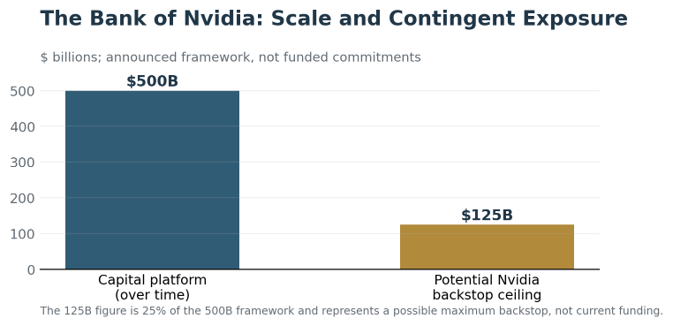
The headline of the week is imposing enough to remind historians of the architects of the old 1860s railroad trusts. In the great build-out of the American rail system after the Civil War, promoters frequently created construction companies they themselves controlled, then awarded those entities inflated contracts at the expense of the operating railroads. Ther left hand was paying the right hand. The most notorious example allowed Union Pacific insiders to bill roughly twice the actual cost of construction, pocket the difference, and distribute discounted shares to members of Congress to secure subsidies and monopolistic standing. Such self-dealing produced overcapitalized enterprises and public outrage that culminated in the Sherman Antitrust Act of 1890, which declared such efforts illegal. As the most valuable company on the planet, Nvidia is a leader in AI investments and a poster child for questionable circular financing arrangements, but there is no hint of illegality, but just a hint of excess speculation. The market is more receptive to Nvidia’s latest AI financing that has enlisted Apollo, BlackRock, Blackstone, Brookfield, Goldman Sachs, and KKR to help mobilize more than $500 billion for AI infrastructure. Investors once asked who could seize AI market share fastest. They now ask who can convert prodigious capital expenditure into profits and free cash flow before technological fashion changes its wardrobe.
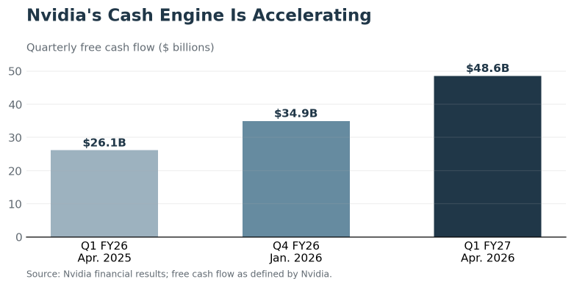
Nvidia is unusually well equipped for this new contest. Its latest quarter produced $48.6 billion of free cash flow (FCF), up from $34.9 billion in the preceding quarter and $26.1 billion a year earlier. We estimate FCF over the next 4 quarters to approach $200 billion. A company producing cash at that velocity can afford to behave like a shadow bank. The more important question is whether it should—and will investors look past the increasing use of profits to fund distant and more speculative returns.
From Circular Finance to Institutionalized Vendor Finance
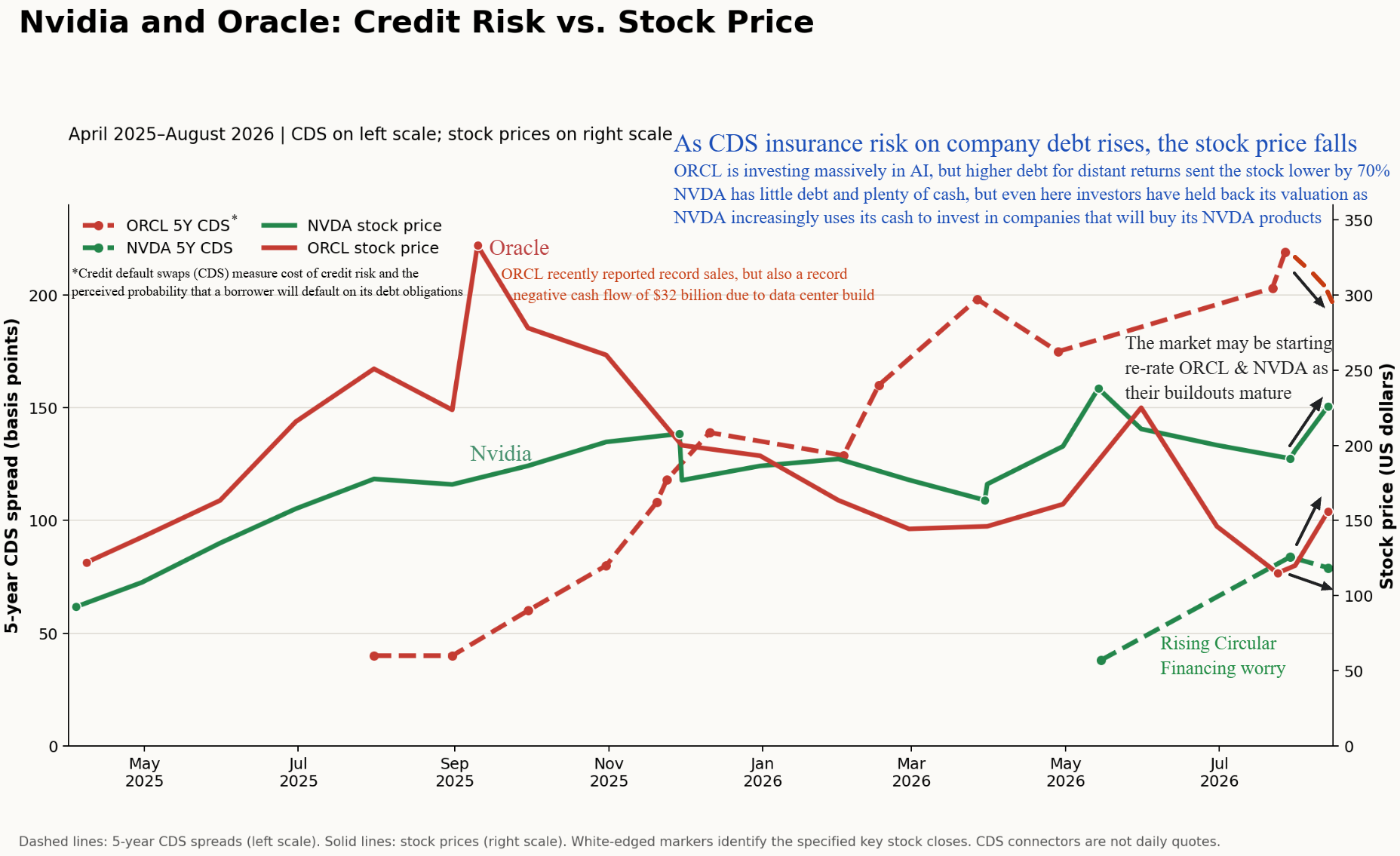
This distinction matters. Nvidia’s earlier equity investments, capacity guarantees, and customer support were more vulnerable to the charge of circularity: capital left Nvidia, strengthened a purchaser, and returned as demand for Nvidia products. That resembled venture capital with a strategically convenient shopping list.
The new arrangement is structurally sturdier because most capital is external and professional investors must assess GPU utilization, contractual cash flow, counterparty quality, and residual chip value. The fulcrum is residual value. An energy power plant may remain useful for decades; an AI accelerator can become technologically aged before its financing paperwork has a chance to collect dust. Nvidia argues that CUDA, fungibility across workloads, and a deep ecosystem extend the productive life of its systems. NVDA is guaranteeing a 25% residual value of its systems and there is evidence of allegedly obsolete Nvidia system iterations that continue to command a mature value. However, at “some point” technology will accelerate and lower residual values and increase financing risk, thus investors should watch realized utilization, lease renewal rates, secondary-market pricing, loan-to-value ratios, and the concentration of end users.
The Market Is Becoming Less Monarchical and More Egalitarian
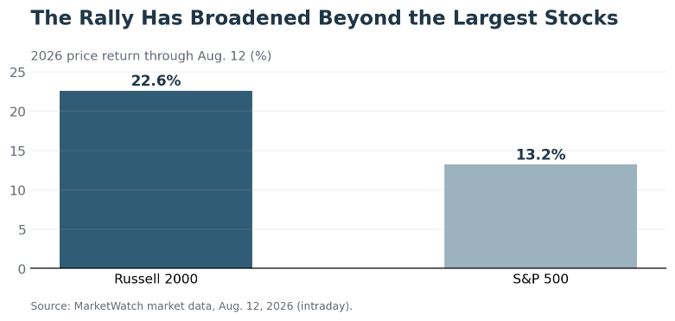
Capital has been migrating from the concentrated heights of mega-cap growth toward small- and mid-cap shares. Through August 12, the Russell 2000 had gained about 22.6 percent in 2026, versus 13.2 percent for the S&P 500. That is not proof that valuation no longer matters; it is evidence that the bull market has acquired more voters.
The valuation argument remains attractive for narrow and broad indices as earnings accelerate higher. Nvidia’s forward multiple is similarly estimate-sensitive ahead of its August 26 earnings report. Rapid earnings growth can make today’s 24x forward multiple look modest. If not for Nvidia’s many financing agreements and shadow banking, investors would quickly add another 20 to 30% to today’s valuation to achieve the premium market multiple it would have deserved.
Benign Economic Conditions
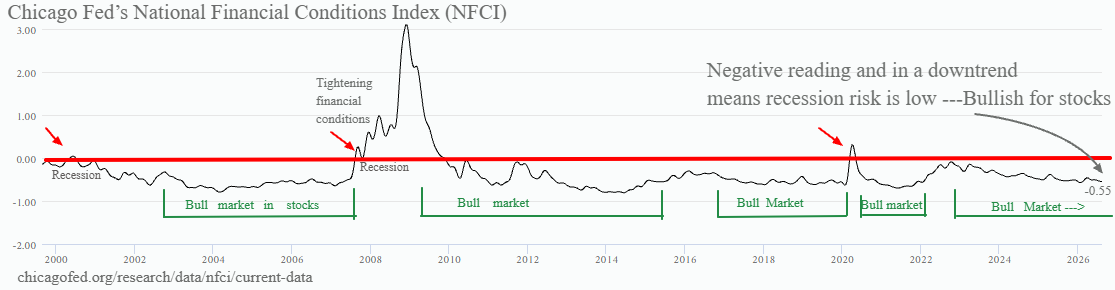
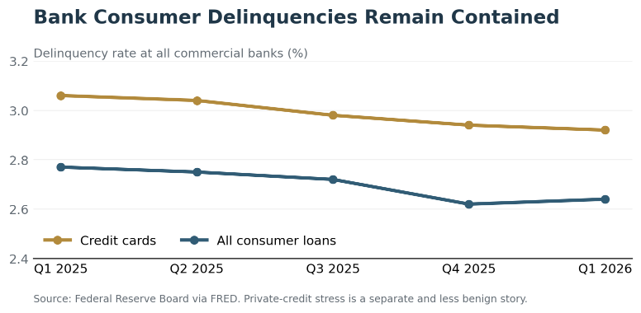
The economic setting remains constructive. The latest Chicago Fed’s National Financial Conditions Index stood at -0.55, trending lower, indicating financial conditions are looser than their historical average. Bank-reported consumer-loan and credit card delinquency rates are low and trending lower. Banks report healthy customer balance growth. Wages in all brackets, especially lower income, are growing. Corporate profits and labor income remain supportive enough to deny the bears their preferred recessionary script. Should the NFCI trend upward and attempt to reach a positive reading, we will quickly raise the warning flag.
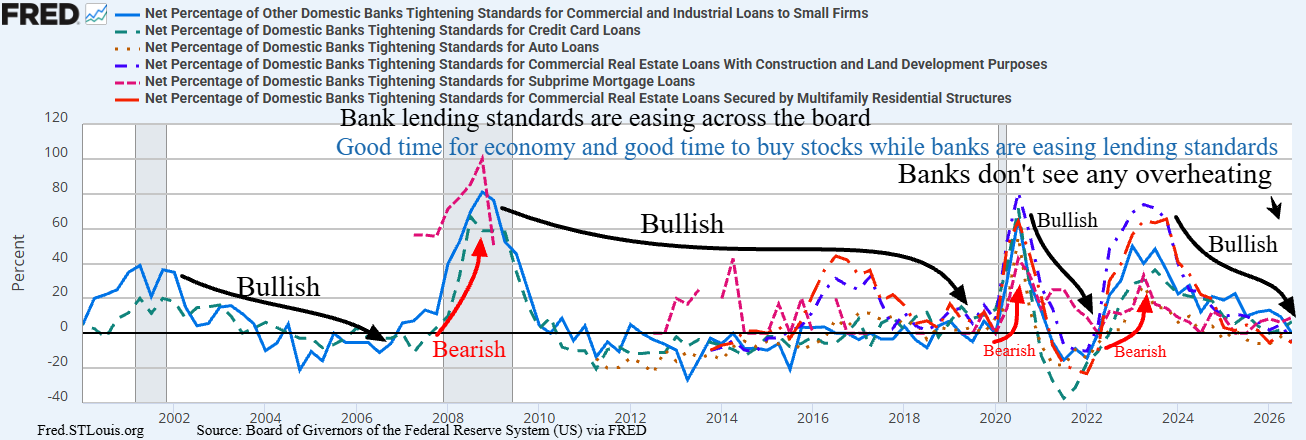
The Federal Reserve’s Senior Loan Officer data add a useful confirmation. Across small-business C&I loans, credit cards, auto loans, commercial real estate, subprime mortgages, and multifamily lending, the net share of banks tightening standards has trended lower from the post-pandemic peaks. A declining positive reading means fewer banks are tightening; a reading below zero means more banks are easing than tightening. Either way, the direction is toward greater credit availability across a broad range of borrowers—usually a friend to economic activity, earnings, and smaller-company stocks. Credit is moving from restraint toward accommodation, which is bullish until easier money begins financing weaker projects rather than productive expansion.
The Tactical Map
Geopolitical alarms surrounding Middle Eastern energy flows and the November elections can still produce brief, sharp corrections, and midterm election years often exhibit some relative weakness between late August and mid October. Politics can interrupt a bull market without repealing its earnings trajectory. The more durable supports remain profit expansion, labor-market resilience, accessible credit, and an AI investment cycle that has not yet exhausted either capital or ambition.
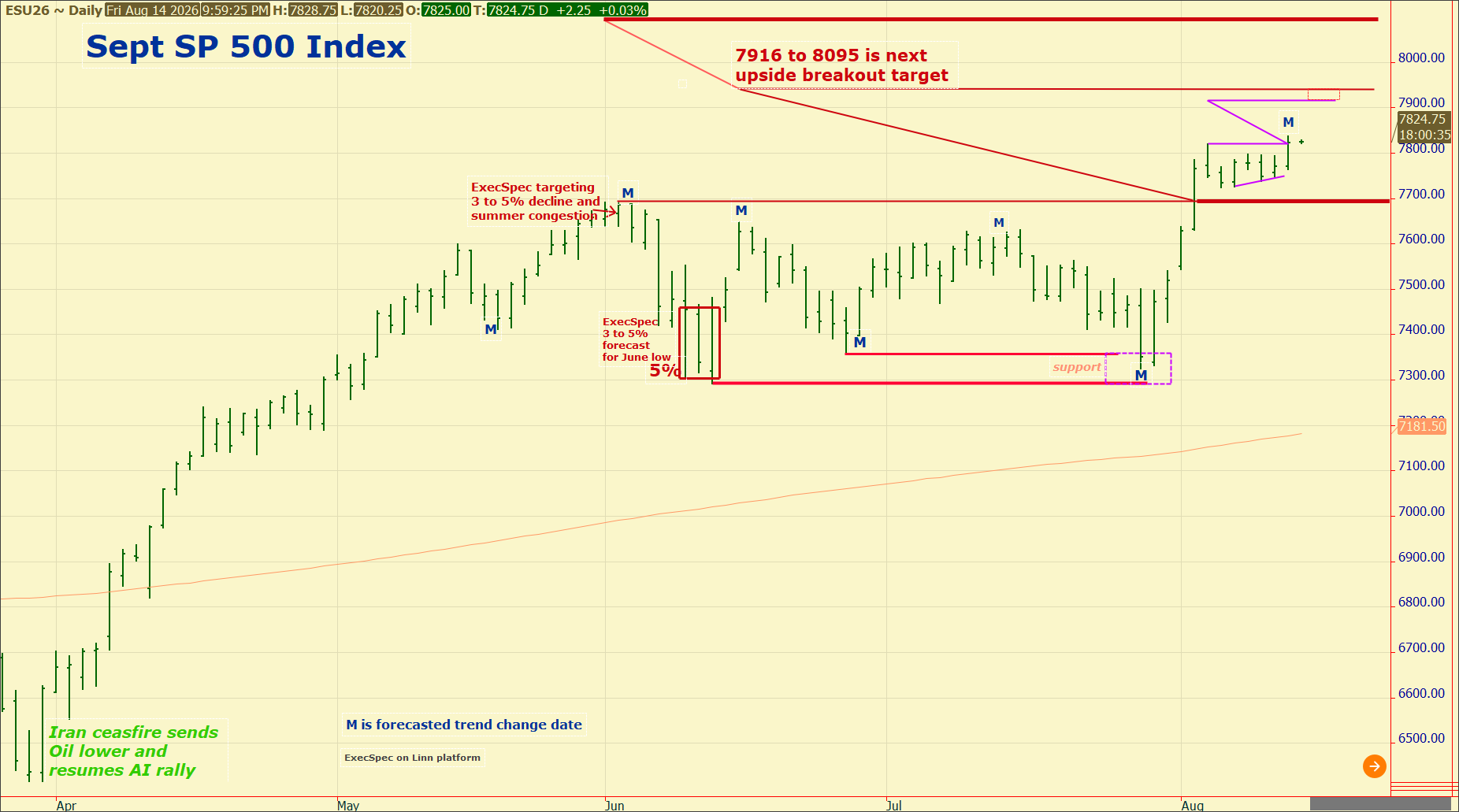
Technically, the cash S&P 500’s breakout area near 7,600 (7694 basis Sept’ S&P) now serves as an important line of demarcation. So long as that zone holds on a closing basis, the advance can plausibly extend toward 7,900-8,100 in the near term. A sustained break below 7,600 would not by itself proclaim recession, but it would suggest that the market is beginning to discount tighter financial conditions, energy disruption, election risk, or disappointment in the conversion of AI spending into cash returns.
The investment risk for this silicon Bull market is not simply far left ‘progressive wins.’ It is any policy combination—whether from the left or right—that delays permitting, restricts power development, impedes transmission, constrains advanced-chip markets, or makes long-duration capital less available. AI factories require electricity, land, cooling, financing, and regulatory expediency. The AI-powered economy advances as more than a speculative fever. It is a productivity engine still in the early innings of application, accompanied by promoters, leverage, grand claims, and a shortage of humility. Prudence requires watching utilization, residual values, customer concentration, and the terms of Nvidia’s backstop. Wisdom requires noticing the other side of the ledger: extraordinary free cash generation, broader market leadership, loose financial conditions, and an economy still capable of financing expansion. The danger is not that Nvidia has become a bank. The danger would be forgetting that, whenever technology companies become banks, investors must analyze both the technology and the loan book.
The headline of the day: Nvidia partners with asset managers to fund $500 Billion AI build-out. Investor focus has shifted from who can capture market share the quickest. It now targets profits and free cash flow from their AI capital expenditures most rapidly. With almost $200 billion in free cash generation projected over the next year, Nvidia can certainly afford to be a shadow bank providing capital to AI companies that also need Nvidia chips. Prior financing rounds had the appearance of over leverage and speculation as Nvidia provideed customers money to by its product in a circular financing operation reminiscent of prior bubble buildouts in history.
In the latest maneuvers of the semiconductor colossus, there is a certain ingenuity that might have impressed—and alarmed others—the architects of the old 1860s railroad trusts. In the great build-out of the American rail system after the Civil War, promoters frequently created construction companies they themselves controlled, then awarded those entities inflated contracts at the expense of the operating railroads. The most notorious example allowed Union Pacific insiders to bill roughly twice the actual cost of construction, pocket the difference, and distribute discounted shares to members of Congress to secure subsidies and monopolistic standing. Such self-dealing produced overcapitalized enterprises and public outrage that culminated in the Sherman Antitrust Act of 1890, which declared such efforts illegal. As the most valuable company on the planet, Nvidia is a leader in AI investments and a poster child for questionable circular financing arrangements.
Nvidia’s recent arrangement is different in structure and spirit than the blatant corruption of the old Railroad Trusts and the late 1990s financing for startups that lacked customers. Nvidia has signed memorandums of understanding with a constellation of Wall Street institutions—Apollo, BlackRock, Blackstone, Brookfield, Goldman Sachs, and KKR—to mobilize more than half a trillion dollars of third-party capital for the construction of “AI factories.” Independent financiers will underwrite the deals according to their own assessments of demand, cash flow, and residual value. Nvidia supplies the technology platform and retains an optional backstop of up to 25 percent (which allows for some depreciation). There is no parallel to the railroad-era device of a sham contractor owned by the same insiders, no systematic inflation of costs for private extraction, and no evident resort to political favoritism. The capital is largely external and risk is more widely distributed.
This is not the same as Nvidia’s earlier practice of equity infusions and capacity guarantees into the companies that then purchase its products. Those earlier transactions invited the charge of circularity—capital exiting the firm’s coffers only to return as revenue. That was more of a venture capital funding arrangement. Whether residual values of rapidly evolving hardware will justify the long-duration financing remains an open question; yet with free cash flow already measured in the hundreds of billions annually, the company’s own exposure appears containable. (almost $50 billion free cash flow in the latest quarter)
The broader market, meanwhile, continues to hold its ground and to broaden its participation. Capital is still migrating from the concentrated heights of large-cap growth toward the less exalted sectors of small- and mid-capitalization value. The hyperscalers and Nvidia itself, tapping debt and equity markets while deploying prodigious free cash, now trade at restrained multiples more restrained than in their recent glory days. Today’s 25.5 forward estimated price to earnings multiple is likely to fall further after another expected blowout earnings report August 26th. If not for continued NVDA financial backing of the broader AI buildout, the stock price would be considerably higher. Investors have grown more discriminating about distant returns that carry technological, utilization and obsolescence risk relative to nearer-term payoffs.
Small- and mid-cap equities at a 14 forward PE multiple valuation, by contrast, remain far from richly valued. The economy they inhabit shows scant evidence of systemic strain. Financial stress indices and credit spreads rest at levels that history regards as safe. Delinquency and default rates among consumers and businesses linger near historical lows. Corporate profits continue to set records; wage growth remains robust, particularly among lower-income cohorts. Sentiment is moderately optimsitic, which seems quite restrained given how frequently the various stock market indices are hitting record highs each week.
Geopolitical alarms surrounding energy flows from the Middle East and the approaching November elections can, of course, still produce the brief but sharp corrections over the next few months. Yet the underlying conditions—profit expansion, labor-market strength, and the absence of financial fragility—suggest that any third-quarter or early fourth-quarter dip is more likely to be yet another opportunity than a harbinger. More record highs lie ahead, provided one retains the patience to distinguish between noise and signal. As long as the 7600 S&P breakout artea holds as support, we would expect the curent breakout to continue higher into the 7900 – 8000 zone. Other than “potential” concerns over energy shortages as the Middle East Oil and Gas curtailment continues and the risk of more Progressive politcal wins that threaten to apply the brakes upon the AI buildout that has become a major factor in US economic growth. However, for now, earnings and AI investment are reaching new heights with no signs of abatement. All income levels show improving finacial balance sheets and banks are anxious to increase lending as barriers to loans are falling. Demand for product and capital is in excess while supply is increasiongly in shortage as far as the two year horizon is visible.
The AI-powered economy advances not as a speculative fever alone but as a productivity engine still gathering force in the early innings of application. Prudence requires that one watch the residual values and the utilization rates. Wisdom suggests that one also note the market’s quiet diversification and the economy’s measured resilience.


Comments
Log in or sign up to join the conversation.