

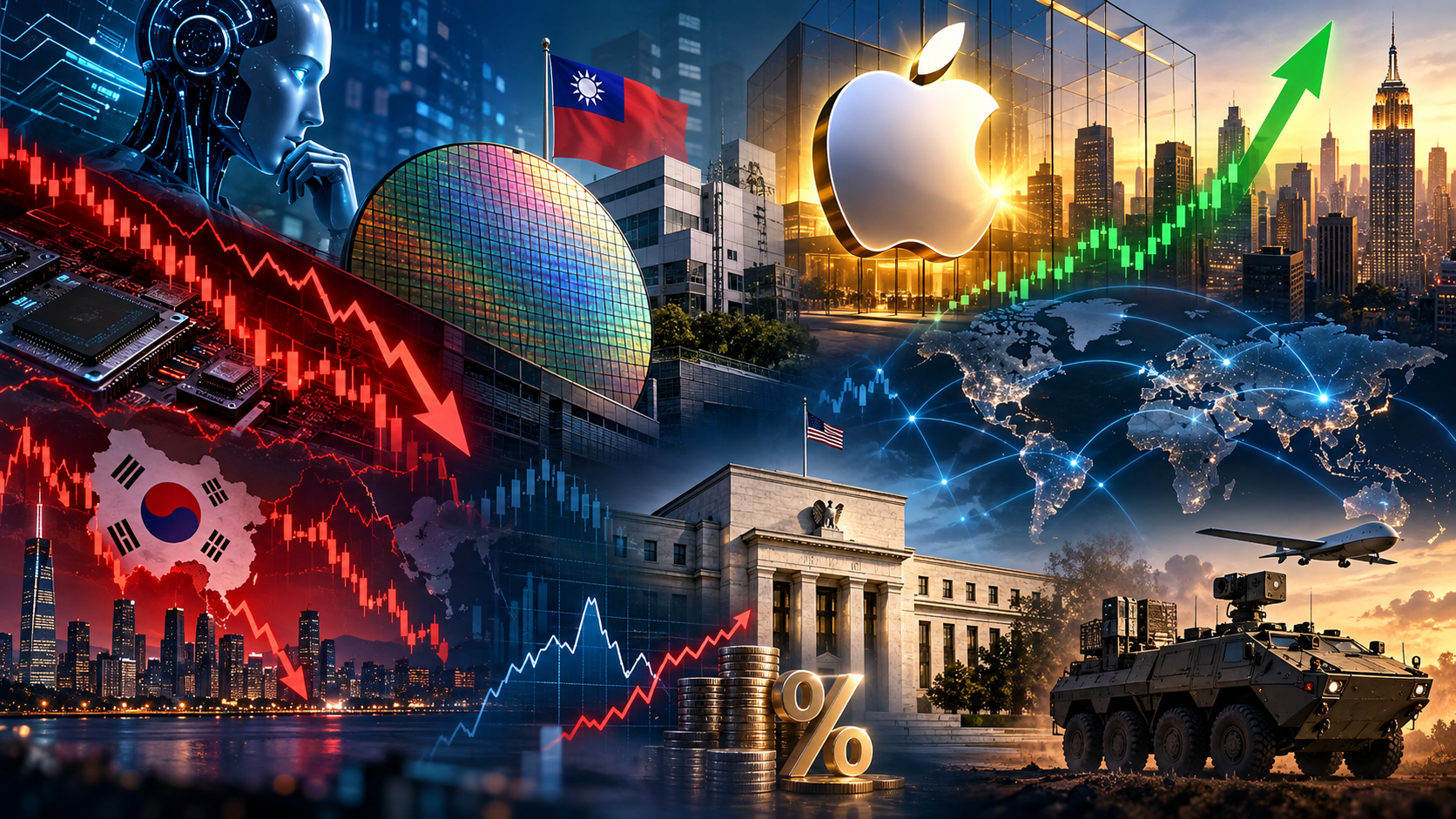
Wall Street managed to find its footing on Thursday, but the recovery concealed a growing divide beneath the surface. The Dow Jones Industrial Average gained more than 550 points, even as technology stocks struggled to recover from a global semiconductor rout. Meanwhile, Taiwan Semiconductor (TSM) delivered spectacular earnings, Apple reached a historic valuation milestone, and investors continued debating whether the AI boom's enormous spending commitments could ultimately become its greatest vulnerability.
The Dow climbed 1.08%, the S&P 500 gained 0.33%, and the Nasdaq edged up just 0.08%. The Russell 2000 advanced 1.37%, suggesting that investors weren't abandoning equities altogether. Instead, they appeared increasingly selective about where to put their money.
AI's Biggest Winners Face Tougher Questions
Few companies illustrate the contradiction in today's market better than Taiwan Semiconductor Manufacturing Company (TSM).
In TSMC Earnings Crush Estimates As Profit Jumps 69%, But Stock Still Faces Big Test, Invezz's Devesh Kumar reported that the world's largest contract chipmaker delivered a 68.7% year-over-year increase in quarterly net income, beating analyst expectations. Revenue surged 50.9%, driven by extraordinary demand for advanced chips used in artificial intelligence.
Those numbers would ordinarily provide a powerful boost to semiconductor sentiment. Instead, investors remained skeptical.
In Nasdaq 100 Futures Fall 1% As TSMC Fails To Revive The AI Trade, Fawad Razaqzada examined why even strong earnings from a central player in the AI supply chain weren't enough to restore confidence.
The issue is no longer whether AI demand exists. Clearly, it does. The harder question is whether the companies investing hundreds of billions of dollars in infrastructure will generate sufficient returns to justify their spending and valuations.
That distinction could become increasingly important as the AI trade matures.
Apple Stands Apart From the Crowd
While much of the technology sector faced selling pressure, Apple (AAPL) offered a striking contrast.
In Apple Hits $5 Trillion As Nvidia Drops 7%: The Mag 7 Split, Money Morning's Cody Alexander highlighted Apple's achievement of a $5 trillion market capitalization, even as Nvidia (NVDA) and other AI-linked companies faced growing scrutiny.
Apple's resilience reflects a different investment proposition. Its established ecosystem of devices and services provides substantial recurring revenue, while its AI initiatives offer potential upside without requiring investors to value the company primarily on the promise of future AI infrastructure returns.
Nvidia remains a dominant force in AI computing, but the divergence suggests that investors are beginning to distinguish between companies selling the tools of the AI revolution and those expected to monetize the technology over time.
For a market long driven by a relatively small group of technology giants, that shift could have significant implications.
A Semiconductor Rout Goes Global
The anxiety surrounding AI wasn't confined to Wall Street.
In KOSPI Plunges 7% As Analysts Warn The Market Is In Denial, new TalkMarkets contributor AllinAllSpace examined the sharp selloff in South Korean equities, where major semiconductor manufacturers came under intense pressure.
The rout reflected mounting concerns about AI valuations, elevated Treasury yields, and the possibility that years of extraordinary investment expectations have pushed share prices too far ahead of underlying fundamentals.
Not everyone believes a broader collapse is inevitable. But the magnitude of the selling in Asia illustrates just how interconnected the global AI trade has become.
A correction in one major chipmaking market can quickly affect sentiment toward technology companies thousands of miles away.
Inflation Keeps the Fed in a Difficult Position
Technology valuations weren't the market's only concern.
In Daily Market Outlook – Thursday, Oct. 15, Patrick Munnelly explored the increasingly complicated environment confronting the Federal Reserve.
September's consumer price index rose 0.65% month over month, pushing annual inflation to 3.74%. Higher energy costs played a significant role, while core inflation also accelerated.
Ordinarily, hotter inflation would strengthen expectations for additional rate hikes. Yet Treasury yields declined as investors sought the relative safety of bonds amid the equity selloff.
That leaves policymakers facing an uncomfortable balancing act: inflation remains stubborn, but tighter financial conditions and weakening market confidence could threaten economic growth.
The Fed's next moves may depend as much on whether financial stress spreads beyond technology as on the inflation numbers themselves.
A Defense Transformation Worth Watching
Away from the mega-cap technology headlines, a smaller company made a significant strategic announcement.
In NUBURU Makes A Bold Defense Pivot. What Comes Next?, author Cents For Sense examined NUBURU (BURU)'s (BURU) acquisition of a 70% controlling interest in Italian defense manufacturer Tekne.
The transaction brings approximately 185 employees, three manufacturing facilities, and specialized electronic-warfare and military-mobility capabilities into NUBURU's expanding defense platform.
It also introduces a reported $93.1 million portfolio of remaining program value, offering a tangible foundation for the company's transition away from its historical focus on industrial laser technology.
The acquisition is a meaningful milestone, but execution remains the central challenge. Integrating operations, securing financing, and converting program opportunities into profitable revenue will determine whether the transformation ultimately creates lasting shareholder value.
The Bottom Line
Thursday's rebound offered some welcome relief after Wednesday's selloff, but it didn't resolve the market's biggest questions.
TSMC's earnings demonstrated that AI demand remains exceptionally strong. Apple's valuation milestone showed that investors still reward established technology franchises. And the Dow's outperformance suggested that opportunities exist beyond the most crowded growth trades.
Yet the global semiconductor rout and renewed concerns about AI financing point to a market becoming more demanding.
The AI revolution may be far from over. But investors increasingly want something more concrete than ambitious spending plans and projections of future growth.
The next phase of the market may be less about who can spend the most on AI, and more about who can turn that spending into sustainable profits.
Comments
Log in or sign up to join the conversation.