


Global equities sold off sharply as the chip sector came under renewed pressure, raising fresh doubts about the durability of the AI-led rally. The MSCI Asia Pacific Index fell 2.8%, heading for its lowest close since July, while Nasdaq 100 futures dropped 0.9%. European futures pointed to a weaker open, with losses of around 1% expected. The epicentre was South Korea. The Kospi plunged as much as 8%, triggering a temporary trading halt, while Samsung and SK Hynix fell more than 10%. The scale of the move reflects a broader reassessment of AI positioning. Investors are questioning whether the enormous capital being committed to AI infrastructure will generate sufficient returns, particularly with valuations elevated, supply-chain bottlenecks visible and competition intensifying.
This is no longer just a semiconductor correction; it is a challenge to the market’s dominant leadership theme. Since the AI trade has carried a large share of global equity performance, weakness in chips has a disproportionate index impact. Narrow breadth had already left markets vulnerable. Today’s move shows what happens when the leadership cohort starts to wobble.
The selloff followed pressure in US chip names, where investors rotated toward safer assets. Nasdaq 100 futures extended the decline, and broader equity futures softened. The key issue is whether this becomes a short, positioning-led flush or a deeper reassessment of AI earnings power. The answer will depend on upcoming guidance around AI demand, capex returns, margins and end-user monetisation. Bonds rallied as risk appetite deteriorated. The US 10-year Treasury yield fell 8 bps to 5.11%, while the two-year yield declined 7 bps to 4.72%. The move suggests investors are treating the equity selloff as a growth and financial-conditions shock, despite yesterday’s inflation data showing the fastest monthly CPI increase in five months. The Dollar weakened as traders reassessed the Fed outlook. That reaction is important. A hot CPI print would ordinarily support the Dollar and yields by reinforcing expectations of further tightening. Instead, the equity selloff and renewed concern over financial conditions have complicated the signal. Markets are now weighing sticky inflation against the possibility that falling equities and tighter credit conditions may do some of the Fed’s work.
September CPI rose 0.65% m/m, slightly above the 0.6% consensus, lifting the annual rate to 3.74% from 3.40%. The rise was driven largely by oil’s impact on transport and home energy costs. Core CPI rose 0.33% m/m, above the 0.2% consensus, pushing the annual core rate to 2.56% from 2.45%. The print was hot, but not a decisive upside regime shift.
There was limited evidence of energy bleeding broadly into core prices, though shelter costs generated isolated momentum. That gives the Fed some room to argue that the headline move is still primarily energy-driven. However, it is early days. Surveys and corporate profits data suggest firms retain pricing power, meaning higher input costs could still be passed through if oil remains elevated. Producer-level pressures already appear to be building. PPI and import/export price data will therefore matter because they can reveal whether the oil shock is travelling through supply chains. Food prices softened again, providing some near-term relief, but energy is a major input into processed costs. That creates future upside risks even if the current month’s data look contained outside transport and shelter.
The other consequence of higher inflation is the hit to real wages. With nominal wage growth slowing, real wages have slipped back into mildly negative territory. That helps explain why strong headline GDP is not translating into improved confidence for many households. The K-shaped economy remains central: asset owners and AI winners have benefited, but the lower 80% are still facing pressure from prices, borrowing costs and weaker real income growth.
Oil remains a central macro risk. Rising prices amid ongoing Middle East tensions continue to intensify inflation concerns and keep central banks cautious. Even if Brent moves are not the immediate driver of today’s equity selloff, they form the backdrop that makes the Fed’s reaction function more difficult. Persistent energy pressure limits the ability of policymakers to respond dovishly to weaker risk assets.
Attention now turns to Fed Chair Warsh’s remarks in Bangkok on Friday. Markets want to know how the Fed balances three competing forces: sticky inflation, softer labour signals and renewed equity-market stress. If Warsh emphasises inflation risks, the bond rally could reverse. If he acknowledges tighter financial conditions, markets may lean further into the idea that the Fed can pause after one final hike, or even avoid additional tightening if stress deepens. The policy message will also depend on whether officials see the equity selloff as disorderly or merely a valuation correction. A decline led by overextended AI names may not concern the Fed as much as a broader credit tightening or funding-market strain. For now, credit spreads and liquidity indicators will matter as much as equity indices.
The UK delivered a stronger-than-expected growth print. August GDP rose 0.1% m/m, defying expectations for a 0.1% decline. Taking revisions into account, even flat September output would leave Q3 GDP growth at 0.7% q/q, far above the BoE’s July Monetary Policy Report projection of 0.1%. That materially strengthens the case that the economy has been more resilient than policymakers expected. On a smoothed three-month basis, services remain the dominant contributor to growth. August also saw particular strength in manufacturing, although this was concentrated in a spike in pharmaceuticals. More broadly, the ONS noted that around half of the 1.8% y/y growth in the three months to August came from computer programming and consultancy, scientific R&D, legal activities and information services. That suggests the UK is receiving some uplift from the global AI and tech boom. That said, the growth mix is not uniformly strong. Construction continues to decline, led by weaker new work in private housing. This remains a rate-sensitive warning sign. Higher borrowing costs are still biting in property-linked activity, even as services and tech-adjacent sectors provide support. The firmer GDP data reinforces expectations that the BoE will hike Bank Rate in November. The primary reason remains inflation, but stronger activity makes tighter policy easier to justify. If the economy is growing materially faster than the BoE projected, policymakers may assume it can absorb higher rates better than previously thought. That said, resilience at the aggregate level does not eliminate household-level stress.
The UK remains vulnerable to the same K-shaped dynamic visible elsewhere. Growth in higher-value services and tech-linked sectors can flatter aggregate GDP, while construction, lower-income households and credit-dependent consumers struggle. The BoE must decide whether to respond to headline resilience or underlying distributional weakness.
In Europe, the equity selloff arrives with French fiscal risk still unresolved. Markets remain focused on budget debates and whether deficit reduction is politically deliverable. Wider French spreads have so far reflected fundamentals rather than disorderly conditions, limiting the case for ECB intervention. But any spillover into Italian or broader peripheral spreads would bring fragmentation risk back onto the policy agenda.
China remains another source of concern. The recent weakness in Asian technology shares is partly tied to fears of rising Chinese competition in semiconductors and AI supply chains. At the same time, Chinese domestic equities remain under pressure from doubts about stimulus effectiveness. That combination is uncomfortable: China is seen as a competitive threat in some global sectors, but not yet as a convincing domestic-demand engine.
Macro to Micro, markets are facing the sharpest test yet of the AI-led rally. Chip stocks are cracking, Asia is under pressure, Nasdaq futures are lower and bonds are catching a strong safety bid. CPI was hot enough to keep the Fed cautious, but the equity selloff and weaker Dollar show that markets are now pricing a more complicated trade-off between inflation and financial conditions. For traders, the key markers are Korean tech, Nasdaq breadth, the US 10-year yield, Brent, credit spreads, Warsh’s Friday remarks and whether the chip selloff remains contained or becomes a broader equity de-risking cycle.
Overnight Headlines
Asian Stocks Plummet As AI Debt And Inflation Fears Bite
US Considering Using ‘Mother Of All Bombs’ Against Iran, Sources Say
US Considers Easing Sanctions On Shadow Fleet Vessels, Official Says
US Floats Unfreezing Some Russian Assets To Restart Ukraine Peace Talks
Saudi Arabia Has No Intention Of Backing Down Against Houthis
Ukraine To Resume Strikes On Russian Refineries, Zelenskyy Says
Ukraine Says Starlink Partially Restored After Slowdown
Fed’s Goolsbee Says Inflation Discouraging, Warns of Overheating
Fed's Daly Says Rate Hikes Likely Needed, But Not Urgently
ECB May Not Have to Do as Much If Markets Tighten, Dolenc Says
ECB Probably Needs To Embrace Mildly Hawkish Stance, Knot Says
UK’s Healey Says He Will “Stay The Path” On Deficit Reduction
Chancellor Healey Is To Rule Out Capital Gains Tax Rise
Australian Employment Falls In September, Quashing Rate Hike Risk
China Seems Routing US Treasury Holdings Through Canada
Anthropic Revenue Jumps 50% To $16.8B In Third Quarter
Nvidia CEO Says He Would Cut Off Buyers Who Build Unsafe AI
Apple Prepares to Debut First AI Features in China in December
Tesla-SpaceX Deal News Possible This Year, Barclays Analyst Says
A Swiss Banking Giant Thinks The Unthinkable: Moving Out Of Switzerland
SK Hynix Conditions New US Factory On More Chipmaking Exports To China
FX Options Expiries For 10am New York Cut
(1BLN+ represents larger expiries and is more magnetic when trading within the daily ATR.)
EUR/USD: 1.1500 (EU3.11b), 1.1250 (EU2.67b), 1.1400 (EU2.21b)
USD/JPY: 156.00 ($1.39b), 158.00 ($1.34b), 158.50 ($734.9m)
AUD/USD: 0.7000 (AUD1.31b), 0.7020 (AUD850m), 0.6900 (AUD657m)
GBP/USD: 1.3325 (GBP426.6m), 1.3200 (GBP376.7m)
EUR/GBP: 0.8480 (EU826.6m), 0.8650 (EU432.4m)
USD/BRL: 5.1750 ($709.5m), 5.0500 ($469.5m)
USD/MXN: 17.15 ($644.2m), 17.35 ($477.3m), 18.10 ($409.9m)
USD/CAD: 1.4150 ($462.6m)
USD/CNY: 6.7000 ($326.8m), 6.7500 ($308.1m)
NZD/USD: 0.5790 (NZD466m), 0.5910 (NZD380.1m), 0.5565 (NZD350m)
USD/KRW: 1 410.00 ($358.3m)
CFTC Positions as of 9/10/26
Equity fund speculators increase S&P 500 CME net short position by 41,003 contracts to 396,700
Equity fund managers raise S&P 500 CME net long position by 3,101 contracts to 904,356
Speculators increase CBOT US 5-year Treasury futures net short position by 167,830 contracts to 1,163,531
Speculators trim CBOT US 10-year Treasury futures net short position by 4,134 contracts to 896,481
Speculators increase CBOT US 2-year Treasury futures net short position by 60,880 contracts to 852,904
Speculators trim CBOT US UltraBond Treasury futures net short position by 50,097 contracts to 276,339
Speculators trim CBOT US Treasury bonds futures net short position by 67,063 contracts to 119,812
Bitcoin net long position is 2,540 contracts
Swiss franc posts net short position of -23,740 contracts
British pound net short position is -97,611 contracts
Euro net short position is -99,332 contracts
Japanese yen net long position is 62,325 contracts
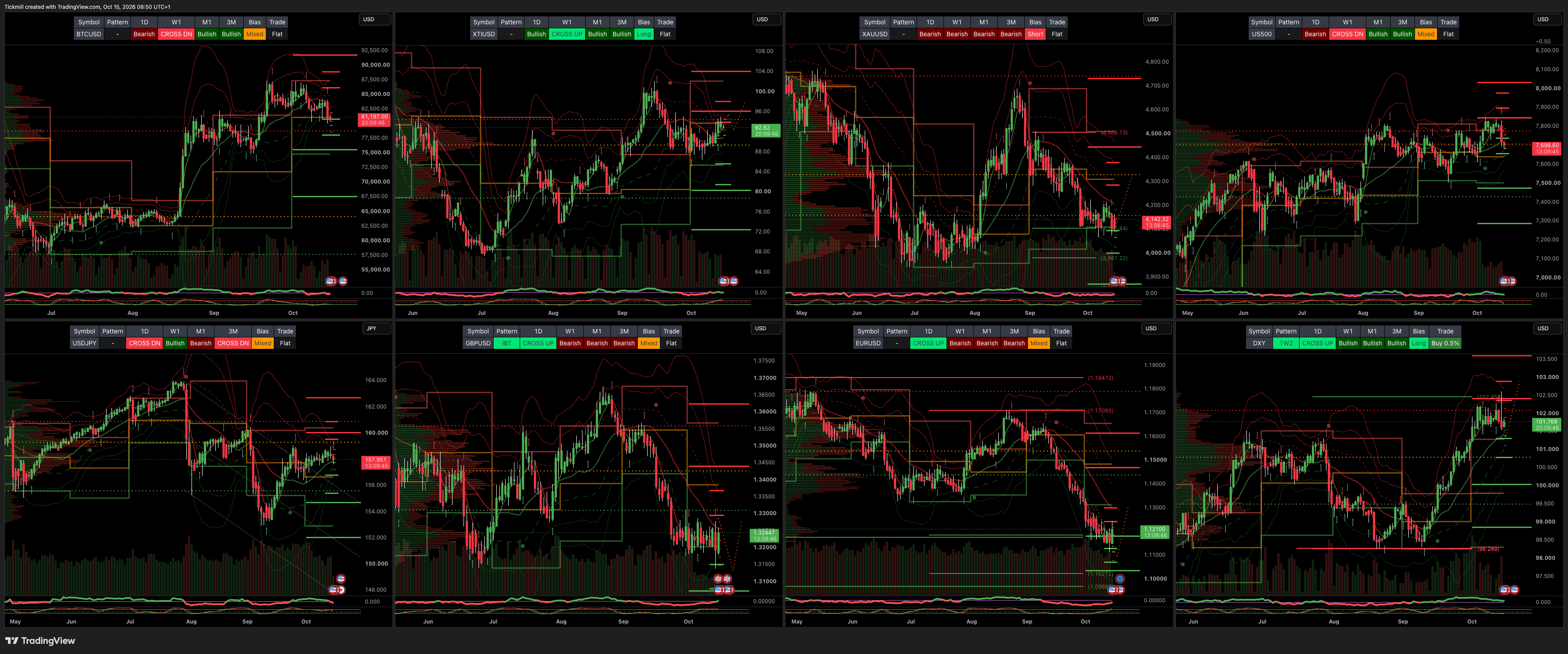
Technical & Trade Views



Comments
Log in or sign up to join the conversation.