


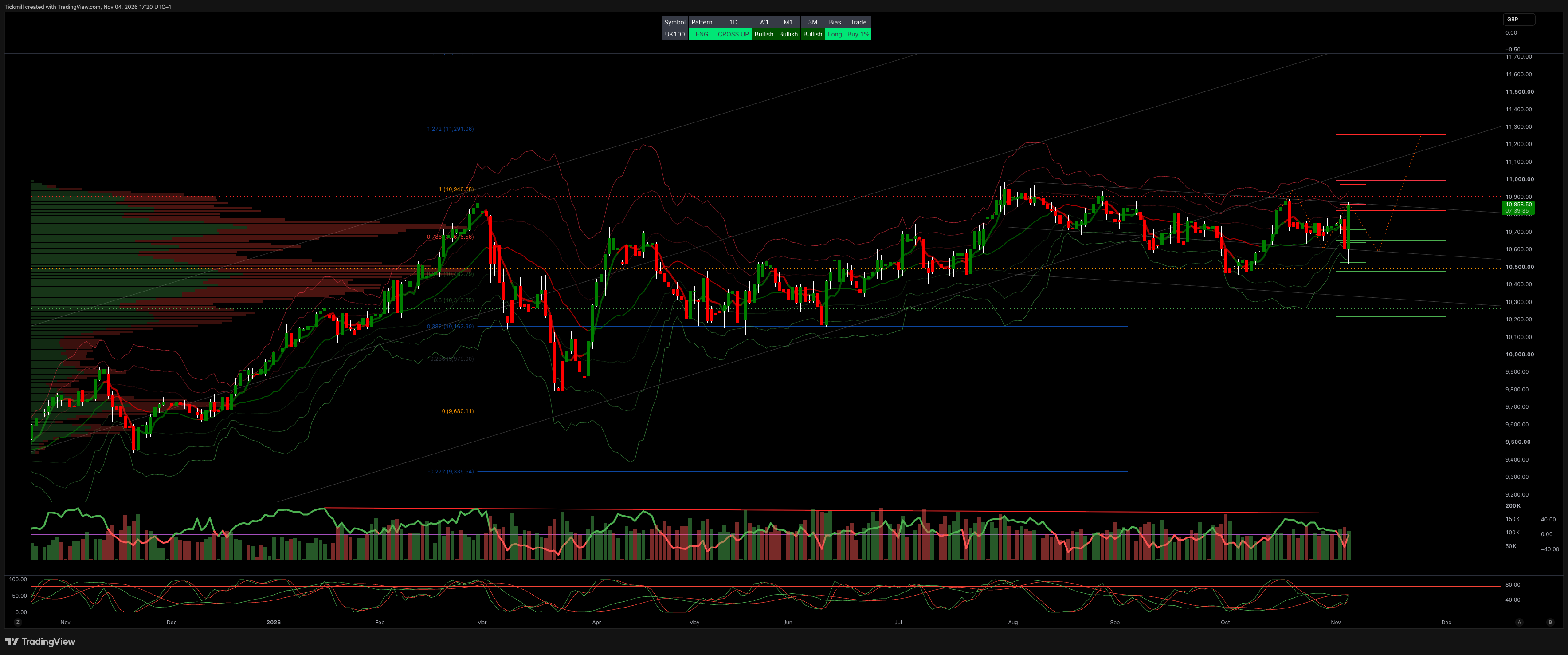
London’s benchmark FTSE 100 rallied sharply on Wednesday, surging alongside broader European markets following the dramatic outcome of the U.S. midterm elections. After tracking more than 130 points higher past midday, aggressive buying extended the top flight's advance to roughly 2.4% into the afternoon, comfortably pushing the index beyond the 10,850 level. Easing government bond yields, cooling crude oil prices, robust domestic services expansion, and blockbuster corporate results provided a powerful catalyst for risk appetite across financial, mining, and tech-adjacent counters.
Broad-based buying propelled multiple sectors to multi-week highs. Natural resource heavyweights surged as global sentiment cleared: precious metals producers Fresnillo and Endeavour Mining jumped 6.8% and 6.5%, respectively, while copper major Antofagasta climbed 5.2%. Anglo American advanced 4.1%, Rio Tinto (RIO) gained 2.7%, and Glencore added 2.5%. Financials experienced exceptional demand: Lion Finance surged 7.7% after delivering a 22.6% revenue jump to GEL 1.145 billion and net profit of GEL 661.88 million (GEL 15.42 per share vs. GEL 12.58 prior year). Rate-sensitive banking heavyweights posted widespread gains of over 4% to 5%, led by Standard Chartered (+5.2%), HSBC Holdings (+4.7%), Barclays (+4.3%), and 4% surges across both Lloyds Banking Group and NatWest Group (NWG). Marks & Spencer rose over 2% after delivering a sharp increase in half-year earnings despite sector-wide cost inflation, while gains of 2% to 3% were logged across Burberry Group, St. James's Place, Associated British Foods, AutoTrader Group, ICG, Games Workshop, Aberdeen Group, and Pershing Square Holdings. Global technology names also drew an indirect bid following AMD's record Q3 AI chip revenue.
Conversely, individual earnings reactions, sliding crude prices, and defence profit-taking capped select counters. Engineering group Weir tanked 7.6% to lead blue-chip decliners, succumbing to profit-taking despite a year-on-year rise of 8% in Q3 group orders. Outside the main index, ticketing platform Trainline tumbled 4% on weaker first-half profits. Defence contractors saw tactical selling following the U.S. election outcome, with BAE Systems down 3.7% and Babcock International down 1.9%. Energy producers also lagged the broader market as oil softened, sending Ithaca Energy down 2.7%, while Computacenter and Spirax Group slipped 2.0% and 1.4%, respectively.
Macro sentiment shifted decisively as investors digested the results of the U.S. midterm elections, where Democrats took control of both houses of Congress. The unexpected sweep relieved immediate market concerns surrounding unilateral trade escalation, aggressive tech disruption, and runaway federal deficit expansions. Commodity markets saw front-month Brent crude futures drop as much as 1.4% to an intraday low of $101.55 a barrel before edging to $102.10, helping suppress broader input-cost worries.
On the domestic macroeconomic front, final survey data confirmed resilient momentum across the U.K. private sector. The S&P Global UK Services PMI rose to 52.8 in October from 52.1 in September, signalling the fastest services expansion since February on strengthening order books. Consequently, the UK Composite PMI climbed to an eight-month high of 52.9 (up from 52.0), providing a solid foundation of business activity ahead of Thursday's high-stakes Bank of England Monetary Policy Committee decision, where a 25-basis-point hike to 4.00% remains broadly anticipated.
Finish Line: U.K. equities mounted a powerful, broad-based relief rally as political clarity from the U.S. midterm elections, softening sovereign yields, and retreating energy prices triggered aggressive inflows into banks, miners, and retail heavyweights. While post-earnings pullbacks in Weir and Defence names provided localised drag, the FTSE 100’s surge past 10,850 firmly realigns the benchmark toward the top of its macro trading range heading into Thursday’s BoE rate verdict.



Comments
Log in or sign up to join the conversation.