


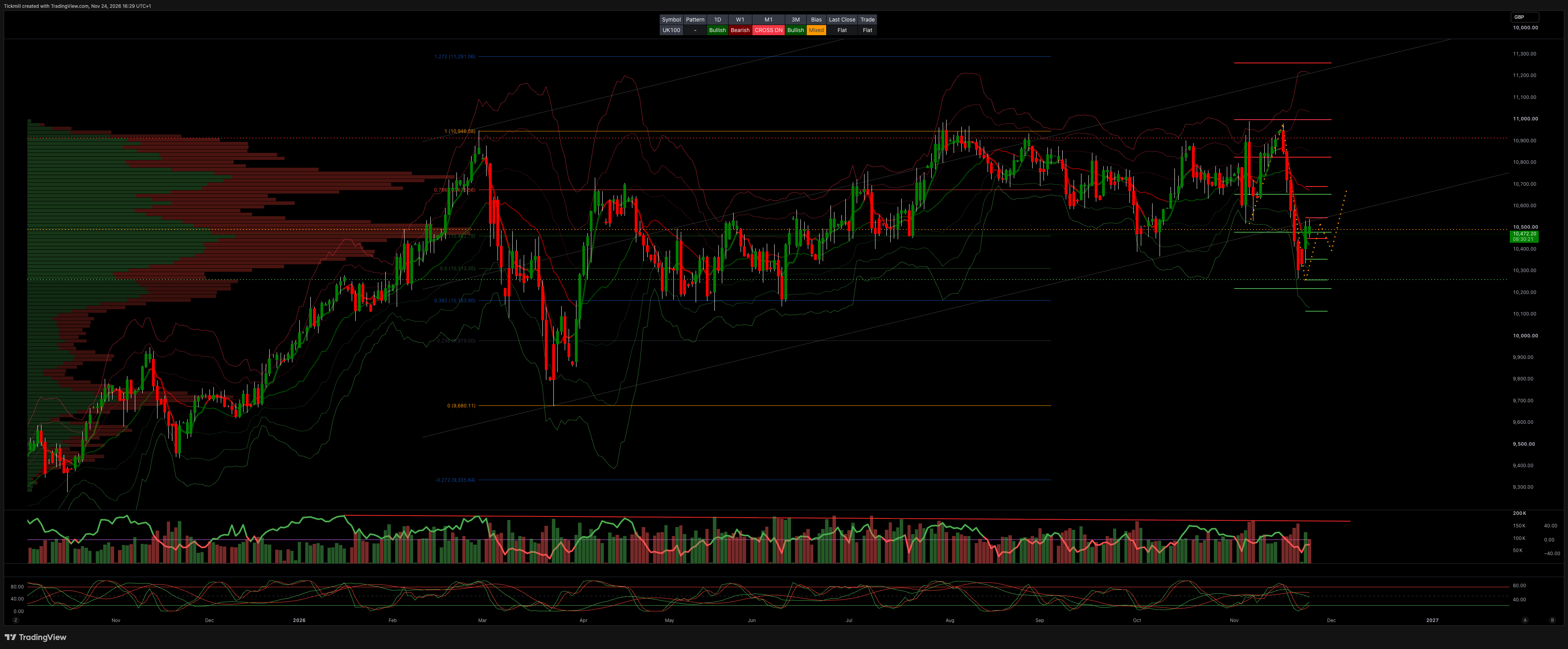
The FTSE 100 saw a slight dip on Tuesday, trading within the 10,450 to 10,470 range, reflecting a modest decline of about 0.1% to 0.3%. This follows Monday's impressive 1.3% surge, which brought the index to 10,480.82. Meanwhile, the mid-cap FTSE 250 faced more significant losses as the excitement from Monday's Nvidia-driven global rally began to wane. With U.S. futures showing weakness and enthusiasm around Jensen Huang's return as Nvidia CEO fading, investors turned their attention back to declining commodity prices, corporate earnings, and the highly anticipated U.S. inflation data set to be released on Wednesday.
Resource-heavy stocks weighed down the blue-chip index, as both industrial and precious metals saw sharp declines. The decline in spot gold prices (hovering around $3,610 to $3,630 per ounce) combined with significant decreases in silver and copper led to losses of 4% to 7% for companies like Antofagasta, Anglo American, Glencore, Rio Tinto (RIO), Fresnillo, and Endeavour Mining. Home improvement retailer Kingfisher also saw its shares fall, despite raising its full-year profit and cash flow guidance after a stronger-than-expected third quarter.
Conversely, strong corporate earnings, upgraded forecasts, and announcements of capital returns supported certain stocks. Balfour Beatty emerged as a leader among blue-chip gainers, rising approximately 4% to 5% after it raised its 2026 outlook for the second time this year, forecasting revenue to be about 10% higher than last year's £9.7 billion and expecting underlying operating profit to be 20% to 25% above 2025's £257 million, fueled by robust U.K. energy projects and U.S. data center orders. Catering giant Compass Group also climbed 3% to 5%, buoyed by solid full-year results, a new share buyback program worth up to $1.5 billion, and plans to discuss shifting its primary listing to the U.S.—where it earns about 75% of its underlying operating profit—while maintaining a secondary listing in the U.K. Additional support came from companies like Experian, SSE, and 3i Group, along with defensive consumer staples.
On the global front, analysts pointed out that Monday's impressive tech rebound—where the Nasdaq surged 6.5% and Nvidia (NVDA) skyrocketed 31.5%—has not resolved broader structural concerns, including capital expenditure intensity among hyperscalers, pressure on free cash flow, and tighter export restrictions. In energy and currency markets, front-month Brent crude traded in the high $88 to $89 per barrel range, while the British pound remained steady against the U.S. dollar near $1.305 to $1.309, and U.S. 10-year Treasury yields eased slightly to around 4.90%.
Domestically, survey data indicated a significant recovery in high-street demand. The Confederation of British Industry (CBI) Distributive Trades Survey indicated that the retail sales volume balance soared to +9 in November from -10 in October, marking the first positive reading in over two years and the highest level since late 2022. This reinforces the resilient flash U.K. Composite PMI reading of 52.3 from Monday. Globally, trading desks are adopting a cautious stance ahead of Wednesday's U.S. core PCE inflation report, which is expected to rise to 3.2% year-on-year from 3.1%, potentially solidifying expectations for a rate hike by the Federal Reserve in December.
Finish Line: U.K. equities are caught in a tug-of-war between the steep declines in mining stocks driven by falling metal prices and the strong corporate performances from Balfour Beatty and Compass Group. While the upbeat CBI retail figures highlight domestic resilience, the fading momentum in global tech and the cautious outlook ahead of the U.S. inflation data keep the FTSE 100 just below the 10,480 mark.
ark.



Comments
Log in or sign up to join the conversation.