

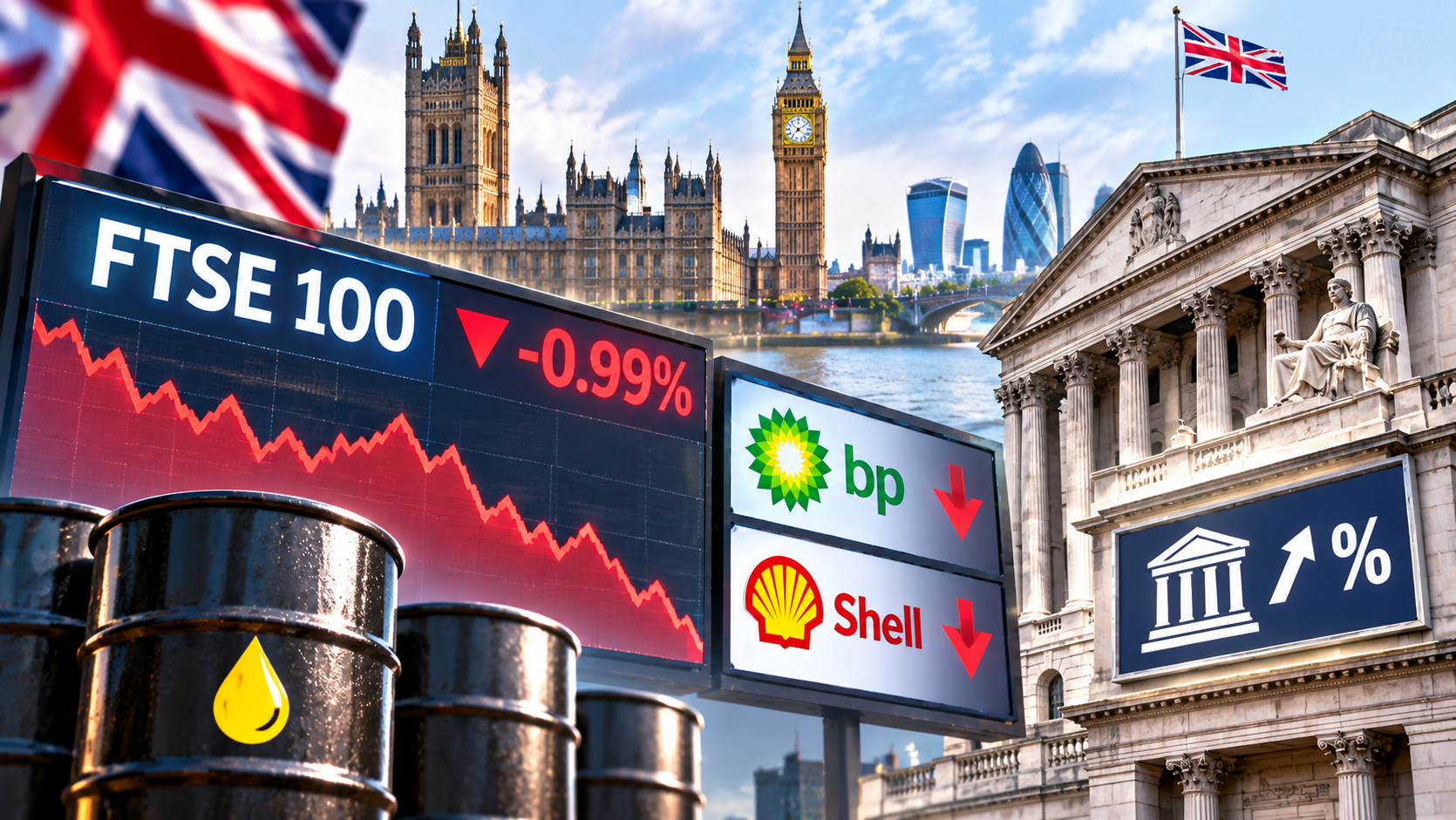
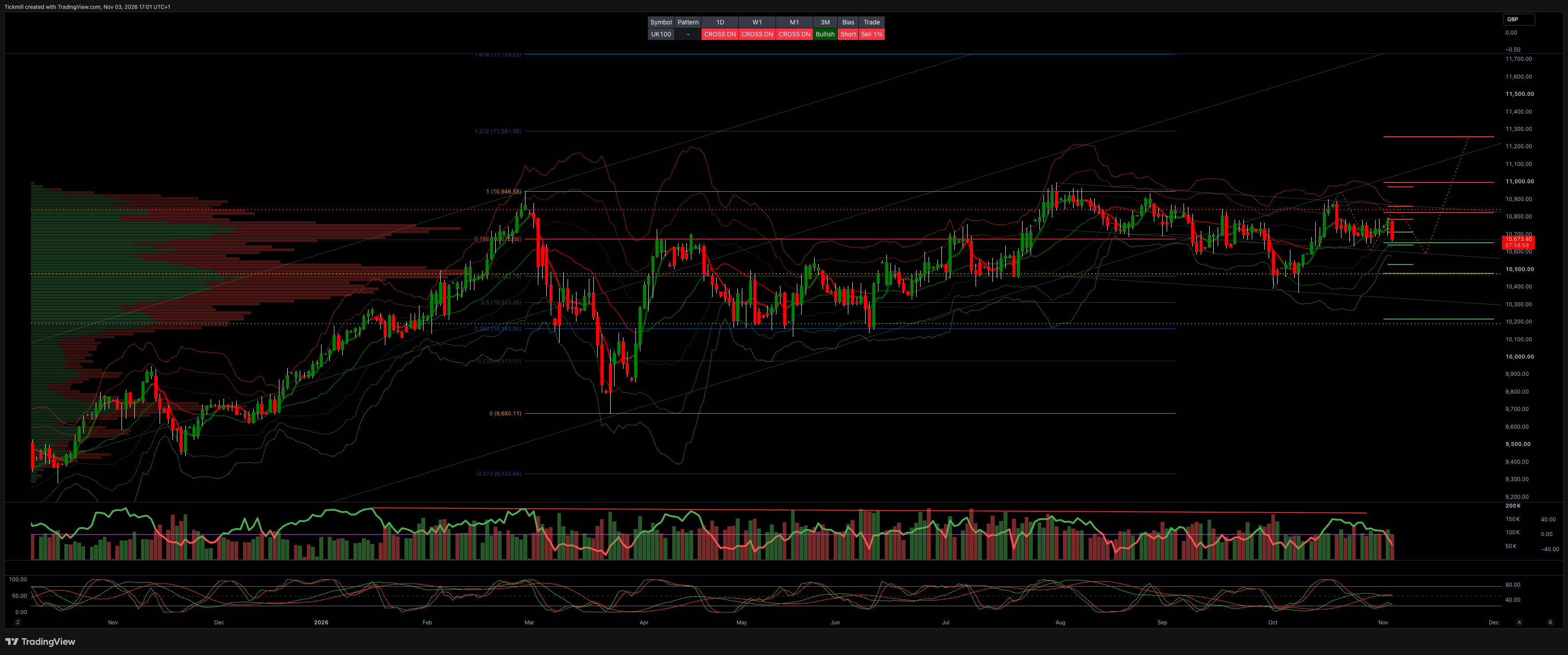
London's benchmark FTSE 100 drifted lower on Tuesday as global markets adopted a defensive posture ahead of the U.S. midterm elections. A sharp decline in crude oil prices—triggered by remarks from U.S. President Donald Trump regarding potential adjustments to overseas financial support—put heavy pressure on index energy heavyweights, offsetting targeted gains across construction and financial names. Having closed at 10,761.33 on Monday, the FTSE 100 shed nearly 1% on the session.
Energy producers led blue-chip losses as crude markets retreated. Ithaca Energy fell 3.2% to become the top-flight's weakest performer, closely followed by BP (BP), which dropped over 3%, while Shell (SHEL) also traded on the back foot. Conversely, infrastructure and financial counters found buying interest against the broader market downdraft: Balfour Beatty rallied 2.6% to top the leaderboard, and Lion Finance Group advanced 2.4%.
In foreign exchange and fixed income markets, the U.S. Dollar Index edged up 0.03% to 101.78. Sterling showed modest strength, with the GBP/USD pair rallying 0.08% to trade at 1.3420 (within an intraday band of $1.3396 to $1.3432), EUR/GBP easing 0.05% to 0.8338, and GBP/JPY climbing 0.27% to 212.22. Ten-year U.K. benchmark Gilt yields ticked up 0.23% to 5.2075% (ranging between 5.1885% and 5.2677%) after closing at 5.1955% on Monday. Further along the curve, long-term Gilts continued their post-Budget consolidation; 30-year Gilt yields have retreated 40 basis points from their October peaks to 5.63%, supported by favorable adjustments to the Debt Management Office (DMO) remit, though analysts caution that strict spending curbs across non-protected departments merely defer sovereign fiscal pressures into the upcoming Spending Review.
Central bank and geopolitical risks remain the primary drivers across global trading desks. The Bank of England’s Monetary Policy Committee is widely expected to deliver a 25-basis-point rate hike this Thursday, lifting the Bank Rate to 4.00%. The move is underpinned by the October Decision Maker Panel (DMP) survey showing year-ahead inflation expectations stuck near 4%, though recent evidence of slowing domestic recruitment may temper the hawkish consensus and produce split voting. Globally, market participants are focused on polling for the U.S. midterm elections, where potential shifts in congressional control threaten to inject fresh regulatory scrutiny around artificial intelligence alongside heightened friction over next year’s statutory debt ceiling.
Finish Line: London equities succumbed to pre-election risk aversion as sliding crude oil prices dragged index heavyweights BP and Ithaca Energy lower. While infrastructure strength and steady long-term Gilt pricing provided a cushion, cautious positioning ahead of Tuesday’s U.S. election outcome and Thursday’s anticipated Bank of England rate hike kept the FTSE 100 under pressure near 10,715.


Comments
Log in or sign up to join the conversation.