

NUBURU (BURU) has spent much of the past two years pursuing an ambitious transformation, moving beyond its roots in industrial laser technology toward a broader role in defense and security.
On October 15, the company announced the completion of its acquisition of a 70% controlling interest in Italian defense manufacturer Tekne S.p.A.
The acquisition brings approximately 185 employees, three manufacturing facilities, specialized electronic-warfare and military-mobility capabilities, and a reported $93.1 million portfolio of remaining program value into the NUBURU group. For a company historically associated with blue-laser technology, this represents a significant expansion of its operating capabilities.
But the more interesting story may be what NUBURU intends to do with those assets, and how the transaction could change its position in a defense market attracting substantial investment.
From Laser Technology to Integrated Defense Systems
NUBURU originally developed high-performance blue lasers for industrial applications, including advanced manufacturing. In 2025, management began pursuing a broader strategy centered on defense, security, and complementary technology acquisitions.
Tekne is an important part of that strategy. Founded in 1990, the Italian manufacturer specializes in electronic warfare, specialized military vehicles, and defense-mobility systems. Its facilities in Ortona, Poggiofiorito, and Guastalla provide NUBURU with an established industrial presence in a NATO member country.
The company is seeking to combine Tekne’s manufacturing and electronic-warfare expertise with the laser and photonics capabilities of Lyocon and the operational-resilience software developed by Orbit. Together, these businesses could support applications ranging from mobile counter-drone systems and electronic-warfare platforms to critical-infrastructure protection.
Rather than supplying individual technologies, NUBURU hopes to offer integrated solutions combining hardware, software, and specialized manufacturing. This could open larger projects and potential maintenance, upgrades, and technical-support revenue. However, technical integration, qualification, and customer adoption remain to be demonstrated.

A $93 Million Portfolio — and the Potential for More
One of the headline figures is Tekne’s approximately $93.1 million in remaining program value. According to NUBURU, the figure comes from Tekne’s September 14, 2026 management production schedule and includes defense, civil-protection, public-safety, and industrial programs.
Importantly, this is a preliminary, unaudited management measure, not guaranteed revenue or fully funded backlog. Some programs remain subject to activation requirements, contractual conditions, and delivery milestones. Nevertheless, the reported portfolio suggests an established base of business activity.
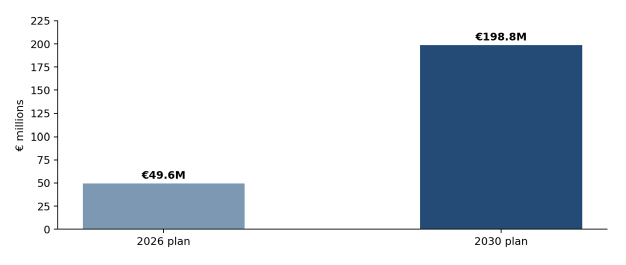
In a business plan disclosed earlier this year, Tekne projected approximately €49.6 million in value of production for 2026, rising to approximately €198.8 million by 2030. These are forward-looking planning targets, not actual results or current revenue guidance; the plan depends on additional business, working capital, and successful execution.
NUBURU has also identified possible reactivation of certain defense-vehicle and mobility programs. These opportunities are not included in the reported $93.1 million and remain subject to future procurement decisions. Investors should focus on conversion into recognized revenue, margins, and sustainable cash flow.
A Deal That Changes NUBURU’s Operating Scale
NUBURU acquired an additional 67.1% interest in Tekne for a fixed purchase price of €5.2 million, including €1.2 million at signing and €4 million deferred through March 2027. It also renegotiated the earn-out payable to historical shareholders, reducing the maximum to €20 million.
The revised earn-out is payable in cash rather than NUBURU shares, avoiding share issuance specifically for those payments, but creating future cash obligations including a €2 million annual minimum beginning in 2028, subject to the cap.
NUBURU also waived approximately €29.7 million in shareholder loans and other receivables, converting those claims into a permanent equity contribution to Tekne. That removes repayment obligations but is not newly generated operating cash. Ultimately, profitability and working-capital requirements will determine the economics of the acquisition.
Entering a Market With Major Defense Players
The acquisition comes at a time when governments are increasing their focus on electronic warfare, counter-drone capabilities, military mobility, and the protection of critical infrastructure.
Recent conflicts have demonstrated how relatively inexpensive unmanned systems can threaten valuable military assets, creating demand for layered defense solutions that combine detection, electronic countermeasures, and physical interception.
In the United States, defense contractors such as Lockheed Martin (LMT), RTX Corporation (RTX), Leonardo DRS (DRS), and Kratos Defense & Security Solutions (KTOS) are active in advanced military systems, electronic warfare, unmanned technologies, and counter-drone defense. European players, including Germany's Rheinmetall and Sweden's Saab, are also developing sophisticated mobile air-defense and counter-drone capabilities.
These established companies illustrate both the growing commercial importance of these technologies and the competitive challenges facing newer entrants. While NUBURU operates on a much smaller scale, its acquisition of Tekne provides an industrial foundation from which to pursue opportunities in these expanding markets.
Additionally, NUBURU is pursuing a more specialized approach, seeking to combine Tekne's defense-manufacturing expertise with laser technology and software into integrated offerings.
Its Italian industrial presence could provide advantages in pursuing certain European and allied defense opportunities, although participation in these markets still requires technical qualification, regulatory compliance, and competitive procurement.
The opportunity is meaningful, but NUBURU will need to demonstrate that its products and capabilities offer customers a compelling reason to choose its solutions.
The Next Test Is Execution
The Tekne closing follows a $38 million public offering in July, the retirement of approximately $16.75 million in debt, and BURU’s return to NYSE American trading in September. These developments have supported the transition, although financing and working-capital needs remain relevant.
NUBURU expects to provide Tekne historical financial statements and pro forma financial information in subsequent SEC filings. Those disclosures should help investors assess revenue, margins, and the acquired business’s contribution. Other milestones include program deliveries, new contract awards, and progress integrating Tekne with Lyocon and Orbit.
The Bottom Line
The Tekne acquisition is a tangible milestone in a defense transformation underway since 2025. NUBURU now controls an established Italian manufacturer with facilities, personnel, electronic-warfare expertise, and an existing portfolio of programs. That creates a more substantial industrial base from which to pursue opportunities in defense mobility, counter-drone systems, and infrastructure protection.
The challenges are equally concrete: integration, production financing, established competitors, and the conversion of program value into profitable revenue. For BURU investors, the central question is whether the expanded platform can become a commercially successful and financially sustainable business.
While success is never guaranteed, the Tekne acquisition gives NUBURU something it previously lacked: an established operating business and a tangible foundation on which to build its defense ambitions.
Source and Notes
October 15 Tekne acquisition announcement
NUBURU investor relations
SEC filings for NUBURU
Editorial note: The $93.1 million figure is management-reported remaining program value and is not audited backlog. The production chart uses two published business-plan endpoints; it is not a historical growth chart. The header image is an AI-generated editorial illustration.



Comments
Log in or sign up to join the conversation.