


At first glance, a company selling birth control for rodents might seem like an unusual investment. But for a company trying to stop rodents from multiplying, SenesTech is giving investors plenty of reasons to watch its own growth.
Rats and mice can do serious damage to a business and its bottom line. For companies facing ruined inventory, costly shutdowns or a damaged reputation, keeping rodents under control is money well spent. SenesTech (NASDAQ: SNES) is pursuing that opportunity through rodent fertility control.
For restaurants and supermarkets, infestations can mean contaminated food, discarded inventory and customers who never return. Warehouses and factories face damaged packaging, chewed wiring and disrupted operations. Farms and food producers risk lost feed, damaged crops and contamination. Hotels, cruise ships, amusement parks and other entertainment venues have guest safety and hard-earned reputations to protect.
The exterminator’s bill may be only the beginning. Following a rodent infestation at an Arkansas distribution center, Dollar Tree (NASDAQ: DLTR) reported approximately $65 million in recall, remediation and impairment costs during fiscal 2022. Family Dollar later agreed to $41.675 million in fines and forfeiture related to insanitary conditions at the facility.
So a rodent infestation at just one of its facilities ended up costing the company over $100 million. Now imagine what infestations cost businesses across all industries! The potential demand for a product that can help prevent those losses could be staggering.
A recurring burden for local governments
The financial burden extends to local governments. Municipalities must protect public health and maintain parks, streets and public buildings, making rodent control a recurring demand on taxpayer funds. Inspections, baiting, cleanup and repairs all carry costs. In June 2025, New York City announced $877,000 in permanent funding for teams dedicated specifically to rat mitigation in street tree beds—just one part of its broader effort.
Keeping infestations under control is difficult because rats reproduce so quickly. SenesTech estimates that, under favorable conditions, a breeding pair and successive generations could produce approximately 15,000 descendants in little more than a year. That helps explain why removing existing rats can bring only temporary relief if the survivors continue breeding.
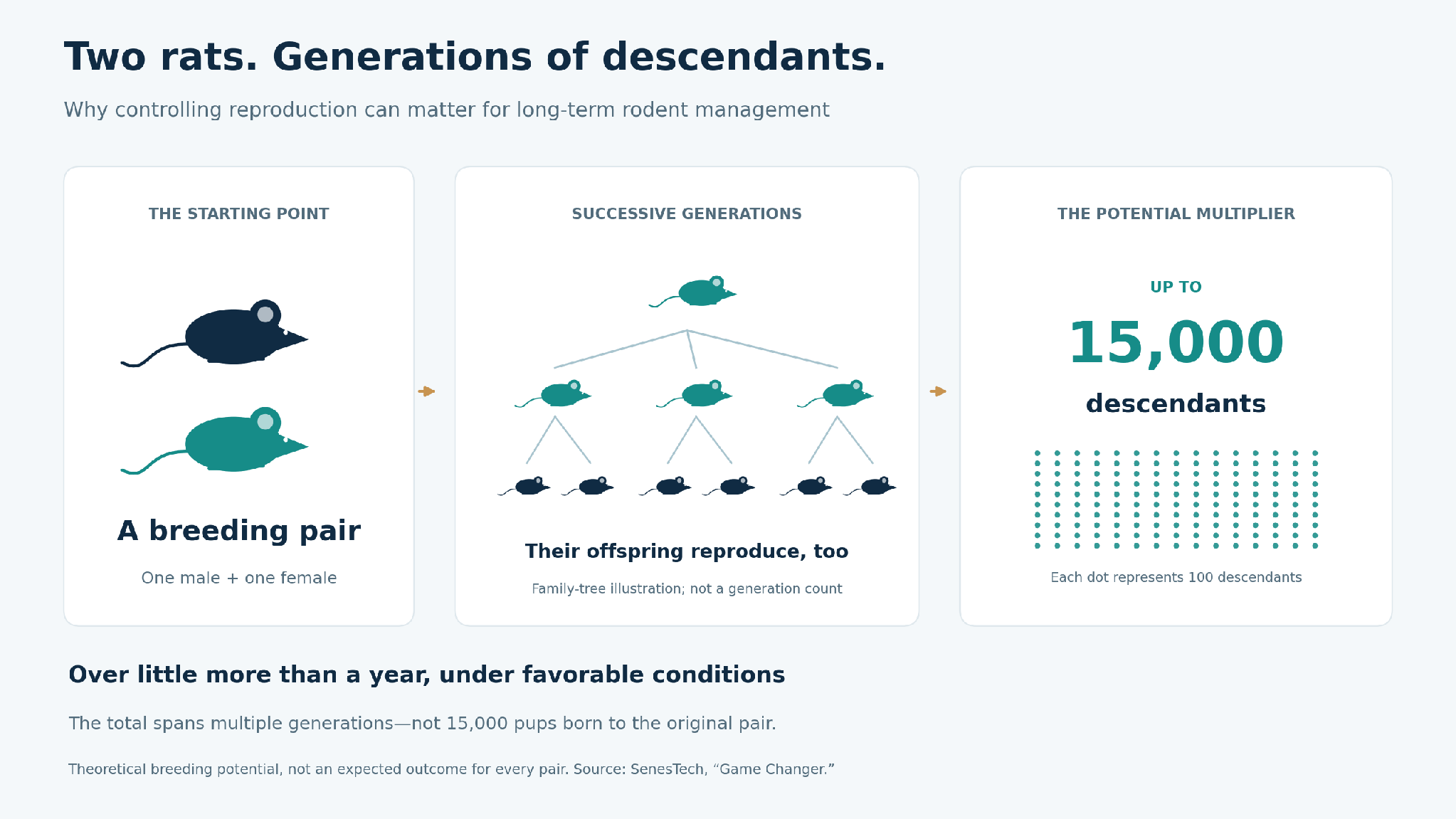
Illustration of theoretical breeding potential across generations. Source: SenesTech.
For businesses and municipalities alike, the appeal of fertility control is straightforward: fewer new rats could mean less damage and a more manageable pest problem over time. SenesTech’s Chicago assessment offers a practical example of how that approach is being put to the test.
Chicago offers evidence from the field
On October 19, SenesTech reported results from its Evolve Rat Birth Control assessment in Chicago’s Wicker Park Bucktown Special Service Area #33. The district added Evolve to its integrated pest management program, deploying 190 bait stations across approximately two miles.
Across a 12-month monitoring period, the company reported an 88% reduction in average rat activity intensity and an 82% reduction in the proportion of monitoring locations detecting activity. Rodent-related 311 requests in the deployment area fell 36%, while citywide requests increased by less than 1%.
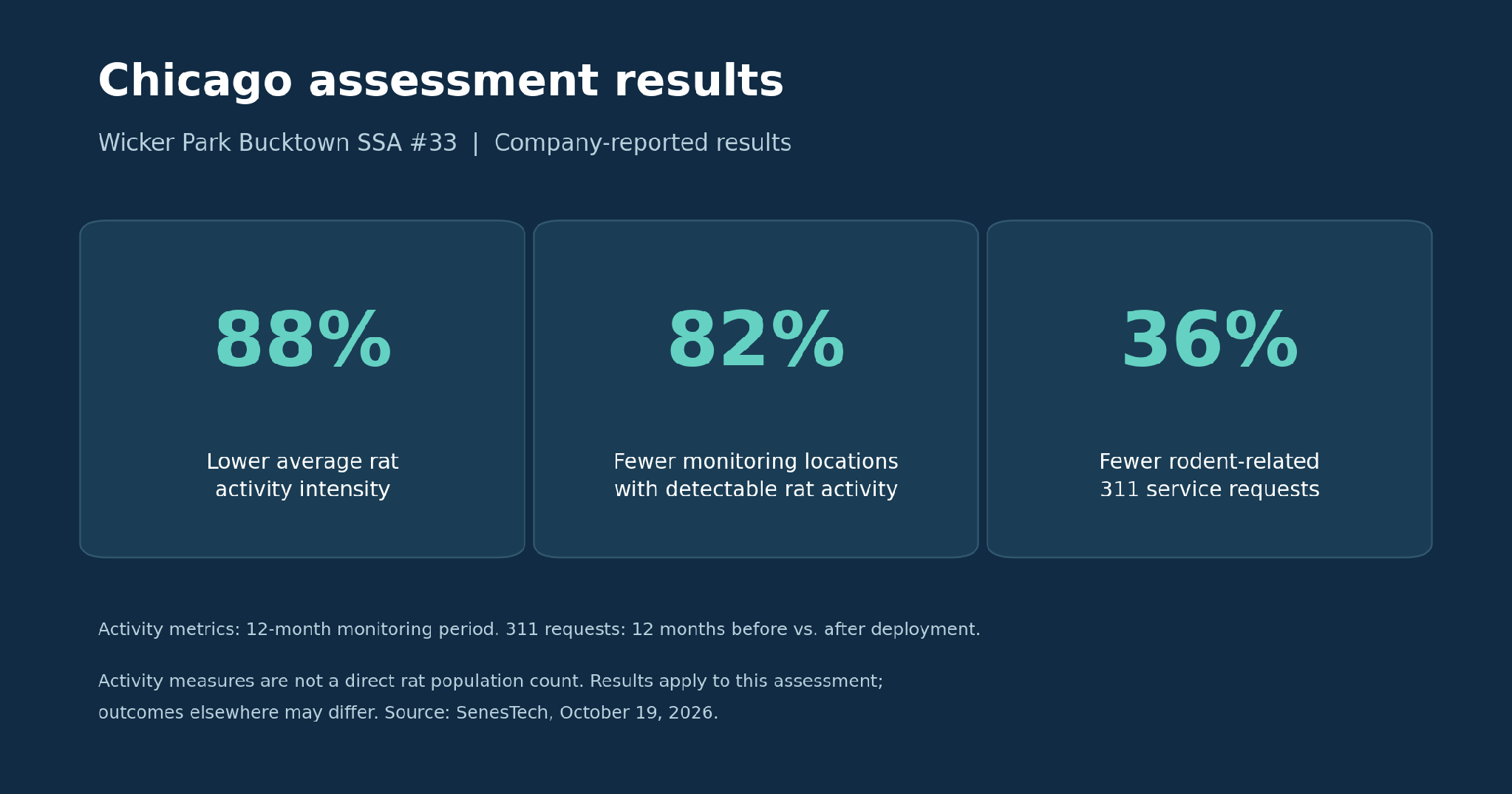
Results apply to this deployment; activity measures are not a direct rat population census. Source: SenesTech.
Management confirmed in written responses for this article that the assessment had no formal untreated control area. The results offer a measured example from an urban deployment, but do not isolate Evolve’s contribution from other pest-management measures or guarantee outcomes elsewhere.
Management also said six Chicago wards or special service areas are ordering Evolve and that the original deployments have expanded within their neighborhoods. Discussions with two additional areas are underway, although those discussions should not be counted as orders.
Axios reports a program-budget increase from $65,000 to $100,000 for 2027, roughly 54%. That is program spending, not SenesTech revenue.
The local chamber’s residential program page also describes buying Evolve in bulk from SenesTech to offer residents a discount. Together, the budget and neighborhood distribution effort suggest a customer looking to build on its initial deployment.
The results attracted coverage from Axios Chicago, CBS Chicago and TipRanks/The Fly, giving the technology broader exposure beyond the usual investor audience.
Substantial growth and meaningful operating improvement
SenesTech may be focused on having fewer rats, but investors care about more cheddar. And SenesTech is delivering. The company announced preliminary third-quarter 2026 revenue of approximately $1.1 million, the highest quarterly revenue in its history and its first quarter above $1 million. Management reported approximately 55% year-over-year growth and 40% sequential growth. The figures are unaudited, preliminary and subject to adjustment.
Revenue has more than doubled from Q1’s $493,000 to preliminary Q3 results. Q2 gross margin reached a record 73.6%. These are meaningful improvements in sales and product economics. Management also says many earlier investments and transition costs are increasingly behind it, creating the prospect that further growth could translate more efficiently into improved financial results.
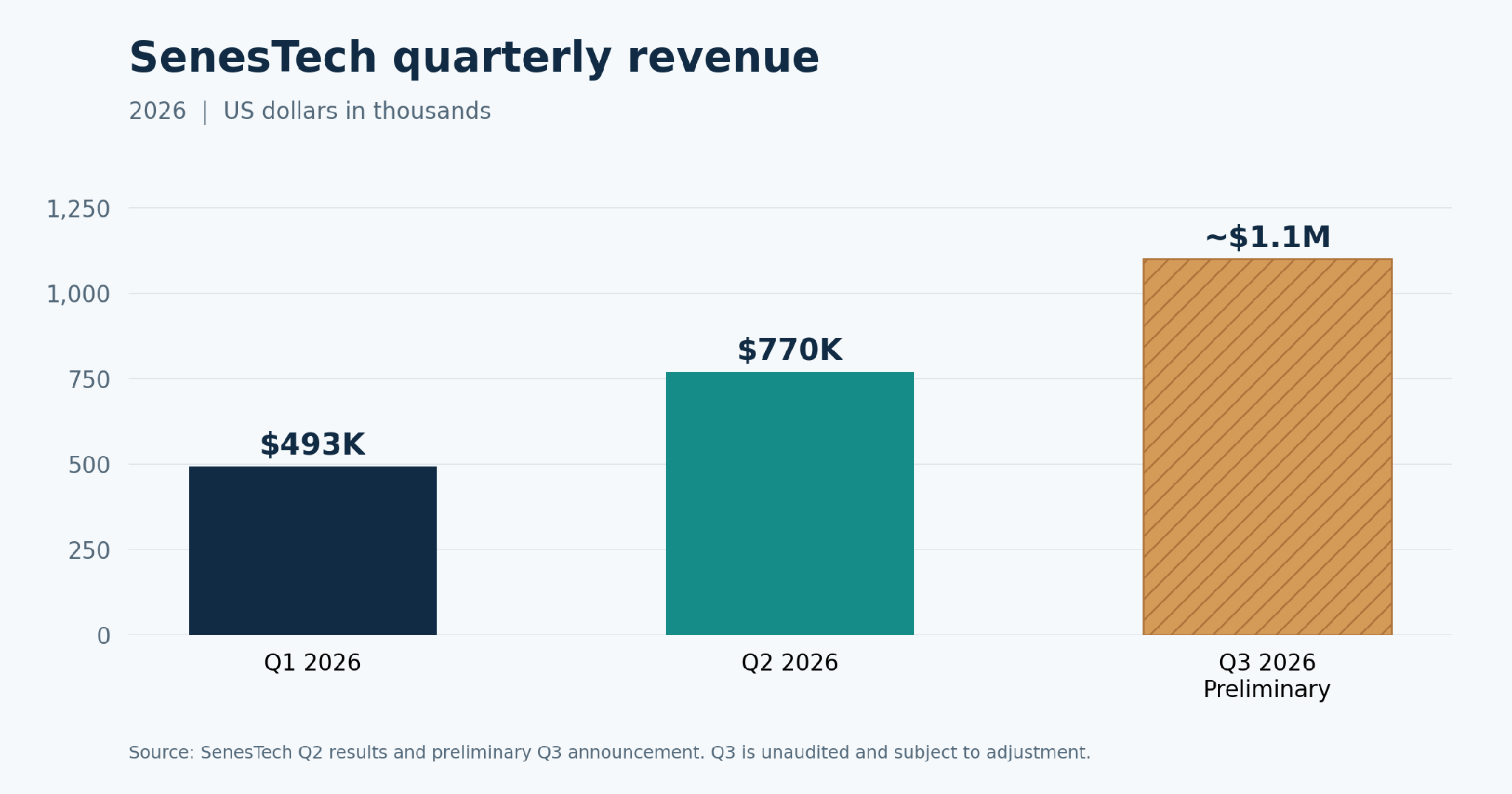
Q3 is preliminary and subject to adjustment. Sources: Q2 results and Q3 announcement.
As part of this article, TalkMarkets was able to arrange for me an exclusive interview with company management, which kindly provided me with additional data points. SenesTech put preliminary Q3 B2B sales at approximately $320,000, up 23.5% from Q2, and identified an encouraging pipeline entering Q4. It did not disclose the precise split of total Q3 revenue among repeat purchases, new customers and initial stocking orders.
“Q3 preliminary revenue surpassed $1 million for the first time, reflecting continued progress across e-commerce, B2B and subscriptions. With earlier investments and transition costs increasingly behind us, we believe strong growth and improving unit economics position us for continued progress,” Michael Edell, Chief Executive Officer, said in a statement provided for this article.
Second-quarter DTC subscription revenue reached $104,000, up 142% year over year, while combined subscriber count across Amazon (NASDAQ: AMZN) and the company’s website increased 117%. Alongside e-commerce momentum and B2B progress, those gains give investors concrete evidence that the commercial strategy is working. Management has not yet disclosed retention or acquisition-cost metrics, which will help investors assess the profitability of those relationships.
Reaching customers through more channels
Distribution has widened, too. SenesTech announced online availability through Home Depot (NYSE: HD) and Lowe’s (NYSE: LOW). Its September 2026 announcement outlined planned availability through Grove Collaborative (NYSE: GROV), adding another potential route to households seeking alternatives to conventional rodenticides.
Management identified pest-management professionals as SenesTech’s largest B2B vertical, while e-commerce remains a leading near-term opportunity. For professional customers, the company says Evolve can be used alongside other integrated pest-management measures, begins affecting fertility within one to two breeding cycles, and requires continued use for continued control.
A modest valuation leaves room for a bullish case
SNES closed at $0.837 on October 27, valuing its outstanding common shares at approximately $4.54 million. Preliminary Q3 revenue annualizes to $4.4 million, putting the equity at roughly 1.03 times that sales level. This is one quarter multiplied by four, not trailing annual revenue or a forecast.
That valuation may not fully reflect the company’s accelerating sales trajectory. Investors are evaluating a business with demonstrated growth and improving product margins. If sales keep expanding while costs rise more slowly, more of each additional revenue dollar could contribute toward profitability. That creates a plausible undervaluation case and a speculative buying opportunity, although sustained growth and reduced funding needs remain essential to the thesis.
A major shareholder pushes for stronger execution
Glenbrook Capital Management announced on October 19 that its ownership exceeded 30% of SenesTech’s outstanding common shares. Its public letter congratulated the company on recent revenue progress while pressing for better marketing and capital discipline.
Glenbrook said it had retained branding and marketing firm Sandstrom Partners at its own expense. It urged efforts to minimize dilution and suggested selective use of equity compensation to conserve cash. Those are Glenbrook’s views and proposals, rather than management guidance or adopted company policy.
In its responses, management said it agrees with much of Glenbrook’s letter and maintains an active dialogue with the shareholder. It did not announce specific changes arising from those discussions.
For existing holders, the important question is how much of the company’s growth translates into value per share. Equity compensation can preserve cash while still diluting ownership. Glenbrook also made further investment conditional on acceptable terms and market conditions; its ownership announcement is not a commitment of future funding.
The operating progress comes with risks. SenesTech remains unprofitable and may need additional financing. It also disclosed a Nasdaq minimum-bid-price notice after its closing bid stayed below $1 for 30 consecutive business days. The notice had no immediate effect on trading; the company has until April 19, 2027, to regain compliance, and success is not assured.
The Next Earnings Report Will Be Key For Investors
Second-quarter results provide a historical baseline: gross profit of $567,000, operating expenses of approximately $2.43 million and a net loss of approximately $1.83 million. June 30 cash and equivalents were approximately $5.08 million. Those figures precede the latest revenue milestone; full Q3 results will show how stronger sales are affecting the financial picture.
Management says cash burn has been declining and operating spending has been redirected toward customer acquisition and sales personnel. It highlighted cash-use trends, recurring revenue and potential growth in backlog, meaning current orders scheduled for future delivery, as measures to watch. The next financial report will help quantify cash-use trends and clarify the remaining funding needs.
SenesTech said it planned to report definitive third-quarter results during the week of November 9. Investors will be able to assess whether higher sales are improving gross profit, spending efficiency and cash performance, along with the progress of subscriptions and B2B relationships.
Conclusion
SenesTech has already shown substantial growth and meaningful improvement in sales, gross margin and subscription adoption. Chicago adds a practical customer reference to that progress. With the equity valued at roughly one time its latest annualized quarterly sales, investors have a concrete reason to consider whether the market is giving the business enough credit. Sustaining that momentum while narrowing losses could make today’s valuation look increasingly attractive and turn this unusual business into a rewarding investment.
For investors with an appetite for a little risk, that may be a story worth nibbling on.



Comments
Log in or sign up to join the conversation.