


An 81% increase in quarterly revenue would be noteworthy for almost any financial services company. For Freedom Holding Corp. (FRHC), however, the latest results tell a story that extends well beyond a single impressive growth figure.
The international financial services and technology group is undergoing a significant transformation, expanding from its traditional brokerage operations into banking, insurance, payments, telecommunications, and an increasingly broad range of digital services.
On November 16, Freedom Holding announced that revenue for its second fiscal quarter of 2027, ended September 30, 2026, reached $910.1 million, compared with $503.6 million a year earlier.
Net income rose 29% to $46.1 million, while diluted earnings per share increased from $0.58 to $0.76. Total assets climbed to $16.6 billion, up 26% from the end of March.
Those figures suggest a business gaining considerable scale.
Yet beneath the headline growth lies an equally important development: Freedom Holding's traditional brokerage business is no longer its largest source of revenue.
Banking and insurance have moved to the forefront, while the company's investment in a wider digital ecosystem is creating additional growth opportunities and potentially valuable operating efficiencies.
For investors, the central question is whether Freedom Holding can turn this expanding network of businesses into a more profitable, diversified financial enterprise.
The Numbers Behind the Revenue Surge
Freedom Holding's latest quarterly results reveal a dramatic shift in the composition of its business.
Banking revenue nearly tripled, while insurance revenue more than doubled. Together, these two segments accounted for approximately 66% of the company's quarterly revenue.
The breakdown illustrates how significantly the business has evolved.
Business segment | Q2 FY2027 revenue | Year-over-year change |
Banking | $298.1 million | +182% |
Insurance | $299.2 million | +133% |
Brokerage | $222.2 million | -5% |
Other businesses | $90.5 million | +161% |
Total | $910.1 million | +81% |
Source: Freedom Holding Corp., [Form 10-Q] for the quarter ended September 30, 2026.
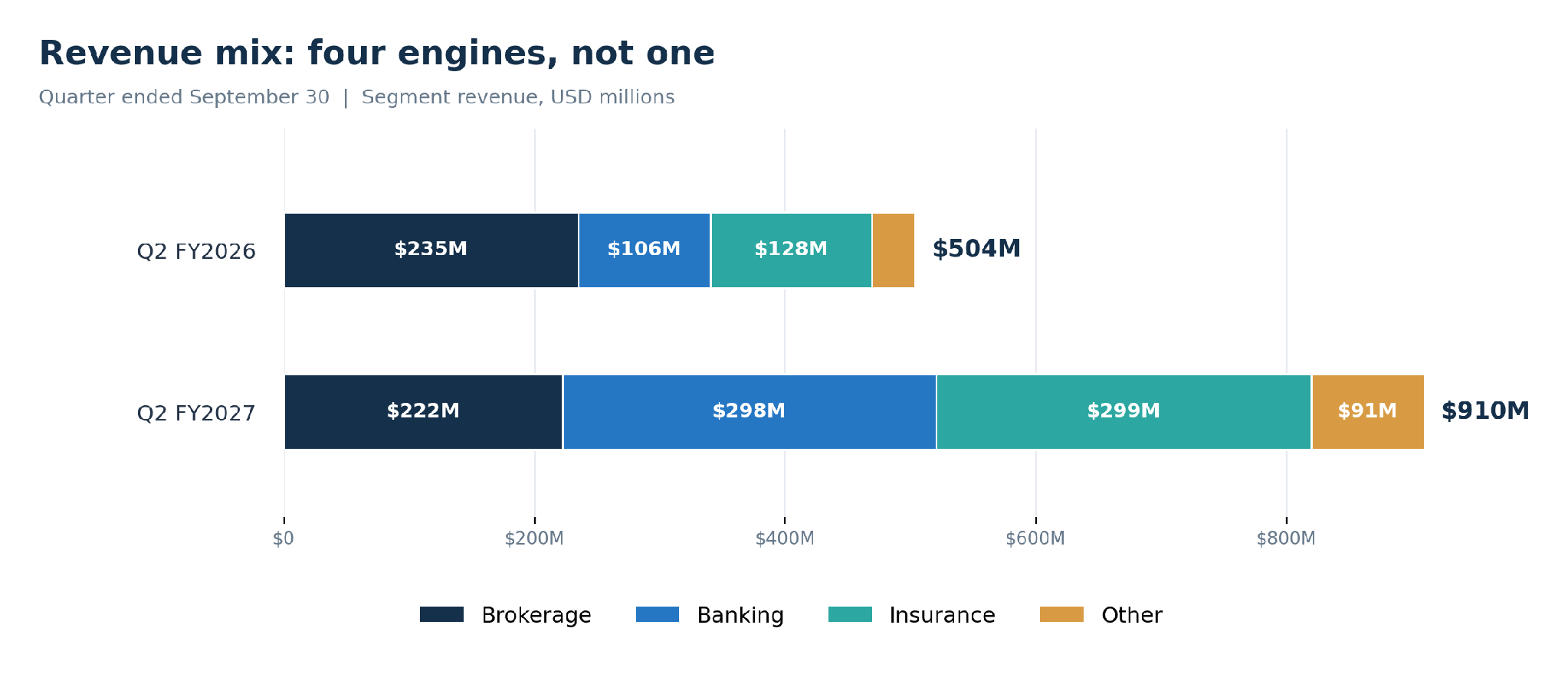
Figure 1. Quarterly revenue by segment (USD millions), compared with the year-earlier quarter. Source: Freedom Holding, September 2026 Form 10-Q.
Banking and insurance generated approximately $363 million of the company's $406 million year-over-year revenue increase.
That means roughly 89% of the additional quarterly revenue came from just two business segments.
Perhaps the most important development is that Freedom Holding is no longer dependent on brokerage as its primary growth engine.
The benefits of that diversification are already becoming apparent. While brokerage revenue declined 5% during the quarter, banking and insurance revenue surged 182% and 133%, respectively, helping drive an 81% increase in consolidated revenue.
This demonstrates one of the fundamental advantages of operating across multiple business lines: weakness in one segment can be offset by strength in others.
Rather than relying on brokerage commissions and trading activity alone, Freedom is developing multiple sources of revenue spanning banking, insurance, investments, payments, and digital services.
That broader foundation could help make the company more resilient to changing market conditions while creating additional opportunities for growth and cross-selling.
Although these businesses are not immune to broader economic risks, their expansion reduces Freedom's reliance on any single revenue stream and strengthens the long-term rationale for its diversified financial-services model.
Banking Emerges as a Major Growth Engine
Banking has become one of Freedom Holding's most important growth drivers.
Quarterly banking revenue reached $298.1 million, compared with $105.7 million a year earlier.
The increase reflects growing lending activities, a larger portfolio of income-generating securities, and gains from securities trading and foreign exchange transactions.
Across the company, interest income rose 53% to $323.9 million.
The expansion is particularly significant because banking provides Freedom Holding with something brokerage alone cannot: a broader relationship with customers' everyday financial activities.
Through Freedom Bank and its digital services, customers can access payments, deposits, loans, investment products, and other financial offerings.
That creates potential opportunities for cross-selling additional services, increasing customer engagement, and generating recurring financial relationships.
As the customer base grows, these interconnected services could become an increasingly valuable source of revenue.
The company's quarterly SEC filing also identifies securities-trading gains and favorable foreign exchange activity among the factors supporting banking revenue.
These can contribute meaningfully to earnings, although they may fluctuate from quarter to quarter.
For investors, the longer-term opportunity lies in the continued expansion of the underlying customer, lending, payment, and service businesses, alongside increasingly consistent profitability.
Insurance Is Becoming Equally Important
Insurance was Freedom Holding's largest revenue segment during the quarter, narrowly exceeding banking.
Revenue increased 133% to $299.2 million, driven substantially by growth in the company's pension annuity insurance operations.
This business serves customers seeking financial protection and longer-term retirement-related products.
The opportunity is meaningful because insurance relationships can extend over many years, potentially strengthening customer retention and providing another source of financial activity within Freedom's ecosystem.
The company reported a 148% increase in net insurance revenue to $254.8 million, supported by growth in new policies and premium inflows.
The expansion also illustrates the advantages of Freedom's broader strategy.
Customers already using its banking or investment services may be interested in insurance products, while insurance customers may eventually explore other financial services offered through the same group.
These complementary relationships could help increase customer engagement and create opportunities for additional revenue.
Of course, insurance growth also brings obligations to policyholders, including future benefit payments and reserve requirements.
The insurance segment generated approximately $9.9 million in net income during the quarter, demonstrating positive profitability even as the business continues expanding.
As the portfolio matures, effective management of underwriting, expenses, and long-term obligations will be important in determining how much of this growing revenue translates into earnings.
The SuperApp Strategy: Bringing Everything Together
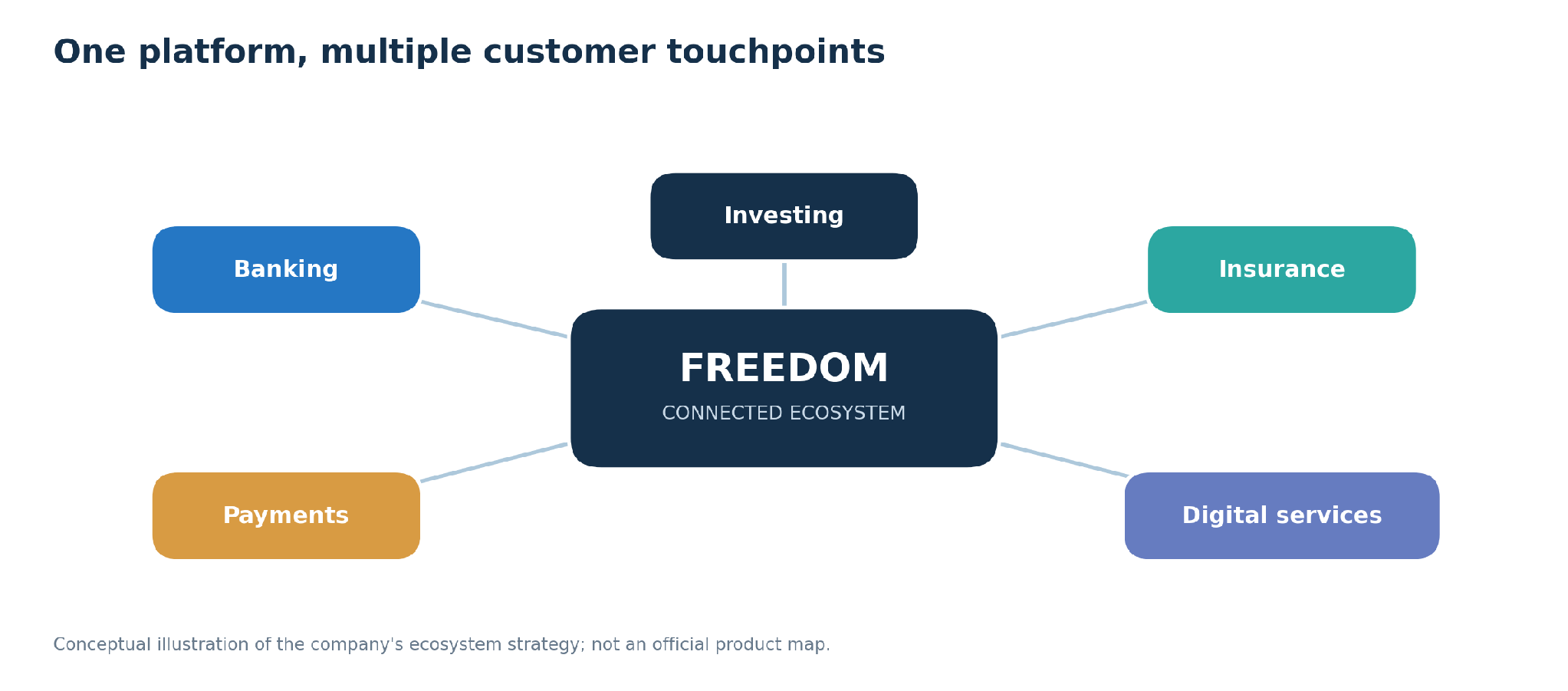
Conceptual illustration of Freedom Holding's integrated services strategy.
Perhaps the most interesting aspect of Freedom Holding's business model is its ambition to connect financial and nonfinancial services within a single digital ecosystem.
In Kazakhstan, the company has been developing this approach through its Freedom SuperApp, which brings together banking, investment, insurance, payments, and everyday digital transactions.
The strategy resembles the broader financial-superapp model that has gained traction in several international markets.
Rather than treating banking, brokerage, insurance, and other consumer services as completely separate businesses, Freedom wants customers to use multiple products within an interconnected platform.
The potential advantages are considerable.
A customer who first opens a bank account may later use investment services, obtain insurance, make payments, or purchase other products through the same ecosystem.
That could increase customer engagement and create additional revenue opportunities without requiring the company to acquire an entirely new customer for every service.
Freedom reported approximately 9.27 million customer relationships across its business segments as of September 30, compared with 8.11 million at the end of March.
Banking customers increased from 5.03 million to 5.93 million, while brokerage customers rose from 858,000 to 907,000.
The Other segment, which includes telecommunications, online retail, and digital services, expanded from approximately 1.11 million to 1.55 million customers.
One qualification is important: the company counts customers separately by segment, and individuals using multiple services may appear in more than one category. The 9.27 million total should therefore not be interpreted as 9.27 million unique customers.
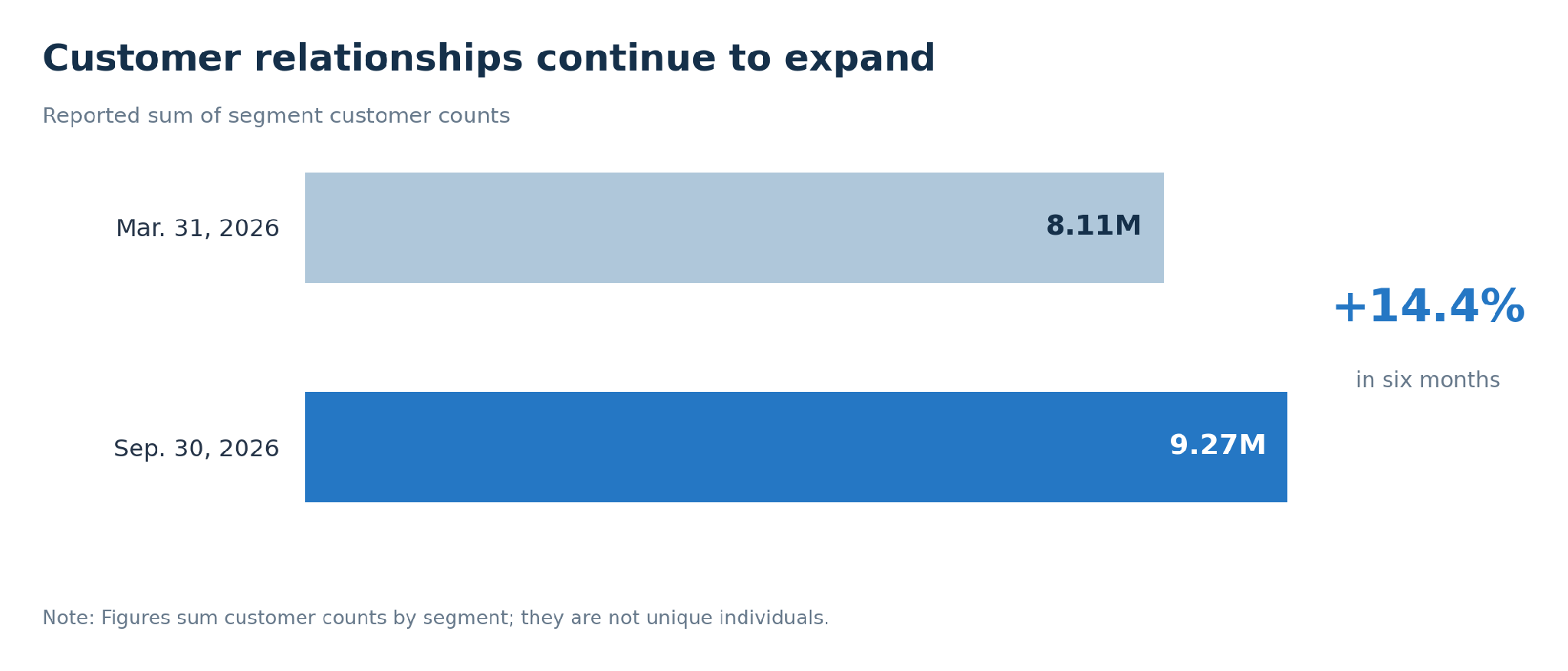
Figure 2. Reported customer relationships across business segments; counts may overlap. Source: Freedom Holding, September 2026 Form 10-Q.
Nevertheless, the growth provides evidence that Freedom's expanding platform is attracting substantial activity.
The greater opportunity may lie in encouraging those customers to use multiple services, potentially increasing revenue per customer while reducing the relative cost of acquiring and serving them.
If successful, this could make the overall ecosystem more valuable than its individual businesses operating independently.
Expansion Beyond Kazakhstan
Freedom Holding is also extending its ambitions geographically.
The company reports a presence across 27 countries, and recent acquisitions demonstrate its intention to build a larger international financial-services platform.
One of the most significant developments came on July 31, when Freedom completed the acquisition of approximately 99.3% of Turkish Bank, subsequently renamed Freedom Bank TR.
The acquisition provides the company with an established banking operation in Türkiye, creating a potential foundation for expanding its financial ecosystem into another substantial market.
Rather than starting a banking business entirely from scratch, Freedom gains an existing licensed institution that it can potentially develop using its digital banking experience.
The company has also moved into businesses outside traditional financial services.
In September, it acquired a 60% interest in Bilim Group, an educational technology company operating in Kazakhstan and Central Asia.
Other acquisitions during the first half included German chess software developer ChessBase and Estonia-based digital asset services provider Wallet Solutions.
These investments demonstrate the breadth of Freedom's strategy.
Management appears to envision a platform in which financial services, technology, education, entertainment, and consumer transactions reinforce one another.
The potential benefits extend beyond simply adding new revenue streams.
Each additional business may create opportunities to introduce customers to other products, share technology and infrastructure, and develop relationships that extend across multiple services.
International expansion could also gradually reduce dependence on any single geographic market, although Kazakhstan currently remains the company's dominant source of revenue.
Successful integration will be important, particularly when entering industries with different regulatory and operational requirements.
Still, Freedom's growing portfolio of businesses provides multiple avenues for future expansion and creates opportunities that would be difficult to achieve through brokerage operations alone.
Investing in Growth Today, With Potential for Greater Profitability Tomorrow
Freedom Holding's rapid expansion is bringing substantial new revenue, but it is also requiring significant investment.
Total quarterly expenses increased 93% to $859.9 million, outpacing the company's 81% revenue growth.
At first glance, that difference might raise concerns about profitability. However, it is important to consider where the additional spending is going and how those investments could affect future earnings.
Freedom is expanding its banking operations, acquiring businesses, entering new markets, investing in technology, and building infrastructure to support a growing customer base.
Many expanding businesses experience periods when expenses rise ahead of revenue as they establish operations intended to support future growth.
Some of these investments may create longer-term operating advantages. Once technology platforms, distribution networks, and other infrastructure are established, the company may be able to serve additional customers without increasing every category of expense at the same rate.
This creates the potential for economies of scale, where revenue expands faster than the costs required to support it.
Freedom's interconnected ecosystem could provide additional advantages. Customers acquired through one business may use other services, potentially reducing customer-acquisition costs and increasing revenue per customer over time.
Importantly, Freedom is already generating consolidated profits while undertaking this expansion.
Net income increased 29% to $46.1 million during the latest quarter, despite substantial spending across its growing operations.
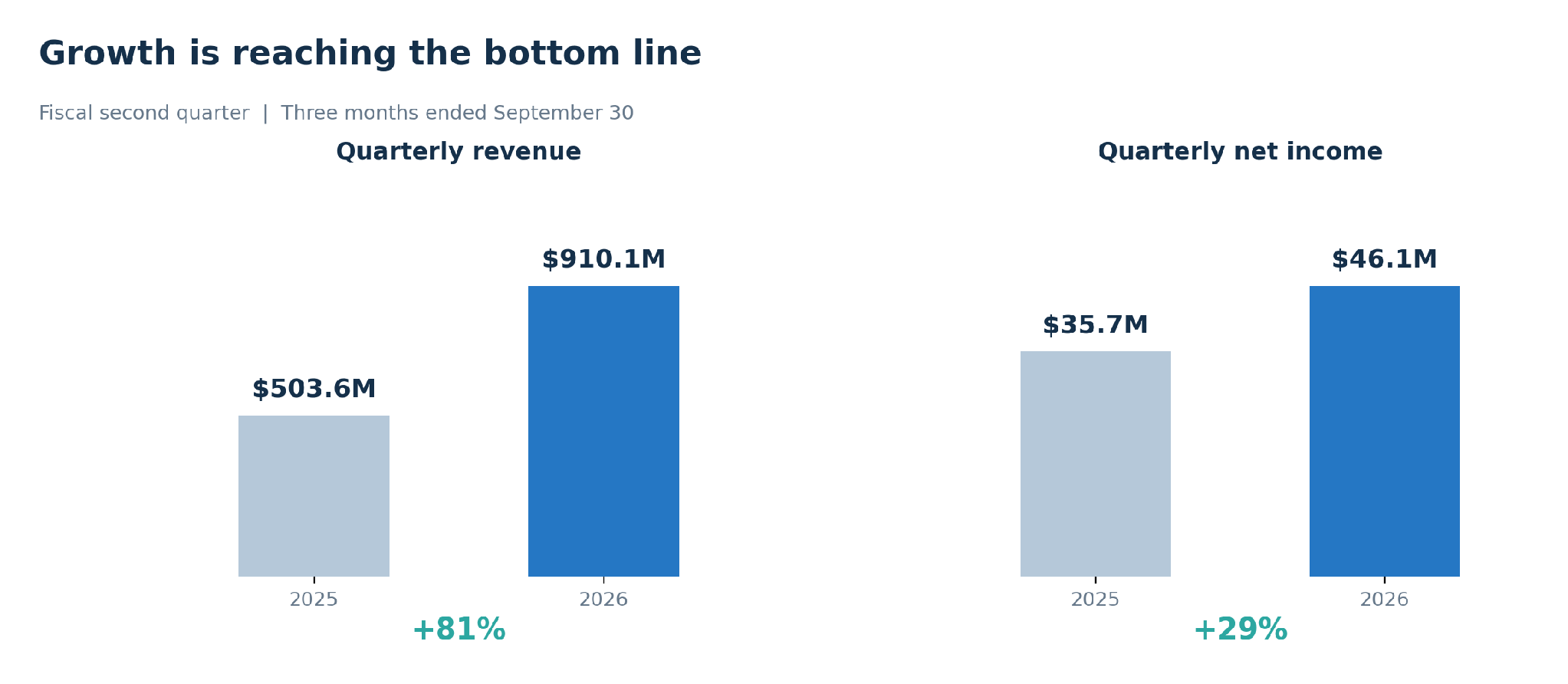
Figure 3. Revenue and net income both increased year over year. Source: Freedom Holding, second-quarter FY2027 results.
The company's established brokerage business remains particularly profitable, generating approximately $115 million in quarterly net income.
Meanwhile, newer operations within the Other segment, including telecommunications and digital services, reported a net loss of approximately $129 million as Freedom continued investing in their expansion.
Not all those expenses are temporary. Higher interest costs, insurance obligations, employee compensation, and other operating expenses will continue to accompany business growth.
Nevertheless, the central opportunity is clear.
If Freedom can build on its expanding customer base while achieving greater operating efficiency, its growing revenue could eventually translate into stronger profit margins.
The company's next stage of development may therefore be defined not simply by how much its businesses grow, but by how effectively it converts that larger operating scale into earnings.
A Stronger Financial Profile Could Support Expansion
Another encouraging development is growing recognition from credit-rating agencies.
In September, S&P Global Ratings (SPGI) revised the outlook on Freedom Holding and several subsidiaries from stable to positive while affirming their international credit ratings.
Moody's (MCO) also assigned insurance financial strength ratings to two Freedom insurance subsidiaries for the first time.
Freedom Life received a Baa3 rating, placing that subsidiary at the lowest investment-grade level on Moody's scale. Freedom Insurance received a Ba1 rating, one level below investment grade.
These ratings apply to the respective insurance entities and should not be interpreted as investment-grade ratings for Freedom Holding as a whole.
Still, they represent potentially useful developments as the company seeks to strengthen its financial position and expand across additional markets.
Creditworthiness matters particularly for a growing financial institution because access to capital and confidence among counterparties can influence its ability to fund operations and pursue expansion.
Freedom's total assets reached $16.6 billion at the end of September, compared with $13.2 billion six months earlier.
Asset growth demonstrates the increasing scale of the business, although it also needs to be evaluated alongside liabilities, capital adequacy, credit quality, and funding costs.
One outstanding regulatory matter is an ongoing SEC investigation involving certain brokerage settlement practices, accounting, and disclosures. In March 2026, Freedom Holding and CEO Timur Turlov received Wells Notices indicating that SEC staff had preliminarily recommended civil enforcement action. The company and Turlov have challenged that determination, and no formal charges have been publicly announced. The matter remains unresolved, although a Wells Notice does not constitute a finding of wrongdoing.
As Freedom grows, disciplined capital allocation, effective compliance, and operational integration will become increasingly important in supporting its long-term expansion.
What Could Drive the Next Phase of Growth?
Several factors could help determine whether Freedom Holding's current momentum develops into a more durable growth story.
The first is continued expansion in banking and insurance.
Both segments have demonstrated the ability to generate substantial additional revenue. Their continued growth could provide a more diversified earnings base and further reduce reliance on brokerage activity.
The second is the continued development of Freedom's SuperApp and interconnected digital services.
Increasing customer adoption is encouraging, but deeper engagement across multiple products could create additional revenue opportunities and improve operating efficiency.
Third, the Turkish banking acquisition creates a potentially important international opportunity.
Successful integration and growth could demonstrate that Freedom's digital banking model can be extended into additional markets.
Another important factor will be the performance of the company's newer businesses.
The substantial investments currently being made in telecommunications, technology, and other digital services could become more valuable as those operations mature.
If revenue continues expanding while infrastructure and other fixed costs are spread across a growing customer base, these businesses may eventually contribute more meaningfully to consolidated profitability.
Finally, the company has opportunities to strengthen the consistency of its earnings.
Continued growth in lending, customer fees, insurance profitability, and recurring service revenue could complement its more market-sensitive brokerage and trading activities.
Taken together, these developments could make Freedom's business increasingly diversified, efficient, and resilient.
The Bottom Line
Freedom Holding's latest earnings report reveals a company undergoing a significant transformation.
Its 81% quarterly revenue increase is impressive, but the larger story may be the emergence of a diversified financial and technology ecosystem with multiple engines of growth.
Banking and insurance are rapidly expanding, while the company's established brokerage business continues generating substantial profits. Together, these operations provide a broader foundation that could help reduce dependence on any single business and create opportunities across different market conditions.
Freedom's continued investments in technology, infrastructure, and international expansion are also laying the groundwork for potential economies of scale as its newer businesses mature.
Although expenses are growing rapidly and some operations have yet to achieve profitability, the company is already generating higher consolidated earnings while expanding its reach.
If Freedom Holding can successfully integrate its growing businesses, deepen relationships with its customers, and capitalize on the efficiencies of its expanding ecosystem, it could emerge as an increasingly significant force in international financial services.
The company's remarkable revenue growth is already evident. The next chapter could be even more interesting: turning that expanding financial ecosystem into a powerful engine for sustained profitability and long-term value creation.



Comments
Log in or sign up to join the conversation.