


For biotechnology companies, developing a promising treatment is only half the battle. Getting that treatment through regulatory review, manufacturing it consistently, and ultimately making it available to patients can be just as challenging.
INmune Bio (INMB) is attempting to address several of those challenges simultaneously.
On October 21, the company announced two developments that, taken together, could represent an important step toward its long-term commercial ambitions.
The first was a strategic agreement with Uniphar, establishing a framework to support international access, distribution, and potential commercialization of Ebstrocel, its investigational cell therapy for a rare inherited skin disorder.
The second was a regulatory update outlining progress toward a planned UK marketing application, with the company now targeting February 2027 for its full submission and identifying mid-2027 as a potential approval timeframe, subject to regulatory review.
Neither announcement guarantees regulatory approval or commercial success. Together, however, they suggest a company beginning to prepare for a future beyond clinical development.
For investors, the question is whether 2027 could become the year that years of research and development begin translating into a viable commercial business.
A Rare Disease With Significant Unmet Needs
Ebstrocel is being developed to treat recessive dystrophic epidermolysis bullosa (RDEB), a rare genetic condition that causes extremely fragile skin.
Patients can develop painful blisters and wounds from minor friction or everyday activities. The condition can also cause chronic itching, infections, scarring, and complications affecting other parts of the body.
For children living with severe RDEB, even ordinary activities can become painful and exhausting.
Treatments have advanced in recent years. Products including Krystal Biotech's (KRYS) Vyjuvek, Chiesi's Filsuvez, and Abeona Therapeutics' (ABEO) Zevaskyn have introduced additional wound-treatment options.
INmune Bio is pursuing a different therapeutic approach.
Rather than applying treatment directly to individual wounds, Ebstrocel is being developed as a systemic cell therapy intended to address inflammation and other aspects of the disease.
The treatment uses mesenchymal stromal cells derived from donated human umbilical cord tissue, manufactured through INmune Bio's proprietary CORDStrom platform.
The company believes this approach could provide benefits extending beyond localized wound care, potentially including reductions in itching, pain, and other symptoms.
If supported by additional clinical evidence and regulatory approval, that distinction could give Ebstrocel a role alongside existing therapies rather than necessarily replacing them.
Clinical Results Show Promise, but Important Questions Remain
The investment case for Ebstrocel rests partly on results from the MissionEB clinical trial, which evaluated the CORDStrom treatment in approximately 30 children with intermediate or severe RDEB.
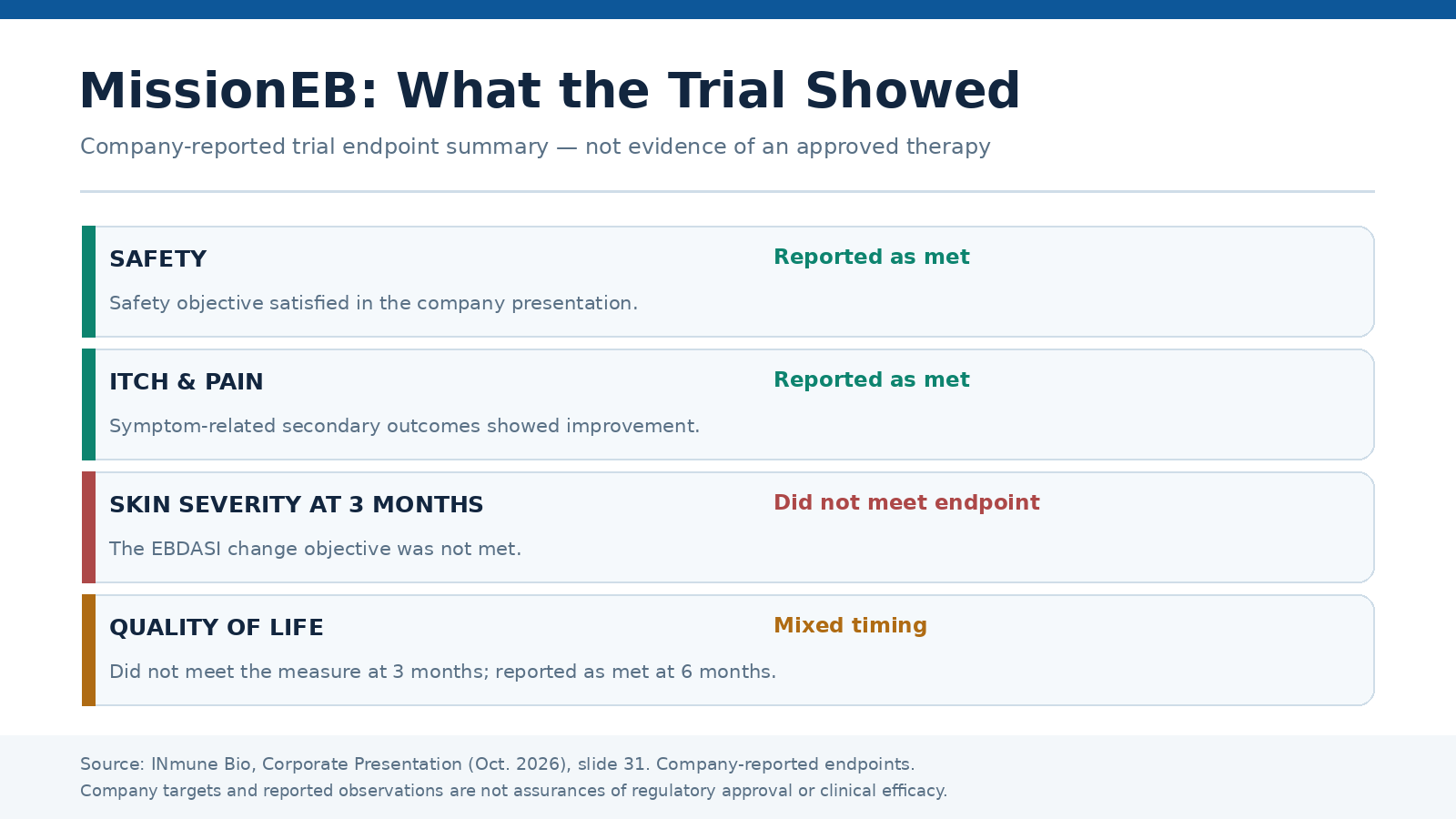
According to INmune Bio's October 2026 corporate presentation, the study met its safety objective and reported improvements in several secondary measures, including itching and pain.
Some findings were particularly encouraging.
The company reported a 25% reduction in itching at three months among patients with severe RDEB, with a 27.5% improvement reported at six months in that subgroup.
However, the clinical picture is more complicated than those numbers alone suggest.
The study failed to meet its primary three-month skin-severity endpoint, measured by changes in the Epidermolysis Bullosa Disease Activity and Scarring Index (EBDASI).
A quality-of-life measure also failed to meet its objective at three months, although the company's presentation reported improvement at six months.
These limitations matter.
While improvements in symptoms such as itching and pain could offer meaningful benefits to patients, they are not equivalent to demonstrating durable wound closure or broad disease modification.
Regulators will ultimately determine whether the available evidence, together with manufacturing, safety, and other supporting data, is sufficient for authorization.
INmune Bio's strategy appears increasingly focused on the clinical importance of symptom relief, particularly itching and pain, while continuing development of confirmatory evidence.
That could become an important distinction for Ebstrocel's eventual commercial positioning.
Why the Uniphar Agreement Matters
The newly announced Uniphar relationship addresses a different obstacle: how INmune Bio could reach patients across multiple international markets without building an extensive commercial network itself.
Under the Master Services Agreement, Uniphar Durbin Ireland Limited may provide services including distribution, storage, regulatory feasibility assessments, market-access support, treatment-center onboarding, order processing, and shipment tracking.
The specific services will depend on future country-level arrangements.
For INmune Bio, this approach could reduce the cost and complexity of establishing commercial operations internationally.
Its initial focus is particularly interesting.
The company intends to pursue named-patient access in selected European countries and markets in the Middle East and North Africa.
Under certain national regulatory frameworks, physicians may request access to an investigational treatment for individual patients before it becomes broadly available in that market.
Such programs are subject to country-specific laws, eligibility requirements, and implementation agreements.
For patients with severe rare diseases, these pathways can potentially provide additional treatment options when approved alternatives are limited.
For INmune Bio, they could also create opportunities to develop relationships with specialist physicians, establish distribution procedures, and gain experience with treatment-center logistics.
There may eventually be opportunities for early revenue, although the company has not announced completed named-patient sales under the new agreement.
Importantly, the Uniphar agreement is a commercial framework, not a marketing authorization or confirmation that international sales have begun.
Nevertheless, by working with an established pharmaceutical-services provider, INmune Bio could be positioning itself to move more efficiently if regulatory milestones and country-specific access requirements are satisfied.
Manufacturing Could Be a Critical Competitive Advantage
Manufacturing is one of the less visible, but potentially most important, aspects of advanced cell therapy development.
Unlike conventional medicines produced through established chemical manufacturing processes, cell therapies rely on complex biological materials.
Maintaining consistent quality, potency, and reproducibility across production batches can be difficult.
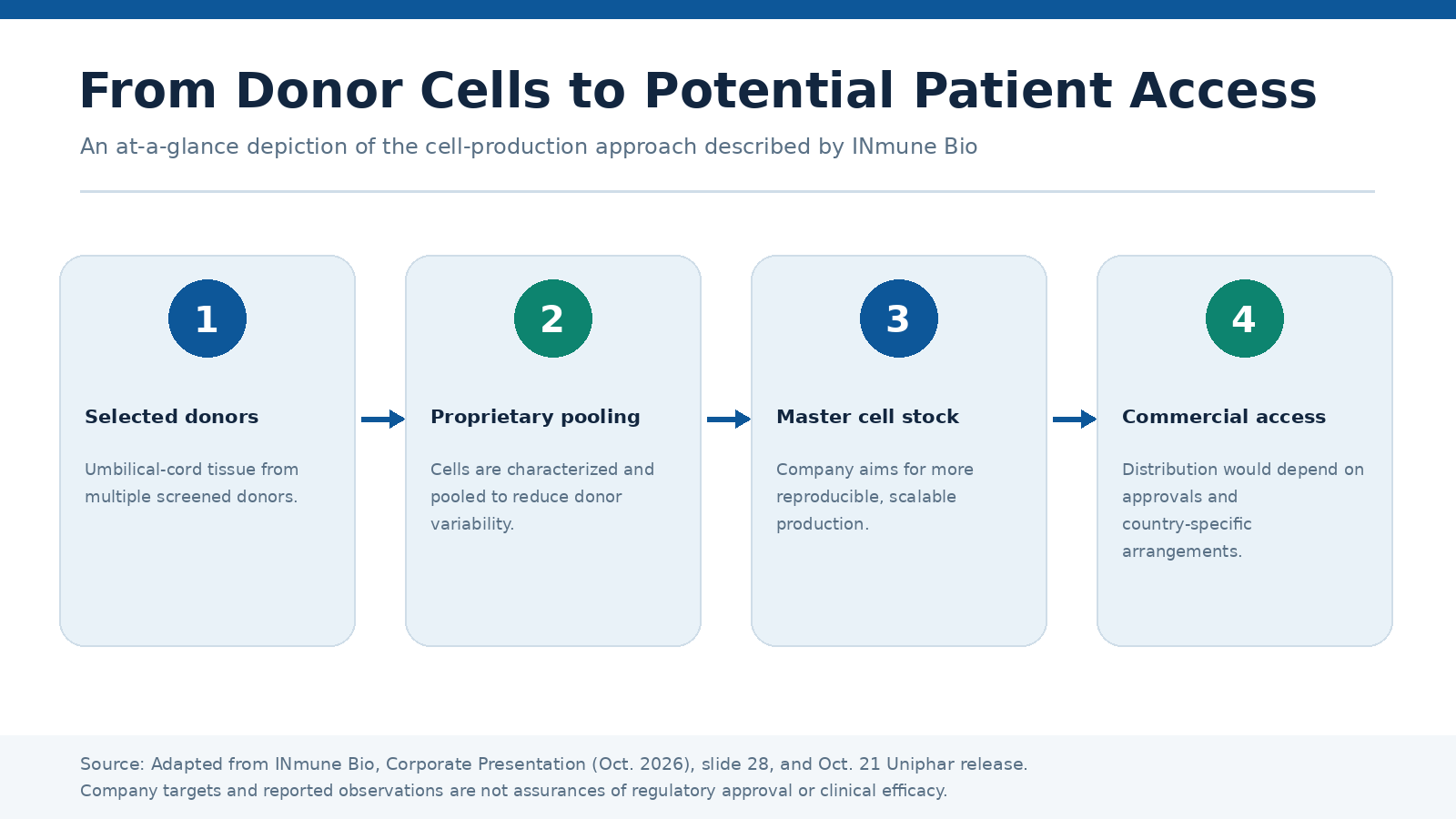
INmune Bio's CORDStrom platform is designed to address some of those challenges by pooling carefully selected donor-derived cells to reduce variability.
The company has also made progress transferring production processes to manufacturing facilities intended to support future commercial supply.
In its second-quarter business update, INmune Bio reported completing a commercial-manufacturing preparation milestone at the Cell and Gene Therapy Catapult Manufacturing Innovation Centre in Stevenage, United Kingdom.
Manufacturing progress also played a role in the company's revised UK regulatory strategy announced October 21.
According to management, faster-than-anticipated progress in chemistry, manufacturing, and controls helped support a decision to pursue a complete application rather than the previously planned rolling submission.
The significance extends beyond Ebstrocel itself.
If the CORDStrom platform can produce reliable, scalable therapies, it may eventually support additional indications. But its broader commercial potential remains unproven.
A Potentially Pivotal Regulatory Year
The United Kingdom could become INmune Bio's first major regulatory opportunity for Ebstrocel.
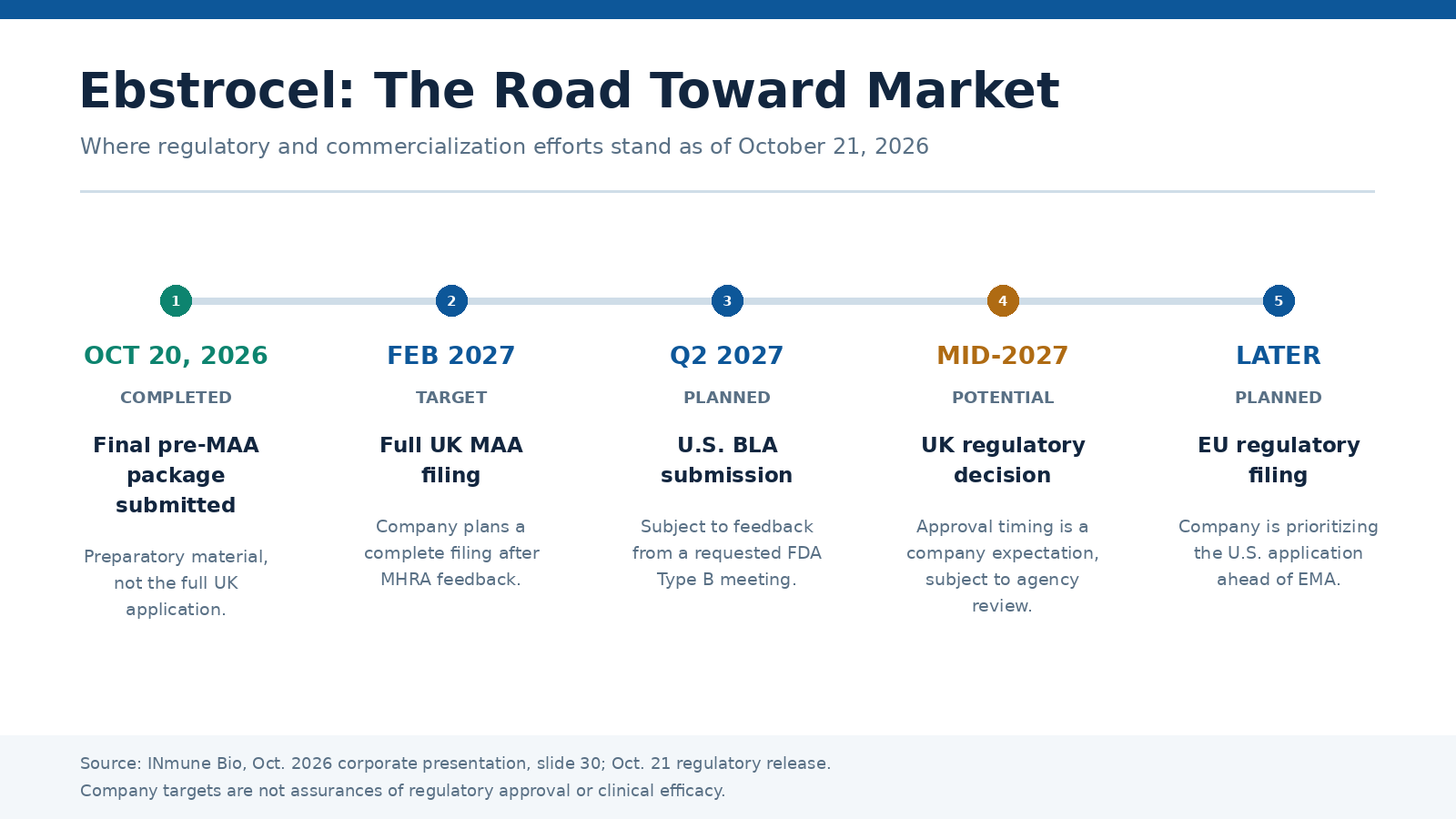
On October 20, the company submitted its final pre-Marketing Authorisation Application package to the UK's Medicines and Healthcare products Regulatory Agency (MHRA).
This was a pre-application submission, not the completed marketing application, and Ebstrocel has not received UK marketing approval.
INmune Bio now plans to submit a complete Marketing Authorisation Application in early February 2027, following MHRA feedback.
This represents a change from its earlier strategy, which had envisioned beginning a rolling submission in late 2026.
The company believes the revised approach could bring a potential UK approval decision forward by approximately six weeks, to mid-2027.
That timetable remains an estimate, not a commitment from the MHRA.
The timing and outcome will depend on application validation, regulatory review, potential requests for additional information, and the agency's assessment of the supporting evidence.
Meanwhile, INmune Bio is preparing for further interactions with the U.S. Food and Drug Administration.
The company has engaged regulatory advisers to prepare a Type B meeting request and currently targets a U.S. Biologics License Application submission in the second quarter of 2027.
However, that plan remains subject to FDA feedback. The agency has not confirmed a final approval pathway for Ebstrocel.
Management has also indicated that it intends to prioritize the U.S. application ahead of its planned submission to the European Medicines Agency.
Taken together, these milestones could make 2027 an unusually consequential year for the company.
The distinction for investors is straightforward: Ebstrocel is moving through regulatory preparation, but the major filing and approval decisions still lie ahead.
Beyond Ebstrocel: Another Potential Growth Platform
Ebstrocel is not INmune Bio's only development program.
On October 14, the company announced a collaboration with Quantum Computing Inc. (QUBT) to explore how quantum optimization, artificial intelligence, and advanced data analysis could help identify new applications for its separate XPro platform.
XPro is being developed to address neuroinflammation and is under investigation for Alzheimer's disease and other potential conditions.
The collaboration aims to analyze clinical and biological datasets, identify potentially promising patient populations, and prioritize additional research opportunities.
Whether quantum-assisted analysis ultimately provides an advantage over conventional approaches remains to be demonstrated.
Although unrelated to Ebstrocel's commercialization framework, the partnership illustrates how INmune Bio is pursuing multiple avenues for creating long-term value.
Ebstrocel is moving toward potential regulatory filings and commercialization. XPro remains focused on further therapeutic development and identifying additional opportunities.
For now, Ebstrocel's nearer-term milestones make it particularly important to investors evaluating the company's prospects over the next year.
The Financial Challenge Behind the Opportunity
Regulatory progress and commercial preparations are encouraging, but financial resources remain an important part of the equation.
INmune Bio reported approximately $18.4 million in cash and cash equivalents as of June 30, 2026.
Its quarterly SEC filing showed a net loss of approximately $6.7 million and operating cash usage of approximately $6.6 million during the first six months of the year.
The filing also identified substantial doubt about the company's ability to continue as a going concern without additional financing.
Those figures describe its June financial position rather than its current October liquidity. The company subsequently disclosed receiving an approximately $4.2 million Australian research-and-development tax rebate in July.
Still, the financing challenge helps explain the emphasis on capital efficiency.
By using Uniphar's infrastructure, INmune Bio may be able to avoid some of the substantial costs associated with building its own international distribution capabilities.
That could allow management to concentrate resources on regulatory submissions, confirmatory clinical development, and manufacturing.
But the Uniphar agreement does not eliminate the need for additional capital, nor does it establish the potential economics of commercial supply.
Until pricing, reimbursement, patient uptake, and operating costs become clearer, investors have limited visibility into the revenue or profitability Ebstrocel might ultimately generate.
What Investors Should Watch Next
Several developments will help determine whether INmune Bio can turn its current momentum into measurable progress.
The most immediate regulatory milestone is the planned February 2027 UK marketing application. Completing that filing would represent an important step toward formal review.
Any subsequent MHRA communications will help clarify whether the company's anticipated review timetable remains achievable.
In the United States, FDA feedback following the proposed Type B meeting will be especially important in determining the next development and submission steps.
Investors should also watch for concrete progress under the Uniphar agreement, particularly country-specific implementation arrangements, treatment-center participation, and any disclosed named-patient access activity or sales.
Further clinical evidence will matter as well, especially given the original trial's missed primary skin-severity endpoint.
Finally, the company's ability to secure sufficient financing while advancing manufacturing and regulatory activities will remain central to its commercial prospects.
The Bottom Line
INmune Bio's two October 21 announcements offer a revealing picture of where the company hopes to go next.
The Uniphar agreement provides a framework for international patient access and potential commercial distribution. Meanwhile, the updated UK regulatory strategy establishes a more specific timetable for a planned full marketing application in February 2027, with the company targeting potential UK approval by mid-2027, subject to regulatory review.
Neither development guarantees success. Only the pre-MAA package has been submitted to the MHRA, Ebstrocel remains investigational, and important clinical, financial, and regulatory challenges remain.
But if INmune Bio can successfully navigate the approval process and execute its commercialization strategy, it could achieve a transformation years in the making: from a clinical-stage biotechnology company into a commercial enterprise serving patients across international markets.
And that is what could make 2027 INmune Bio's breakout year.



Comments
Log in or sign up to join the conversation.