

The tech sector has extended its decline, with Nasdaq (QQQ) futures falling around 1% by mid-morning European trade. The sector was already under pressure after hotter-than-expected US inflation revived expectations of further Federal Reserve rate hikes. But even as Treasury yields and the dollar subsequently gave back much of their post-CPI gains, the Nasdaq failed to recover. That points to something deeper at work. Investors are starting to question whether the enormous sums being poured into artificial intelligence infrastructure will generate returns quickly enough to justify current valuations.
For a market that has relied heavily on the AI trade to drive gains, that is a more significant concern than a temporary move in bond yields. Against this backdrop, the Nasdaq 100 futures could extend their losses in the near term.
The AI trade is facing a credibility test
The reaction to TSMC (TSM)’s latest outlook was particularly revealing. The chipmaker delivered a very strong revenue forecast, yet the news failed to provide the usual lift for technology stocks.
Normally, stronger-than-expected demand for advanced chips would reinforce the bullish AI narrative. Instead, investors largely looked through it.
The debate appears to be shifting from how big AI can become to how profitable the investment cycle will ultimately be. Strong chip demand is one thing; generating adequate returns on the huge sums being spent on data centres, computing capacity and infrastructure is another.
There are already signs that the pressure is spreading beyond equities. Credit markets are showing increased concern around heavily indebted technology companies, while businesses with large capital requirements face a particularly difficult backdrop if financing costs remain elevated.
Higher interest rates make future cash flows less valuable, while also raising the cost of funding the very infrastructure needed to support the AI boom.
That helps explain why the Nasdaq has struggled even as bond yields have retreated.
Markets turn more hawkish on the Fed
On the economic calendar today, we had PPI inflation, retail sales and jobless claims. All of these figures came out stronger, a day after consumer inflation surprised to the upside. The inflation surprise has clearly shifted expectations for US monetary policy. The probability of an October rate hike has risen to around 45%, from roughly 20% before the CPI release, while a December hike is now priced at around 85%.
That is considerably more hawkish than the guidance coming from the Federal Reserve itself. New York Fed President John Williams has indicated that he expects only one further rate hike this year and none in 2027.
The problem is that elevated oil prices and a still-resilient US economy could keep inflationary pressure alive. If that happens, markets may be forced to price a more aggressive rate path.
Nasdaq 100 technical outlook
The technical picture has also deteriorated. Nasdaq 100 futures have broken below a bullish trend line extending back to March. A close below the trend line would strengthen the case that the broader uptrend is beginning to reverse.
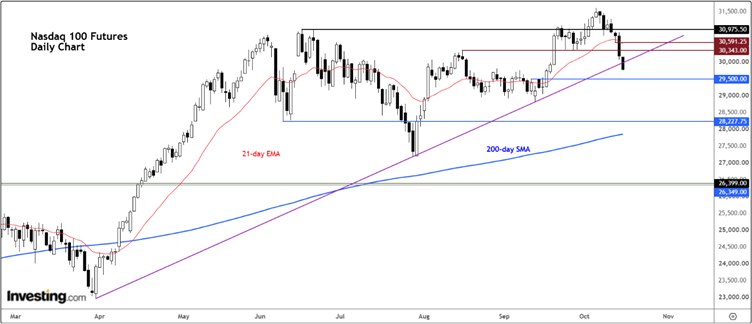
The first important support level is around 29,500. Below there, 29,000 becomes the next obvious downside target.
On the upside, resistance is now concentrated between 30,340 and 30,600. Unless the index can reclaim that area, the short-term bias remains bearish.
For now, the combination of stretched valuations, doubts over AI investment returns and a potentially more hawkish Fed leaves the Nasdaq vulnerable to further losses.



Comments
Log in or sign up to join the conversation.