

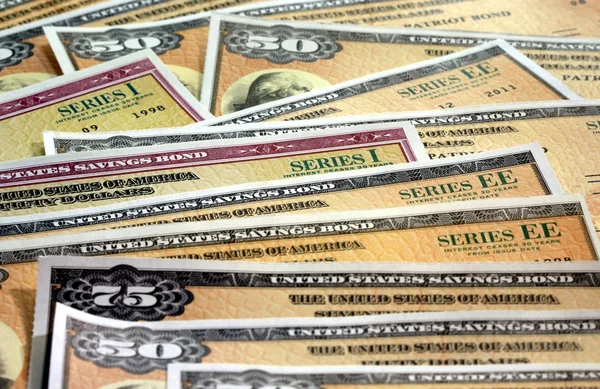
Today’s global bond sell-off is a continuation of a steady drumbeat featuring rising yields. The bond market indicates that central bankers have to raise rates to curb the inflationary pressures across the world. Fed Chairman Warsh's speech last week focused on price stability, with no reference to the other side of its dual mandate, full employment. The Fed is now feeling very uncomfortable with inflation running well above 3 %. Similarly, the U.K. and the Eurozone recorded consumer prices advancing by 3% in July.
The pressure on consumer prices is coming from various directions. A recent renewed flare-up in the US war with Iran has pushed Brent crude to $92/bbl. The cat-and-mouse game between Iran and the US regarding the control of the Straits of Hormuz continues to keep the gasoline prices in the US well in the $4-4.50 a gallon. As energy prices ripple through economies, it is impossible for central bankers to hold down their policy rates.
Ten-Year Bond Yields
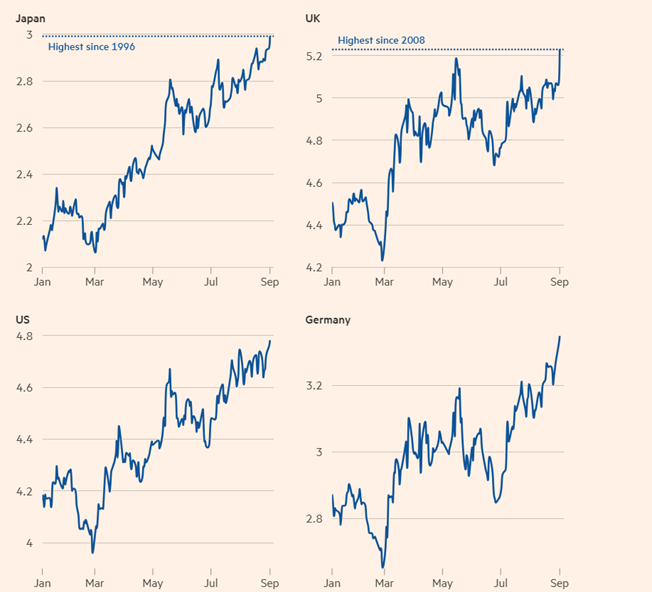
Governments still have to keep borrowing to fund deficits. US Treasury debt stands at $40 trillion, the highest on record. The US is on track to add another $2 trillion for the fiscal year 2026. These thresholds have resulted in the US having to offer higher rates for newly issued bonds, especially at the long end of the market. Traders are prepared to fund the US debt, but at a steeper price level ( higher yields). Facing a similar fiscal threshold, the UK 10-year gilt yield hit 5.2%, the highest since the 2008 crash. Japanese long bond yields reached 3%, a yield last seen 30 years ago.US Intervention in yen trading falls on the heels of the lacklustre efforts of the Bank of Japan to raise rates fast enough to close the interest differentials with the US. Bond market yields and currencies are very much joined at the hip.
The bond markets now have to deal with the surge in borrowing for the build-out of AI centres. The tech giants have become the single largest corporate borrowing group. Goldman Sachs projects that $3 trillion to $5 trillion will be needed to build AI data centers, chips, and electrical power over the next five years. Goldman expects all that financing to come from the debt markets; the hyperscalers will need debt financing of about $500 billion annually.
Borrowing costs are increasing across the whole spectrum of the yield curve. A combination of unchecked inflation and heavy borrowing requirements results in the market asking for greater protection against capital losses in the future. Governments are not reigning in spending; the corporate sector is making huge demands to feed the AI fever. These conditions are going to drive yields higher. Right now, equity traders are not very cognizant of what is happening on the debt side. Just how long the equity markets remain this way is anyone’s guess. But what is clear is that the long rates are still under pressure, and equity traders will have to sit up and take notice.

Comments
Log in or sign up to join the conversation.