

On 6 October 2026, OpenAI casually announced it was "releasing a broad range of new mathematical results produced by an internal frontier model", the same system the technology company used to produce its solution to the Navier-Stokes millennium challenge problem a month earlier.
"Broad range" is something of an understatement. The firm's still-internal AI system solved 376 open problems in several fields of mathematics, backed up by autoformalized proofs using the Lean proof assistant which it made publicly available on a GitHub repository.
On 11 May 1959, Eugene Wigner gave a lecture in which he described "the unreasonable effectiveness of mathematics in the natural sciences", pointing out mathematics was uniquely capable of describing observations in the physical world. So much so that abstract mathematical concepts developed without any connection to any physical science were proving capable of describing and predicting physical reality.
While not quite the same, what's happening now with the specially-trained artificial intelligence models making breakthroughs in solving so many open problems at such a torrid pace might be described as the unreasonable effectiveness of AI in mathematics. The rapid development is shaking up the discipline.
A Productivity Explosion
To show how much AI is rattling mathematicians, here's an updated version of a chart we first featured two months ago to illustrate AI's productivity explosion. It shows the number of math papers submitted to the arXiv repository each month from January 1992 through September 2026.
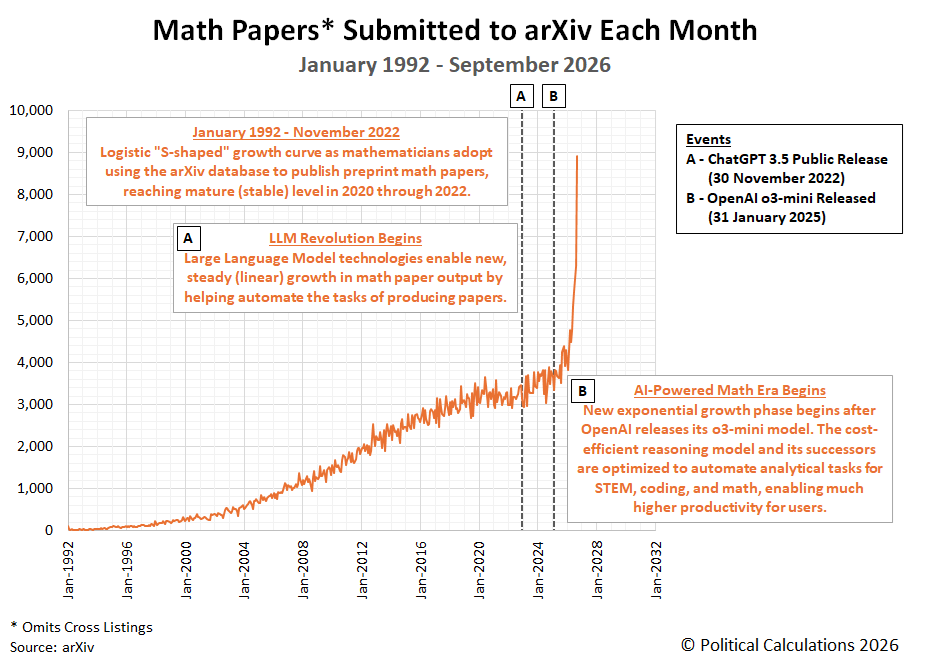
In December 2022, when OpenAI's ChatGPT was first made publicly accessible, arXiv reported some 3,122 math preprint papers had been posted in its database. In July 2026, arXiv reported the posting of 5,696 math papers during the month. For September 2026, arXiv reports 8,919 math papers were added to the archive.
That doesn't include any of the results OpenAI released in October 2026. When we next feature an updated version of this chart, we expect we may have to adjust the vertical scale because the number of newly math papers could exceed 10,000 per month. For its part, arXiv announced it would limit authors to posting no more than two papers per month, but the daily numbers we've seen suggest that is doing little to slow the pace.
Mathematicians Go Into John Henry Mode
In American folklore, John Henry is the story of a former slave who became a "steel driving man" building railroads after the Civil War. In the tale, John Henry took on new steam-powered technology in a contest to find out whether man or machine could do the job of driving steel faster. He won, but died from the exertion.
A team of mathematicians experienced their own version of John Henry's story in September 2026. Quanta Magazine sets the stage for their story:
On the morning of September 11, 2026, Dor Minzer(opens a new tab) received a text message from a friend asking whether he was close to settling one of the most famous open questions in theoretical computer science. Minzer, a professor at the Massachusetts Institute of Technology and a leading expert on the “unique games” conjecture, initially thought it was a joke. Then more messages started coming in, and the rumors began to cohere. The artificial intelligence company OpenAI, fresh from announcing a bombshell proof about the behavior of fluids that sent ripples through the math world, had allegedly discovered a proof of the unique games conjecture. They might make the result public any day. If Minzer had any results of his own to share, the messages suggested, now would be the time to do so.
The unique games conjecture is an iconic question in computational complexity theory, the study of the inherent difficulty of mathematical problems. Roughly speaking, it states that a problem about satisfying multiple constraints at the same time can be extremely hard, even if you’re willing to settle for a poor approximation of the best possible solution. A proof of the conjecture would also automatically imply that current methods for solving many seemingly unrelated problems can’t be improved. Researchers would be a big step closer to a unified theory of computational difficulty.
Minzer had not, in fact, proved the unique games conjecture. But he and his graduate students Yumou Fei and Shuo Wang had recently proved a milestone result about a closely related question. They were in the midst of writing up their findings — a process that would typically take months or longer — when the rumors began circulating. The trio rushed to finish their draft to avoid being overshadowed by an OpenAI press release. Three days later, prioritizing completeness over clarity, they posted a 95-page paper online with a disclaimer on the first page: “The current version of the manuscript is complete mathematically, but it is not in the shape we wished to share in.”...
“From section 6 onward, there are literally no connecting words,” Minzer said — just an unbroken sequence of definitions and proofs of intermediate results. “We felt the need to apologize for that.”
It's not as tragic an ending as John Henry's story, yet it is telling all the same. For mathematicians who until recently haven't had any need for urgency in doing what they do, AI is pressing them to become more productive than they've ever been before.
How will they adapt? And for that matter, how many other professions will soon find themselves in a similar situation?
References
arXiv. Math Submissions. [Online Database]. Accessed 15 October 2026.
arXiv. Monthly Submissions. [Online Article and CSV Data]. Accessed 15 October 2026.
ScriptByAI. OpenAI & ChatGPT Timeline: GPT Release Dates to GPT-5.6 (2026). [Online Database]. Accessed 20 August 2026.
Comments
Log in or sign up to join the conversation.