

How affordable is the typical new home sold in the U.S. for the typical American household?
There are three factors that play into the answer to that question: the median price of new homes sold, mortgage rates, and median household income. In September 2026, all three of these factors increased over their revised levels from August 2026.
Here are the three numbers that define how affordable a new home is for a typical American household in September 2026:
Median new home sale price: $400,400
Median household income: $88,076
Average 30-year conventional fixed mortgage rate: 6.86%
Assuming a 0% down payment, a new home sold in September 2026 at the nation's median sale price would have a mortgage payment that consumes 35.8% of the income earned by a household at the exact middle of the U.S. spectrum of income. The following chart reveals the typical new home sold in the U.S. remained provisionally within the affordable reach of the typical American household during September 2026, though it's nearing the threshold that would push it back into the levels of unaffordability that characterized the Biden-Harris era of high inflation in the United States:
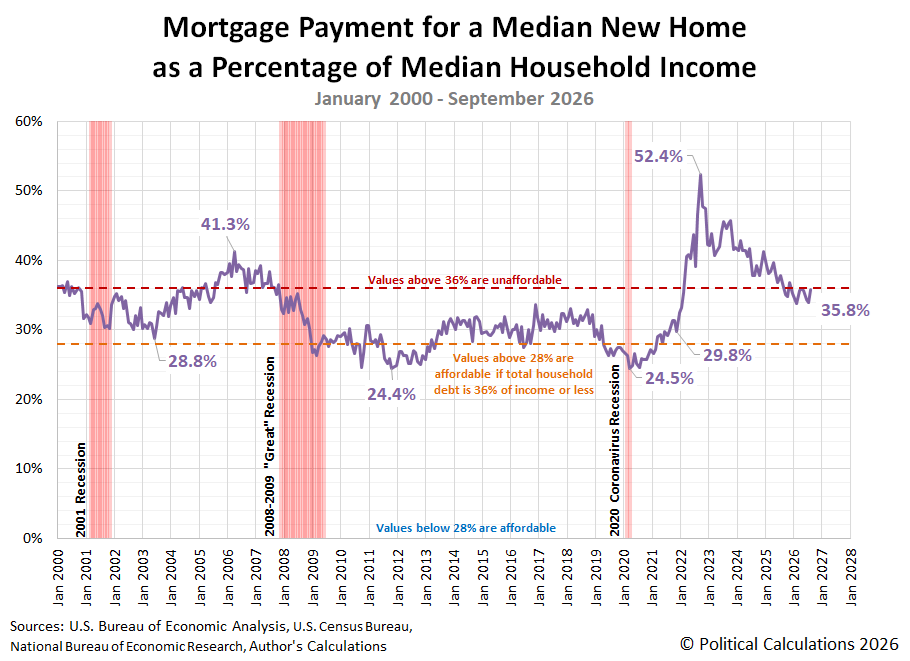
The relative affordability thresholds indicated on the chart are defined by the 28/36 rule that mortgage lenders traditionally use to determine whether to extend a mortgage to new home buyers. Here, a monthly mortgage payment that consumes more than 36% of a household's income means that the median new home sold is fully outside the affordable reach of a household earning the median income, even if it has no other debts. At the other end of the rule, a mortgage that does not exceed 28% of a household's income is considered affordable even with average levels of other kinds of debt.
September 2026's relative affordability level falls between these two levels but nearer the upper end, which means it can be considered affordable provided the household has very little other debt or if its other expenses are lower than average.
Perhaps the biggest reason new home prices have remained within the traditional mortgage lender affordability thresholds as mortgages rates have risen is the increased incentives homebuilders are providing to new home buyers to boost their sales. These incentives, including special financing that reduces the interest rates new home buyers will pay for their mortgages, have been offsetting the overall increase in average mortgage rates in the U.S.
Looking forward, the average interest rate for a 30-year conventional fixed rate mortgage in the U.S. rose to 7.33% in October 2026, so there are serious headwinds for new home affordability in the U.S. Which is a shame because they've only been within the affordable reach of a majority of American households in the past twelve months after having been fully out of reach from 2022 through most of 2025. We'll know more after we have October's median household income and median new home sale price data.
References
U.S. Census Bureau. New Residential Sales Historical Data. Houses Sold. [Excel Spreadsheet]. Accessed 27 October 2026.
U.S. Census Bureau. New Residential Sales Historical Data. Median and Average Sale Price of Houses Sold. [Excel Spreadsheet]. Accessed 27 October 2026.
Freddie Mac. 30-Year Fixed Rate Mortgages Since 1971. [Online Database]. Accessed 1 November 2026. Note: Starting from December 2022, the estimated monthly mortgage rate is taken as the average of weekly 30-year conventional mortgage rates recorded during the calendar month.

Comments
Log in or sign up to join the conversation.