

The Federal Reserve’s decision to raise interest rates by another 25 basis points naturally captured the markets’ attention. U.S. 10-year yields rose back above 5%, immediately reigniting the debate over the future path of monetary policy:
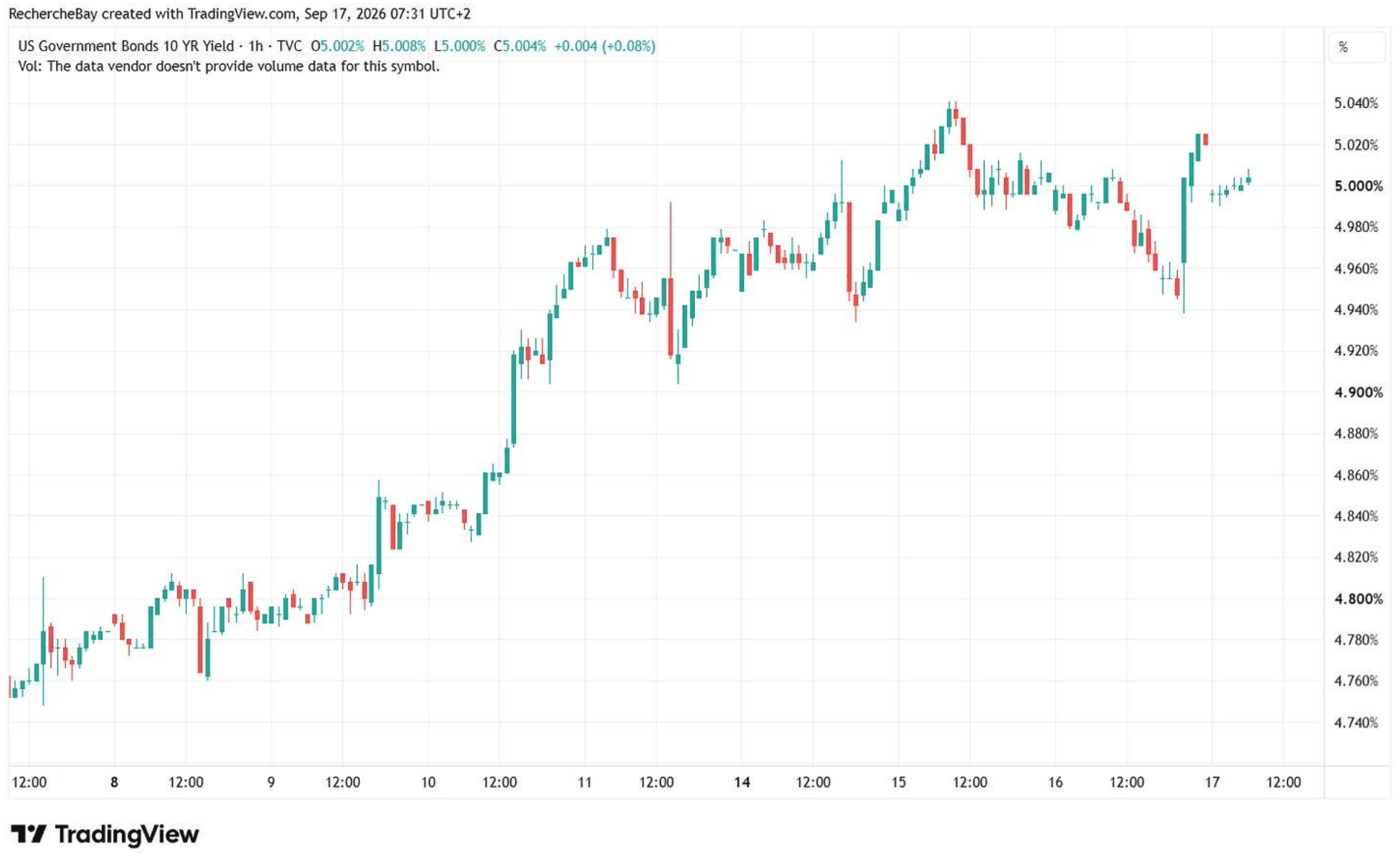
Nevertheless, I still believe that investors today place too much importance on the Fed’s decisions. The central bank can certainly influence demand by raising the cost of credit. However, no rate hike will produce a single additional barrel of oil, rebuild a damaged refinery, reopen a closed pipeline, or bring back the ships that are now avoiding the Strait of Hormuz and Bab el-Mandeb. Central banks remain capable of addressing the financial consequences of the energy crisis. They no longer control its cause.
This is precisely what the developments of the past few days have shown.
Initial analyses naturally focused on the strikes against the facilities in Jizan and their immediate consequences for Saudi production. Yet, as the hours passed, the most concerning reports came from a completely different location: Yanbu.
Several operators are now reporting that Saudi Aramco has reportedly canceled some of its shipments destined for the European market for the month of September, while shipping industry sources are citing disruptions that could last until November. If this information were confirmed, it would mean that the consequences of the attacks extend far beyond a mere temporary halt in production. They would directly affect Saudi Arabia’s ability to load and ship its oil to its main export markets.
Satellite data supports this assessment. Thermal anomalies detected by NASA’s VIIRS satellites show several hotspots of intense thermal activity right at the Yanbu port facilities:
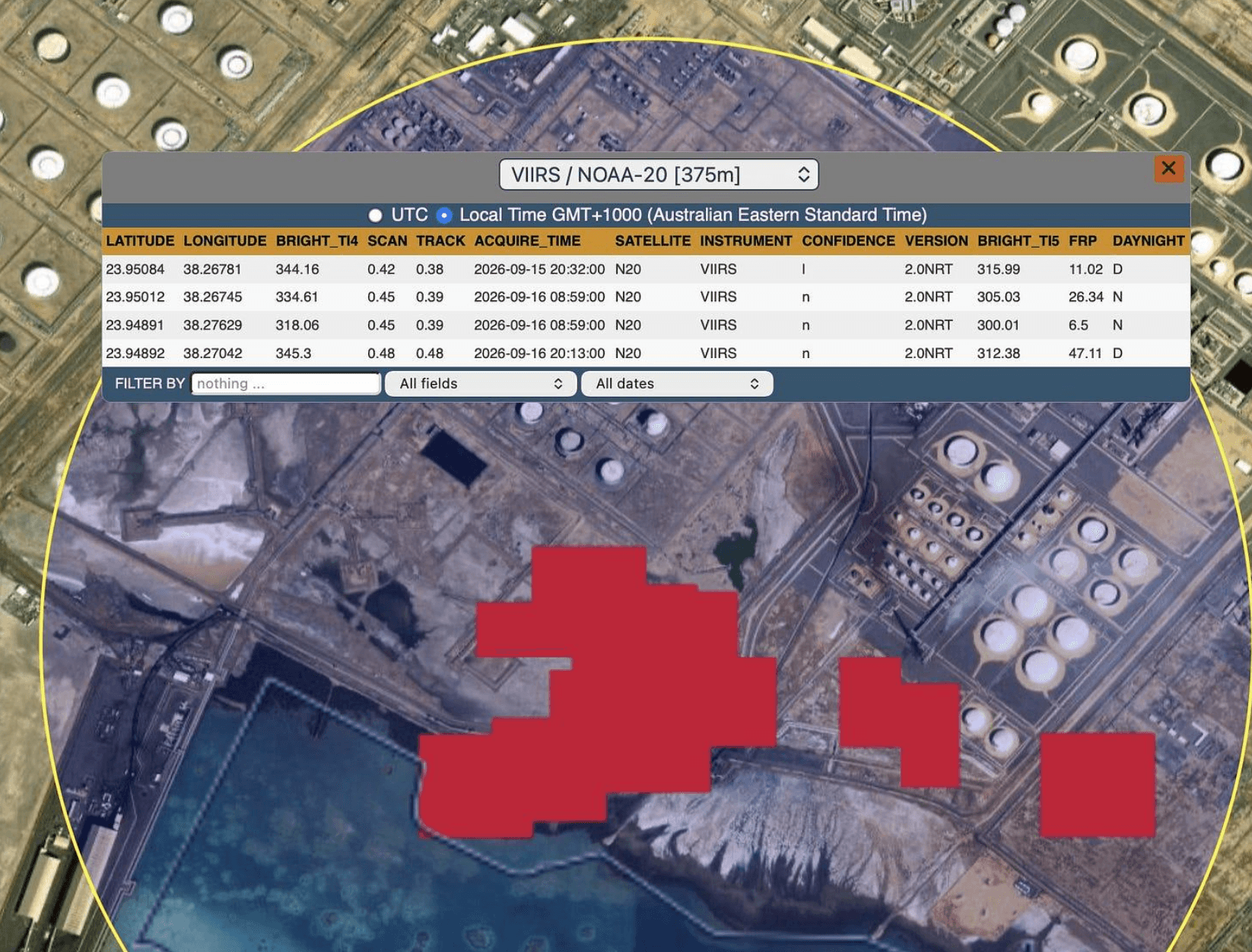
Obviously, these images do not allow for a precise assessment of the extent of the damage or a definitive conclusion that part of the terminal is permanently out of service. However, they do provide further evidence consistent with the numerous reports of ongoing disruptions to port operations.
At the same time, Reuters reports that several scheduled shipments between Sidi Kerir, on Egypt’s Mediterranean coast, and the Polish port of Gdańsk were ultimately canceled. Again, this is not a production issue. The oil is there. The cargoes were available. It is their transportation that is becoming progressively more complex, more costly, and more uncertain.
This distinction seems fundamental to me.
For decades, markets have operated primarily on the basis of production. A disruption of a few hundred thousand barrels per day was enough to drive up prices, while an increase in production generally brought the market back into balance quickly. Today, the problem is shifting to another link in the chain. Oil continues to be extracted, but it is becoming increasingly difficult to transport, load, insure, and deliver it to refineries.
In other words, the real bottleneck may no longer be the oil well.
It is becoming the logistics themselves.
Diesel likely illustrates this trend better than any other indicator. U.S. contracts have just hit an all-time high, European diesel prices are also hitting record highs, and the U.S. diesel crack spread now exceeds $117 per barrel:
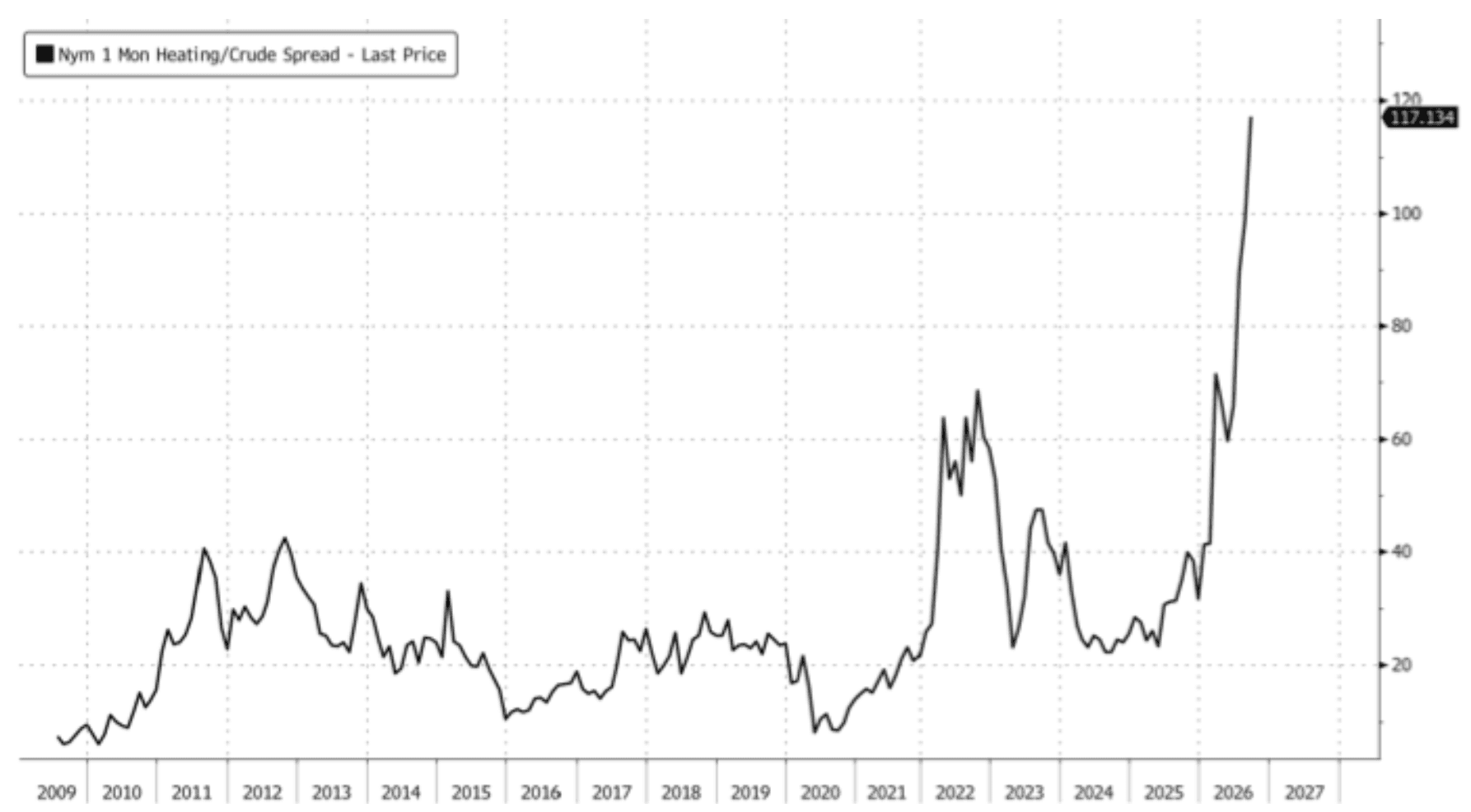
The diesel crack spread measures the theoretical gross margin earned by a refinery when it purchases crude oil to process it into diesel. When it rises, it means that diesel becomes significantly more expensive than the crude oil from which it is derived. Under normal circumstances, this margin typically ranges between $15 and $30 per barrel. When it exceeds $40 or $50, the refining market is already under significant strain. Today, the U.S. diesel crack spread exceeds $117 per barrel, a level unprecedented in Bloomberg’s statistics.
This figure is likely much higher than the price of Brent crude itself.
It shows that the real bottleneck no longer necessarily lies in oil production, but in its conversion into products that can be directly used by the economy. In other words, the market is not yet short of crude oil; it is beginning to run short of the fuel that actually powers trucks, trains, ships, mines, farms, and a large part of global industry.
It would be a mistake, however, to conclude that refineries are deliberately increasing their margins. The diesel crack spread is not a price set by refiners: it is a market price that measures the difference between the price of crude oil and the price the market is willing to pay for the diesel produced.
When it exceeds $117 per barrel, this does not mean that refineries are suddenly making extraordinary profits because they have decided to raise their prices. It means, above all, that demand for diesel currently exceeds the global capacity to produce more of it.
In other words, refineries do not set the price. They simply sell their output at the price buyers are willing to pay.
If diesel becomes much more expensive than crude oil, it is because the market now considers refining capacity to be scarcer than oil itself.
This is the same mechanism at work in any market.
When a hotel is fully booked in August, it’s not because the owner arbitrarily decides to double the rates. It’s because the number of available rooms has become insufficient relative to the number of travelers.
Diesel now operates according to the same logic: available refining capacity is no longer sufficient to produce all the volumes demanded. As a result, the price of diesel is rising much faster than that of crude oil.
This distinction is fundamental.
The real problem isn’t a shortage of oil. It stems from the ability to process it and transport it where it’s needed.
And that is precisely what, in my view, marks the current regime change.
It is also significant that Russia is considering extending its ban on diesel exports and that the Republican majority leader in the U.S. Senate has now declared himself open to the idea of restricting U.S. exports. Governments are no longer seeking merely to secure their oil supplies. They are beginning to seek to protect their supplies of refined products.
In my view, this development extends far beyond the energy market alone. It marks the gradual shift from a system in which central banks were the dominant factor in the markets to one in which physical constraints are once again taking center stage. Investors continue to await every Fed meeting as if a few dozen basis points were still enough to determine the trajectory of the global economy. Yet monetary policy is powerless against a shortage of refining capacity, a partially paralyzed strait, or global logistics that are losing efficiency. The true driver of inflation no longer lies solely in money creation; it is reemerging at the very heart of the real economy.
It is precisely for this reason that I continue to believe that the current movement in gold is not merely a reaction to changes in interest rates or expectations regarding monetary policy. Gold is likely anticipating a much more profound shift in the economic landscape. When central banks gradually lose the ability to offset physical constraints through monetary adjustments, and when governments must simultaneously intervene in the foreign exchange, bond, energy, and credit markets to preserve the stability of the system, gold ceases to be merely a hedge against inflation.
It then regains what has always set it apart during major periods of monetary transition: an asset that protects less against a specific event than against the gradual loss of control over the economic system itself.
It is likely this transition that the gold market is beginning to price in, while most investors are still focused on the Federal Reserve’s upcoming decisions.
This development reinforces a belief I have been articulating for several months: we are likely moving away from a system dominated by central banks and toward one dominated by physical constraints.
For nearly fifteen years, the markets have essentially moved in step with the Federal Reserve’s decisions. Today, refining capacity, energy infrastructure, shipping routes, supply chains, and commodities are once again playing a central role in price formation. This resurgence of hard assets is likely one of the most significant macroeconomic shifts since the 2008 financial crisis.


Comments
Log in or sign up to join the conversation.