


Oil, that most prosaic of commodities, has become a referendum on matters considerably larger than petroleum. Its price is not just an equation about supply and demand. Oil registers anxieties about the unfinished war with Iran, the persistence of inflation, the direction of interest rates, and the confidence in our political leadership. With seven days remaining before the midterm elections, voters encounter these questions at the pump. Investors encounter them in bond yields.
There has been a considerable logistical achievement. Preliminary shipping estimates indicate that Middle Eastern oil exports, excluding Iran, have recovered to or exceeded their prewar pace of above 23 million barrels a day. Pipelines, alternative terminals, and transfers between ships have restored deliveries despite the continuing danger. The giant sucking sound at our strategic petroleum reserves has virtually halted, for now. US and allied ingenuity has accomplished what diplomacy has yet to secure. Yet the recovery remains vulnerable to attacks on the infrastructure sustaining it.
Moving the barrels, however, is different from restoring the pre-war conditions under which they once moved. Ship-to-ship transfers and longer voyages around war zones add expense and delay. Far higher insurance compensates shipowners for risks where diplomacy and military force have failed. And a recovery in current exports does not quickly replenish inventories depleted during earlier disruptions. The resulting freight burden is striking. The Baltic Dirty Tanker Index—the relevant broad benchmark for crude-oil shipping—registered a record 7,999 in October, compared with annual averages near 1,100 during 2023–2025.
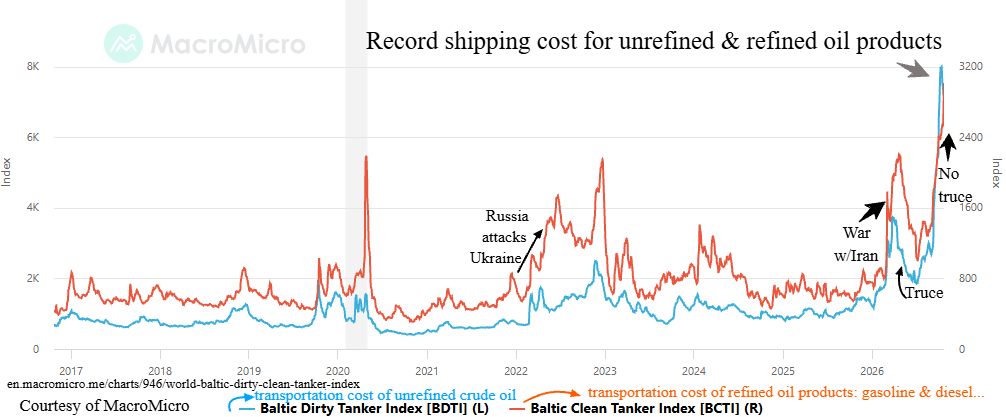
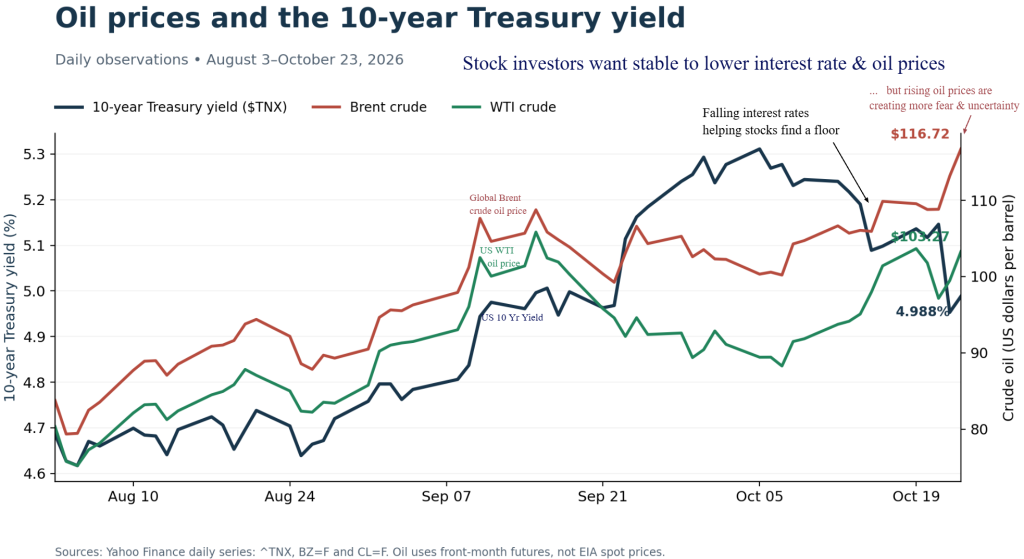
Global – Brent oil surpassed $117, and US WTI tested $104 Friday. Higher transportation costs help explain the persistence of expensive delivered oil, but they are only part of the explanation. Markets also price in the possibility that tomorrow’s attacks will interrupt today’s recovered flows back to prewar levels. This is the uncertainty premium added to the inconvenience cost. Investors want stable, lower interest rates and energy prices. The falling yields over the past couple of weeks are mitigating the stock market correction; however, the October surge in oil prices has kept investors on edge.
Iran’s IRGC has increased its attacks on ships to the highest level since the war began, retaining an uncomfortable capacity to impose economic costs without stopping every tanker. Higher fuel bills absorb discretionary income, complicate the Federal Reserve’s calculations, and make investors less generous when valuing distant profits. These pressures remain consistent with our expectation of a summer trading range giving way to weakness around the election, before potential oversold conditions energize another run to new highs.
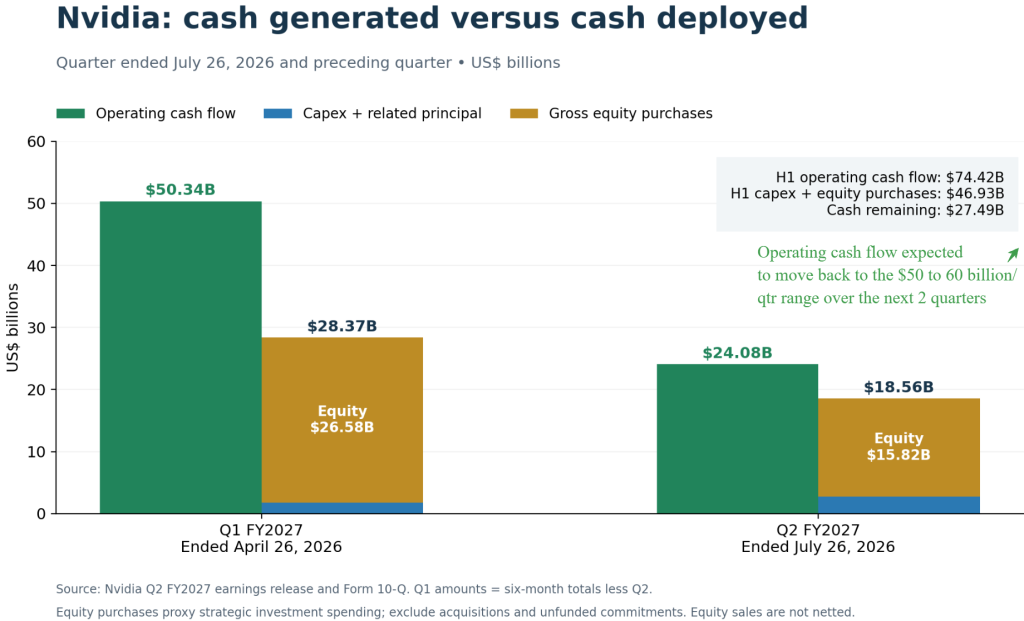
Meanwhile, the journey from artificial-intelligence spending to cash returns is another expensive passage occupying investors. Operating cash flow is the cash generated by the business; free cash flow generally subtracts capital expenditures. Equity investments are typically not included. Consequently, an AI company can report impressive free cash flow while committing substantial additional cash to companies that purchase its chips and services.
Nvidia (NVDA) and its neocloud clients are poster children for today’s AI valuation concern. In its quarter ended July 26, NVDA operating cash flow was $24.1 billion. Equipment, intangible-asset purchases, and related principal payments consumed approximately $2.7 billion, leaving reported free cash flow of $21.3 billion. Deduct another $15.8 billion of gross equity purchases in neocloud customer companies, however, and the remaining amount falls to approximately $5.5 billion. Nvidia remains a powerful cash generator, but its financial participation in the ecosystem is much larger than its own equipment budget suggests. Some estimates indicate its quarterly cash flow will more than double since the spike in working capital drained cash in the latest reporting. The so-called bank of Nvidia is committed to supporting neoclouds, such as CoreWeave (CRWV), whose capital spend is multiples higher than its revenue for the foreseeable future.
Amazon’s (AMZN) filing identifies $28.7 billion invested in OpenAI and another $10 billion in Anthropic during the first half of 2026. These investments coexist with commercial relationships under which the recipients purchase AWS capacity. The existence of reciprocal business relationships does increase their shared financial exposure.
Microsoft (MSFT) and Alphabet (GOOGL) entered this expansion with substantial cash production. Their annual cash-capex figures show meaningful cushions, although leases, investment purchases, and the pace of new commitments complicate any simple ranking. Broadcom (AVGO) retains particularly strong cash economics on the supplier side. Oracle (ORCL) and CoreWeave display larger funding gaps; their plans depend more heavily on converting contracted demand into deliveries, and adequate returns.
Our working scenario remains that renewed American military action after the election could eventually help establish a more durable equity-market bottom. This is a scenario, not a timetable. Initial war escalation in November could instead raise oil prices temporarily and deepen the correction. Iran’s IRGC appears to be an entity that will never acquiesce. While the US continues to strangle Iran financially and is preparing to strike Iran’s new offensive capabilities, a constructive signal would be evidence that shipping routes had become more secure, accompanied by improving stock market breadth.
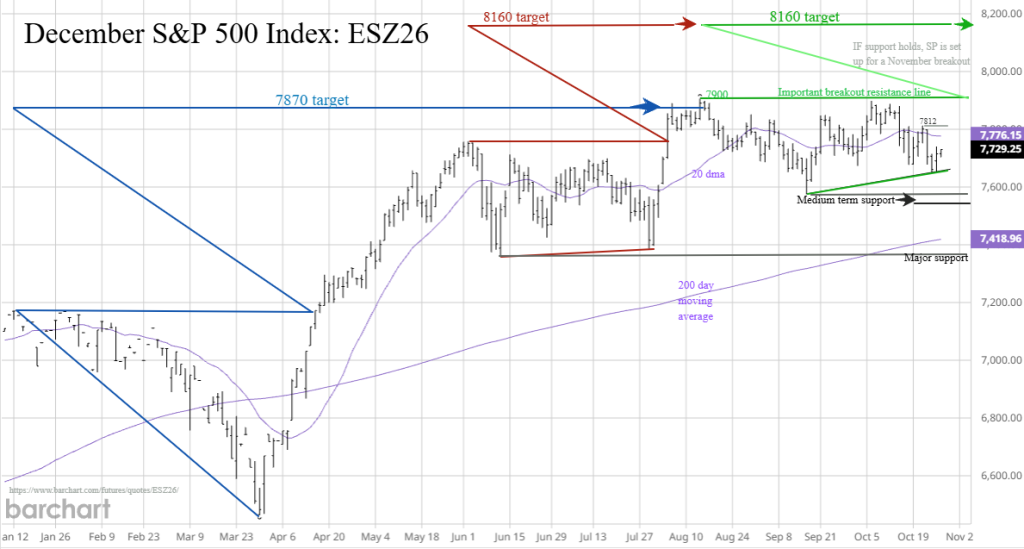
The near-term price action in the SP indicates a medium-term battleground around the 20 and 50-day moving averages, yet with a healthy cushion for the Bulls before the 200-day MA is threatened. A subsequent advance toward the upper 8,000s in the S&P 500 over the following year or so remains our bullish scenario. It requires sustained earnings growth, lower interest rates, and wider evidence that AI investment is being monetized to produce greater cash returns. Digital advertising offers one avenue; cloud services, software, and productivity improvements must increasingly supply others.
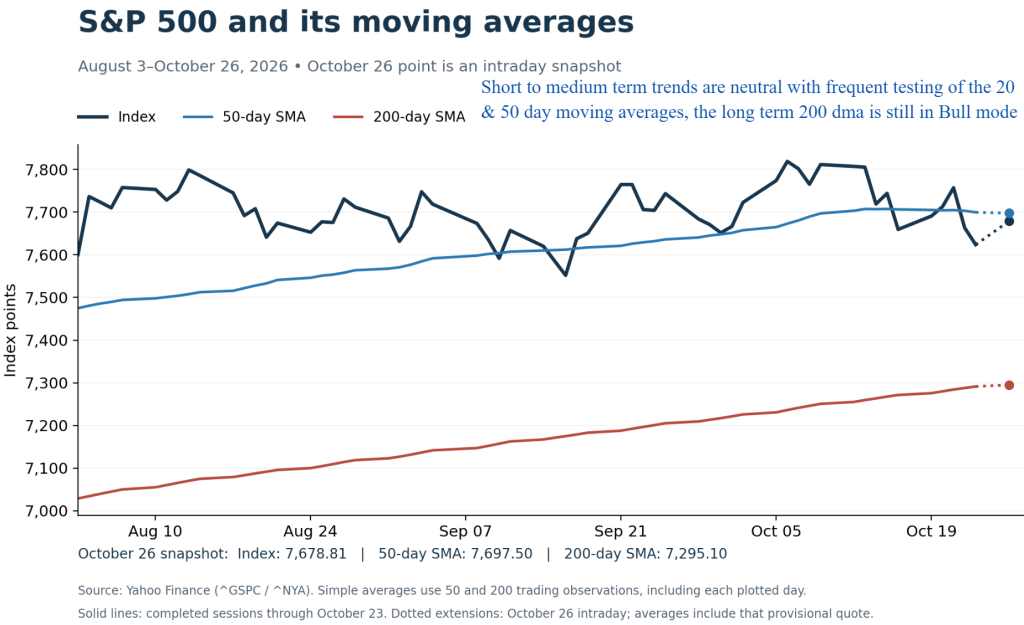
If there is another test of 7,900 on the SP 500 (Dec. futures), we would expect an ensuing breakout towards 8,160+. Faltering below 7,600 would likely usher in another leg lower and merely delay the next push to more record highs. For now, we are watching oil, tanker freight, Treasury yields, market breadth, and the anti-data center vote, should the Senate shift to the Left. Together, they will help distinguish a correction preparing the next advance from a consequential reassessment of the prices paid multiple for future growth.
Voters await relief; investors await returns. Washington and Silicon Valley face a similar difficulty: the bills arrive on time, while the returns observe a more leisurely calendar.


Comments
Log in or sign up to join the conversation.