

Between the war in Iran and the oil shock, most investors haven’t noticed that rare earth prices have doubled since January. Here’s the ex-China spot price for NdPr oxide, the blend at the heart of every permanent magnet.
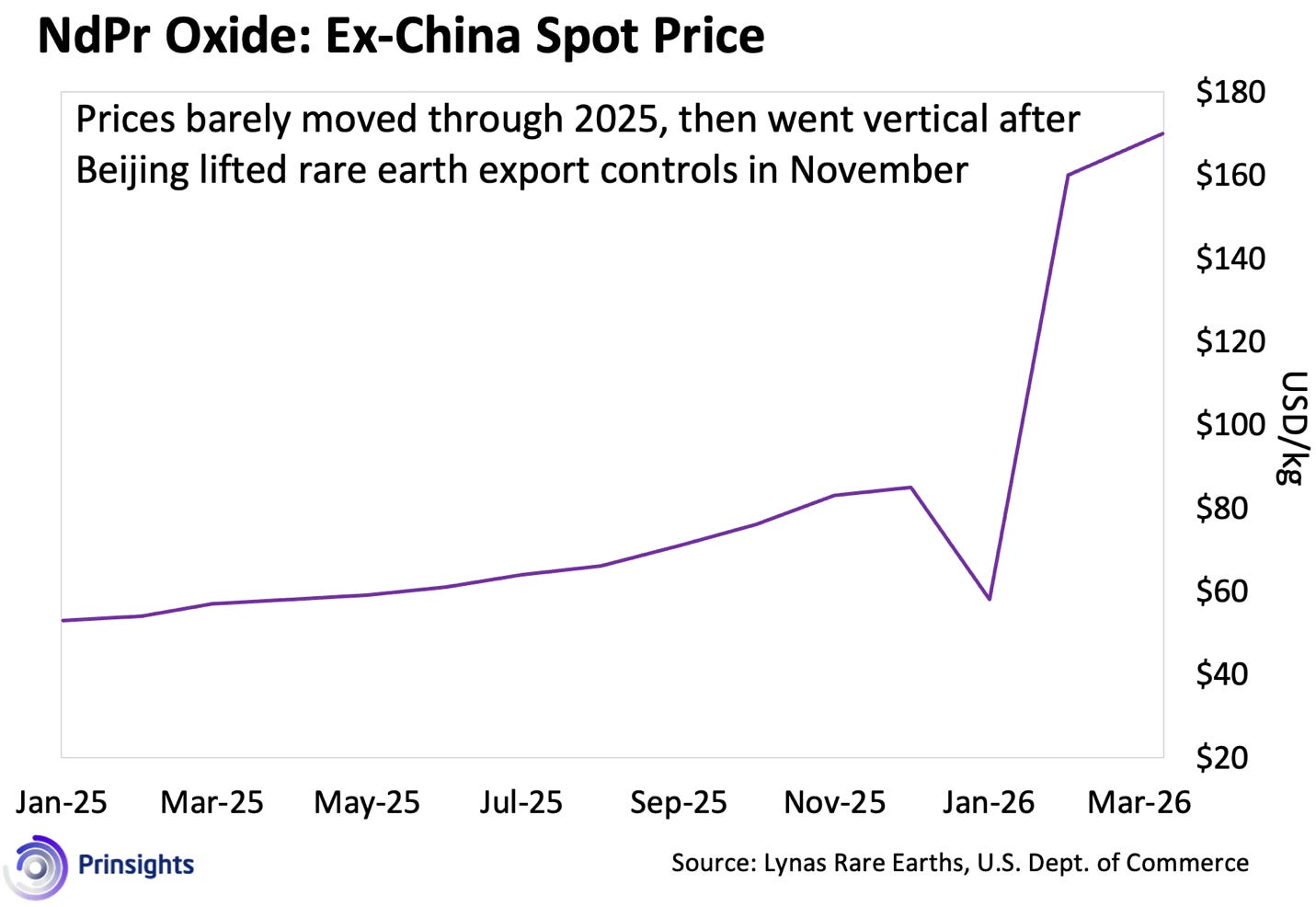
That spike isn’t a supply-demand story. It’s a capacity story. Most investors are focused on mining or magnets – and rightly so. But the real bottleneck is somewhere else entirely.
In February, we wrote about why mining rare earths is the easy part and manufacturing magnets is the hard part. That remains true. But there’s a step between those two that almost nobody talks about, one that China controls even more tightly than magnets, and one that makes everything downstream impossible without it.
That step is separation and refining. And it’s actually the hardest part.
See, before a rare earth can go into a magnet, an EV motor, or a missile guidance system, it has to be separated from the 15+ other elements it was dug up with. These elements are chemically near-identical. Pulling them apart requires hundreds of stages of solvent extraction, run through massive banks of mixer-settlers, tuned to exacting specifications over weeks of continuous operation.
The U.S. used to do this. In the 1980s, domestic companies were pulling rare earths out of iron ore and phosphate by-products. Then came the uranium regulations. Worried about nuclear proliferation, regulators went after anyone handling ores with even trace amounts of uranium. It didn’t matter that the material was harmless. Rare earth production shut down almost overnight. The metals got buried.
One country didn’t have the same hang-ups. China kept processing rare earth by-products, refined the chemistry, scaled the infrastructure – and spent the next three decades perfecting it. Today, it controls roughly 91% of global rare earth separation capacity. For the heavy rare earths that matter most for defense and high-temperature applications – dysprosium, terbium, yttrium – that figure is closer to 99%.
The Price Gap Tells the Story
Now, here’s something you won’t see in that chart above. That ex-China NdPr price, the one that just went vertical, actually represents a 63% premium over what the same material costs inside China. Same oxide, same specs. The only difference is where it was separated.
That premium isn’t about tariffs or shipping costs. It’s about a capacity that doesn’t exist. When a buyer in the U.S. or Europe needs separated rare earth oxides from a non-Chinese source, they’re competing for output from a handful of facilities – primarily Lynas in Malaysia and a small number of pilot-scale operations. There simply isn’t enough non-Chinese separation capacity to meet the demand at any price.
And that scarcity could get a lot worse. In November 2025, Beijing suspended part of its rare earth export controls as part of a trade truce with Washington. That suspension expires November 10, 2026. Unless a new agreement is reached, those controls snap back. That’s on top of the restrictions already in place since April 2025 that never went away. Every month that ticks closer to that deadline, buyers get more nervous and the scramble for non-Chinese supply intensifies.
Meanwhile, back in Washington. Section 4872 of the U.S. Code now prohibits defense contractors from acquiring rare earth materials mined, refined, separated, or melted in China. As of January 1, 2026, that ban covers the full supply chain. Contractors who can’t certify a China-free chain face contract termination.
But here’s the catch: certifying a China-free supply chain for rare earths right now is very hard to do. The law demands non-Chinese separated rare earths, but outside-China separation capacity is still barely a fraction of what’s needed.
That’s the gap. And that’s exactly where the next wave of government investment is being pointed. That’s not at mining and not at magnets, but at the midstream bottleneck that makes both of those steps possible.

Comments
Log in or sign up to join the conversation.