

In September 2010, a seemingly isolated maritime incident that took place off the Senkaku Islands in the East China Sea sparked a geopolitical earthquake that would rewrite the rules of global supply chains.
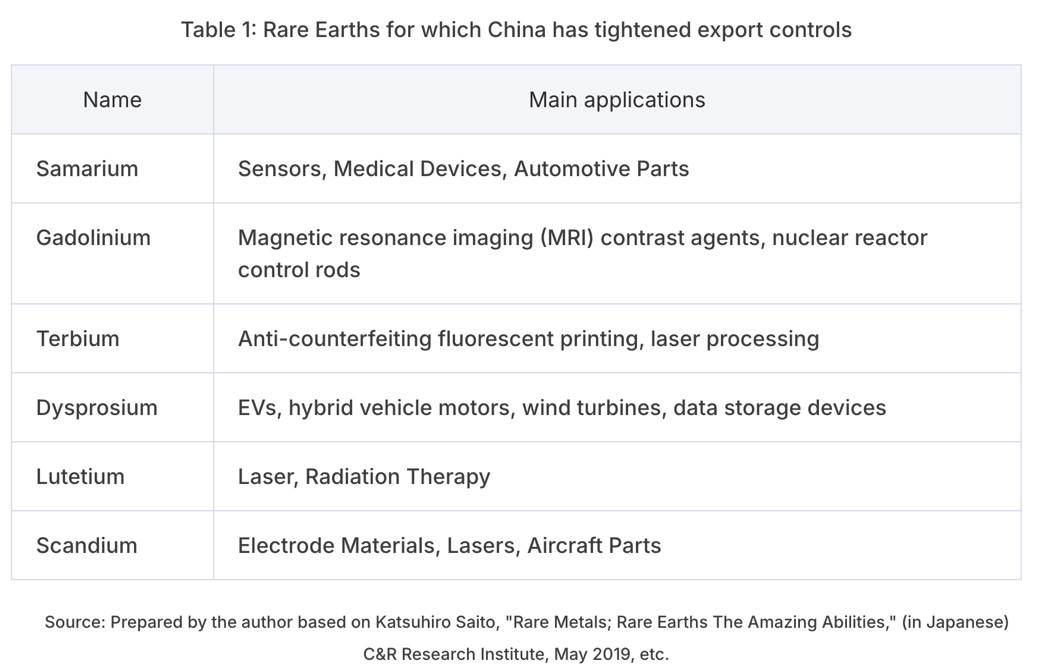
Following the high-seas dispute and Japan’s subsequent detention of a Chinese fishing trawler captain in contested waters, Beijing retaliated with unprecedented economic force. The Chinese government imposed an unannounced, sweeping trade embargo on all exports of rare earth elements to Japan. Rare earths are a crucial category of 17 minerals essential for manufacturing hybrid cars, wind turbines, guided missiles, and smartphones.
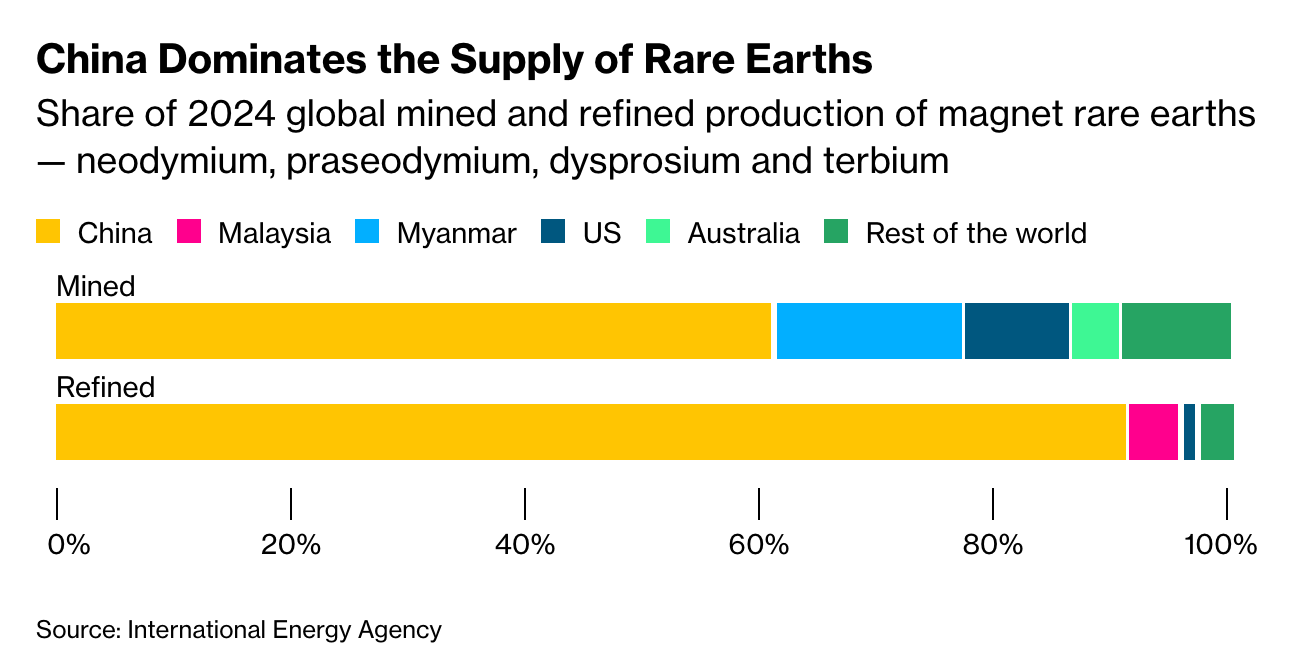
At the time, the world was dangerously exposed to China, which controlled a staggering 97% of the global supply of rare earths. Tokyo, facing an existential threat to its key tech and automotive industries, ultimately capitulated and released the captain. Strikingly, the United States offered virtually no support to Japan during the dispute, leaving Japan on the hook to navigate the crisis alone.
This aggressive maneuver was the realization of a long-standing strategic intent. As Deng Xiaoping, architect of China’s economic transformation, famously said in 1992, “There is oil in the Middle East, there is rare earth in China.” By the early 2000s, China’s growing restrictions and export quotas on rare earths were already violating the commitments it made upon joining the World Trade Organization (WTO). However, the 2010 embargo against Japan constituted an even more blatant violation of international trade law, signaling to the world that Beijing was ready to weaponize its geological dominance.
As Michael Schuman, of The Atlantic, would observe regarding the leadership in Beijing’s escalating economic leverage, “This marks a real shift in Chinese policy—a willingness to use economic power to compel companies around the world to act in Beijing’s interest.”
Building the Diversification Blueprint
Rather than remaining victims of geographical vulnerability, Japan used the crisis as a catalyst to build an entirely new economic playbook. Having experienced the direct, painful impacts of weaponized trade firsthand, Japan set out on a multi-decade mission to systematically dismantle its then 90% reliance on Chinese rare earths. “I had to confess, I had zero knowledge about rare earths,” said Tatsuya Terazawa, who was responsible for economic policy with Japan’s trade ministry in 2010.
The Japanese saw an opportunity and a necessity. The strategy that was built relied heavily on government backing, public-private partnerships and strategic foreign direct investment. Japan’s state-owned oil, gas, and metals national corporation (Jogmec) began pouring hundreds of millions of dollars into non-Chinese mining infrastructure. The most significant triumph of this strategy was Japan’s early and sustained financial lifeline to Lynas Rare Earths, an emerging Australian mining company.
Sojitz, a Japanese conglomerate, and Jogmec would jointly sign a deal that provided $250 million in loans and equity to Lynas. As the New York Times noted, “the transaction secured for Japan a long-term supply of rare earths sourced outside China.”
Through continued subsidized loans and long-term equity investments, Japan enabled Lynas to actually begin to mine rare earths in Western Australia and finally begin to refine them in Malaysia, establishing the world’s premier commercial-scale supply chain entirely independent of China.
At that time, Japan was diversifying its sourcing across geopolitical lines, and securing partnerships throughout the global landscape from Africa to the Americas. Because of these concerted efforts, Japan successfully worked to reduce its reliance on Chinese rare earth imports from over 90% down to under 60%, creating a more resilient, diversified architecture that the rest of the West is only now trying to replicate.
To be clear, rare earth stockpiles and even the best efforts are still no clear rival to China – but they do offer a clearer path forward. While Japan, along with much of the world, remains highly dependent on China’s rare earth supremacy, the supply chain diversification roadmap for the modern era is beginning to take hold.
The Two-Part Playbook for the Modern Era
When Beijing launched aggressive new export controls on gallium, germanium, graphite, and rare earth processing technologies between 2023 and 2026, the rest of the world began to both panic and sober up. Japan, however, was ready.
The modern Japanese strategy offers a two-part masterclass for middle powers and Western nations alike.
Part 1: The Long-Term Approach
First, supply chain diversification cannot be achieved via short-term market dynamics. Instead, it requires a generational, patient capital approach.
According to analysis by the Center for Strategic and International Studies (CSIS), Japan’s success in working to reduce its reliance on China lay in its willingness to establish alternate supply security. This involved initial costs and deep institutional commitments, such as fostering strategic diplomatic ties with mineral-rich nations like Mongolia.
It also required implementing historic pricing mechanisms. Recently, Japan worked with companies like Lynas to introduce landmark “price floors“ to protect allied producers from the predatory pricing and artificial oversupply, tactics often used by Chinese state enterprises to crush foreign competitors.
Part 2: Alliances and Strategic Cross-Border Diversification
Second in the playbook is that alliances and strategic diversity across clear geopolitical lines are non-negotiable.
In today’s fragmented trade landscape, reliance on any single large hegemon is a liability.
Driven by tariff wars and aggressive protectionist measures, both the United States and China can increasingly be viewed through a similar lens of trade restriction risk. To survive, global tech companies must now build redundancies outside of both superpower spheres.
While frameworks such as the U.S.-Japan Critical Minerals Action Plan provide high-level diplomatic platforms, long-term physical supply resilience requires advanced technological hubs as well as dependable operations.
As such, major industrial and tech players like Japan, South Korea, and increasingly India, which are heavily investing in localized processing and alternative supply corridors, will be the defining factor for future supply independence. As they work to remain competitive when international trade barriers inevitably snap shut, how this unfolds will largely define the supply chain and the rare earth dynamics of the future.
What This Means for Investors
For investors, the lesson out of the Japan playbook is that the critical minerals thesis has fundamentally shifted from a narrative of scarcity to a narrative of security.
Profitability is no longer dictated purely by finding the cheapest deposit. Instead, what offers a true edge to companies and investors is identifying the supply chains that are geopolitically insulated and structurally backed by sovereign balance sheets. It also recognizes that relying on a single country for critical industrial supplies is a risk that can ripple through the broader economic landscape. Japan was in many ways a test case for how geopolitical tensions can pop up in a fishing boat but reverberate in supply chains and trade alliances.
As the G7 aims to enforce strict mandates to cap China’s global rare earth supplies at 60%, there is a massive capital reallocation underway. Western governments are aggressively subsidizing processing plants, imposing tariffs on Chinese imports, and guaranteeing off-take agreements for non-Chinese material.
Companies that can reliably deliver “de-Chinafied” rare earths will command a structural geopolitical premium, supported by sovereign price floors, which can protect them from market manipulation.
Investors looking to follow this macro shift over the long term should monitor targeted exchange-traded funds like the VanEck Rare Earth/Strategic Metals ETF (REMX), which provides direct exposure to the global corporations leading the charge in the production, refining, and recycling of rare earth and strategic metals. As the global tech supply chain fractures, tracking REMX offers a front-row seat to watch the companies that could benefit from the global adoption of the Japan playbook.
The companies that successfully mirror Tokyo’s multi-decade blueprint will be better positioned to become the key backbones of tomorrow’s industrial economy.


Comments
Log in or sign up to join the conversation.