


“Economic progress is the work of the savers, of the inventors, and of the entrepreneurs.”
— Ludwig von Mises, Human Action
For the past six weeks, we’ve walked through the forces creating America’s K-shaped economy, housing, healthcare, education, wages, incentives, and the political consequences when enough people decide the system is not working for them. This week let’s look at the situation from a more optimistic angle.
First, we must start with a problem, perhaps the biggest problem of all: federal debt and deficits. Now, this is not going to be a letter telling you Washington spends too much. You already know that.
Instead, let’s ask a more interesting question…
To help set it up, the federal government spent about $7 trillion last year and collected about $5.2 trillion. The difference, roughly $1.8 trillion, was 5.8% of GDP. The Congressional Budget Office projects the deficit will reach 6.7% of GDP by 2036, with debt rising from 99.4% of GDP to 120%.[1]
For context, federal deficits have averaged 3.8% of GDP over the past 50 years. We are running well above that now, and CBO projects we will stay there. The trajectory is clear: federal deficits, and therefore the debt, are growing faster than the economy’s ability to carry it.
There are ways to fix the problem. Washington can spend less. We all know how that goes. Everyone likes cutting spending until you start naming what gets cut.
The government can collect more tax revenue. But from whom? There are not many volunteers (I for one think income tax rates are plenty high and I’m not eager to pay more. I’m sure I’m not alone in this thinking. I’d prefer they close loopholes, but let’s not get sidetracked...).
There’s a third scenario - one that every politician will love (and take credit for). We could grow our way out of the debt problem.
This is the argument Treasury Secretary Scott Bessent has been making: grow the economy faster. As he recently said about the US debt, “There’s nothing magic about the $40 trillion number, and we can grow our way out of that.”
What would it take to grow our way out of debt? Have we done it before? And is anything happening today that gives us reason to believe, realistically, we could do it again?
What Would It Actually Take?
First, let’s define what “grow our way out” means.
It does not mean paying off $40 trillion in its entirety. It means getting the debt burden to stop growing relative to the size of the economy carrying it. Think about a family whose income grows faster than its mortgage payment. The mortgage does not disappear; it just becomes easier to carry each year.
We’ll use the CBO’s numbers for this exercise. In its higher-growth scenario, the CBO estimates real GDP growth averaging 2.6% over the next decade (note, “real GDP growth” is GDP adjusted for inflation). That seemingly modest improvement to the CBO’s baseline projection lowers their projected 2036 debt from 120% of GDP to 109%, and the deficit drops from 6.7% of GDP to 5.5%.[2]
Faster growth materially changes the math.
Let’s take the exercise a step further. What if the US were to boost real GDP by four percent annually? To be clear, four percent is not an official CBO forecast. It is simply a useful thought exercise and not impossible. Ambitious by recent standards, for sure, but not outside America’s historical experience.
The chart below illustrates the size of the economic impact: if real GDP grew at 4% annually from the same 2026 starting point, the economy would produce roughly $6.4 trillion more annual output by 2036 than under CBO’s baseline.
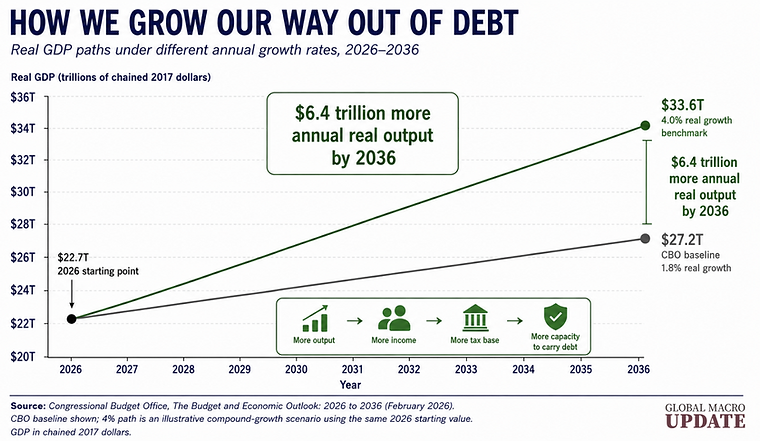
That does not make the $40 trillion debt disappear, but it leaves the economy far better able to support it. With fiscal restraint, it could put the debt burden on the other side of the curve, falling as a percentage of GDP instead of rising.
Four percent sounds like it would be ambitious by recent standards. but we’ve done it before…
Is That Crazy?
Historically, no.
For roughly a century and a half, from the 1820s through the 1970s, U.S. real GDP growth generally ran in the 3% to 4% range.
America went from an agrarian economy to the world’s largest industrial power. We built railroads across a continent, electrified the country, created entirely new industries, fought a Civil War and two world wars, survived the Depression, and built the postwar middle class.
Growth in that era was not 4% every year. But growth of 3% to 4% was much closer to the norm than the exception.
Since then, growth has slowed. It averaged about 3.1% in the 1980s and 3.2% in the 1990s. Since 2000, it has been closer to 2.1%.[3]
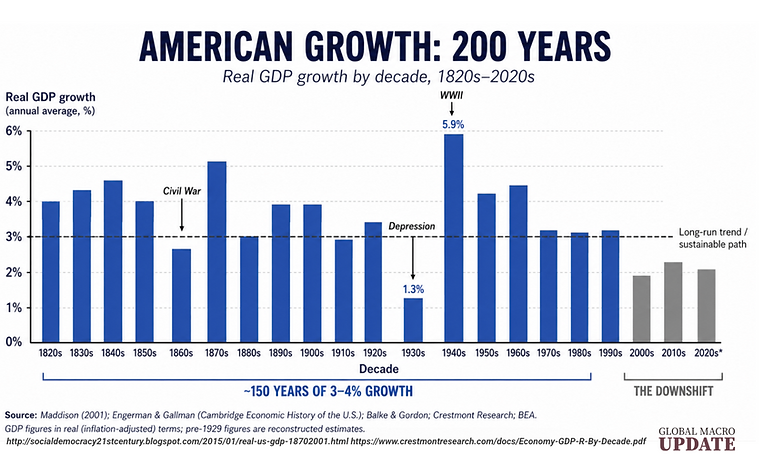
So asking whether America can get back toward 4% is not asking whether it can do something unprecedented.
Critics will rightly point out that today’s workforce is older, labor-force growth is slower, and the debt burden is larger. These are strong headwinds.
The Key is Productivity
If America is going to get back toward 4% real GDP growth, it will not come primarily from adding workers. It will come from helping each worker produce more.
Economic growth comes from two places: more people working, and/or each worker producing more. Demographics are not likely to provide much help with the first. CBO expects labor-force growth of only about 0.5% per year.[4] That means productivity has to do the heavy lifting.
And this is where my friend Dr. Pippa Malmgren believes it gets interesting. She describes the period we’re living through as the "controlled demolition of an old system," with rapid advances in AI, computing, energy, and science potentially changing the economic assumptions built around the recent past.
One reason is speed. Pippa points to AI and supercomputing dramatically shortening the time required for scientific discovery. She believes breakthroughs in areas like energy, materials, and manufacturing can now more quickly move from impossible, to possible, to commercially useful.
Scale that concept across the economy, and workers will produce more with the same time, capital, and resources. Getting anywhere near 4% growth with a slowly growing workforce requires exactly the kind of productivity regime Pippa is describing.
Is she right? There are signs…
From 2007 through 2019, U.S. labor productivity grew at an annualized rate of about 1.5%. From the second quarter of 2023 through the third quarter of 2024, it averaged 2.6%. Full-year productivity growth was 2.3% in 2024, and productivity rose 2.8% over the four quarters ending in late 2025.[5]
Three years is not enough to declare a new productivity boom. But it is not nothing. More importantly, we can see where some of it may be coming from.
Capital Is Being Deployed
So, if productivity is going to keep accelerating, what would we expect to see? Investment.
New technologies do not raise economy-wide productivity simply because they exist. Businesses have to put them to work: building factories, buying better equipment, installing new technology, and expanding the infrastructure required to support it. That is how an idea becomes output, and how output per worker rises.
The capital is being deployed.
Manufacturing construction spending rose from roughly $75 billion at an annual rate in 2020 to a peak near $249 billion in 2024. It has cooled, but was still running at about $173 billion in June 2026, more than twice its 2020 level.[6]
Data-center construction has surged to roughly a $50 billion annualized rate.[7]
These are not assets changing hands. They are factories, semiconductor fabs, data centers, power facilities, and physical productive capacity being built in America.
Policy is increasingly encouraging more of it.
Last year’s tax bill permanently restored full expensing for domestic R&D and 100% bonus depreciation for qualifying capital investment.[8][9] In plain English, Washington made it cheaper and more predictable for companies to invest in research, equipment, factories, and other productive capacity.
Energy policy is moving, too. The ADVANCE Act reduced licensing-review fees for advanced nuclear-reactor applicants and established more defined Nuclear Regulatory Commission review timelines.[10]
These policies do not guarantee higher productivity. Some of these investments will fail. But this economic behavior is what you expect to see when a new productivity cycle is beginning: more incentive to invest, more physical capacity being built, and fewer barriers around the energy required to run it.
Where This Leaves Us
A sustained return toward 4% real growth would dramatically change the fiscal arithmetic. If DC can show enough restraint to not spend away the gains (a big “if”), it would put the debt burden on a declining path relative to the economy.
That is a high bar, but perhaps not out of reach. Productivity has accelerated from pre-pandemic levels. Manufacturing and data-center construction have surged. Policy has become more favorable to R&D, capital investment, and energy development.
Four percent growth would feel extraordinary today. For long stretches of American history, it was not. None of that guarantees we get there. Washington will probably have to do some combination of all three options: spend less, tax more, and help the economy grow faster. But the Treasury Secretary is right about growth being the force that makes every other choice easier.
We are making a massive investment in AI. What if it works? So far, the feared job losses are not showing up in the data. The Federal Reserve Bank of New York reports that over 50% of manufacturing and service firms have now adopted AI, leading to retraining instead of layoffs.[11]
America, with all its frustrations, is still a place to build. Today’s young builders are impressive. I recently spent a couple days in LA, where I toured Valar Atomics’s small modular reactor facility.
Hearing directly from the founder about where the US is heading for energy development, hearing his unwavering dedication to success, and hearing from other entrepreneurs building new technologies that sound like science fiction... this is why I’m a Rational Optimist at heart. I like to joke that I’m really a prudent pessimist, but I think Pippa is on to something. Let’s grow our way out of this!


Comments
Log in or sign up to join the conversation.