

“Not everything that can be counted counts, and not everything that counts can be counted.” — William Bruce Cameron
Last week we looked at the Federal Reserve’s inflation problem. This week, let’s look at the other half of its mandate: maximum employment.
After raising the Federal Funds Rate by 25 basis points, Chairman Warsh said labor is “in good shape.” With unemployment at 4.1%, rising job openings and weekly hours, and claims consistent with full employment, he noted the economy was operating “largely…consistent with full employment.”[5]
He’s right, at a glance, the labor market looks pretty good.
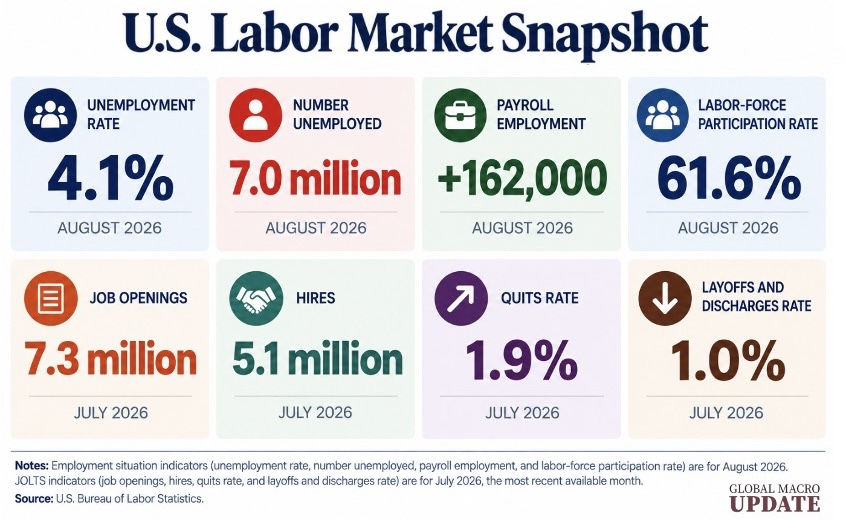
But a 4.1% unemployment rate only tells us so much. This doesn’t look like a labor market in trouble. And it isn’t, at least not in the way most of us think about a weak labor market. Employers are still adding jobs. There are more openings than unemployed workers. Layoffs are low.
But it is not the red-hot job market of 2021 and 2022 either. Hiring has cooled. Workers are quitting less often. Employers are not firing many people, but they are not hiring as aggressively either.
We’re in the “low-hire, low-fire” labor market. In August, employers added 162,000 jobs, unemployment held at 4.1%, and 7.0 million Americans were unemployed.[2]
Looking beyond the aggregate, we see a labor market undergoing structural shifts.
America Has Almost No New Workers
In April, a Federal Reserve note projected that the pool of available U.S. workers could grow by less than 10,000 people per month in 2026. An “unprecedented” pace in recent history, saying this year, “Labor force growth could slow to near zero.”
The reasons are largely demographic. Historically weak population growth due to reduced net immigration, coupled with an aging population.
As a result, the monthly payroll growth needed to keep employment stable could fall from roughly 155,000 in 2023–24, to 85,000 in 2025, to less than 10,000 in 2026.
Let me state up front, I am glad the border issues we faced in recent years have largely been resolved. I am not in favor of illegal immigration. That shouldn’t be controversial. I do, however, think we have plenty of room for improvement when it comes to legal immigration. There are plenty of smart, able-bodied people around the world who would add to our economy, if we’d give them the chance. We make it preposterously difficult for them to join us. My friend Stephen McBride is a great example. Born and raised in Dublin, he’s an American at heart. He works hard, is smart, entrepreneurial, self-sufficient, and a natural change agent (I’ll stop lest his head get too big). He’s all but given up on his dream of living in the US. We just make it too hard for the world’s best and brightest to join us. We can and should fix this. <rant off>
Beginning in 2030, the CBO projects that deaths will exceed births in the United States every year. From that point forward, immigration accounts for all population growth.
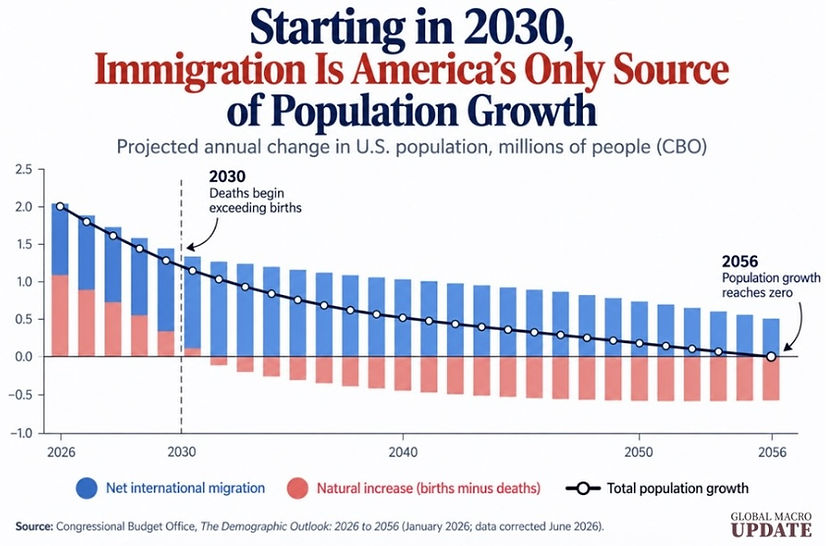
These are big changes. They force a rethink to how we read payroll reports. When the labor force is barely growing, weak-looking job growth doesn’t automatically push unemployment higher. A low unemployment rate can continue even as hiring loses momentum.
It raises a big question: if the US is adding almost no new workers, where does future growth come from?
For most of the past six decades, America grew in two ways: more people went to work, and each worker produced more.
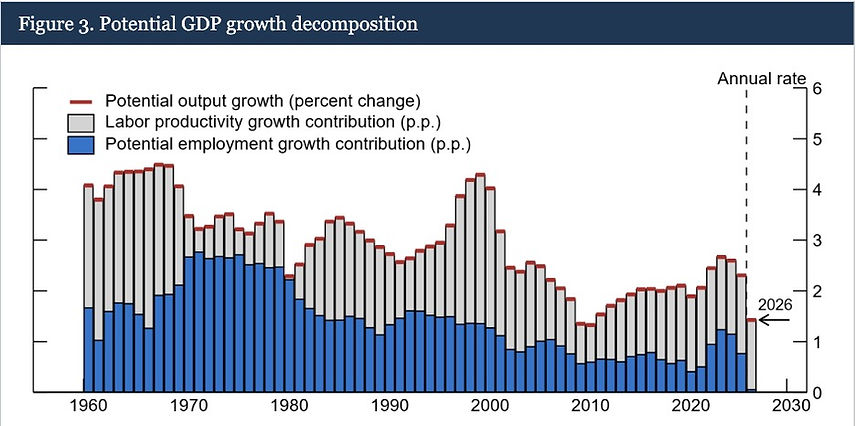
Look at the blue bars. They show how much of America’s growth came from adding workers. By 2026, that contribution is nearly gone. With the pool of workers barely growing, more of America’s future growth will have to come from producing more per worker.
Can Productivity Make Up the Difference?
Can productivity grow fast enough to make up for a workforce that is barely growing?
If it can, our economy can still grow, wages can rise, and the Fed may be able to bring inflation down without breaking the labor market. If it cannot, worker scarcity could lead to a wage-price spiral, where rising wages fuel inflation, which leads to higher wages, and on and on.
So far, the news is good. The economy is producing substantially more without using substantially more labor. Since Q4 2019, nonfarm-business output has risen 17.4%. Total hours worked rose only 3.3%. The difference is productivity: output per hour is up 13.7%.[3]
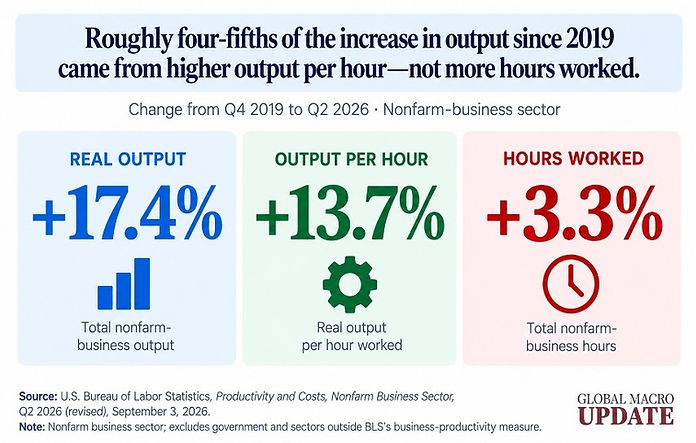
So far, so good. America is producing a lot more without adding many more labor hours. A country with fewer new workers does not automatically mean slower growth.
AI may end up being a meaningful part of that story, but apparently not yet. This week I interviewed Lakshman Achuthan of the Economic Cycle Research Institute (NOTE: there is a link to my discussion with Lakshman at the end of this essay). Lakshman brought up a quote from economist Robert Solow, who in 1987 observed “You can see the computer age everywhere but in the productivity statistics.” The same holds true today for AI. So far, the impact on productivity has been relatively small and limited to specific sectors.
We know technology boosts productivity. But just like computers in 1987, we are in the early days of AI adoption. We have yet to see a meaningful boost in productivity that can be attributed to the new technology. Some will quibble with this. Let’s just agree that it’s early days. It will come.
Forecasts from the likes of Goldman Sachs predict a 15% boost to productivity when AI becomes fully adopted.[4] It could be higher. What if Elon Musk is right and we not only have robots performing daily tasks, but robots making robots? There are clear signs this is starting to happen.
The Wall Street Journal reported this week that Amazon.com (AMZN) has invested over $230 billion in robotics manufacturing since 2010. They are building the robots they use. And they are using a lot. Again, from the article, “Amazon’s robots, which are deployed across more than 300 of its facilities, assist with 75% of customer orders.”
By “robots” they mean robotic arms and Autonomous Mobile Robots (AMRs), which are automated transport devices that move heavy items like pallets or entire shelves of products. Together, they replace forklifts and other material handling equipment, along with the people who operate that type of machinery. By this definition, the material handling website Exotec claims Amazon has deployed more than a million robots.
This leads us to question the long-term usefulness of another often-cited statistic: Labor share of nonfarm business activity. This represents the percentage of economic output that accrues to workers as compensation. Said more simply, for every dollar of sales, how much goes to workers. According to the BLS, this ratio is at an all-time low.
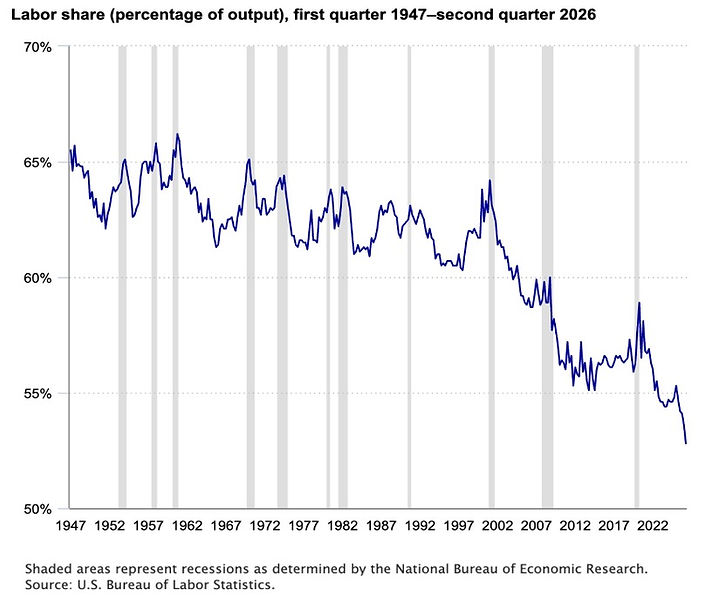
Labor’s share of nonfarm-business output fell to 52.8% in the second quarter, the lowest level on record. Workers are producing more, but receiving the smallest recorded share of the output they help produce as compensation.[5]
I’ve been writing about that gap for weeks: housing, healthcare, education, and wages. It is real, but perhaps the problem will self-correct. Living in a highly automated economy would change the way we think about this metric.
Labor share could flatline or even continue to drop, not because workers are getting a raw deal, but because they represent a smaller input to economic activity. That’s not the scenario today, but one can hope.
In the meantime, going back to the US Labor Snapshot chart above, we continue to have a disconnect. Seven million unemployed people, and 7.3 million open positions. This sounds like an easy math problem, if only… We have a disconnect between skills and open jobs. That might get worse before it gets better.
Going back to Amazon, they are building a new, $100 million robotics manufacturing facility in Indiana, with another on deck for Texas. Quoting the WSJ, “the Indiana facility would create 300 skilled manufacturing and engineering jobs, commanding average salaries of almost $100,000 a year, well above the state’s median household income.”
These are the types of jobs that come with automated workplaces. There will be fewer workers per machine and per facility. If a worker ran one CNC machine in the 1960s, they’ll run five or ten today (that’s already happening). Expand that to a few short years from now, and relatively few workers will be on hand simply to make sure the manufacturing facility faces no anomalies. Otherwise, it will mostly run itself.
That’s what reshoring will look like. Given the demographic outlook for the US, I’m all for it.
Ten years ago we counseled our kids to go into computer sciences. Today, better advice might be engineering.
Before I go, be sure to check out my latest podcast, with former Strategic Investment Conference speaker Lakshman Achuthan, co-founder of the Economic Cycle Research Institute.
Lakshman and I discuss the Economic Cycle Research Institute’s forecast for inflation, employment, and growth. He believes we are in an economic inflationary boom cycle, with inflation to remain elevated even if oil prices come down. I hope you find time to watch, listen, or read the transcript, whichever you prefer, this long-form discussion is worth taking in.



Comments
Log in or sign up to join the conversation.