
"Time is what we want most, but what, alas! we use worst..." — William Penn
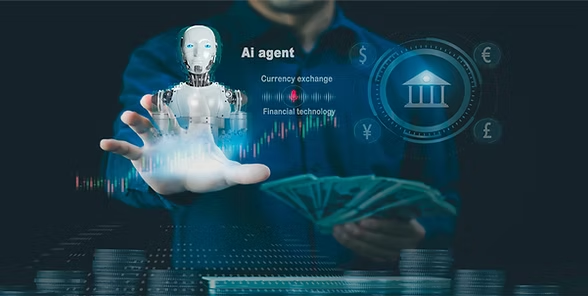
This week gave us another glimpse of our AI-powered future. AI personal agents are becoming a thing you need to understand, if not use.
Torsten Sløk of Apollo posed a question about the impact of these agents on banking. When everyone has a personal agent doing their shopping, will traditional banks lose deposits, as agents seek out higher interest rates?
Until recently, most of us used AI by asking it a question and waiting for an answer. But AI agents can act on the answers. Give one a goal, and instead of telling you what to do, it can do the work for you. Samantha, our VP of Operations, told me this week that she has “at least six” AI agents performing tasks for her in the background. I had no idea. She is finding ways to scale, boosting her productivity. She is an early adopter. Soon we’ll all have a personal AI.
Today there are still limits, of course. Broadly speaking, an AI agent can help you find a better interest rate. Compare insurance policies. Cancel the subscription you forgot about. Switch phone plans. Appeal a medical claim. Move your money.
None of these things is particularly difficult. But they take time.
Solving that annoyance is worth a lot of money. Businesses have a name for obstacles like these: friction. A surprising number of business models benefit from it. Banks hold cheap deposits. Gyms sell unused memberships. Subscription services renew long after they’ve been forgotten. And so on.
AI agents can remove much of that friction. Instead of reminding you that a better deal exists, they can increasingly go get that deal for you. And when the friction disappears, some very profitable customer behavior may disappear with it.
Agentic Bank Run
On September 8, Meta (META) launched Muse, a personal AI agent. It quickly rose to the top of Apple (AAPL)’s App Store. Through a partnership with Plaid, it can access a user’s bank accounts, transactions, and investments.
Apollo’s chief economist, Torsten Sløk, immediately posed a consequential question. What happens when agents like Muse begin sweeping household cash out of checking accounts earning about 0.1% and into accounts paying roughly 3.3% to 5.0%?
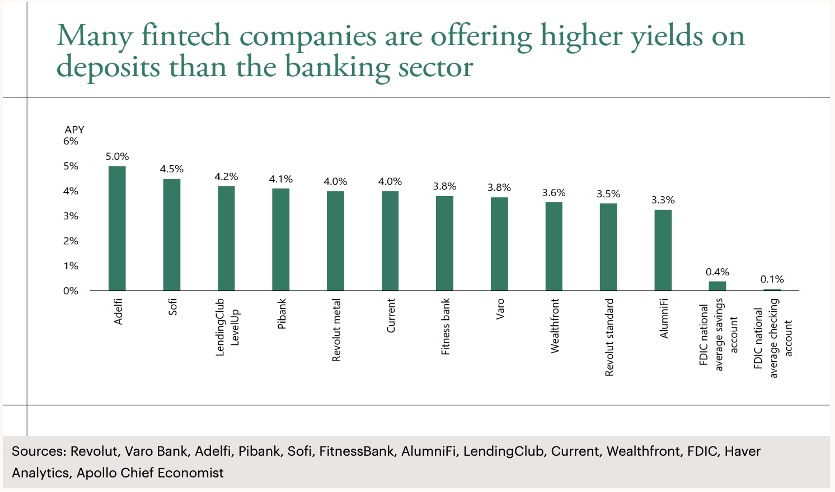
His answer? An “agentic bank run”.
Opening a new account, linking it, moving direct deposit, updating automatic payments, keeping enough cash to pay bills… this is friction. Banks count on you not having the time or patience to do this. An AI agent can do it for you seamlessly, and as often as necessary to keep you earning a maximum yield.
The agent can stay within FDIC-insurance limits, sweep excess balances into higher-yield accounts, and move money back when it is needed. For one household, that may mean an extra few hundred or few thousand dollars a year.
Multiply that decision across millions of households, and banks could lose a large share of the cheap deposits they rely on to fund loans and investments. This is not a 1930s-style panic. It’s a different kind of bank run, driven by automated optimization.
If deposits leave in search of higher yields, it could force banks to pay a higher interest rate on deposits, squeezing margins and perhaps fueling more bank consolidation.
The higher yields are being offered by online banks (aka fintechs) but also by online brokers like Schwab and Fidelity. These entities are less encumbered by the overhead associated with bricks and mortar.
A loss of deposits could also expose weaknesses in bank balance sheets. Remember Silicon Valley Bank? Depositors withdrew enough capital that the bank was forced to sell some of its treasury bonds to cover withdrawals. The problem was those securities had been purchased during the near-zero interest rate period. As interest rates went up in 2022 and 2023, the value of the bank’s treasuries went down, and the bank suffered a $1.8 billion loss. That triggered a bank run.
Fast forward to today, with rates at 20-plus year highs. How many banks have paper losses on their treasury holdings? This question is largely irrelevant if the treasuries are to be held to maturity. But as we saw with SVB, when a bank needs to raise capital, it has to sell assets. If the sales result in actual losses, what we saw with SVB could happen across the country.
To Sløk’s point, what happens when a customer with $25,000 sitting in that bank earning almost nothing gets an AI agent that can move it somewhere earning 4% in a few minutes?
Nothing, probably. But what happens when a thousand customers get the same agent?
An AI agent doesn’t make the bank's bonds worth less. It makes the cheap, sticky deposits that allow the bank to patiently hold those bonds less dependable.
Banks could respond by paying depositors more to stay, of course. But when long-dated assets are earning roughly 3% and the deposits funding them currently cost 0.06%, that creates a different problem.
Banks are only one example of what happens when an AI agent makes it easier for customers to act in their own financial interest.
Who Lets Your Agent In?
On September 21, Amazon (AMZN) blocked Meta’s Muse from shopping on Amazon.com, raising privacy and security concerns around customer credentials and account information. To be fair, those are legitimate concerns. If I give an AI agent access to my Amazon account and permission to spend my money, I want to know what it can see and what happens if it screws something up.
But that makes me wonder about everything else we just discussed. What happens if your bank decides it does not want an outside agent moving deposits? Or your insurer does not want one filing appeals? Or a hospital does not want one scrutinizing its bills?
Maybe they have legitimate security or privacy reasons. Maybe they have business reasons. Probably both. I suspect we are going to hear a lot more about this in the days ahead.
And there is one other question I would keep in mind: Who is the agent actually working for?
If it recommends a bank, insurance policy, or product because it is genuinely the best choice for me, great. If somebody paid the company behind my agent to put it there, I haven't gained an advocate. I've (once again) become the customer of big tech.
An AI agent with a fiduciary responsibility to you could become a powerful equalizer for consumers. Agents that can tackle friction will empower individuals, who often have day jobs and can’t take hours, days or weeks to do things like challenge insurance companies, shop for better interest rates, compare mortgages, or find the best prices and terms for major purchases like cars, appliances, etc. The potential opportunities are endless.
An agent doesn’t get tired of comparing rates. It doesn’t forget an appeal deadline. It doesn’t give up after 45 minutes on hold. And it doesn’t decide that saving $500 isn’t worth ruining its Saturday afternoon. But Meta doesn’t exactly have the best track record when it comes to societal good.
AI agents might give consumers a little more leverage. But only if they are truly working for you.


Comments
Log in or sign up to join the conversation.