

“You have sat too long here for any good you have been doing.” — Leo Amery, quoting Oliver Cromwell, House of Commons, May 7, 1940
I hope you were not too surprised.
For months now we’ve been writing about angst across the economy. Depending on the writer or the economic report, Americans are described as workers, labor, youth, baby boomers, Gen Xers, Millennials, consumers, the elite, MAGA, liberals, centrists, etc. As you’ll see below, the Bureau of Labor Statistics refers to families as “consumer units.”
This week many of those cohorts voted in unison, for one reason: discontent.
It may be hard to imagine, but lots of people don’t follow markets or politics (though it has been hard to tune out of the latter in recent years - the media won’t give you a break). They go about their days and weeks taking care of the kids, getting together with family and neighbors, and increasingly, working two or even three jobs. What they cannot ignore is how much money they are spending on basic goods, and what little (if anything) is left at the end of every month.
From the Bureau of Labor Statistics on October 29:
On average, consumer units spent $27,790 on housing in 2025, which was 33.9 percent of total average annual expenditures. The next largest shares of total expenditures were transportation (16.5 percent), food (13.0 percent), and personal insurance and pensions (12.4 percent).
This is up 4.3% from 2024. Just take the first three: housing, transportation, and food. That’s 63.4% of their total spend. And we know those costs have only gone up in 2026.
It’s no wonder people showed up to voter booths looking for change.
This week we are all hearing pundits give their reasons for the change. What I said above is what I believe to be the number one reason, but there are certainly many others. After reading dozens of explanations, my favorite comes from DC insider Bruce Mehlman. Full quote below:
American voters are unhappy with the governance of their country, especially with respect to the economy. They’re frustrated, anxious & angry. So they keep voting to “throw the bums out” and bring in new bums, hoping for real change. Rinse & repeat.
Tuesday was a referendum on the party in power, same as 2022, 2018, 2014, 2010 & 2006. 12 of the past 14 elections were “change elections,” as neither party has figured it out yet. In the days & weeks ahead we’ll hear many theories on what happened, why & what it means. Don’t overthink it.
It should be an interesting next two years.
What does that mean for investors?
A divided government does not necessarily mean a falling stock market.
BlackRock’s analysis of midterm elections since 1970 found that the S&P 500 delivered an average total return of 14.1% in the six months following the vote. But results varied with the political outcome: the average gain was 10.4% when a party lost unified control of Washington, versus 16.1% when unified control was gained or Congress remained divided. [1]
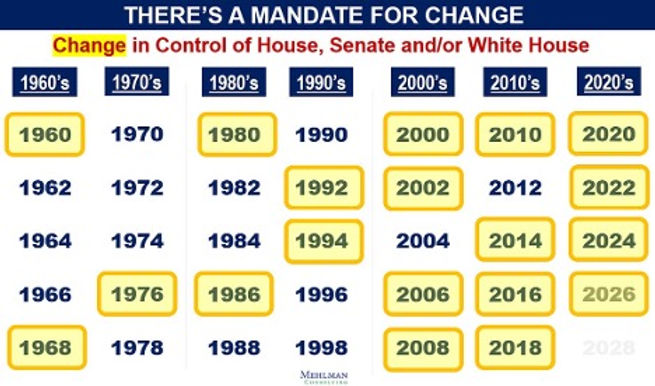
Source: Bruce Mehlman
Those are historical averages, not a forecast. And as we've seen many times, what happens in Washington is only one of many factors influencing the stock market.
Voting for Change
Stocks could rise over the next two years. The economy could continue growing. Both would be welcome. There’s a difference between an economy that makes a few people spectacularly wealthy and one that gives ordinary people a fair shot at a comfortable life.
About 35 million American households owned their homes outright in 2024, roughly four in ten homeowners, with no monthly mortgage payment. Among those with mortgages, more than half had rates below 4% as of the third quarter of 2025.[2]
On the other side, only about one-third of homes listed for sale were affordable to a household earning the median income in June 2026, even assuming a 15% down payment.[3]
Same housing market. Very different economies.
But what if the economy continues to grow, the stock market keeps rising, and more Americans find themselves falling further behind? What happens to young families who spend another four years saving for a home, only to find that home prices have risen faster than their savings? Or couples who put off having children because they can't afford a larger place to live?
To me, that's the bigger concern. Not whether the market rises or falls following an election, but whether the economic conditions that brought so many frustrated voters to the polls actually improve.
I don't see an easy fix. I've been around long enough to know that changing which party controls Congress won't be enough. Which brings us back to Bruce Mehlman's observation.
The question isn’t whether Americans will demand change again. It’s whether either party can deliver enough improvement in their everyday lives to break the cycle. Otherwise, two years from now, we may find ourselves having this same conversation. Different politicians. Same frustrations.
Rinse and repeat.



Comments
Log in or sign up to join the conversation.