
No one is from here. - St. Regis Hotel manager, Shenzhen, China
Oh, the places you’ll go! - Dr. Seuss
It is a distinctly American trait to create environments where entrepreneurs thrive, hard work leads to a better life, and a combination of determination, capital, and talent delivers new technologies, businesses, and wealth.
Right?
After spending a week visiting four top-tier cities in mainland China, I’ve realized some of my long-held beliefs are outdated, at best.
It turns out the US doesn’t have a monopoly on innovation or even on capitalism. What I saw in China was a fiercely competitive, ultra-modern marketplace driven by commitments to excellence, engineering, and in some cases, culture. Not Eastern culture, but corporate culture.
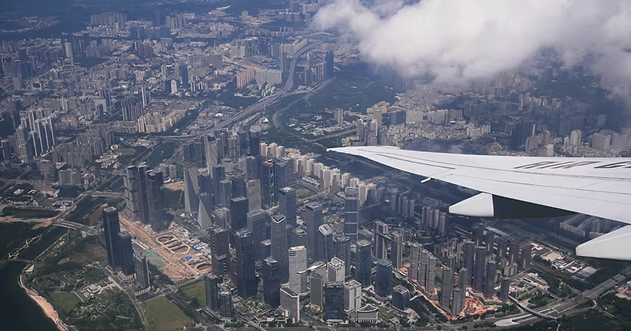
Today I want to tell you about the city of Shenzhen. Unless you are in global manufacturing, you may not have heard of this Chinese city of 18 million people. As recently as 1979, the area had only 30,000 residents, living in small fishing villages. Today, it is one of the most modern cities in the world. It is also quite wealthy.
Here’s a picture I took from the lobby of the Shenzhen St. Regis Hotel. The lobby is on the 96th floor of a 100-story tower. The river divides mainland China (on the right) and Hong Kong.
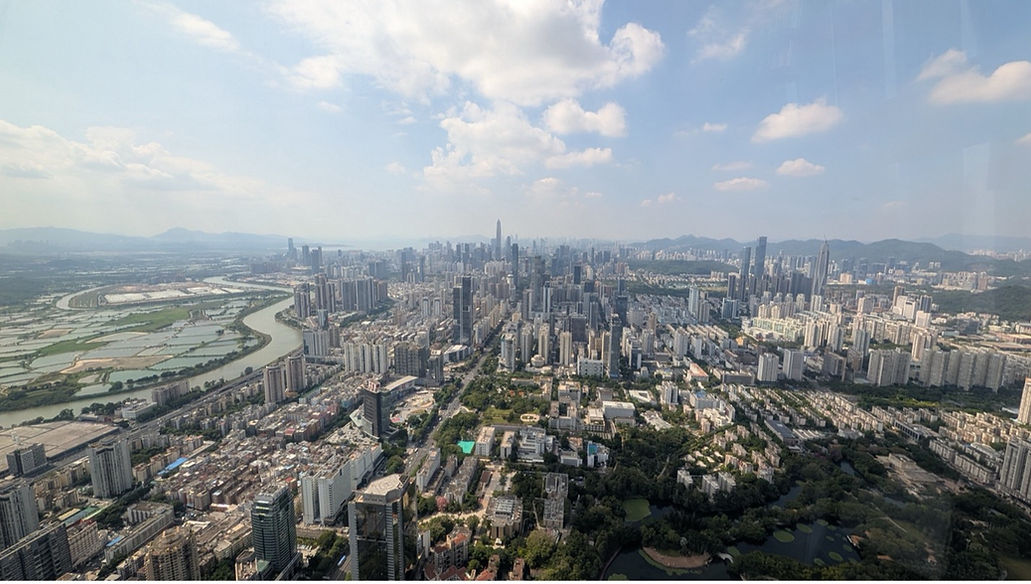
As I was taking in the immensity of the city, the St. Regis hospitality manager said to me, “No one is from here.” The city was built almost entirely by people who came from somewhere else, chasing opportunity.
Shenzhen was one of China’s first Special Economic Zones, created in 1980, as China’s leader Deng Xiaoping introduced market-driven reforms. These zones were created to test the potential for capitalism to boost the nation’s economy. As an SEZ, Shenzhen’s local government was free to implement tax and business incentives, reduce red tape, and otherwise foster business creation and growth. It worked. Today Shenzhen is called China’s Silicon Valley and is home to Tencent (TCEHY)and Huawei.
Battery maker BYD (BYDDF) was founded in Shenzhen in 1995. You may know them as a car company.
They are the global leader in battery-powered vehicles (EVs). That’s just part of their story. They also produce solar panels, whole-house battery backup systems, grid-level battery storage units, semiconductors, sophisticated metal components for the communications industry, and rail transportation systems. They are in the global Fortune 500, with 860,000 employees (including 120,000 engineers) and hold over 42,000 patents.
I had heard of them but had no idea of their size and scope.
Olivier Garret (Mauldin Economics CEO) and I toured their facility. Our guide shared some impressive statistics. It takes BYD about 400 minutes to manufacture a car, from start to finish. 90% of the components are manufactured in-house. They are so vertically integrated, they even own and operate eight cargo ships to deliver their vehicles to the world. And they are buying ten more.
This is in stark contrast to the typical US “asset-light” business model, where firms offload production to subcontractors. While we’ve been focused on quarterly results and financial acronyms like ROE (return on equity) and ROA (return on assets), China’s biggest companies have been building resilient, diverse, vertically integrated businesses.
BYD is an engineering-driven business with a long-term approach to growth and innovation. Their auto factory has a massive hallway with the company’s patents on display on one wall. The adjacent wall is filled with pictures of their top engineers.
BYD would come up again and again on this trip, in conversations with investors, Chinese consumers, and foreigners. My favorite BYD moment came later in the week, at a Hong Kong pub.
The food on this trip was wonderful, but after a week I needed something more familiar. My lowbrow tastes steered me to Delaney’s, a cozy Irish pub in the center of Hong Kong. After a warm greeting from the friendly female bartender (“Welcome home, my daahling”), a fresh pint of Guinness and a plate of bangers and mash, I chatted with a Kiwi making his way home from Germany. I asked if there were Chinese cars in New Zealand. He gave a quick laugh and told me China is taking over the New Zealand and Australian car markets. He owns a BYD Shark (pronounced Shaaahhhk in NZ). Here’s his description.
“My pickup truck is amazing. So much better than the Toyota Hilux in every way, and way better economy [the Shark is a hybrid]. And it was cheaper. Way cheaper.”
This just confirmed what I’d been thinking all week - legacy car manufacturers are, to use a technical term, screwed. They just cannot iterate fast enough. In car manufacturing, the student has become the master. And the master doesn’t just want market share. They need it.
An article in the Wall Street Journal this week confirms something else I was told in Hong Kong: China’s car industry needs to consolidate. They have over 100 brands. They are producing far more cars than their domestic market can absorb. Most brands will eventually disappear. Others will be acquired. The next phase in China’s auto market is consolidation. In the end, only the strongest, most innovative, and well capitalized will survive. I’d bet BYD will be one of the winners when the shakeout is over.
By now you may be thinking, “Wait a minute – this is all possible because of China’s government.” You’re right. There is most definitely a maestro conducting this activity. The government’s hand in the economy is quite visible. For better or worse, the government sets the direction, they state the priorities, they may even invest, but they leave it to the private sector to execute.
It’s different than in the US, but maybe not that different, especially lately. Over the past two years the US government has committed $2 billion to quantum computing, with IBM (IBM) alone receiving $1 billion to invest in a quantum chip production facility. MP Materials (MP), a miner and producer of rare earth magnets, saw a government investment of $400 million. Other companies receiving government investment dollars include defense contractor L3Harris, Intel (INTC), US Steel (X), and Westinghouse. If you add in tax incentives, the list grows far longer.
I’ll have more thoughts for you on China next week and beyond, as well as a great podcast I recorded with Jason Hsu, founder of Rayliant Global Advisors, the firm behind the Rayliant ETFs. Jason has been on the SIC stage and is a longtime friend of Mauldin Economics. I’m hoping to feature his insights regularly on the podcast moving forward.
I’m once again writing this week’s letter on a plane as I start my journey back to Connecticut. I was just told to close the laptop and prepare for my transfer in Tokyo. Thank goodness for airplane wifi. What a week! Thanks for being with me, and as always, thanks for reading.


Comments
Log in or sign up to join the conversation.