


“Ill fares the land, to hastening ills a prey,
Where wealth accumulates, and men decay.”
— Oliver Goldsmith, The Deserted Village (1770)
I feel like I’ve stepped into the future, or onto a Sci-Fi movie set. Today is my third day in China, where I’m on a tour of technology companies. “Wow” is the word I find myself continuously saying.
Yesterday I toured Xiaomi’s 784,000 square meter car factory. For scale, this is larger than Toyota’s largest auto factory. It was built in two years (can you imagine!) and today produces over 1,000 cars per day, with only 2,000 employees, plus around 1,000 robots. The cars are some of the sexiest, most sophisticated high-end vehicles I’ve ever seen. At half the price of anything comparable from the US, Japan, or Germany. Trust me, when you actually sit in one, you’ll want one.
I’m writing to you while traveling at 180 miles per hour… but I’m not flying. I’m on a train. The open-top, fresh cup of hot coffee on my tray is barely vibrating. I wouldn’t dare try this on an Acela train, let alone a Metro North commuter. Out my window is the first of several nuclear power plants I’m told I’ll see on this trip.
I’ll have more for you on China in the weeks ahead, once I’ve had a chance to experience and digest all of this.
For now, we need to talk about something more urgent, and that’s what is happening in France and why you should care.
On Saturday, October 17, hundreds of thousands of people marched across France. Families struggling with living costs. Students protesting overcrowded classrooms and missing teachers. Workers frustrated by stagnant wages and rising taxes.
The French government is looking boxed into a corner. For decades they have borrowed to keep the peace. In 2023 President Macron tried to increase the retirement age from 62 to 64. This was an important step toward fiscal responsibility. The French responded with massive protests and strikes. Ultimately the retirement age was only increased by nine months. But the fiscal problems didn’t go away. They got deferred.
As the saying goes, debt doesn’t matter until it matters. For France, today it matters.
French 10-year bond yields are now roughly 5.5%, a 24-year high. The move has come quickly. Just last week Juliette Declercq of JDI Research highlighted how France is borrowing at roughly 4.8%, while its economy is growing roughly 2.5%. What she is pointing out, is the status quo is unsustainable, and getting worse.
France, like so many western nations, got addicted to borrowing when rates were low. In a world where very little debt gets paid off, this is now a problem. As sovereign bonds mature, nations are forced to refinance at today’s higher interest rates. The increased cost of servicing their debt leaves even less money for other budget items. Things like social services, defense, and juicy political payouts to appease voters.
In France, markets are pressing for a measure of austerity, while the population wants more, not less.
On the one hand, families are squeezed by costs they can’t keep up with and entitlement programs they’ve come to see as a right. On the other, the government is squeezed by debt it can’t grow out of. Every way out (higher taxes, deeper cuts, more borrowing) infuriates the populace or delays the problem. Neither side has any room left. Something has to give.
Does any of this sound familiar?
Plenty of Americans are frustrated, too. The cost of everything keeps climbing. Housing is out of reach for a generation of first-time buyers. College costs more than ever. Healthcare is obscenely expensive. This is the K-shaped economy. I’ve written about it for months, from a US perspective. But it is not unique to the US.
What happens next in France is important for Americans. It will be like seeing one potential future for our own debt crisis. So far the solution, for France at least, does not look peaceful.
I think we can avoid that fate, but only if we get ahead of the problem now – something politicians are loathe to ever do, especially in an election season. Given our politics, “election season” could last for the next two years.
Two Different Economies
The K shaped economy was a hot topic at Jared Dillian’s DirtCon conference in Nashville two weeks ago.
Over two days, the data and conversations with speakers and attendees kept finding their way to this contradiction: The US economy continues to grow, the stock market has created enormous wealth, yet plenty of Americans are being left out.
If you own a home and have a substantial investment portfolio, the last several years have been very good to you. If you’re trying to buy your first home, raise a family, and accumulate some savings, your experience may be quite different.
My friend Peter Boockvar discussed housing affordability. Existing home sales are running at about 4 million a year, roughly where they were in the mid-1990s, when the country had more than 70 million fewer people.
Meanwhile, home prices are up roughly 50% over the past six years. Add today’s mortgage rates, and the market is, in Peter’s word, frozen.
Peter also made the point that a couple of generations ago, the typical home cost about 3.5 times household income. Today it’s closer to 5 times. Ultra-low mortgage rates let buyers stretch to cover that gap. With rates back to normal, something has to come down, and the most direct route back is lower prices.
And look at who’s buying. The National Association of Realtors reported that the median age of all homebuyers reached 59 in its 2025 survey. First-time buyers had a median age of 40 and accounted for just 21% of transactions.
Lower prices would help younger buyers, but reduce the equity of everyone who already owns a home. If you’re counting on that equity to fund your retirement, you probably don’t want the value of your house to fall. One generation’s nest egg is another generation’s locked door. A political hot potato.
Who Pays?
Households aren’t the only ones squeezed. The US government faces the same trap France does: promises it made, money it borrowed to keep them, and a debt that keeps growing.
Jared showed us a chart at DirtCon breaking down government expenditures.
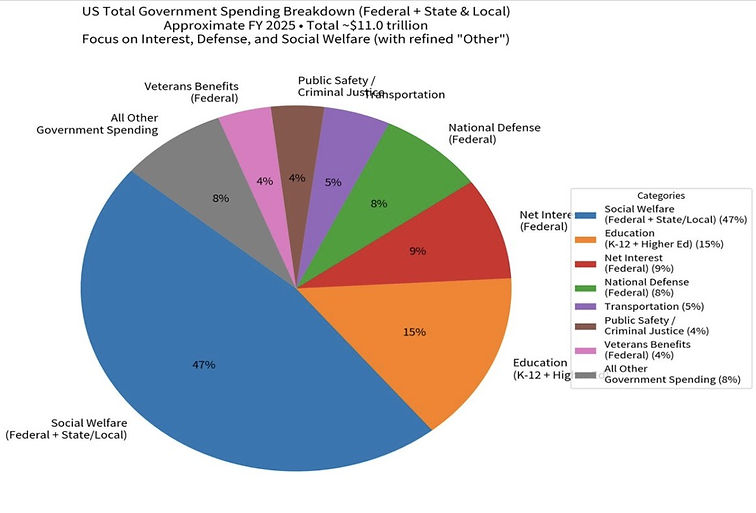
Source: Jared Dillian’s DirtCon presentation
We’re spending more servicing debt than defending the country. In fiscal 2025, federal net interest costs reached approximately $970 billion, exceeding the $917 billion spent on national defense. This is dangerous territory for a global power. Niall Ferguson points to numerous examples of past super-powers that have crossed the “Ferguson Limit” and lost their global dominance.
The thing is, this is not an insurmountable problem. As I have written, and Jared mentioned at his conference, we don’t necessarily need to balance the budget. We need to reduce the deficit relative to GDP. The rule is simple: keep spending growing slower than the economy. Do that for long enough, and the debt shrinks as a share of what we produce. We can improve the arithmetic without eliminating every deficit.
Social welfare programs make up nearly half of all government spending. Restraining spending growth eventually will require touching sacred cows like Social Security, Medicare, and the other programs Americans have planned their lives around.
The math is becoming less sustainable. No one is going to like our options. Again, a political hot potato.
What Comes Next
The fix is obvious, but the solution is infinitely complicated. It’s easy to say we need to spend less. It gets harder when we start talking about what gets cut. Every solution has opponents. Raise taxes, and households and businesses resist. Keep borrowing, and interest consumes more of the budget. Allow inflation to erode the debt, and people lose purchasing power.
And Americans are in no mood to give anything up.
People don’t experience the economy as a GDP report. They experience it through their paychecks, housing costs, medical bills, and what’s left at the end of the month.
If they’re working and saving but still getting further from buying a home or retiring comfortably, we shouldn’t be surprised when they start looking for different answers.
Many Americans already feel that way. In a New York Times/Siena poll earlier this year, two-thirds of voters said a middle-class lifestyle is now out of reach for most people. More than three-quarters said it’s harder to achieve than it was a generation ago. Only 14% said they feel they’re getting ahead.
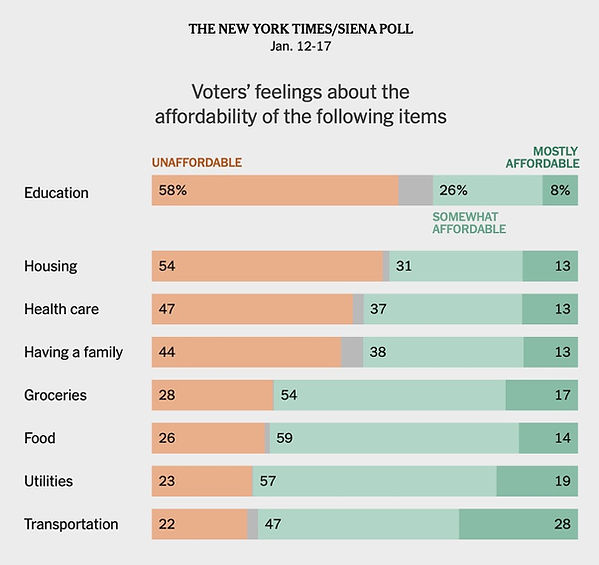
Source: The New York Times/Siena College
Look at what tops the list: education, housing, and health care. Translated: a home, a degree, a family, medical care. The divide runs along the same line as the housing market. Most voters over 65 said they can afford the life they feel they should have. Three-quarters of voters under 30 said they can’t.
These aren’t the views of one party. Voters were split almost evenly on whom to blame. But the frustration is shared.
With the midterms this close, affordability is on the ballot. I don’t know how this election will turn out and I’m not advocating for one party. I’m advocating for collaboration and cooperation.
France is a reminder that economic frustration doesn’t stay economic. It becomes political and physical. We shouldn’t assume we’re immune.
People can live with hard times. What they struggle to live with is the belief that hard times are permanent, or that the system is rigged.


Comments
Log in or sign up to join the conversation.