

At the start of this year, we ranked aluminum eighth in our ten-commodity framework and classified it as a dark horse for upside event risk in 2026. The Iran war is that event, and it is squeezing an already limited global supply chain.
China, the world’s largest consumer and producer of aluminum, had effectively reached its self-imposed 45-million-ton production cap by the end of 2025. That means the country that produces roughly 60% of the world’s aluminum had no meaningful room left to grow capacity.
Outside of China, the supply constraint picture is not clearer or better. Many European smelters that shut down when natural gas prices spiked after Russia invaded Ukraine in 2022 have not fully restarted. Approximately 800,000 tons of capacity across Germany, Slovakia, and Iceland remains offline as of early 2026.
In the Northern hemisphere, U.S. domestic output has declined dramatically from its historical peak, with the country now importing close to 60% of what it consumes.
Plus, LME aluminum inventories, which sat above three million tons four years ago, had fallen to around 700,000 tons by late 2025 and stood at 442,800 tons as of March 16, and they are still falling.
Meanwhile, as we’ve long detailed, the demand side shows no signs of letting up and it continues to be transformational. Demand continues building from multiple directions, with EVs, grid infrastructure, aerospace, defense and data centers all competing for the same constrained metal.
The structural setup for aluminum will be exacerbated by this war. And, as we have prepared readers here, it was possible to be well positioned ahead of time.
In our October 2025 Prinsights Pulse Premium monthly issue, we identified a U.S. aluminum fabricator positioned at the intersection of that supply squeeze and Washington’s industrial policy push. Since then, the U.S. Midwest Premium, the surcharge domestic buyers pay on top of the LME base price, crossed $1 per pound for the first time in January 2026, more than quadrupling from $0.24 per pound a year earlier.
It peaked at around $1/lb in late February before easing to roughly $0.81/lb as of mid-March, where it remains historically elevated and volatile.
What the Iran War Changed for Aluminum
Aluminum smelting is one of the most energy-intensive industrial processes on earth. Producing one ton of aluminum requires roughly 15 megawatt-hours of electricity, which for context is approximately what an average American home uses in 18 months.
That energy dependency is precisely why European and North American smelters closed when gas prices spiked in 2022 – and a why so few have restarted since.
The Strait of Hormuz carries roughly 20% of global LNG flows. With the Strait effectively in lockdown since late February 2026, natural gas flows to Europe and Asia have been disrupted in ways that are directly hitting industrial energy costs. European smelters that were already operating on the edge of viability are facing yet another round of cost pressures. The ones that survived 2022 are being squeezed again – with questions mounting about their ability to survive “the next one.”
Another compounding issue is that Iran also attacked Oman’s Port of Salalah on March 11, which serves as the deep-water terminal that shippers had been using as an alternative route around Hormuz. Because of the move, it is forcing a suspension of operations. Container operations have partially resumed but liquid cargo handling remains suspended. \
Bahrain and the UAE are two of the U.S.’s primary aluminum import sources outside Canada. The Middle East as a whole accounted for roughly 21% of U.S. unwrought aluminum imports in 2025. Both countries are now operating inside an active war zone. Neither has halted production, but the risk premium on sourcing from the Gulf corridor has increased materially.
U.S. smelters also run on domestic natural gas. The Hormuz closure has amplified that cost advantage for now, as European and some Asian competitors face rising energy costs that U.S. producers don’t. But even so, aluminum prices will continue to bear the brunt of some of those costs, which will in turn, squeeze prices of processed aluminum.
To Note: The U.S. fabrication capacity we highlighted in October is now sitting at a greater structural cost advantage that it did not have when we released that issue.
The Supply Picture Has Just Gotten Tighter
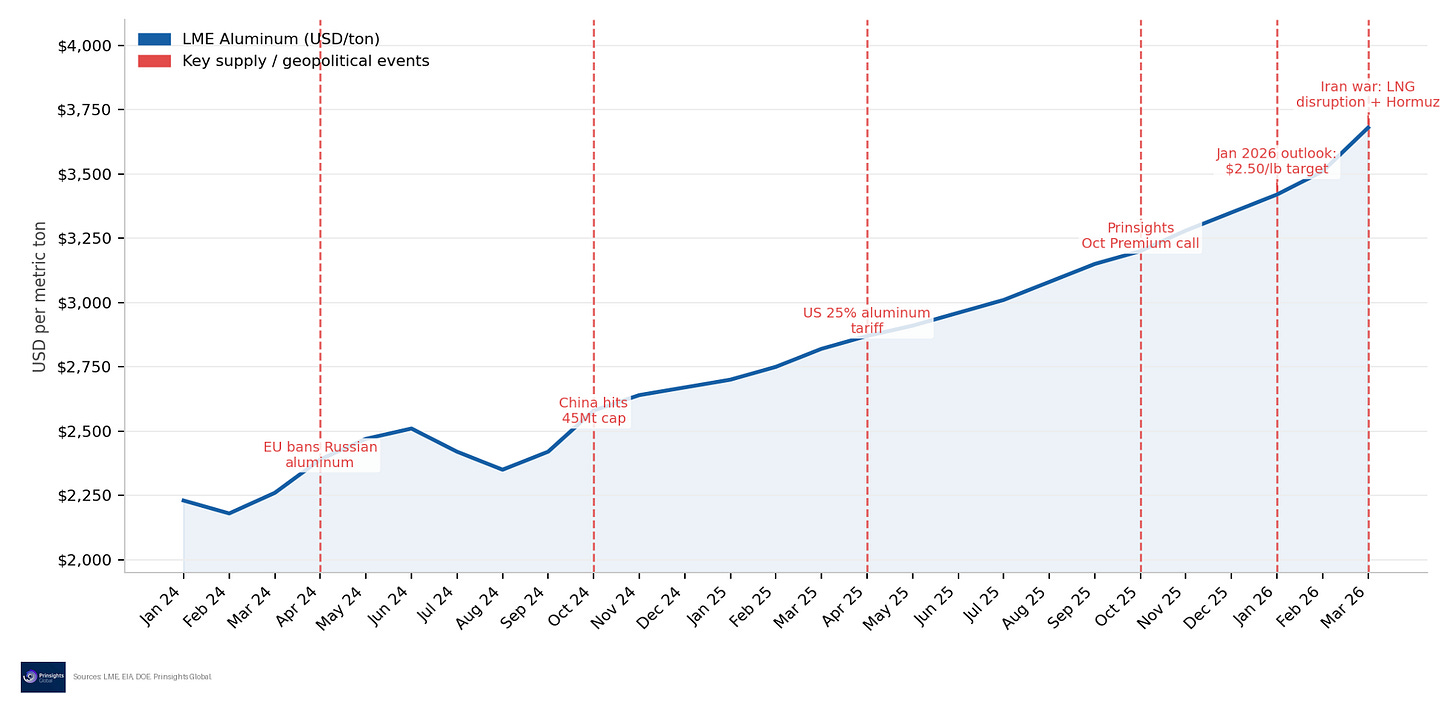
LME aluminum was trading at around $3,400 per ton as of March 16, up more than 20% over the past year. Prices were already elevated before the war started. The Iran war added another price catalyst, with Gulf-based producers including Qatar’s Qatalum cutting output as the regional disruption hits their operations directly.
Aluminum prices were already moving higher on the back of multiple forces before this war started, including U.S. tariffs that remained in place even after the Supreme Court struck down much of the broader tariffs on February 20. Meanwhile, grid upgrades and construction developments, defense procurement, EV manufacturing and aerospace orders are all still drawing from the same constrained pool.
The International Aluminium Institute expected global aluminum consumption to grow roughly 3% this year while supply outside China grows just 1%. That was the pre-war estimate. The war has amplified that gap.
The chart below shows LME aluminum prices since early 2024, with the key events we tracked impacting them most. The upward trend was moving before the Iran war. What the war did was remove any near-term ceiling on prices.
LME, EIA, DOE. Prinsights Global.
What We Are Watching Now
The key variables impacting the price of processed aluminum remain the ones we were tracking since January. The reality of the situation is that European smelters run on gas, much of which reaches them as LNG through Hormuz. The longer the Strait stays closed, the higher their energy costs, and the more of that offline capacity stays offline. U.S. domestic capacity investment through the Defense Production Act and the Speed-to-Power program was already underway before the war, though whether the Iran situation accelerates the timeline remains to be seen.
The supply gap we identified in January is even wider today and the fundamental case for aluminum has only gotten stronger because of the Iran War. This is the kind of longer-term structural story investors are following – and what we look for with Prinsights.
In our March Prinsights Pulse Premium monthly issue that will be out next week, we’re applying the same framework to the oil market, identifying a high-dividend producer outside the Middle East supply chain positioned for the same kind of structural repricing.
Comments
Log in or sign up to join the conversation.