

Summary
The Iran ceasefire ended this morning, pushing crude oil back toward $74 after a full round-trip from $70 to $119 and back. Will macroeconomic headwinds catch up with a stock market that to this point has mostly refused to care? PCE inflation accelerated from 2.8% in January to 4.1% in May, a three-year high, with the Fed signaling rate hikes rather than cuts, with the next PCE reading due July 30. The 10-year Treasury at 4.57% is pricing in not just inflation but some deeper concerns over a $40 trillion federal debt that’s growing fast, a $2 trillion deficit, and Japan and others reducing their appetite for U.S. paper as their own rates rise. Mortgage rates near 6.6% continue to squeeze buyers in Long Island, NYC, and elsewhere where entry-level homes are priced extremely high, with the lock-in effect keeping millions of 3%–4% mortgage holders on the sidelines. Against all of it, the S&P 500 is near record highs, powered by AI-driven earnings growth of 29% in Q1, a semiconductor index up 88% in a quarter, and a Wall Street year-end target for the S&P 500 of 7,850. Bottom line? Stay informed, stay ready for opportunity, and don't panic.
What Message Are The Markets Trying To Tell Us?
Over the past 6-months, we witnessed a crude oil market that basically had a round-trip from about $70/barrel to $119/barrel, and then back down below $70/barrel, until news that the ceasefire with Iran has now ended, pushed it up to $74/barrel this morning.
At the same time, the 10-year Treasury yield has hovered between 4.2% and 4.60%, while the inflation gauge most watched by the Federal Reserve, PCE, has risen significantly.
Mortgage rates, a key driver for activity in the real estate market, rose as high as 6.85% before falling to the current level of around 6.6%
And through all of the volatility surrounding it, the S&P 500 has continued to make new highs.
This is certainly the definition of a resilient stock market, but where do we go from here, particularly in light of the war with Iran heating up again?
The Oil Round-Trip: Relief Without Resolution
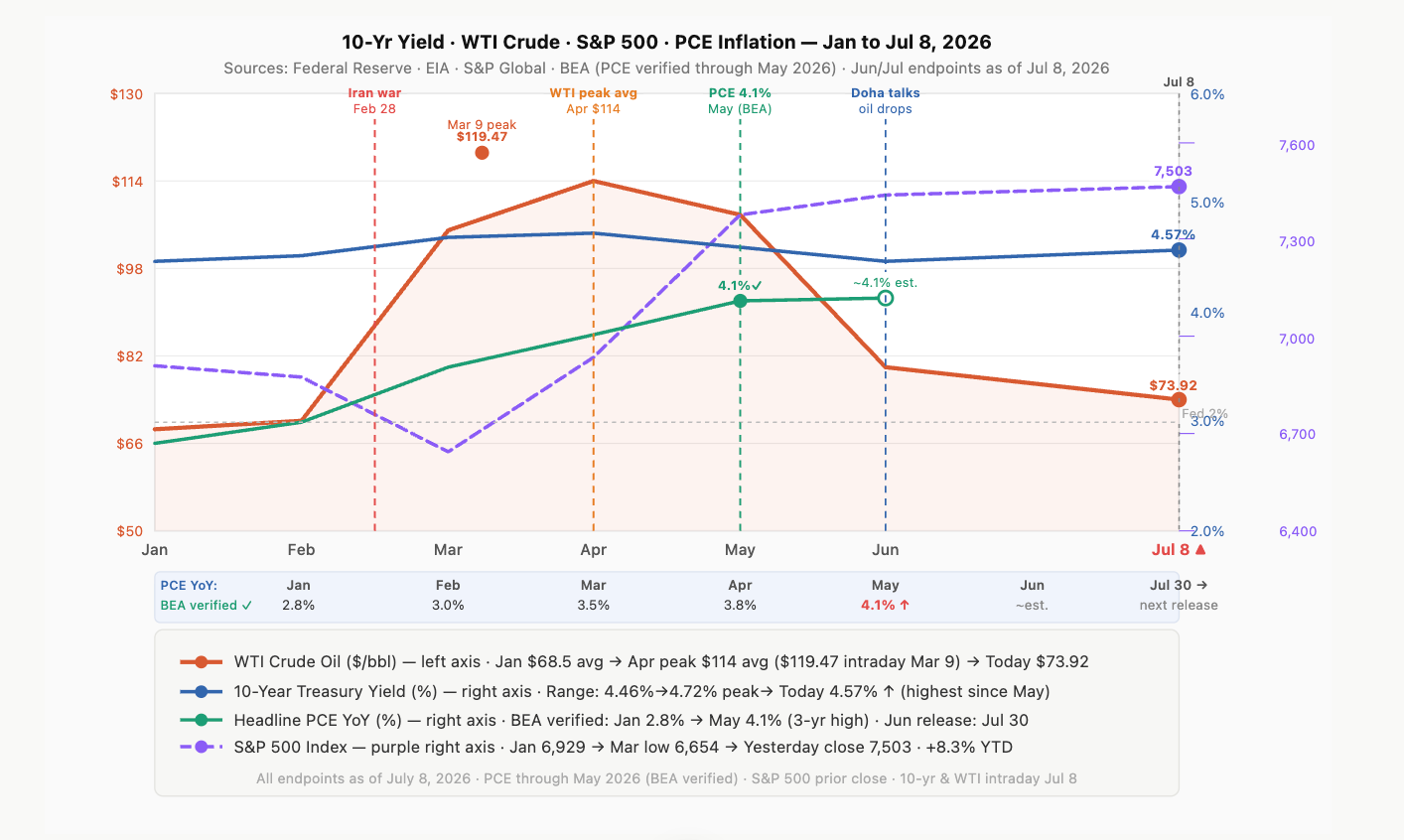
When the U.S. attacked Iran on February 28, WTI crude spiked from roughly $68 a barrel to an intraday peak of $119.47 on March 9. Peace talks, normalizing Hormuz traffic, and OPEC production increases brought it all the way back. Full round-trip. For energy consumers, that was welcome news.
And now, with the temporary ceasefire with Iran officially ending this morning, crude oil prices will likely move higher, but just how high will depend on a variety of factors.
In any event, crude oil prices in the low $70s have not brought inflation back down with it. Prices go up like a rocket and typically come down slower, and the downstream effects of an energy shock on trucking, manufacturing, utilities, and services don’t reverse on a dime when crude falls.
PCE: The Inflation That Won’t Go Away
The numbers from the Bureau of Economic Analysis tell a troubling story, particularly as we wait for the Fed minutes from the June 16-17 meeting to be released today.
Headline PCE inflation started 2026 at 2.8% year-over-year in January. By May, it had accelerated to 4.1%, which is its highest reading since April 2023. Core PCE, which excludes food and energy, reached 3.4%.
The Federal Reserve has taken notice. At its June 2026 meeting, the Fed raised its own inflation forecasts, projecting headline PCE at 3.6% and core PCE at 3.3% for the full year, both numbers well above the 2% target. Nine of 19 policymakers projected at least one rate hike before year-end. Fed Chair Kevin Warsh has been direct: anyone expecting the Fed to tolerate inflation above 2% “would be disappointed.”
The next test comes July 30, when the June PCE report is released.
The 10-Year Treasury: Stubbornly Parked Around 4.5%
The 10-year yield started the year at 4.46%, peaked at 4.72% during the war-driven inflation scare, and has since settled back to 4.57% this morning. slightly above where it started.
Bond traders are sending a message.
The bond market isn’t primarily worried about oil.
It’s worried about the bigger picture: federal debt quickly approaching $40 trillion, a Federal Reserve that may hike rates, a federal budget deficit this year projected to be $2 trillion when the economy is supposed to be good, and reduced appetite from Japan, one of the largest foreign holders of U.S. Treasuries, as its own domestic rates rise, with it’s 10-year at 2.89% (Japan’s 10-Year Yield Is 2.27%...Is That A Significant Threat to U.S. Mortgage Rates?).
Falling oil helped at the margin. It didn’t change the structural story.
The bond market is the most honest scorekeeper in finance. The ‘smart money,’ if you will. Right now, it is saying: risk is elevated, and we want to be paid for it.
Mortgage Rates: Where the Macro Meets Main Street
For most Americans, the real-world consequence of elevated inflation and stubborn Treasury yields arrives in the form of a mortgage rate, not to mention the daily cost of living.
With the 10-year near 4.57%, conventional 30-year fixed rates sit in the 6.6% range, which is down from the 6.85% cycle high, but still well above where buyers were hoping they would be at this point in time.
Every 10 basis points the 10-year moves higher, with mortgage rates following, adds approximately $60 to $70 per month to the cost of a $1 million mortgage. At the $1MM+ price points that now define the entry-level market across Long Island and the New York suburbs, that arithmetic matters in a big way.
Compounding the challenge is the “lock-in effect”: millions of existing homeowners sitting on 3% and 4% mortgages from 2020–2021 have an issue selling and then taking on a 6.5% replacement loan.
That keeps inventory constrained, prices elevated, and new buyers squeezed. Until rates move meaningfully lower, which requires either an unlikely Fed pivot to lower rates or a recession, the housing market will remain caught between limited supply and deteriorating affordability.
The S&P 500: The Rally That Wasn’t Supposed to Happen
Against all of the issues mentioned, including 4.1% inflation, a Fed signaling rate hikes, near-5% 10-year Treasury yields, and an Iran war, the S&P 500 has powered to record highs. Twenty-four record closes and the best quarter since 2020.
The explanation is corporate earnings, driven almost entirely by artificial intelligence.
In Q1 2026, S&P 500 companies reported earnings growth of 29% year-over-year, the strongest since 2021. Technology and communication services led with 55% and 49% growth, respectively, powered by AI infrastructure spending from Alphabet, Amazon, Meta, Micron, and Nvidia. The semiconductor index surged nearly 88% in a single quarter. Wall Street’s consensus year-end target for the S&P is now 7,850, with Q2 earnings growth projected at 23.3%.
The market has made a clear bet: the AI earnings engine is powerful enough to override every macro headwind currently in play. So far, the data has backed that bet every quarter.
The Ultimate Battle: Which Side Wins?
That is the question every investor, homeowner, and business owner needs to ask, which I will be doing today when I speak with my financial advisor.
On one side: a powerful AI-driven earnings cycle, a resilient labor market, and an equity market with a demonstrated ability to absorb shock.
On the other side: inflation more than twice the Fed’s target, a fiscal trajectory that the bond market is pricing as risky, mortgage rates that have sidelined a meaningful number of potential buyers, and geopolitical risks that are on the front burner.
Nobody knows which side of the equation will win. What we do know is that uncertainty rules the day.
The risks are real, and as in every market cycle, the opportunities are real as well.
Historically, periods of elevated rates and elevated uncertainty have been among the best long-term entry points for disciplined real estate investment, because the short-term noise surrounding the market often makes for great entry points as prices will typically drop. Of course, particularly in markets such as Long Island and NYC, the real estate market is anything but typical.
The Federal Reserve, the July 30 PCE report, the Q2 earnings season, and of course geopolitical headlines will all help to pave the way.
We do know this: the battle between AI-driven optimism and the macroeconomic reality will continue, with any outcome completely unknown!
Comments
Log in or sign up to join the conversation.