

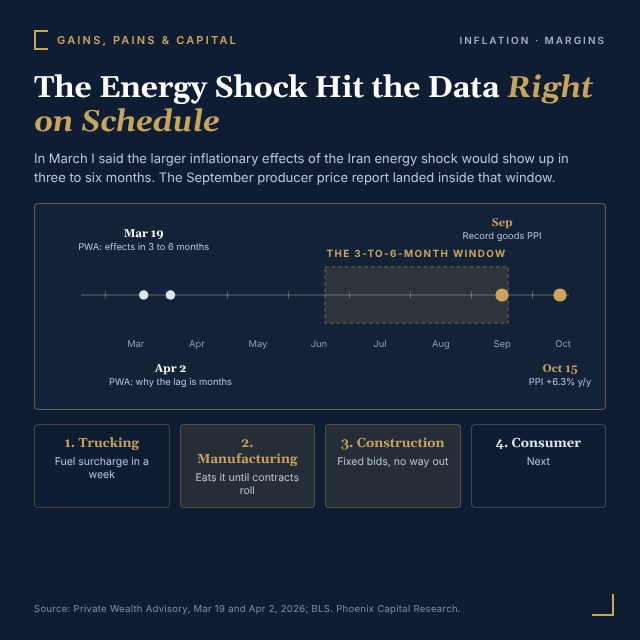
On March 19, three weeks into the Iran conflict, I wrote the following to my Private Wealth Advisory subscribers:
“The rise in energy prices will hit the CPI within four weeks. But the other larger effects (higher input costs for the economy, lower productivity, etc.) will begin showing up in three to six months.”
Three to six months from March 19 is mid-June to mid-September.
I also laid out the order in which it would happen. First transportation and logistics, because energy is one of their largest input costs. Then manufacturing, because oil and petrochemicals are embedded in plastics, fertilizers, pharmaceuticals, and industrial lubricants, so when crude rises, input costs climb across entire industries in lockstep. Then construction, where diesel runs the equipment and energy runs the cement kilns, steel furnaces, and aluminum smelters that produce the materials.
Two weeks later, on April 2, I explained why the timeline was months rather than days. A trucking company can put a fuel surcharge in place within a week. A manufacturer cannot. Most of them sell on quarterly or annual contracts with fixed pricing, so when energy spikes mid-contract, they eat the difference until the contract rolls. A contractor on a fixed-bid project has it even worse, since he is legally obligated to finish building at prices he agreed to a year or more ago.
The point was simple. An energy shock does not hit the economy all at once. It works its way down the supply chain one contract renewal at a time, and the real inflationary damage arrives with a lag.
That lag just ended.
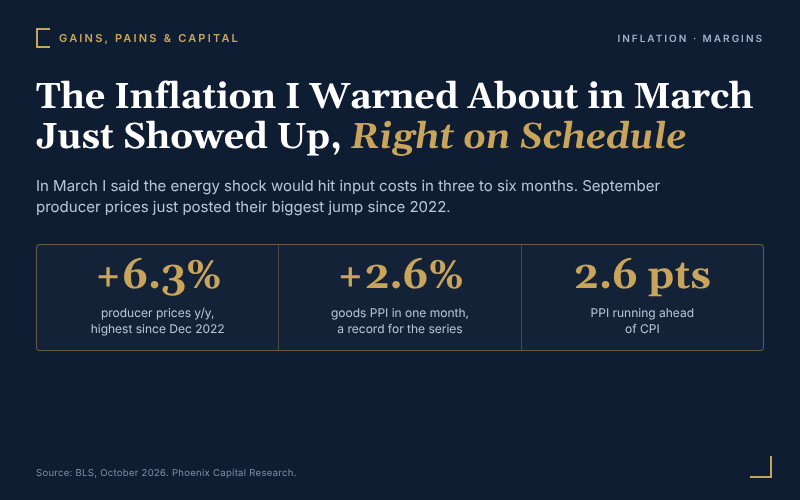
Today’s Producer Price Index for September came in at +1.3% for the month against an expected +0.6%. That is the biggest monthly jump since March 2022. On an annual basis producer prices are now rising 6.3%, the fastest pace since December 2022. Core PPI, which strips out food and energy, rose 0.7% in the month and is up 5.0% year over year.
Dig into the components and you see exactly the sequence I laid out in March. Final demand goods prices rose 2.6% in September, the largest monthly increase since the Bureau of Labor Statistics started the series in 2009. Energy prices at the producer level jumped 10.8% and hit a record high. Gasoline rose 20.3%. Diesel, jet fuel, and residential electricity all rose sharply. These are the prices businesses pay for the inputs that go into everything they make and ship, well before any of it reaches the consumer.
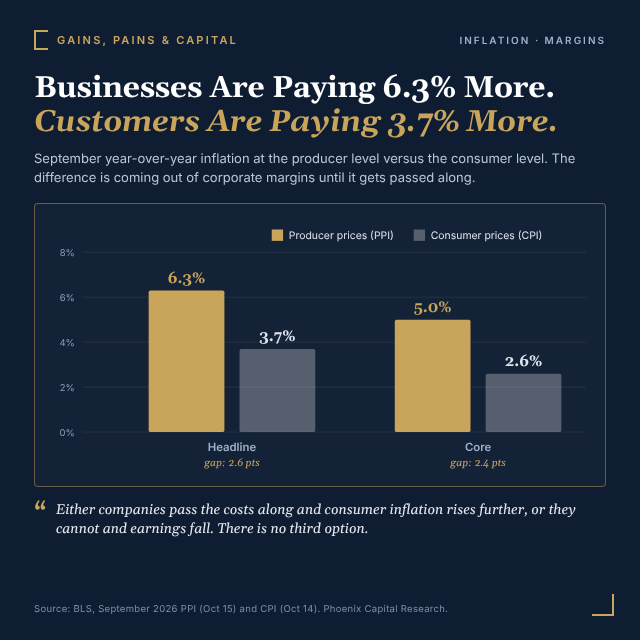
Now put that next to the Consumer Price Index, which came out the day before. Headline CPI rose 3.7% year over year. Core CPI rose 2.6%.
So producer prices are rising at 6.3% while consumer prices are rising at 3.7%. On a core basis the gap is even wider: 5.0% versus 2.6%. That is a spread of roughly 2.5 percentage points between what businesses pay and what they are able to charge, and it is one of the widest gaps we have seen in this cycle.
That spread is the whole story, and almost nobody is writing about it.
When producer prices run ahead of consumer prices, someone is absorbing the difference. In the short run, that someone is corporate America. Margins get squeezed. This is precisely what I described in April when I wrote that manufacturers on fixed contracts “eat the difference” and that contractors on fixed bids watch “their margin evaporate week by week.”
In the longer run, companies do one of two things. Either they pass the costs along, which means consumer inflation has further to rise, or they cannot pass them along, which means earnings fall. There is no third option. Both outcomes are now being decided in real time, because this data is landing in the first week of third-quarter earnings season with the S&P 500 near 7,800 and priced for margins to expand, not contract.
I want to be careful about what this does and does not mean.
It does not mean inflation is spiraling out of control. Energy accounted for more than 80% of the September PPI increase, and the headline chatter about inflation “broadening out” is running ahead of the evidence. Food prices were flat in the September CPI. Shelter is rising 3.2%, which is elevated but not alarming. This is an energy shock working through the system, exactly as I described, and energy shocks are finite.
What it does mean is three things.
First, the Fed is boxed in. Headline inflation is accelerating, producer prices are at four-year highs, and New York Fed President Williams said this week he still sees one more hike as appropriate this year. There is no rate cut coming to rescue housing, which I wrote about on Wednesday, or to rescue the manufacturers and builders who are stuck on bad contracts.
Second, the earnings reports over the next three weeks matter more than usual. Watch the gross margin line, not the revenue line. Companies with pricing power will show stable margins and raise prices. Companies without it will miss on margins and blame “input costs.” The market will sort them quickly, and the sorting will be brutal for the second group.
Third, the investment implications are the same ones I have been laying out all year. You want to own the companies that set prices: energy producers and infrastructure, miners and hard-asset producers, and the handful of businesses whose customers have no alternative. You want to avoid consumer-facing businesses with thin margins and labor-heavy cost structures, because they are the ones that end up holding the bag when producer prices run ahead of what the customer will pay.
I laid out the sequence in March and the timing in April. Trucking first, then manufacturing, then construction, with the pain growing at each step, and the bulk of it arriving three to six months out. September’s producer price data is the manufacturing and construction stage showing up inside that window. The consumer stage comes next.

Comments
Log in or sign up to join the conversation.