

While everyone here was watching the Fed and the AI earnings, a G7 bond market cracked.
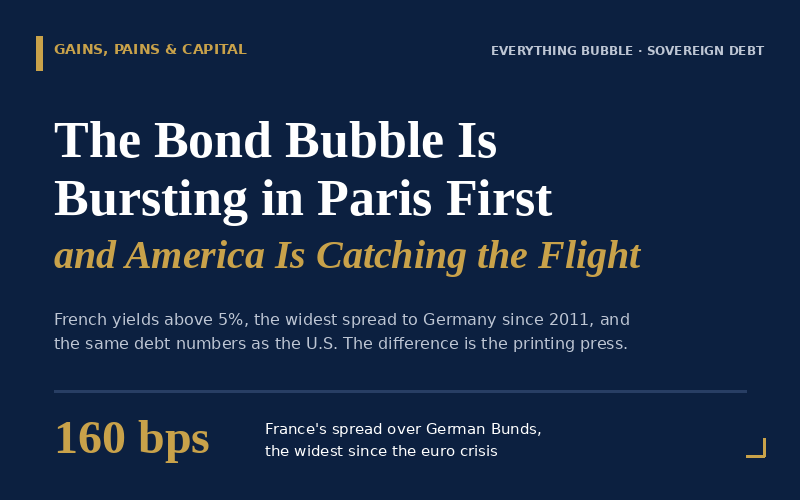
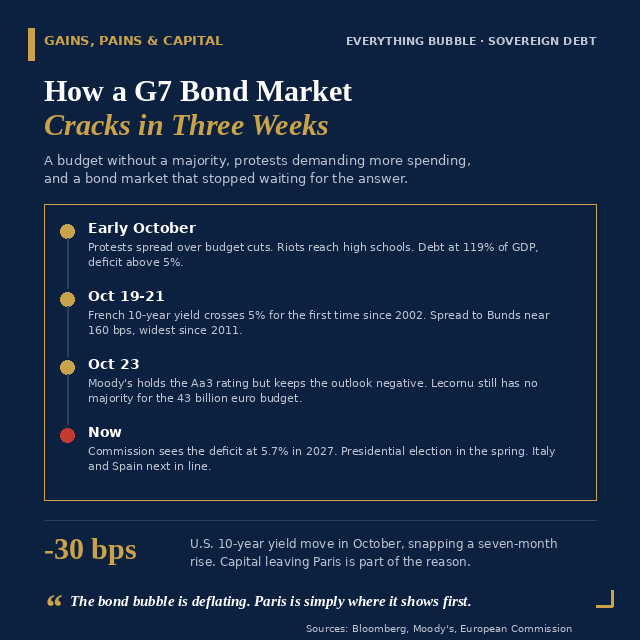
Last Wednesday the yield on French 10-year government debt rose above 5% for the first time since 2002. The spread between French and German yields, the single most watched gauge of creditworthiness inside the eurozone, widened to nearly 160 basis points. That is the widest it has been since 2011, the peak of the euro crisis, when the question was whether the currency union would survive.
The numbers behind it are simple. French public debt is 119% of GDP. The deficit is above 5%. The European Commission expects the deficit to reach 5.7% next year and debt to pass 120%. Prime Minister Lecornu is trying to pass a 2027 budget with 43 billion euros of cuts, and he does not have a majority to pass it. The response in the streets has been weeks of protests, some of them violent, demanding more public spending rather than less. Moody’s held France’s rating on Friday but kept the outlook negative. There is a presidential election in the spring.
So you have a government that cannot cut, a population that will not accept cuts, a deficit that is growing anyway, and a bond market that has stopped waiting for the answer. That is a sovereign debt crisis. It is happening in the second largest economy in Europe, and it is barely registering in the U.S. financial press.
I have been writing about the Everything Bubble since 2014. The core of that argument was never about stocks or houses. It was about sovereign bonds. Central banks pushed the price of government debt to levels that had no relationship to the risk of lending to those governments, and every other asset got priced off that mistake. The unwind was always going to start in the bond market, and it was always going to start with the sovereigns that could not print their way out.
France cannot print euros. The ECB can, but it has to answer to Germany, and the tools it has for this situation, like the Transmission Protection Instrument, were built for the 2012 playbook, where the crisis was in the periphery and the core was sound. France is the core. There is no obvious playbook for the core going bad, and the market knows it. Italy and Spain, with their own debt loads and banks stuffed with domestic government bonds, are next in line if this spreads.
Now here is the part that matters for American investors, and it is the part nobody is saying out loud.
The U.S. 10-year Treasury yield fell more than 30 basis points in October. It is sitting just under 5% this morning, and it is about to snap a seven-month streak of monthly increases. The financial press is treating that as good news, a sign that the inflation scare is fading ahead of the Fed meeting tomorrow.
Look at why yields actually fell. The three reasons cited by every desk on Wall Street are the AI selloff, the crisis in France, and the war with Iran. Every one of those is a fear trade. Money left risk and went into Treasuries because Treasuries are where money goes when something breaks. Not one of those reasons has anything to do with inflation coming down. Core CPI printed hot in September. The Fed’s own forecast is 3.7% for the year. Brent is at $116.
So the drop in yields that everyone is celebrating is capital fleeing a cracked sovereign in Europe and a cracked trade in AI, landing in the one bond market big enough to absorb it. That is not the bond bubble reflating. That is the bond bubble deflating in Paris and the air rushing into New York on its way out.
And here is what should give you pause. Put the French numbers next to ours. France has debt at 119% of GDP and a deficit above 5%. The United States has debt around 120% of GDP and a deficit above 6%. The French 10-year yields just over 5%. Ours yields just under. The fiscal pictures are the same. The difference, the entire difference, is that France borrows in a currency it does not control and the United States borrows in one it does.
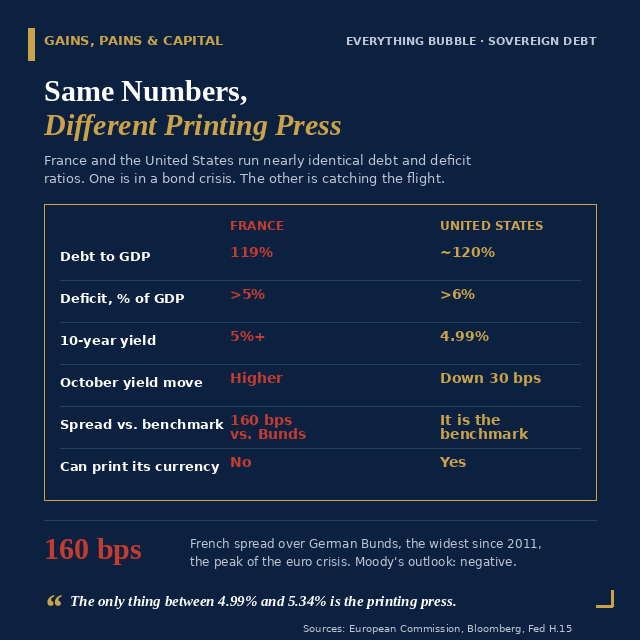
That is a real advantage and it is why the flight is landing here rather than leaving here. But it is worth being clear about what it is. It is not a sign that the U.S. fiscal position is sound. It is a sign that when the bond bubble deflates, the sovereign with the printing press gets to go last. Last is still on the list.
The investment implications follow from that. First, the rally in Treasuries is a fear rally, and fear rallies reverse when the fear passes. If Iran settles or France passes a budget, the 30 basis points come back, and the housing and credit stories I wrote about last week resume where they left off. Do not mistake this for a new regime.
Second, a sovereign crisis in the eurozone core is exactly the kind of event that moves capital into assets that are nobody’s liability. Gold is holding above $4,000 after a sharp pullback, and the French story is the strongest argument for why that floor holds. When a G7 government’s bonds become a question mark, the asset that answers the question is the one that has answered it for 5,000 years.
Third, watch the spread. If France-Germany pushes past 200 basis points, that is the level where 2011 stopped being a French problem and became a European one, and the ECB will be forced to choose between its inflation mandate and its currency. Every choice it makes from there is good for hard assets and bad for the euro.


Comments
Log in or sign up to join the conversation.