

Something odd is happening in the Treasury market, and almost nobody is talking about it.
Yesterday, the Fed held rates at 3.75% to 4%. Two officials dissented in favor of a hike. Warsh said financial conditions are tighter, but he is “unwilling and unable” to call them tight. Futures are pricing an 85% chance of a hike in December and roughly three more by next fall. Producer prices are rising 6.3% a year. Oil is back above $100. The Treasury is borrowing at a record pace.
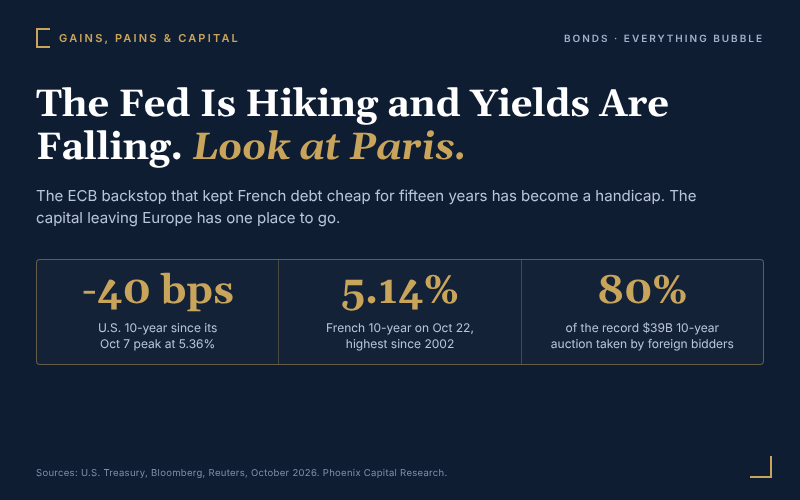
Every one of those things should push long-term yields higher. Instead, the 10-year Treasury yield peaked at 5.36% on October 7 and has spent the three weeks since drifting lower. It touched 4.95% last week and sits right around 5% today. That is a 40 basis point decline into a hawkish Fed, hot inflation data, and $100 oil.
When the price of an asset moves against every domestic input, the buyers are usually coming from somewhere else.
Look at Paris.
France has spent the past two months in a slow-motion fiscal crisis. Its parliament cannot pass a budget. The presidential election is next year, so nobody in the National Assembly has an incentive to vote for austerity. Two weekends ago, civil unrest spread across major cities. On October 22, the yield on the French 10-year hit 5.14%, its highest level since 2002. The spread between French and German bonds is the widest it has been since the eurozone crisis of 2011. Moody’s held France’s rating last Friday, but only on the stated assumption that a deficit-cutting budget passes in 2027, which is the one thing French politics has shown it cannot deliver.
For a stretch of last week, France was paying more to borrow for ten years than the United States. On its face, that is how it should be. A country with no budget, protesters in the streets, and a political class that cannot agree on anything ought to pay more than the issuer of the world’s reserve currency. The remarkable part is that it took this long. For most of the past fifteen years, French yields sat below U.S. yields, through deficit after deficit, because investors treated French paper as nearly German. The reason they did is the European Central Bank.
And that is the real story here. The ECB backstop that made French debt cheap for fifteen years has turned into a handicap.
Think about how the eurozone bond market actually works. France does not have its own central bank. It cannot print euros, it cannot devalue, and it cannot set its own interest rate. What it had instead was the promise, made explicit by Mario Draghi in 2012, that the ECB would do whatever it takes to hold the currency union together. For over a decade, that promise did the work that fiscal discipline was supposed to do. Investors lent to Paris at close to German prices because they assumed Frankfurt stood behind the bonds.
That arrangement worked as long as nobody tested it. France is now testing it, and three things have become clear.
First, the backstop has conditions. The ECB’s crisis tool, the Transmission Protection Instrument, is only supposed to be used for countries that are following the EU’s fiscal rules. France is already under the EU’s excessive deficit procedure and is about to go into 2027 without a credible budget. For the ECB to step in, it would have to reward exactly the behavior the rules exist to prevent, in front of Italy, Spain, and every other member watching. Frankfurt cannot do that without destroying its own credibility, so the backstop everyone priced in is, in practice, unavailable to the one country that needs it.
Second, the ECB sets rates for twenty countries. It held again today. It cannot cut for France while inflation is above target across the bloc, and it cannot buy French bonds without buying everyone’s. A country with its own central bank can at least count on its lender of last resort to care only about it. France has a lender of last resort that answers to nineteen other governments.
Third, the floor under French yields is moving up on its own. Germany has loosened its debt brake and is borrowing at a pace not seen since reunification, which pushes Bund yields higher. France trades as a spread over Bunds. When the anchor rises and the spread widens at the same time, French borrowing costs go up from both directions, and there is no French institution with the power to stop it.
So the thing that compressed French yields for fifteen years, a currency union with a central bank that was assumed to backstop everyone, is now the thing holding France underwater. It cannot inflate its way out, it cannot devalue its way out, and the institution that was supposed to catch it is bound by rules that say it cannot.
Compare that to the United States. We have our own currency, our own central bank, and a Treasury market deep enough that a sovereign wealth fund, a pension plan, or another central bank can move $20 billion without moving the price. Our fiscal position is bad, and I have written about that for years. But a global allocator does not ask whether the U.S. is in good shape. He asks where the money can go that is deep, liquid, and backed by an institution that will act. In October, the answer was obvious.
I want to be careful here, because the easy version of this story is wrong. Capital does not move in a straight line from a French bond auction to a U.S. one, and you cannot draw an arrow from a bad week in Paris to a good week in Treasuries. What is happening is slower and bigger than that. Over the past year, the number of places where large institutions can park money safely has been shrinking. Japan’s bond market has been under pressure since its government started leaning on the central bank. The U.K. has had its own gilt scares. Now France, the second largest economy in the eurozone, is trading like a credit risk. Each episode pushes a little more global capital toward the one market deep enough to absorb it.
The data backs this up. On October 7, the day U.S. yields peaked, the Treasury sold a record $39 billion of 10-year notes. Indirect bidders, the category that captures most foreign buyers, took 80% of the auction. Primary dealers, the Wall Street banks obligated to buy whatever is left over, were stuck with 2.5%, the smallest share ever recorded. Foreign money showed up for U.S. paper at 5.3% in size, and it has kept showing up since.
I have been writing for months that the Everything Bubble is deflating, and that the sovereign bond market is where it started. The question readers keep asking is why the U.S. is not the first domino. This is why. When the bubble deflates in a world with one deep reserve-currency market, the air escapes from the weakest markets first, and the money that leaves them has to go somewhere. For now, it is going here.
This is not a permanent condition. The U.S. is running deficits that would sink any other country, and a bid driven by other people’s problems can fade faster than one driven by confidence. If France passes a budget and calms down, some of this reverses. If the Fed hikes into a slowing economy, the front end gets ugly even if the long end stays supported. And at some point the sheer volume of Treasury issuance will test even foreign demand. The 30-year auctions over the next few months are the thing to watch.
But for now, the investment implications are clear.
First, stop fighting the U.S. long bond. Every rate scare this year has been bought by foreign money, and yields near 5% are a gift relative to what the rest of the developed world offers at comparable risk. The 10-year has pulled back into a range; it is a buy on weakness, not a short.
Second, the dollar has a floor under it. Capital leaving Europe and Japan has to be converted into dollars to buy Treasuries, and that flow does not care what the Fed does in December.
Third, the Everything Bubble’s next casualties are abroad, and they share France’s handicap. Every eurozone country borrows in a currency it cannot print under a central bank it does not control. France is the first large one to feel it. It will not be the last.
The Fed can raise rates all it wants. As long as Paris looks like this, the long end of the Treasury market has a bid.


Comments
Log in or sign up to join the conversation.