

There are now more than 500 leveraged ETFs trading in the U.S. markets.
That number has more than tripled in the past five years, and it's accelerating.
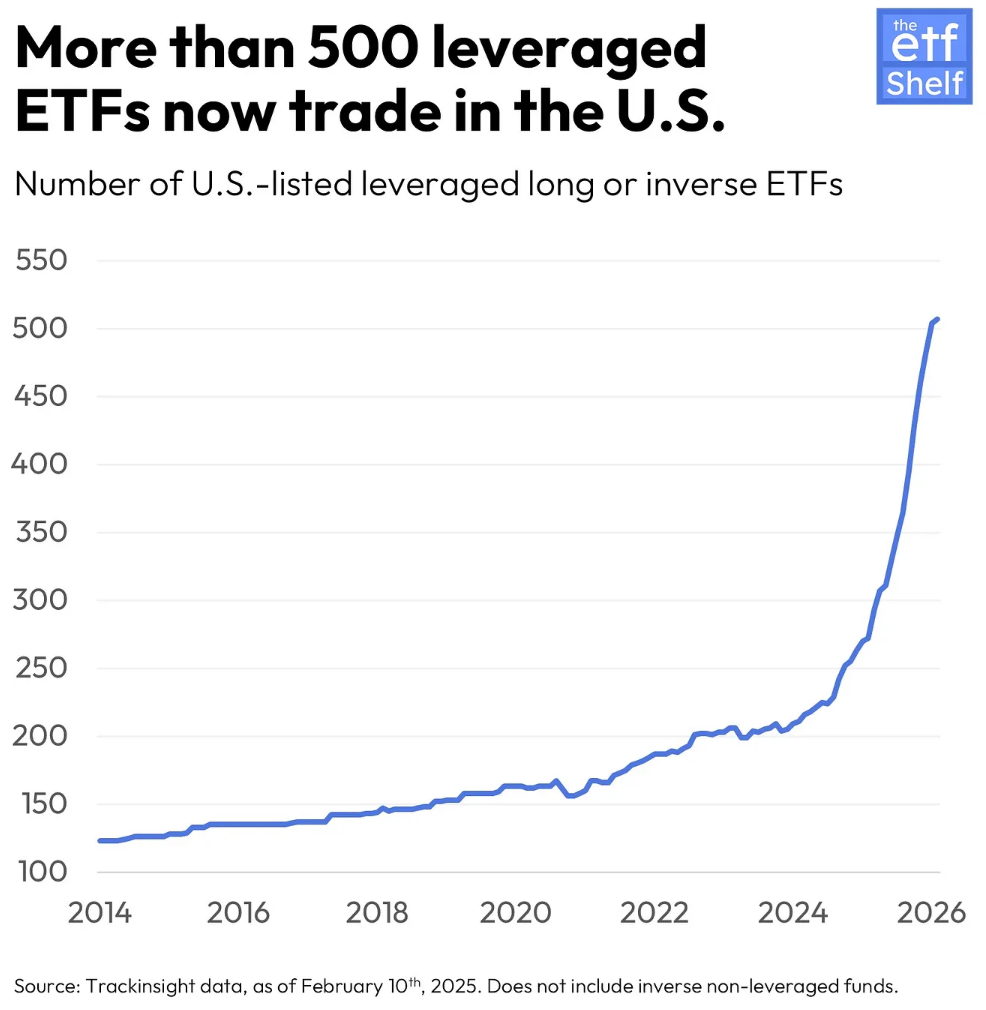
Many investors have never heard of these funds. And most of those who have don't fully understand what they're doing to the structure of today's market.
That's a problem. Because the risks these funds create don't just affect the investors who hold them. They affect everyone who owns stocks.
Here's what you need to know.
What IS a Leveraged ETF?
The concept is simple -- and seductive.
You invest $1,000 into a leveraged ETF. But instead of getting the return on $1,000 worth of stocks, you get the return on $2,000 or $3,000 worth. If the market rises 2% today, you don't gain $20. You gain $40 or $60.
That's a 2x or 3x multiplier on your money.
These funds achieve this in different ways. Some borrow capital to buy additional shares of stock. Others use futures contracts to engineer amplified returns. The mechanics vary, but the end result is the same: maximum exposure with minimum capital.
During a bull market, these funds feel like magic.
Why This Is Fueling the Rally
Here's something most market commentators miss: the explosive growth of leveraged ETFs isn't just a symptom of the bull market. It's helping to sustain it.
Think about it this way. When investors pour $1,000 into a leveraged fund, the fund effectively purchases $2,000 or $3,000 worth of stocks. That's amplified demand flowing into the market.
Multiply that across 500+ funds and hundreds of thousands of investors, and you have a powerful structural force pushing stock prices higher. It's one of the reasons this bull market has been so persistent. There's an enormous amount of leveraged buying quietly supporting valuations at every level.
For investors who are positioned correctly, this is a tailwind. And right now, it's still very much blowing in our favor.
The Risk Nobody Is Talking About
But here's where it gets dangerous.
Leverage is a two-way street.
When the market pulls back (and it will pull back, because it always does) leveraged ETF investors don't experience a normal correction. A 10% decline in the market doesn't feel like a modest pullback to these investors. It can wipe out nearly 30% of their position.
That's not a paper loss most people can stomach quietly.
When people see 30% of their money evaporate in days, they panic. They sell. And not because they want to! (Sometimes because their broker forces them to when margin requirements kick in.)
This forced selling then drives prices lower still. Which triggers more panic. Which triggers more selling. Which drives prices lower still.
This is what financial professionals call a self-reinforcing feedback loop. And it can be brutal.
The loop only comes to an end when leveraged positions have been nearly fully liquidated and value investors decide prices are cheap enough to justify buying.
But value investors are famously patient and disciplined... they can wait a long time for prices to reach levels they find attractive. The pain can go on far longer than anyone expects.
The very mechanism that helped push the market higher becomes the engine that drives it lower.
What This Means for You Right Now
Let me be direct: this is not an imminent risk.
We are still in a bull market. There is still plenty of opportunity ahead. The trend remains your friend, and I'm actively finding trades (both on the long side and the short side) that are generating real returns right now.
But here's the thing about market risks: by the time they're obvious to everyone, it's too late to prepare.
The weather can shift fast. So can market sentiment.
Which is why I believe every serious investor should hold what I think of as insurance positions: Trades that are specifically designed to profit when the market pulls back. Not because you think a crash is coming tomorrow, but because you want to be protected if one does.
Think of it the same way you think about car insurance. You don't buy it because you plan to crash. You buy it because crashes happen, and when they do, you want to be covered.
Real Profits From "Insurance" Trades In a Bull Market
Here's what I find particularly exciting about this approach: these insurance positions don't have to just sit there as a cost. When positioned correctly, they can generate real income even while the bull market continues.
In my Speculative Trading Program, I currently hold a handful of positions specifically designed to profit from individual stocks trading lower. Even as the broader market has continued to climb, we've been banking real gains:
$9,867 locked in from AXON trading lower
$2,531 gained from DUOL trading lower
$5,028 booked from PLTR trading lower
And those are just the closed profits from February alone. January was equally strong.
These aren't lucky guesses. They're disciplined, calculated trades... part of a program with a four-year track record of results that I trade with my own money alongside every subscriber.
The Simple Action to Take Today
You don't have to choose between participating in this bull market and protecting yourself from the risks building beneath the surface.
You can do both.
If you'd like to see exactly which stocks I'm watching right now (including 20 I expect to trade higher, 20 I expect to trade lower, and 20 I'm using to generate income) I'd invite you to take a look at my Watch List Service (comment "WATCH LIST" below and I'll send you more info).
For just $27 per month, you get access to my full watch list, every new addition I make throughout the year, and a monthly market update with no fluff... just the stocks I'm actually trading in my own account.
The growth of leveraged ETFs is one of the most important (and most overlooked) structural dynamics in today's market. Understanding it puts you ahead of 99% of retail investors.
And being prepared for both outcomes -- the continued rally AND the eventual correction -- is what separates great investors from lucky ones.
Here's to growing and protecting your wealth!



Comments
Log in or sign up to join the conversation.