


In the rythim of Bull markets, episodes of concentrated advance are always followed by periods of correction. The stock market rarely sustains leadership by a narrow cohort without pause. The headlong charge of Bullish investors into artificial intelligence and its semiconductor handlers has entered a necessary consolidation. The semiconductor complex, the vanguard of the artificial-intelligence wave, delivered precisely such a 12 week advance into June 22nd — with the benchmark SP 500 and Nasdaq peaking June 2nd. What has emerged since is a welcome shift on the leaderboard, in which small-capitalization stocks and several cyclical and defensive sectors have taken the reins of the broader bull market. Consider the performance contrast. The PHLX Semiconductor ETF (SOXX), a proxy for the chip sector, recorded its strongest monthly gain in history during April 2026, rising more than 40 percent. Gains extended meaningfully into May and June, propelling the sector to an extraordinary double from year-to-date at the peak. Despite a quick 35% correction over 2 weeks, the SOXX remains up more than 80% this year. Yet even as semiconductor leadership paused, the market edged higher on the backs of lesser known names. The Russell 2000 Index, representing small-capitalization companies, has delivered roughly 20 percent gains year-to-date through July 10th 2026—materially outpacing the S&P 500’s approximately 10 percent advance over the same span. This has been the best start to a year for the small cap Russell 2000 Index since 1991.
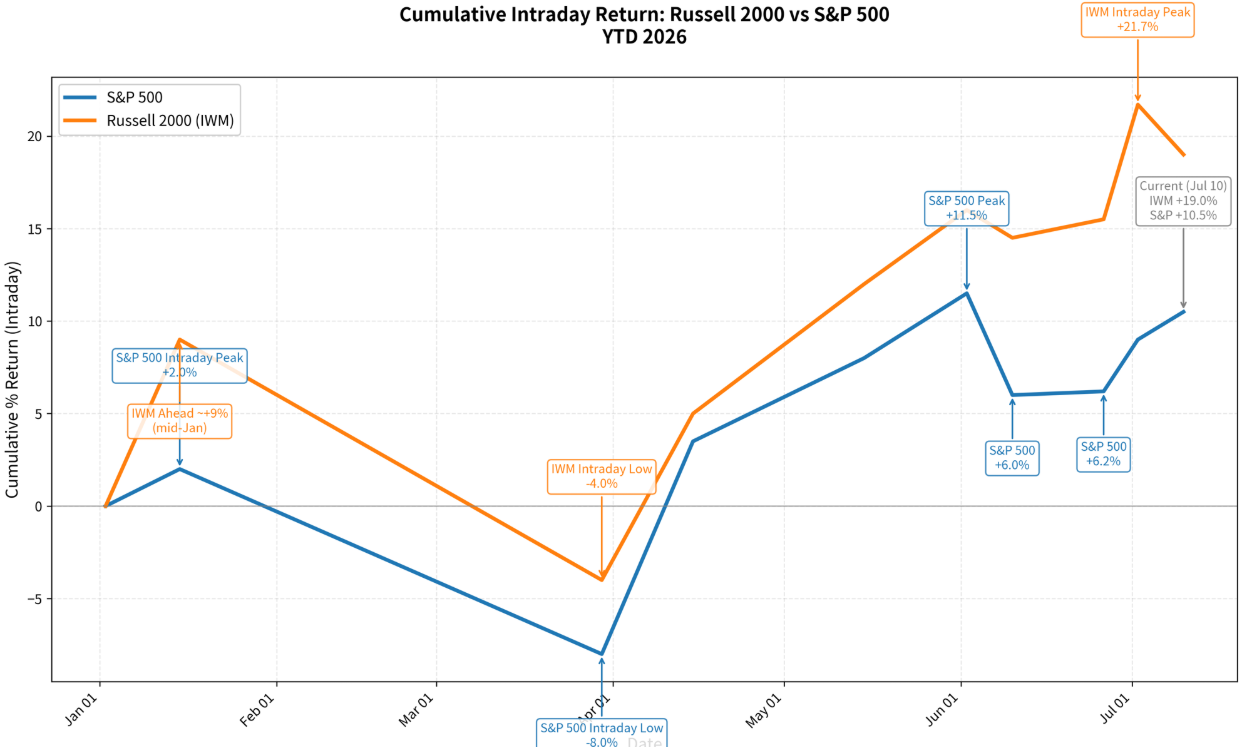
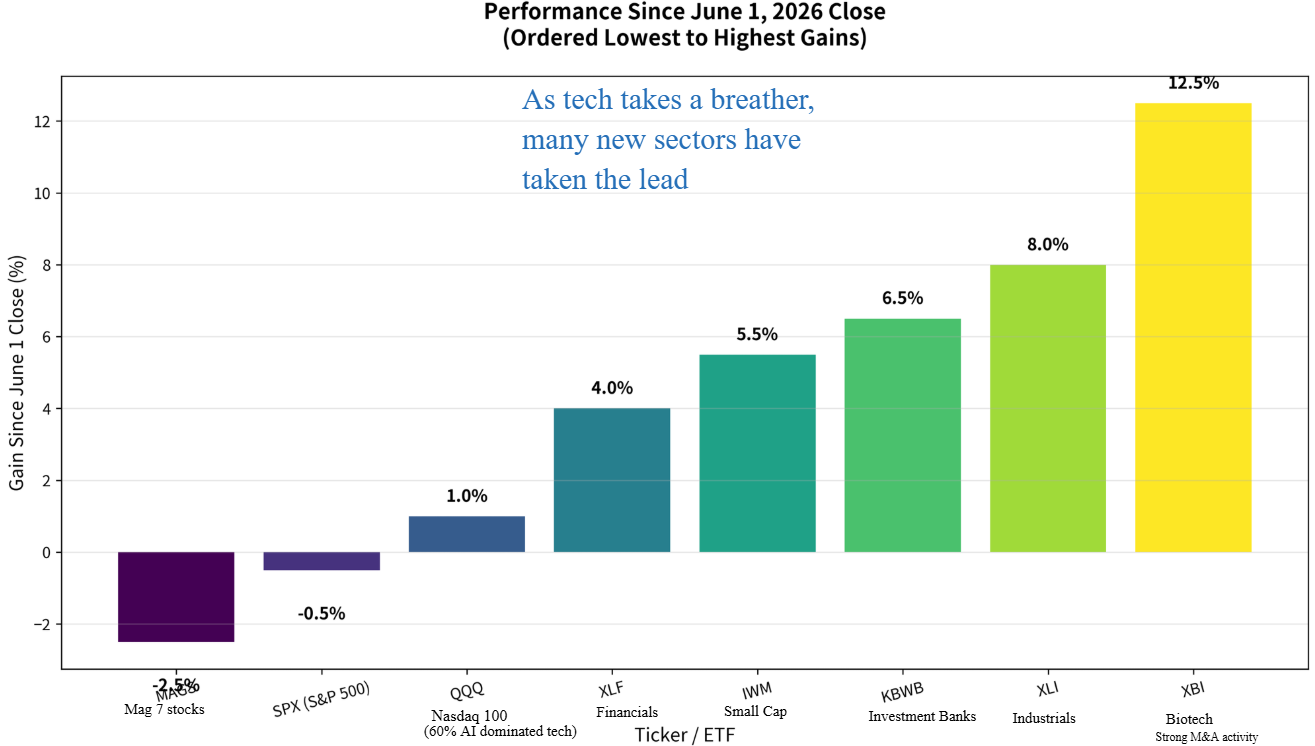
Small caps have not merely participated; they have led the procession during the recent consolidation phase. Sector ETFs tell a similar story of leadership rotation. The Financial Select Sector SPDR Fund (XLF) (led by Investment banks and Insurance) along with Industrials and Biotech have provided steady support amid the broader diffusion. These robust gains while large cap AI tech pulls back, are reflective of a cyclical recovery and capital-spending tailwinds. The gains shown below from June 1st to July 10th occurred during a period when SOXX semiconductor index and the S&P had no gains and the Mag 7 hyperscalers lost ground.
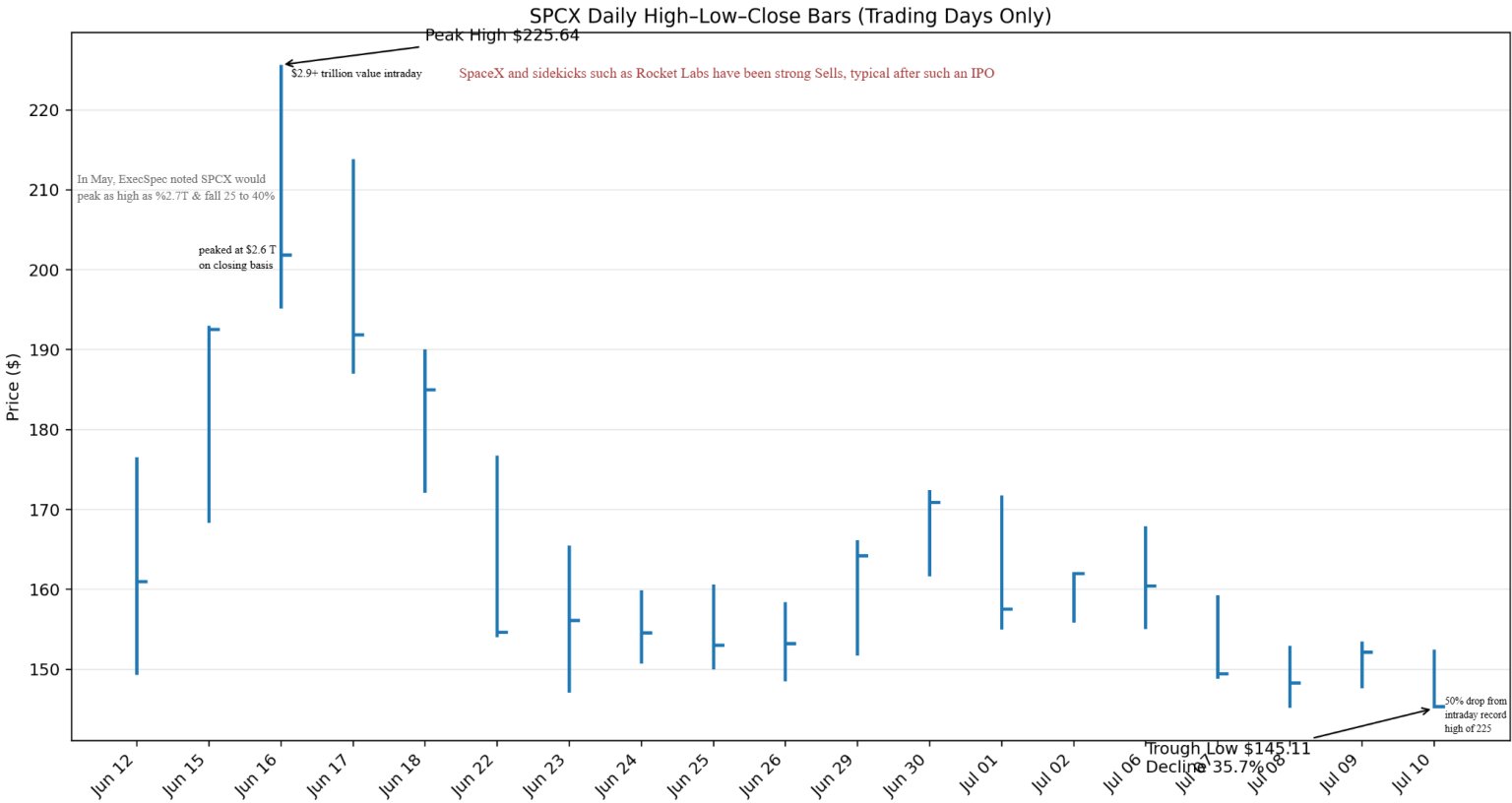
The supply side of the equation reinforces the case for consolidation and rotation. The IPO market, ignited in part by the long-awaited public debut of SpaceX (SPCX), is on pace to approach or surpass the record $275 billion raised in 2021—the previous cyclical peak. Average deal sizes this year are roughly three times those of 2025 and ten times those of 2022. A flood of new equity is entering circulation at precisely the moment when investor capital is being competed for by an already richly valued technology group. Dilution is not a theory; it is arithmetic. When new shares proliferate while sentiment remains anchored to the same cohort of large technology names, pressure on multiples is the predictable result. SpaceX itself met oor forecast back in late May with more precision than we expected. The company peaked near our $2.7 trillion valuation estimate shortly after its June IPO, reaching over $2.6 trillion on a closing basis ($2.9T intraday) just 3 days into public trading. It has since undergone the classic post-IPO correction of 25–40 percent we talked about, now down approximately 35 percent on a closing basis (with intraday declines approaching 50 percent). This pullback has helped facilitate the rotation away from chip and AI-related names, which had served as ready sources of liquidity for new-issue buying. AS SPCX bottoms out, perhaps in the 120 – 140 range, the selling of other tech as a source of funds should begin to dry up.
This rotation aligns with the thesis we advanced in May: a labored but durable advance in which overbought conditions in semiconductors would give way to broader participation. The April–June semiconductor rush represented the market at its most concentrated; the subsequent period has rewarded patience with those areas possessing more reasonable valuations and domestic economic sensitivity. Small caps, financials, healthcare, industrials, and biotechnology have collectively shouldered the burden of sustaining the bull market while the chip sector went on a diet to digest its glutinous gains. The supply-side dynamics reinforce this pattern.
Record IPO activity—on pace to approach or exceed the 2021 peak of $275 billion free cash raised —has introduced fresh equity into circulation, exerting natural pressure on the most richly valued segments. Geopolitical frictions in the Persian Gulf continue to cast a shadow over energy flows, yet the sharp decline in oil and gasoline prices (more than 30 percent from recent peaks) will begin to ease headline inflation pressures starting on July 14th when CPI data is reported for June. Lower energy costs, if sustained, should translate into softer inflation readings over the coming months, setting the stage for eventual Federal Reserve easing or at least a shift in Fed voting members who favored raising rates to a neutral to easier monetary stance.
Pre-election uncertainty adds a familiar layer of caution. Markets historically price political outcomes conservatively until clarity emerges.
The combination of increasing IPO share supply, sector rotation, and political overhang has produced the measured, two-steps-forward one to two steps backwards character anticipated earlier. As long as the June lows in the S&P 500 hold, the technical foundation remains intact for an eventual test of 8,000. A break of the Jne lows would present a technical risk of 9 to 10% down from the top. The fundamental supports of the bull market endure with targets above 8,000 by early 2027 and above S&P 9000 this decade. The capital-spending wave tied to artificial intelligence, data centers, and electrification continues unabated – accelerating from $410 billion in 2025 to over $1 trillion in 2027. This provides a strong tailwind to GDP. Semiconductor companies retain their technological and earnings leadership even as multiples adjust lower. The current consolidation is less a verdict on those fundamentals than an overdue alignment of price with rapidly expanding earnings. The most potent catalyst for the next sustained leg higher remains monetary. Declining inflation metrics—facilitated by lower energy prices—should exert a modest downward pressure on interest rates and inflation expectations. In that environment, the very sectors now leading the broadening—small caps, financials, healthcare, industrials, and biotechnology—stand to benefit from both cheaper capital and renewed economic confidence. The market’s recent diffusion is not a departure from the bull market but its natural maturation for what we view as a middle innings ballgame. Markets require periodic redistribution of leadership to sustain vitality. The semiconductor surge in Q2 was spectacular; the measured advance of small caps and select sectors since has been no less consequential. Both phases reflect the same underlying vitality: an economy still early in a profound secular technological and industrial transformation. A reduced big tech exposure with broader portfolio representation and sideline cash is favored until the next leg higher is ready to accelerate.

Comments
Log in or sign up to join the conversation.